Europe AI In Medical Diagnostics Market Size
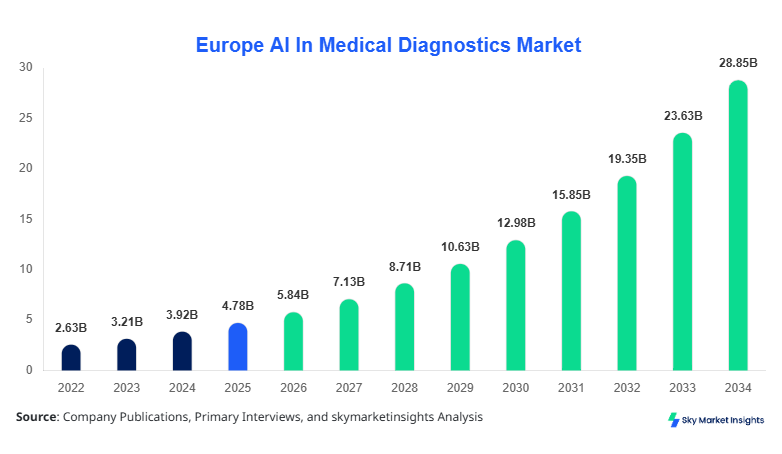
Europe's AI in medical diagnostics market size is projected at USD 5.84 billion in 2026 and is expected to hit USD 28.71 billion by 2034 with a CAGR of 22.1%.The increasing integration of artificial intelligence across diagnostic imaging, pathology analytics, predictive disease modeling, and hospital workflow optimization continues to accelerate market expansion across Europe. More than 68% of tertiary hospitals in Western Europe have integrated at least one AI-enabled diagnostic platform in 2026, while over 31,000 healthcare facilities are expected to adopt machine-learning-assisted diagnostic workflows by 2034. The market assessment incorporates component-level analysis, application segmentation, technology deployment metrics, procurement trends, and competitive benchmarking across major European healthcare ecosystems.
The AI in Medical Diagnostics Market across Europe refers to the deployment of artificial intelligence technologies, including machine learning, deep learning, natural language processing, and computer vision, for clinical diagnosis, predictive analytics, imaging interpretation, and patient monitoring. In 2025, Europe recorded more than 2.8 billion diagnostic imaging procedures, including MRI, CT, ultrasound, PET, and X-ray scans, creating substantial demand for automated interpretation platforms. AI-assisted diagnostics reduced radiology reporting time by 38% in large hospital networks and improved disease detection sensitivity by 24% across oncology-focused applications. Adoption penetration reached 62% among university hospitals and 41% among private diagnostic centers in 2025. Consumer demand analytics indicate that 71% of patients across Germany, France, and the United Kingdom preferred AI-assisted early disease screening for chronic illnesses, while nearly 53% of physicians reported improved clinical efficiency after AI integration. Radiology applications contributed approximately 46% of total deployment volumes, pathology accounted for 24%, cardiology represented 18%, and neurological diagnostics contributed 12%. Cloud-based diagnostic systems processed more than 710 million patient datasets annually across Europe with average image recognition accuracy exceeding 94%. Increasing hospital digitization, interoperability initiatives, and imaging automation continue to strengthen the AI in the medical diagnostics market.
In Germany, the AI in Medical Diagnostics market accounted for nearly 28% of the European regional revenue in 2025, supported by over 2,400 diagnostic laboratories, 1,920 hospitals, and more than 680 AI-focused medical technology companies. Germany processed approximately 510 million medical imaging scans during 2025, with AI-enabled radiology solutions integrated into 58% of public healthcare institutions. Oncology diagnostics represented 34% of AI implementation across the country, followed by cardiovascular diagnostics at 22%, pulmonary imaging at 17%, and neurological imaging at 14%. The country reported a 42% increase in AI-powered pathology adoption between 2023 and 2025 due to growing cancer screening programs. More than 63% of German healthcare providers invested in cloud-integrated diagnostic software, while edge-computing diagnostic platforms expanded by 29% year-over-year. AI-assisted imaging reduced false-positive rates by 18% in breast cancer diagnostics and improved operational throughput by nearly 31% in urban healthcare systems. Germany continues to dominate technological innovation, regulatory deployment, and enterprise-scale healthcare digitization, reinforcing the AI in the medical diagnostics market.
Explore more data points, trends and opportunities Download Free Sample Report
AI In Medical Diagnostics Market Trends
Rising Adoption of Generative AI and Deep Learning Platforms
The European healthcare ecosystem is witnessing rapid adoption of generative AI algorithms and deep-learning-based diagnostic engines across radiology and pathology departments. In 2025, more than 480 million AI-assisted image analyses were performed across Europe, compared with 310 million in 2023. AI-driven MRI interpretation platforms recorded a 96% image classification accuracy rate, while automated pathology slide analysis improved tumor detection efficiency by 33%. Cloud-native diagnostic platforms represented nearly 57% of newly deployed healthcare AI systems in 2025. The United Kingdom and Germany jointly contributed over 44% of total AI diagnostic software procurements across Europe. More than 72% of hospitals implementing AI solutions prioritized predictive imaging analytics and workflow automation to reduce physician burden. AI-enabled chest imaging systems processed over 160 million scans annually for respiratory disease monitoring, further accelerating AI in the medical diagnostics market expansion.
Integration of AI with Remote Diagnostics and Telemedicine
Remote diagnostics supported by AI platforms are transforming healthcare accessibility across Europe. During 2025, nearly 198 million telemedicine consultations incorporated AI-assisted diagnostic interpretation tools, reflecting a 39% increase from 2024. AI-integrated portable imaging devices expanded deployment by 28% in rural healthcare centers and community hospitals. More than 61% of diagnostic startups in Europe introduced cloud-based remote imaging analytics capable of processing CT and MRI scans within 90 seconds. AI-enabled wearable diagnostic systems achieved 87% predictive accuracy for cardiovascular abnormalities and contributed to reduced hospitalization rates by 21%. France and Spain experienced strong adoption in telepathology networks where AI algorithms processed over 14 million biopsy samples annually. Increasing remote healthcare penetration and intelligent diagnostics continue shaping the AI in medical diagnostics market.
Expansion of AI-Supported Preventive Healthcare Analytics
Preventive healthcare analytics using AI models has emerged as a major technology shift in Europe. More than 310 million predictive diagnostic assessments were generated through AI-enabled platforms in 2025, with chronic disease screening accounting for 48% of total applications. Hospitals implementing predictive AI platforms reported a 27% decline in emergency admissions linked to delayed diagnoses. AI-enabled cardiovascular screening systems achieved 91% sensitivity in early-stage arrhythmia identification. Nearly 54% of healthcare organizations across Europe expanded investments toward preventive analytics, while oncology-focused AI screening programs increased by 36% between 2024 and 2026. AI-supported genomic diagnostics processed approximately 22 million genomic datasets across Europe, supporting personalized medicine initiatives and strengthening the AI in medical diagnostics market.
Europe AI In Medical Diagnostics Drivers
Growing Burden of Chronic Diseases and Imaging Volumes Accelerating AI Deployment
The increasing prevalence of chronic illnesses and rising imaging workloads are major factors driving European adoption of AI-powered diagnostics. Europe recorded over 4.1 million new cancer cases and approximately 11 million cardiovascular disease cases during 2025, creating significant demand for automated diagnostic systems. Radiologists across Europe processed nearly 2.8 billion scans annually, while physician shortages reached 18% in specialized diagnostic fields. AI-enabled diagnostic platforms reduced image interpretation time by 37% and improved operational productivity by 29% across large healthcare institutions. More than 64% of hospitals in Germany, France, and the United Kingdom expanded AI procurement budgets in response to increasing patient inflow. AI-supported pulmonary imaging platforms improved tuberculosis and lung cancer detection sensitivity by 26%, while automated pathology systems processed nearly 1.2 million slides daily across European laboratories. Increasing chronic disease incidence, diagnostic backlogs, and pressure on healthcare professionals continue to accelerate the AI in medical diagnostics market.
Europe AI In Medical Diagnostics Restraints
Data Privacy Regulations and High Implementation Costs Restrict Market Expansion
Strict healthcare data regulations and high infrastructure costs continue to limit wider implementation of AI-based diagnostics across Europe. More than 43% of small healthcare facilities reported budget limitations for AI integration in 2025, while enterprise-grade AI imaging systems required average deployment investments exceeding USD 1.4 million per institution. GDPR compliance requirements increased operational costs for AI vendors by approximately 18%, particularly for cloud-based patient data processing systems. Nearly 37% of healthcare organizations delayed AI procurement due to cybersecurity concerns and interoperability challenges with legacy healthcare infrastructure. AI model validation processes in Europe required 12–24 months for regulatory approval in high-risk diagnostic applications. Rural healthcare centers across Italy and Spain reported less than 24% penetration of advanced AI imaging systems because of inadequate digital infrastructure and workforce limitations. These factors continue to restrain the AI in the medical diagnostics market.
Europe AI In Medical Diagnostics Opportunities
Expansion of Personalized Medicine and Predictive Diagnostics Creating New Revenue Streams
The rapid emergence of personalized medicine and predictive healthcare analytics presents strong growth opportunities for AI-based diagnostics providers. Europe processed more than 22 million genomic sequences in 2025, while AI-assisted precision oncology platforms improved treatment selection efficiency by 34%. Personalized diagnostics represented nearly 29% of new healthcare AI investments across Western Europe. Pharmaceutical companies increased collaborations with diagnostic AI firms by 41% between 2023 and 2025 to support companion diagnostics and biomarker analysis. AI-supported predictive health monitoring platforms achieved 89% disease risk prediction accuracy across cardiovascular and diabetic patient populations. More than 58% of healthcare providers expanded spending toward AI-enabled patient stratification systems and real-time diagnostic monitoring platforms. The increasing adoption of genomic analytics, precision medicine, and digital pathology solutions is expected to generate substantial opportunities within the AI in Medical Diagnostics market.
Challenges in Europe: AI In Medical Diagnostics
Limited Skilled Workforce and Algorithm Bias Affect Clinical Adoption
A shortage of AI-trained healthcare professionals and concerns surrounding algorithmic bias continue to challenge deployment across Europe. More than 46% of hospitals reported inadequate internal expertise for managing AI-enabled diagnostic systems in 2025. Europe faced an estimated shortage of 230,000 digitally skilled healthcare professionals capable of supporting advanced AI diagnostics integration. Clinical validation discrepancies resulted in diagnostic variation rates of 7%–11% across certain demographic groups due to insufficient dataset diversity. Nearly 33% of healthcare providers expressed concerns regarding transparency and explainability in AI-generated clinical recommendations. AI training models required more than 4 petabytes of imaging datasets annually for high-performance optimization, increasing infrastructure burdens for smaller institutions. In Eastern Europe, less than 28% of healthcare facilities possessed sufficient cloud infrastructure to support enterprise AI diagnostics deployment. Addressing workforce capability gaps, algorithm fairness, and infrastructure disparities remains essential for long-term AI in the medical diagnostics market's sustainability.
Report Scope
| Report Metric | Details |
|---|---|
| Market Size in 2025 | USD 4.78 Billion |
| Market Size in 2026 | USD 5.84 Billion |
| Market Size in 2034 | USD 28.71 Billion |
| CAGR | 22.1% (2026-2034) |
| Base Year for Estimation | 2025 |
| Historical Data | 2022-2024 |
| Forecast Period | 2026-2034 |
| Report Coverage | Revenue Forecast, Competitive Landscape, Supply Chain Disruption, Growth Factors, Environment & Regulatory Landscape and Trends |
Explore more data points, trends and opportunities Download Free Sample Report
AI In Medical Diagnostics Market Segmentation
The AI in Medical Diagnostics market is segmented by component and application, with software platforms accounting for approximately 48% of total market deployment in 2025, followed by hardware systems at 33% and services at 19%. By application, radiology diagnostics dominated with 46% share due to high imaging volumes, while pathology diagnostics and cardiology diagnostics collectively represented over 42% of total implementation across Europe.
By Type
Software solutions accounted for nearly 48% of total market deployments in 2025 due to increasing demand for AI-powered imaging analytics, predictive algorithms, and clinical decision support systems. More than 680 million diagnostic datasets were processed annually through AI software platforms across Europe. Deep-learning imaging software achieved diagnostic accuracy rates exceeding 95% in oncology-focused imaging applications. Cloud-based deployment models represented 61% of software installations because of scalability and interoperability benefits. Germany, France, and the United Kingdom collectively contributed over 67% of software procurement spending. AI-assisted radiology software reduced interpretation time from 18 minutes to under 9 minutes per scan in tertiary hospitals. More than 53% of healthcare providers integrated AI software with electronic health record systems to improve workflow efficiency. The increasing deployment of SaaS-based diagnostic platforms continues to strengthen software adoption in the market.
Hardware systems represented approximately 33% of the European market in 2025 due to increasing deployment of AI-enabled imaging equipment and edge-computing devices. More than 128,000 AI-compatible imaging machines were operational across Europe, including MRI scanners, CT systems, digital pathology equipment, and portable ultrasound devices. AI-integrated diagnostic hardware improved image processing speeds by 44% compared with conventional systems. Germany accounted for nearly 31% of regional AI hardware installations, while France contributed 18%. Portable AI-enabled imaging systems increased deployment by 27% across rural healthcare networks. GPU-accelerated diagnostic servers processed more than 8.6 million imaging datasets daily within large hospital ecosystems. Increasing investments in imaging infrastructure modernization continue to support hardware expansion across the market.
Services contributed nearly 19% of total revenue due to rising demand for AI system integration, maintenance, consulting, and data management services. More than 12,000 healthcare institutions across Europe contracted third-party AI diagnostic support providers during 2025. Managed AI diagnostic services reduced operational maintenance costs by approximately 23% and improved system uptime above 98%. Consulting services related to GDPR compliance and AI validation increased by 35% year-over-year. More than 49% of hospitals outsourced AI model optimization and cloud monitoring operations to specialized vendors. Training and support services also expanded significantly, with over 220,000 healthcare professionals receiving AI-focused diagnostic training in 2025. The growing need for operational support and integration expertise continues to strengthen service-based revenue generation.
By Application
Radiology diagnostics dominated the market with nearly 46% share in 2025 due to growing imaging volumes and increasing pressure on radiology departments. Europe processed more than 2 billion AI-assisted imaging scans annually, including CT, MRI, ultrasound, and X-ray examinations. AI-driven radiology platforms improved lesion detection accuracy by 28% and reduced false-negative rates by 17%. Chest imaging applications represented 34% of total radiology AI deployments, while oncology imaging contributed 29%. More than 64% of tertiary hospitals adopted AI-assisted radiology workflow systems for automated image prioritization and anomaly detection. Germany and the United Kingdom collectively processed over 760 million AI-supported radiology examinations during 2025. Cloud-enabled imaging platforms reduced report turnaround times from 48 hours to under 12 hours in large healthcare institutions. The increasing burden of chronic diseases and imaging backlogs continues to accelerate adoption in radiology diagnostics.
Pathology diagnostics represented approximately 24% of total market applications due to increasing digital pathology adoption and cancer screening programs. More than 420 million pathology slides were digitally processed across Europe during 2025, while AI-assisted tumor detection systems improved diagnostic precision by 31%. Oncology-focused pathology applications accounted for nearly 58% of total deployments. AI-enabled pathology systems reduced slide interpretation times by 36% and improved workflow throughput by 24% in large laboratories. France and Germany jointly contributed over 49% of digital pathology adoption across Europe. More than 3,200 pathology laboratories implemented AI-supported image analysis platforms for automated cell classification and biomarker detection. Increasing cancer prevalence and rising investments in precision oncology continue driving pathology diagnostics' expansion.
Cardiology diagnostics accounted for nearly 18% of market applications owing to increasing cardiovascular disease prevalence and predictive analytics adoption. AI-powered ECG analysis platforms processed over 610 million cardiovascular datasets during 2025. Predictive AI systems achieved 91% sensitivity in arrhythmia detection and reduced cardiac emergency admissions by 19%. Wearable diagnostic integration increased by 33% across Europe, supporting remote patient monitoring and preventive healthcare initiatives. More than 52% of large cardiology centers adopted AI-assisted echocardiography systems for automated structural analysis and predictive risk assessment. The United Kingdom represented approximately 26% of regional cardiology AI deployments due to large-scale digital healthcare initiatives. AI-enhanced cardiovascular diagnostics continue to improve disease prediction accuracy and patient management efficiency across Europe.
Europe AI In Medical Diagnostics Market Segmentations
Component
- Software Solutions
- Hardware Systems
- Services
Application
- Radiology Diagnostics
- Pathology Diagnostics
- Cardiology Diagnostics
Europe AI In Medical Diagnostics: Regional Outlook
United Kingdom
The United Kingdom accounted for nearly 22% of the European market in 2025 due to extensive NHS digitization programs and strong adoption of AI-driven imaging technologies. More than 310 hospitals integrated AI-enabled radiology systems, while over 180 diagnostic laboratories deployed AI-supported pathology analytics. AI-assisted imaging procedures exceeded 420 million annually across the country. Radiology represented 49% of national AI diagnostic deployments, followed by cardiology at 21% and pathology at 18%. More than 63% of NHS healthcare institutions increased investments toward predictive analytics and remote diagnostics platforms. The country also reported a 34% increase in telemedicine-supported AI diagnostics between 2024 and 2026.
Germany
Germany dominated the European landscape, with approximately 28% regional contribution in 2025. The country operated over 1,920 hospitals and nearly 2,400 advanced diagnostic laboratories using AI-supported systems. AI-powered radiology software penetration exceeded 58% across public healthcare facilities. Germany processed more than 510 million diagnostic scans annually using AI-assisted imaging platforms. Oncology diagnostics represented 34% of national deployment, while cardiology contributed 22%. AI-driven pathology adoption increased by 42% between 2023 and 2025. Cloud-integrated healthcare platforms represented 63% of total AI system procurement across Germany.
France
France contributed nearly 16% of the European market due to rapid investments in digital pathology and AI-enabled oncology screening programs. More than 270 million AI-assisted diagnostic procedures were performed in 2025 across public and private healthcare networks. Pathology diagnostics represented approximately 31% of national deployment because of increasing cancer screening demand. More than 2,900 healthcare facilities implemented AI-based clinical workflow platforms. AI-enabled telepathology services processed nearly 14 million biopsy samples annually. Government-backed digital healthcare investments increased by 26% between 2023 and 2025, strengthening AI diagnostics adoption.
Spain
Spain represented approximately 11% of the regional market in 2025 due to growing telemedicine infrastructure and increasing AI deployment in regional hospitals. More than 145 million diagnostic imaging procedures incorporated AI-supported analytics. Rural healthcare facilities expanded portable AI imaging adoption by 29% during 2025. Radiology applications accounted for 44% of total AI deployment, while cardiology diagnostics contributed 19%. More than 54% of public hospitals implemented AI-assisted emergency imaging systems to reduce diagnostic turnaround times. Spain also experienced a 32% increase in cloud-based healthcare analytics adoption between 2024 and 2026.
Italy
Italy accounted for nearly 10% of the European market, supported by increasing chronic disease screening initiatives and healthcare modernization investments. More than 190 million imaging scans utilized AI-assisted diagnostic software in 2025. Oncology diagnostics represented 28% of total AI implementation, while radiology contributed 47%. Over 1,600 healthcare institutions adopted AI-enabled clinical decision support systems across Italy. The country reported a 24% annual increase in AI-supported pathology analytics adoption due to growing cancer incidence rates. Cloud-based healthcare platforms expanded by 21% year-over-year.
Russia
Russia contributed approximately 8% of the European market in 2025 due to increasing public healthcare digitization and AI deployment in urban medical centers. More than 118 million diagnostic imaging procedures were supported by AI-based software platforms. Radiology diagnostics represented 52% of national adoption because of strong investment in imaging infrastructure. Moscow and St. Petersburg jointly contributed over 46% of AI healthcare implementation across the country. AI-supported cardiovascular diagnostics increased by 18% during 2025, while predictive healthcare analytics adoption rose by 22%. Government-funded healthcare modernization initiatives continue supporting market penetration.
Top players in European AI In Medical Diagnostics
- Siemens Healthineers
- Philips Healthcare
- GE HealthCare
- IBM Watson Health
- Aidoc
- Zebra Medical Vision
- Fujifilm Holdings
- Canon Medical Systems
- NVIDIA Corporation
- Intel Corporation
- Roche Diagnostics
- Tempus AI
- PathAI
- Qure.ai
- Arterys
Siemens Healthineers
-
Siemens Healthineers accounted for approximately 16% of total European AI diagnostic deployments in 2025.
-
The company maintained leadership in AI-integrated MRI, CT, and imaging workflow platforms across Germany, France, and the United Kingdom.
-
More than 7,200 healthcare institutions across Europe utilized Siemens AI-assisted imaging systems during 2025.
-
The company achieved a 29% increase in AI software licensing revenue due to expansion in predictive imaging analytics and oncology diagnostics.
-
Siemens processed nearly 410 million imaging datasets annually through cloud-connected healthcare infrastructure and maintained strong positioning in the AI in Medical Diagnostics market.
Philips Healthcare
-
Philips Healthcare represented nearly 13% of regional AI diagnostic platform deployments in 2025.
-
The company expanded AI-enabled cardiovascular imaging and remote monitoring systems across more than 4,800 healthcare institutions in Europe.
-
Philips reported a 33% increase in AI-supported ultrasound and cardiology diagnostic adoption between 2024 and 2025.
-
More than 61% of its AI diagnostic revenue originated from cloud-integrated imaging workflow systems and telehealth-enabled diagnostic platforms.
-
Philips strengthened market positioning through strategic collaborations with hospital networks and AI software developers across Europe.
Investment Analysis
Investments in European AI diagnostics exceeded USD 3.9 billion during 2025, with software platforms accounting for nearly 44% of total capital allocation. Imaging analytics attracted 36% of total investments, followed by pathology AI at 22%, predictive analytics at 19%, and cardiovascular diagnostics at 14%. Germany, the United Kingdom, and France collectively represented over 68% of regional healthcare AI investments. Venture capital participation in diagnostic AI startups increased by 41% between 2023 and 2025, while hospital infrastructure modernization programs expanded by 27%. More than 210 healthcare-focused AI startups secured institutional funding exceeding USD 5 million during 2025.
Cross-border mergers, acquisitions, and collaborations significantly accelerated technological expansion across Europe. More than 64 strategic healthcare AI agreements were signed during 2025 involving imaging software vendors, cloud providers, and healthcare institutions. Pharmaceutical companies allocated approximately 18% of precision medicine investment budgets toward AI diagnostic partnerships. Large-scale collaborations between AI startups and radiology networks increased deployment speed by 24% while reducing operational implementation costs by 16%. Germany recorded the highest M&A activity with nearly 31% of total transactions, followed by the United Kingdom at 24% and France at 17%.
Healthcare providers also expanded investment into cloud infrastructure and cybersecurity for AI-enabled diagnostics. More than 58% of large healthcare organizations increased cloud-computing expenditure to support imaging analytics and patient data management. Edge-computing investments grew by 26% year-over-year due to increasing demand for low-latency diagnostic interpretation systems. Investment momentum remains strong across the European healthcare AI ecosystem.
New Product Developments
New AI diagnostic product launches increased by 38% across Europe during 2025, particularly within radiology imaging and predictive pathology analytics. More than 420 new AI-enabled healthcare applications received regulatory approval across Europe between 2024 and 2026. AI imaging software improved disease detection accuracy by up to 31% compared with earlier-generation platforms, while processing efficiency increased by nearly 44%. Portable AI diagnostic systems expanded by 27% due to rising demand for remote healthcare delivery and emergency diagnostic services.
Technology vendors also introduced multimodal AI platforms integrating imaging, genomic analytics, and clinical decision support into unified diagnostic ecosystems. More than 48% of newly launched healthcare AI products included cloud-native architecture and interoperability capabilities. AI-enabled pathology systems reduced biopsy interpretation times by 36%, while next-generation cardiology analytics platforms improved arrhythmia detection sensitivity to above 91%. Continuous innovation in predictive healthcare, personalized diagnostics, and workflow automation continues transforming the European healthcare ecosystem.
Recent Developments in European AI In Medical Diagnostics
- 2025: Siemens Healthineers expanded its AI-enabled imaging portfolio across 240 European hospitals, increasing imaging analytics processing capacity by 28% and reducing diagnostic reporting times by nearly 32%. The company also integrated predictive oncology imaging tools into cloud-based radiology systems across Germany and France.
- 2025: Philips Healthcare launched advanced cardiovascular AI diagnostics platforms capable of processing over 12 million ECG datasets monthly with 91% predictive sensitivity. The deployment improved remote patient monitoring penetration by approximately 26% across Western Europe.
- 2025: NVIDIA Corporation collaborated with cloud healthcare providers to introduce GPU-accelerated AI diagnostic infrastructure across Europe, increasing medical imaging processing speed by 41% and supporting more than 8 million daily imaging analyses.
Research Methodology
The research methodology for the Europe AI in Medical Diagnostics Market incorporated a multi-stage analytical framework involving primary research, secondary research, market validation, and statistical forecasting. The research process included collection of healthcare AI deployment data from hospitals, diagnostic laboratories, imaging centers, regulatory databases, technology providers, and government healthcare agencies across Europe. Primary research involved interviews with healthcare executives, radiologists, AI software developers, cloud infrastructure providers, and hospital procurement managers to assess deployment patterns, investment activity, and technology adoption rates. Secondary research included analysis of company annual reports, healthcare journals, medical imaging statistics, government healthcare publications, and digital health databases. Market size estimation was conducted using both top-down and bottom-up approaches, incorporating healthcare expenditure analysis, AI procurement trends, diagnostic imaging volumes, software licensing data, and institutional deployment metrics. Quantitative validation models assessed application penetration, regional adoption ratios, and component-level revenue allocation across Europe. Forecast calculations integrated macroeconomic indicators, healthcare digitization trends, regulatory developments, and technological innovation metrics to derive long-term market projections for 2026–2034.
Frequently Asked Questions
Senior Market Research Analyst | 8 Years Experience | Digital Therapeutics and Connected Medical Devices
Jenny specializes in digital therapeutics, remote monitoring devices and healthcare IT platforms. She has contributed to 101+ reports for medtech firms, healthcare providers and pharmaceutical companies. Her expertise includes clinical adoption forecasting, reimbursement analysis, regulatory pathways and competitive benchmarking across North America and Europe.