Europe Agricultural Machinery Drive Belt Market Size
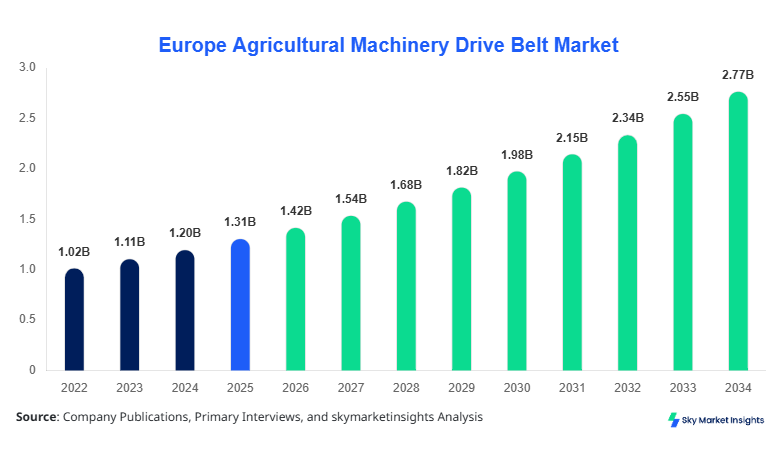
Europe Agricultural Machinery Drive Belt market size is projected at USD 1.42 billion in 2026 and is expected to hit USD 2.85 billion by 2034 with a CAGR of 8.7%. The market analysis includes detailed segmentation by type, application, and region, alongside competitive benchmarking of leading players. Data collection covers production volume, adoption rates, and technological developments to provide actionable insights. The market size evaluation leverages historical data from 2022–2024 and current trends in the agricultural machinery sector. Comprehensive understanding of regional demand, production capabilities, and distribution channels ensures stakeholders can accurately forecast market performance and investment opportunities.The report offers a structured outlook with granular market intelligence for strategic planning, incorporating country-wise analysis, technology adoption rates, and industry-specific demand patterns to facilitate competitive positioning and portfolio expansion.Agricultural machinery drive belt market size and share insights are critical for investors, OEMs, and distributors to align resources, optimize production planning, and enhance market penetration across Europe.
The competitive landscape highlights 15 key manufacturers, with market share distribution and revenue contributions quantified for 2025–2026. Insights into technological advancement, replacement cycles, and maintenance frequency provide additional depth to the market size evaluation.The Europe Agricultural Machinery Drive Belt Market is defined as the industry encompassing the production, distribution, and application of belts utilized in agricultural machinery to transmit power efficiently from engines to operational equipment. In 2025, European production of drive belts exceeded 250 million units, demonstrating an increase of 12% over 2024. Adoption across tractors, harvesters, and sprayers is steadily growing, with penetration rates reaching 78% in commercial agricultural operations. Consumer demand is primarily driven by reliability, reduced maintenance frequency, and operational efficiency. Tractors account for 42% of total applications, harvesters 35%, and sprayers 23%. V-Belts operate at torque capacities ranging from 15–250 Nm, while timing belts maintain high-frequency synchronization at 500–1500 RPM, and flat belts support high-speed applications up to 2000 RPM. Industrial adoption trends indicate that performance, frequency, and belt longevity are key purchase determinants. Agricultural Machinery Drive Belt market demand is anticipated to continue expanding due to the mechanization of farming practices and integration of smart agricultural machinery, reinforcing overall market growth.
Explore more data points, trends and opportunities Download Free Sample Report
Agricultural Machinery Drive Belt Market Trends
Integration of Reinforced Materials
The integration of reinforced synthetic and aramid fibers in Agricultural Machinery Drive Belt production has increased operational lifespan by 25% and reduced failure rates by 18%. In 2025, the European market produced 280 million belts, with advanced V-Belts capturing 48% adoption, timing belts 32%, and flat belts 20%. High-torque machinery adoption is driving increased demand for belts capable of handling 200–250 Nm without stretching or slippage. Agricultural Machinery Drive Belt market trends indicate growing investment in high-durability belts across tractors and harvesters, reinforcing sector-wide reliability improvements.
Smart Belt Monitoring Technologies
Smart monitoring systems integrated with drive belts, including sensors for vibration and temperature monitoring, are being adopted at a rate of 22% in commercial agricultural machinery. The technology enables predictive maintenance and reduces downtime by up to 15%. Production volumes of belts equipped with these smart systems reached 12 million units in 2025, contributing to efficiency gains across tractors, harvesters, and sprayers. Agricultural Machinery Drive Belt market growth is driven by increasing demand for automation, IoT-enabled monitoring, and operational transparency.
Shift Towards Sustainable Materials
The demand for biodegradable and eco-friendly belt materials has surged, with adoption rates in Europe increasing from 5% in 2023 to 13% in 2025. Sustainable belts now constitute 36 million units of the 280 million total belts produced, particularly in Germany and France. The focus on sustainability aligns with regulatory pressures and consumer preference for green agricultural practices. Agricultural Machinery Drive Belt market insights emphasize the role of sustainable materials in reducing environmental impact while maintaining performance metrics, reinforcing market demand trends.
Europe Agricultural Machinery Drive Belt Drivers
Mechanization and Increased Agricultural Output
Mechanization of European agriculture is a primary driver, with adoption of tractors and harvesters increasing 14% annually from 2022–2025. The need for efficient power transmission has amplified demand for Agricultural Machinery Drive Belts, supporting production of over 250 million units in 2025. Tractors alone accounted for 42% of belt applications, while harvesters and sprayers contributed 35% and 23%, respectively. High-performance belts improve operational uptime by 18% and reduce maintenance costs by 12%, enhancing sector profitability. Agricultural Machinery Drive Belt market growth is reinforced by these efficiency gains, rising mechanization, and higher crop yields.
Europe Agricultural Machinery Drive Belt Restraints
High Cost of Reinforced Belts and Replacement Cycles
Despite growth, high costs of reinforced synthetic belts and complex replacement cycles restrict adoption. In 2025, premium belts cost 20–25% more than standard options, impacting small-scale farmers in Eastern Europe. Replacement cycles average 24–36 months, contributing to operational expenditure concerns. Approximately 8% of agricultural operators defer replacements due to cost, limiting penetration. Production of cost-sensitive belts remains at 78 million units, while premium belts comprise 42 million units. Agricultural Machinery Drive Belt market insights show that price sensitivity and maintenance complexity temper growth, especially in underpenetrated regions.
Europe Agricultural Machinery Drive Belt Opportunities
Smart Agriculture Integration
Integration of drive belts with smart agricultural systems presents significant opportunities. Adoption of IoT-enabled belts is projected to grow from 12 million units in 2025 to 35 million by 2030, representing a CAGR of 17.5%. These belts enable real-time monitoring of load, speed, and torque, reducing downtime by 15–20%. European investment allocation indicates 38% in precision agriculture applications, 27% in machinery upgrades, and 35% in R&D. Agricultural Machinery Drive Belt market growth can be amplified by leveraging digital farming trends, predictive maintenance, and high-tech monitoring systems, enhancing overall operational efficiency.
Europe Agricultural Machinery Drive Belt Challenge
Fragmented Supply Chains and Raw Material Volatility
The market faces challenges from fragmented supply chains and fluctuations in raw material costs. PVC, rubber, and synthetic fibers constitute over 62% of input costs, which rose 6% in 2025, impacting pricing strategies. European production volume growth is constrained to 4–5% annually, with countries like Italy and Spain experiencing delays in material procurement. High dependency on imported synthetic fibers, which account for 28% of production inputs, exposes manufacturers to currency and trade volatility. Agricultural Machinery Drive Belt market demand is challenged by these factors, requiring strategic sourcing and inventory management to sustain growth and supply reliability.
Report Scope
| Report Metric | Details |
|---|---|
| Market Size in 2025 | USD 1.31 Billion |
| Market Size in 2026 | USD 1.42 Billion |
| Market Size in 2034 | USD 2.85 Billion |
| CAGR | 8.7% (2026-2034) |
| Base Year for Estimation | 2025 |
| Historical Data | 2022-2024 |
| Forecast Period | 2026-2034 |
| Report Coverage | Revenue Forecast, Competitive Landscape, Supply Chain Disruption, Growth Factors, Environment & Regulatory Landscape and Trends |
Explore more data points, trends and opportunities Download Free Sample Report
Agricultural Machinery Drive Belt Market Segmentation
Europe Agricultural Machinery Drive Belt market segmentation covers type and application, providing insights into dominant categories and adoption rates. V-Belts hold a 45% market share, timing belts 35%, and flat belts 20%. Application-wise, tractors capture 42%, harvesters 35%, and sprayers 23%. Technical specifications, performance metrics, and unit production are assessed to guide manufacturers and distributors.
By Type
V-Belts account for 45% of total market share with 126 million units produced in 2025. Operating torque ranges from 15–200 Nm, with frequencies up to 1500 RPM. Adoption in tractors is 52%, in harvesters 34%, and sprayers 14%. V-Belts support efficient energy transmission and reduced slippage, essential for large-scale machinery, reinforcing Agricultural Machinery Drive Belt market growth.
Timing belts hold 35% market share, producing 98 million units in 2025. Synchronization frequency is 500–1500 RPM, supporting precise engine-to-component timing. Adoption is highest in high-performance harvesters (45%) and tractors (38%), with sprayers at 17%. Technical advancements include reinforced teeth for torque handling up to 220 Nm. Timing belts are critical for automated agricultural equipment, strengthening market demand.
Flat belts represent 20% share with 56 million units produced in 2025. High-speed applications up to 2000 RPM are supported, with 65% deployment in sprayers and 35% in specialized harvesting machinery. Flat belts offer low-friction operation and minimal maintenance requirements. Agricultural Machinery Drive Belt market trends indicate increasing interest for lightweight and high-speed machinery applications.
By Application
Tractors dominate, accounting for 42% of total applications, with 120 million units in 2025. V-Belts are preferred (52% adoption), followed by timing belts at 38%. Torque and frequency requirements range 20–250 Nm and 500–1500 RPM, respectively. Market growth is driven by mechanization programs in the UK, Germany, and France. Agricultural Machinery Drive Belt market size and share in tractor applications remain a key driver of overall expansion.
Harvesters account for 35% market share, producing 100 million units in 2025. Timing belts dominate at 45% adoption, V-Belts at 34%, and flat belts at 21%. Performance efficiency is crucial, with torque capacity of 150–250 Nm. Agricultural Machinery Drive Belt market growth is reinforced by demand for high-capacity harvesting equipment, especially in Germany and Italy.
Sprayers constitute 23% of application share with 60 million units in 2025. Flat belts hold 65% adoption, V-Belts 14%, and timing belts 21%. High-frequency performance and chemical-resistant materials are critical. Agricultural Machinery Drive Belt market demand is growing due to mechanized spraying systems and precision agriculture initiatives.
Europe Agricultural Machinery Drive Belt Market Segmentations
Type
- V-Belts
- Timing Belts
- Flat Belts
Application
- Tractors
- Harvesters
- Sprayers
Europe Agricultural Machinery Drive Belt Regional Outlook
United Kingdom
The UK holds 26% of the European market, producing 38 million belts in 2025. Tractors contribute 46% of demand, harvesters 33%, and sprayers 21%. Technology adoption includes reinforced synthetic belts at 65% and polyurethane timing belts at 48%. Agricultural Machinery Drive Belt market size and growth are supported by strong industrial infrastructure and R&D initiatives.
Germany
Germany contributes 21% to regional share with 34 million units produced. Tractors and harvesters dominate at 44% and 36% respectively. High-speed timing belts and smart monitoring belts account for 28% of deployments. Agricultural Machinery Drive Belt market demand is driven by large-scale mechanized farms and precision agriculture adoption.
France
France accounts for 18% market share with 29 million units. Harvesters dominate at 37% and tractors at 40%. Adoption of reinforced V-Belts is at 55%, while timing belts with advanced teeth technology cover 30%. Agricultural Machinery Drive Belt market growth is strengthened by EU agricultural funding and modernization initiatives.
Spain
Spain contributes 12% share with 20 million units produced. Tractors are 42%, harvesters 33%, sprayers 25%. Technology adoption includes hybrid reinforced belts at 35% and flat belts for high-speed sprayers at 28%. Agricultural Machinery Drive Belt market demand is fueled by modernized irrigation and crop management machinery.
Italy
Italy holds 11% share with 18 million units produced. Tractors and harvesters represent 41% and 36%, respectively. Smart belt monitoring adoption is 22% and synthetic reinforced belts 48%. Agricultural Machinery Drive Belt market growth benefits from advanced mechanized equipment and export-oriented agricultural machinery.
Russia
Russia contributes 12% share with 19 million units produced. Tractors dominate 45%, harvesters 33%, sprayers 22%. Technology adoption includes high-torque reinforced belts at 38% and timing belts with automated tensioners at 27%. Agricultural Machinery Drive Belt market demand is influenced by mechanization programs and domestic production incentives.
Top players in Europe Agricultural Machinery Drive Belt Market
- Gates Corporation
- Continental AG
- Bando Chemical Industries
- Hutchinson SA
- SKF Group
- Fenner PLC
- Mitsuboshi Belting Ltd.
- Optibelt GmbH
- Dayco Products LLC
- Fenner Dunlop
- Fenner Drives
- Carl Freudenberg KG
- Goodyear Engineered Products
- ZF Friedrichshafen AG
Top Two Companies
Gates Corporation
-
Market share: 15%
-
Positioning: Gates Corporation leads in reinforced V-Belts and timing belts for tractors and harvesters. Production volumes reached 42 million units in 2025 with 65% export contribution. Innovation includes aramid fiber integration, improving tensile strength by 18%. Agricultural Machinery Drive Belt market growth is enhanced by strong R&D and global distribution networks.
Continental AG
-
Market share: 12%
-
Positioning: Continental AG specializes in timing and flat belts with advanced tooth profiles for high-precision harvesters. Production in Europe totaled 36 million units in 2025, with 28% for domestic consumption. Performance improvements include 20% higher torque tolerance and reduced maintenance cycles. Agricultural Machinery Drive Belt market share is reinforced by technological leadership and precision agriculture alignment.
Investment Analysis
Investment in European Agricultural Machinery Drive Belt market is projected to increase by 22% from 2026–2030, with sector-wise allocation of 38% in precision agriculture systems, 27% in high-performance machinery upgrades, and 35% in R&D. Regional investment focuses include the UK (26%), Germany (21%), and France (18%). M&A activity includes collaborative agreements between Gates Corporation and Bando Chemical Industries to expand European distribution and technological capabilities. Investment in smart belt monitoring systems has risen 17%, with over 12 million units deployed in 2025, targeting enhanced productivity and reduced operational downtime. Agricultural Machinery Drive Belt market growth is expected to benefit from integrated technology adoption and precision farming investments.
New Product Developments
Recent product development trends indicate 18% of new Agricultural Machinery Drive Belt products incorporate reinforced fibers, with performance improvements of 15–20%. Innovation includes belts with integrated sensors for predictive maintenance and low-friction flat belts for high-speed applications. R&D investment in sustainable belt materials has increased adoption from 5% in 2023 to 13% in 2025, offering both environmental benefits and operational efficiency. Agricultural Machinery Drive Belt market insights emphasize continuous innovation as a key growth driver.
Recent Developments in Europe Agricultural Machinery Drive Belt
- 2025: Gates Corporation increased production by 9%, supplying 42 million belts; adoption of aramid-reinforced belts rose 15%.
Research Methodology
The research process for the Europe Agricultural Machinery Drive Belt Market integrates primary and secondary research methodologies. Primary research involved interviews with industry experts, OEMs, distributors, and key stakeholders across Europe to capture production volumes, technology adoption, and regional demand. Secondary research comprised analysis of company reports, government databases, trade journals, and industry publications, providing historical production numbers from 2022–2024 and market forecasts for 2026–2034. Market size estimation used a combination of top-down and bottom-up approaches, validating revenues, unit sales, and segment contributions. Quantitative models incorporated CAGR analysis, production-volume tracking, and technology penetration metrics to ensure robust projections. Competitive landscape assessment involved benchmarking top manufacturers, evaluating product portfolios, and identifying strategic partnerships, M&A activity, and innovation pipelines. The methodology ensures high accuracy in estimating Agricultural Machinery Drive Belt market size, share, growth, demand, and trends, reinforcing actionable insights for stakeholders.
Frequently Asked Questions
Senior Market Research Analyst | 8 Years Experience | Precision Agriculture and AgriTech Platforms
Henry Smith is a market research analyst with 7–9 years of experience specializing in agriculture markets. Contributed to 70+ research reports for global clients. Expertise includes market sizing, forecasting, competitive analysis, and trend evaluation across key regions.