Europe Aesthetic Lasers Market Size
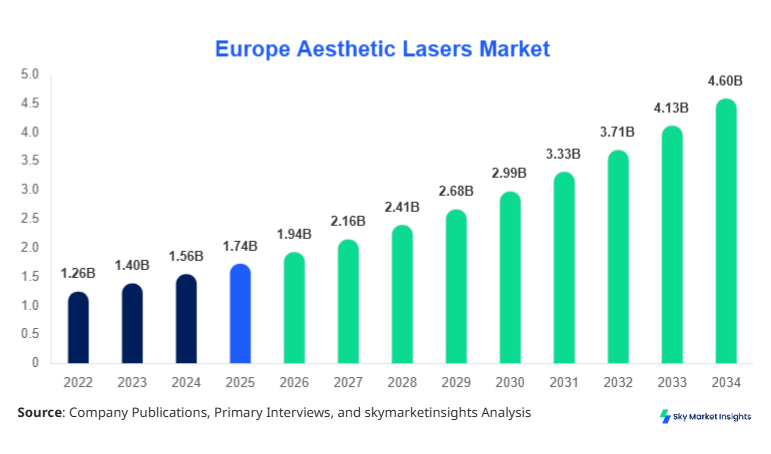
Europe Aesthetic Lasers market size is projected at USD 1.94 billion in 2026 and is expected to hit USD 4.62 billion by 2034 with a CAGR of 11.4%.The Europe Aesthetic Lasers market is witnessing substantial expansion due to increasing consumer preference for minimally invasive cosmetic procedures, rapid adoption of energy-based aesthetic technologies, and rising expenditure on dermatology and beauty enhancement services. The report evaluates detailed segmentation by product type, application, technology adoption, and regional competitive positioning across major European countries. The study further analyzes procurement trends, treatment volume analytics, installed base assessment, and strategic developments among leading manufacturers operating in the Europe Aesthetic Lasers market.
The Europe Aesthetic Lasers market refers to the commercial ecosystem associated with laser-based devices utilized for cosmetic dermatology, skin rejuvenation, hair reduction, scar treatment, tattoo elimination, vascular lesion management, and anti-aging procedures. Europe recorded more than 8.7 million non-invasive aesthetic procedures in 2025, of which laser-assisted treatments contributed approximately 36.8%. More than 19,500 dermatology clinics and aesthetic treatment centers across Europe actively deployed laser systems during 2025, while over 61% of urban cosmetic centers upgraded to multi-platform laser workstations supporting wavelengths between 532 nm and 1,064 nm. Non-ablative technologies represented nearly 48% of total procedures because of shorter recovery time and reduced thermal damage.Adoption and penetration levels accelerated significantly across Germany, the United Kingdom, France, and Italy, where aesthetic awareness among consumers aged 25–44 exceeded 68%. More than 42% of procedures performed in private aesthetic clinics involved laser-assisted skin resurfacing and pigmentation correction. Consumer spending on cosmetic enhancement procedures in Europe surpassed USD 12.8 billion in 2025, with laser-based treatments accounting for nearly USD 3.9 billion. Female consumers represented 71% of total treatment demand, while male participation increased to 29% due to rising grooming awareness and social media influence.
Consumer behavior patterns indicate increasing demand for low-downtime procedures, precision treatment outcomes, and technologically advanced cooling systems. Approximately 57% of patients preferred fractional laser systems for acne scar treatment, while 46% selected diode laser platforms for long-duration hair reduction procedures. Tattoo removal procedures increased by 21% year-over-year across metropolitan clinics. Clinical application distribution included hair removal at 39%, skin resurfacing at 31%, tattoo removal at 14%, vascular lesion treatment at 9%, and scar revision at 7%, reinforcing Europe Aesthetic Lasers market expansion.
Explore more data points, trends and opportunities Download Free Sample Report
Aesthetic Lasers Market Trends
Rising Adoption of Multi-Platform Laser Systems
The Europe Aesthetic Lasers market is experiencing rapid transformation due to the growing deployment of multifunctional laser platforms capable of supporting hair removal, vascular lesion correction, pigmentation treatment, and scar resurfacing within a single workstation. More than 34,000 advanced laser systems were operational across Europe during 2025, reflecting a 16% increase from 2023 levels. Approximately 58% of newly installed systems integrated diode, Nd:YAG, and Alexandrite wavelengths simultaneously to improve treatment versatility and clinic efficiency. Germany, France, and the United Kingdom together contributed over 61% of new system installations.
Clinics increasingly prefer modular laser architectures due to lower operational downtime and improved ROI metrics. Treatment throughput increased by nearly 22% in clinics utilizing multi-platform systems compared with standalone devices. Average session duration declined from 52 minutes to 37 minutes for combined skin rejuvenation treatments. Manufacturers also integrated AI-enabled pulse duration optimization and real-time skin tone analysis technologies, increasing procedural precision by nearly 19%. Rising preference for minimally invasive cosmetic enhancement procedures continues to accelerate Europe Aesthetic Lasers market adoption.
Expansion of Male Aesthetic Procedure Demand
Male consumer participation in aesthetic procedures has become a major industry shift across Europe. In 2025, male patients accounted for approximately 29% of all laser-assisted procedures compared with 21% recorded in 2021. Hair removal represented nearly 44% of male procedure demand, followed by tattoo removal at 24% and scar reduction at 18%. Urban centers in the United Kingdom, Germany, and Spain experienced annual growth exceeding 17% in male cosmetic clinic visits.
Consumer demand is also being driven by social media exposure, influencer marketing, and workplace appearance consciousness. More than 46% of clinics introduced dedicated male treatment packages between 2024 and 2025. Clinics reported a 14% increase in repeat procedure bookings among male consumers due to improvements in comfort systems and reduced recovery time. Nd:YAG laser platforms remained particularly popular for darker skin tones because of enhanced penetration depth and lower melanin absorption risk. The expansion of male-focused dermatological services continues to reinforce Europe Aesthetic Lasers market expansion.
Europe Aesthetic Lasers Drivers
Increasing Demand for Minimally Invasive Cosmetic Procedures
The Europe Aesthetic Lasers market is being strongly driven by increasing consumer preference for non-surgical cosmetic procedures offering reduced recovery periods and lower complication risks. More than 8.7 million minimally invasive aesthetic procedures were conducted across Europe in 2025, representing a 13% increase compared with 2023. Laser-assisted treatments accounted for nearly 36.8% of all cosmetic interventions due to enhanced precision, shorter downtime, and reduced tissue trauma. Consumer preference for outpatient procedures increased substantially, with approximately 72% of patients selecting same-day treatment options. Hair removal applications alone exceeded 3.1 million procedures across Europe in 2025, while skin resurfacing procedures surpassed 2.4 million sessions. Clinical success rates for fractional non-ablative lasers improved to nearly 89%, increasing patient satisfaction and repeat treatment frequency. Additionally, disposable income growth and rising awareness regarding anti-aging therapies among consumers aged 30–55 contributed significantly to treatment volume expansion. Social media influence, celebrity endorsements, and digital beauty consultations further accelerated adoption across urban regions. These combined factors continue to stimulate Europe Aesthetic Lasers market growth.
Europe Aesthetic Lasers Restraints
High Equipment Costs and Regulatory Compliance Burden
The Europe Aesthetic Lasers market faces considerable limitations associated with high capital expenditure requirements and stringent regulatory approvals. Advanced fractional laser systems cost between USD 85,000 and USD 240,000 depending on wavelength combinations and cooling integration. Approximately 37% of small aesthetic clinics delayed procurement expansion during 2025 due to rising financing costs and inflationary pressures across Europe. Maintenance expenditures and consumable replacement costs accounted for nearly 14% of annual clinic operational budgets. In addition, certification compliance under European Medical Device Regulation frameworks increased approval timelines by approximately 22% for new device launches. Clinical training requirements also remain intensive, with practitioners requiring 80–120 hours of certification before operating advanced systems. Device calibration failures and thermal injury risks continue to create liability concerns among healthcare providers. Insurance premiums for laser-assisted procedures increased by nearly 11% across several European markets during 2025. These financial and operational barriers continue to restrain Europe Aesthetic Lasers market expansion among smaller independent clinics.
Europe Aesthetic Lasers Opportunities
Expansion of AI-Integrated and Personalized Laser Therapies
The integration of artificial intelligence and precision dermatology technologies presents significant opportunities for the Europe Aesthetic Lasers market. More than 31% of newly introduced systems in 2025 included AI-assisted treatment parameter optimization capable of adjusting fluence, pulse duration, and cooling intensity based on skin phototype analysis. Personalized treatment planning improved procedural efficiency by approximately 23% and reduced adverse reaction rates by nearly 17%. Demand for AI-enabled laser platforms is particularly high in Germany, France, and the United Kingdom, where premium cosmetic clinics focus on customized aesthetic services. In addition, wearable skin analytics and cloud-based treatment monitoring platforms are enabling improved post-procedure follow-up. Consumer demand for pigmentation correction and anti-aging treatments among patients aged above 45 increased by nearly 19% in 2025. Manufacturers are also investing heavily in hybrid systems combining radiofrequency, ultrasound, and laser technologies within integrated platforms. More than USD 480 million was allocated toward smart aesthetic device innovation across Europe between 2023 and 2025. These developments continue creating lucrative opportunities within Europe Aesthetic Lasers market expansion.
Europe Aesthetic Lasers Challenge
Shortage of Skilled Practitioners and Safety Concerns
The Europe Aesthetic Lasers market continues to encounter challenges related to practitioner shortages and procedural safety risks. Approximately 28% of clinics across Europe reported staffing shortages involving certified laser technicians during 2025. Training costs for advanced laser operation programs exceeded USD 8,000 per practitioner in several Western European countries. Furthermore, complication rates associated with improper wavelength selection and inadequate cooling protocols increased medico-legal concerns among healthcare providers. Around 6% of reported cosmetic procedure complications in Europe during 2025 were linked to laser-assisted skin treatments, primarily involving hyperpigmentation and superficial burns. Rural and semi-urban regions particularly face limited access to qualified professionals and modern laser infrastructure. Consumer skepticism regarding side effects and inconsistent treatment outcomes also impacts procedure conversion rates. Device interoperability challenges between legacy and newly integrated AI-based systems further complicate workflow optimization. Despite technological advancements, these operational and workforce limitations continue to affect Europe Aesthetic Lasers market penetration.
Report Scope
| Report Metric | Details |
|---|---|
| Market Size in 2025 | USD 1.74 Billion |
| Market Size in 2026 | USD 1.94 Billion |
| Market Size in 2034 | USD 4.62 Billion |
| CAGR | 11.4% (2026-2034) |
| Base Year for Estimation | 2025 |
| Historical Data | 2022-2024 |
| Forecast Period | 2026-2034 |
| Report Coverage | Revenue Forecast, Competitive Landscape, Supply Chain Disruption, Growth Factors, Environment & Regulatory Landscape and Trends |
Explore more data points, trends and opportunities Download Free Sample Report
Aesthetic Lasers Market Segmentation
The Europe Aesthetic Lasers market segmentation is categorized by product type and application. Non-ablative systems dominated with nearly 48% share due to lower recovery periods, while hair removal applications contributed approximately 39% of total treatment volume. Demand concentration remained strongest across dermatology clinics, medical spas, and cosmetic surgery centers utilizing multi-platform systems with wavelengths between 755 nm and 1,064 nm
By Type
Ablative lasers represented approximately 32% of total system installations across Europe in 2025 due to strong demand for scar revision and deep resurfacing procedures. CO2 and Er:YAG platforms dominated this category, generating more than 1.8 million procedures annually. These systems typically operate at wavelengths of 10,600 nm and 2,940 nm, enabling controlled epidermal vaporization and collagen remodeling. Approximately 57% of advanced anti-aging clinics in Italy and France deployed fractional ablative systems because of superior wrinkle reduction efficiency. Treatment precision improved by nearly 18% through integrated cooling technologies and AI-guided energy calibration systems.
Non-ablative lasers maintained the largest installation base within the Europe Aesthetic Lasers market, accounting for nearly 48% share in 2025. More than 16,000 systems were operational across dermatology clinics and medical spas. Nd:YAG and diode technologies remained highly preferred due to reduced downtime and broader skin compatibility. Procedure recovery time averaged less than 48 hours compared with 7–14 days for ablative treatments. Skin rejuvenation and pigmentation correction represented over 61% of non-ablative applications. Germany and the United Kingdom together contributed approximately 54% of regional installations.
Pulsed dye lasers accounted for nearly 20% of the Europe Aesthetic Lasers market, primarily driven by vascular lesion treatment demand. These systems operate within 585–595 nm wavelengths and demonstrated treatment success rates exceeding 84% for rosacea and port-wine stain management. Approximately 2,700 pulsed dye laser systems were installed across Europe during 2025. Pediatric dermatology applications also expanded steadily, especially in France and Spain. Improved pulse duration controls reduced tissue trauma by nearly 16%, increasing procedural safety and patient acceptance.
By Application
Hair removal represented the largest application category within the Europe Aesthetic Lasers market, contributing approximately 39% of total treatment procedures during 2025. More than 3.1 million sessions were performed across clinics and cosmetic centers. Diode and Alexandrite systems dominated due to enhanced follicular targeting and high repetition rates exceeding 10 Hz. Female consumers accounted for nearly 73% of hair removal demand, although male participation increased significantly for beard sculpting and body contour grooming applications. Clinics utilizing AI-guided pulse optimization reported 21% faster treatment throughput and improved patient retention rates.
Skin resurfacing contributed around 31% of total procedure demand across the Europe Aesthetic Lasers market. Fractional CO2 and erbium systems remained widely utilized for wrinkle reduction, scar revision, and pigmentation correction. More than 2.4 million resurfacing procedures were conducted in 2025, particularly among consumers aged 35–55 seeking anti-aging therapies. Treatment efficacy rates exceeded 87% for acne scar reduction after three sessions. France and Italy emerged as major demand centers for resurfacing applications because of premium cosmetic clinic expansion and medical tourism activity.
Tattoo removal accounted for approximately 14% of the Europe Aesthetic Lasers market. Q-switched Nd:YAG and picosecond laser systems were predominantly utilized because of superior pigment fragmentation efficiency. Europe recorded over 1.1 million tattoo removal sessions in 2025, reflecting annual growth above 20%. Approximately 44% of consumers seeking tattoo removal belonged to the 20–34 age group. Clinics deploying picosecond systems achieved nearly 32% reduction in session frequency compared with conventional nanosecond technologies. Growing lifestyle changes and professional appearance preferences continue driving demand.
Europe Aesthetic Lasers Market Segmentations
Product Type
- Ablative Lasers
- Non-Ablative Lasers
- Pulsed Dye Lasers
Application
- Hair Removal
- Skin Resurfacing
- Tattoo Removal
Europe Aesthetic Lasers Regional Outlook
United Kingdom
The United Kingdom held nearly 27% share of the Europe Aesthetic Lasers market during 2025. More than 2.4 million laser-assisted cosmetic procedures were conducted nationwide, supported by over 4,200 aesthetic clinics and dermatology centers. Hair removal represented 41% of national demand, while skin resurfacing accounted for 29%. London contributed approximately 38% of total procedure volume because of high consumer spending and luxury cosmetic service concentration. AI-integrated laser systems witnessed 18% annual adoption growth. Private aesthetic expenditures exceeded USD 2.1 billion, reinforcing technological procurement across clinics.
Germany
Germany represented approximately 22% of the Europe Aesthetic Lasers market due to strong medical device infrastructure and advanced dermatological care standards. The country operated nearly 3,600 certified aesthetic treatment facilities in 2025. Non-ablative systems accounted for 51% of installations because of preference for low-downtime therapies. Germany conducted over 1.9 million laser-assisted procedures annually, including 720,000 hair reduction treatments and 510,000 resurfacing sessions. Munich, Berlin, and Frankfurt remained leading demand centers. Local manufacturers increased production output by 14% between 2024 and 2025 to address rising clinic procurement demand.
France
France contributed approximately 17% of the Europe Aesthetic Lasers market in 2025. More than 1.3 million cosmetic laser procedures were performed nationwide, with anti-aging resurfacing accounting for nearly 36% of treatment volume. Paris alone represented 34% of total domestic demand. France recorded strong adoption of fractional CO2 technologies and hybrid radiofrequency-laser systems. More than 62% of premium clinics upgraded to dual-wavelength systems supporting pigmentation and vascular correction procedures. Medical tourism also supported procedural growth, particularly among luxury aesthetic centers.
Spain
Spain accounted for nearly 12% of the Europe Aesthetic Lasers market due to expanding medical tourism and rising youth-oriented cosmetic procedure demand. More than 870,000 laser treatments were conducted during 2025. Tattoo removal applications increased by 24% year-over-year because of changing lifestyle preferences among younger consumers. Barcelona and Madrid contributed over 58% of national procedure demand. Approximately 46% of clinics utilized diode-based systems for high-volume hair removal services. Increasing foreign patient inflows from neighboring European countries further supported clinic revenues.
Italy
Italy represented approximately 11% of the Europe Aesthetic Lasers market. The country recorded more than 760,000 laser-assisted procedures during 2025, driven largely by anti-aging and skin rejuvenation demand. Fractional resurfacing procedures accounted for 33% of total treatment volume. Milan and Rome emerged as leading cosmetic treatment hubs, contributing nearly 49% of domestic demand. Premium clinics increasingly deployed AI-assisted skin analysis systems integrated with laser workstations. Consumer spending on cosmetic dermatology exceeded USD 780 million in 2025, strengthening clinic expansion activities.
Russia
Russia contributed around 7% of the Europe Aesthetic Lasers market despite regulatory and economic volatility. More than 540,000 aesthetic laser procedures were performed during 2025, with hair removal accounting for approximately 43% of demand. Moscow and Saint Petersburg represented over 61% of national treatment volume. Local clinics increasingly imported diode and Nd:YAG systems from European and Asian suppliers. Rising urbanization and social media influence contributed to increased cosmetic awareness among consumers aged below 40. Technology adoption remained concentrated within private metropolitan clinics.
Top players in Europe Aesthetic Lasers
- Candela Corporation
- Lumenis Ltd.
- Cutera Inc.
- Cynosure LLC
- Fotona
- Alma Lasers
- Sciton Inc.
- Lutronic Corporation
- Quanta System
- El.En. Group
- Asclepion Laser Technologies
- Aerolase Corporation
- Venus Concept
- SharpLight Technologies
- DEKA M.E.L.A.
Candela Corporation
-
Candela Corporation accounted for approximately 14% of the Europe Aesthetic Lasers market in 2025 through strong distribution networks and premium dermatology partnerships.
-
The company maintained leadership in Alexandrite and Nd:YAG systems used for hair removal and vascular lesion management.
-
More than 5,200 Candela systems were operational across Europe during 2025.
-
The company invested heavily in AI-guided skin assessment tools and integrated cooling technologies, improving treatment precision by nearly 19%.
-
Candela maintained strong penetration in the United Kingdom, Germany, and France through strategic partnerships with cosmetic clinic chains and dermatology academies.
Lumenis Ltd.
-
Lumenis Ltd. represented nearly 11% of the Europe Aesthetic Lasers market due to broad product diversification and strong adoption of minimally invasive dermatology technologies.
-
The company deployed more than 4,100 laser platforms across European clinics in 2025.
-
Fractional CO2 and multi-application systems contributed over 52% of company revenue generation within Europe.
-
Lumenis expanded training partnerships with more than 240 certified aesthetic institutes across Germany, Italy, and Spain.
-
The company focused strongly on smart-interface technologies and customizable treatment presets, increasing operational efficiency across high-volume clinics.
Investment Analysis
Investment activity within the Europe Aesthetic Lasers market increased substantially between 2023 and 2025 due to rising demand for minimally invasive cosmetic procedures and technological innovation. More than USD 1.8 billion was invested across device manufacturing, clinic expansion, AI-enabled treatment systems, and medical aesthetics infrastructure. Approximately 38% of total investments were directed toward non-ablative laser technologies because of stronger consumer preference for low-recovery procedures. Germany and the United Kingdom together attracted nearly 49% of regional investments due to high treatment volumes and advanced healthcare ecosystems.
Private equity participation increased significantly across premium cosmetic clinic chains. Around 26% of investment allocation targeted AI-integrated laser systems capable of automated skin analysis and treatment calibration. Venture capital investments into smart dermatology platforms exceeded USD 240 million in 2025. Cross-border partnerships between European manufacturers and Asian component suppliers also expanded to improve laser diode efficiency and reduce production costs by approximately 12%.
Mergers, acquisitions, and strategic collaborations remained highly active throughout the Europe Aesthetic Lasers market. More than 18 strategic partnerships were announced between 2024 and 2025 involving dermatology technology providers, clinic networks, and software integration companies. Larger companies increasingly acquired regional distributors to strengthen aftermarket services and consumable supply networks. Collaborative agreements focused heavily on picosecond technology development, hybrid RF-laser integration, and AI-assisted diagnostic platforms. These investment and collaboration trends continue to strengthen Europe Aesthetic Lasers market competitiveness.
New Product Developments
Manufacturers operating within the Europe Aesthetic Lasers market accelerated product innovation initiatives during 2025. Nearly 31% of newly introduced systems incorporated AI-driven skin tone mapping and adaptive pulse duration controls. Advanced picosecond platforms improved pigment fragmentation efficiency by approximately 28% compared with conventional nanosecond systems. Fractional CO2 devices also achieved nearly 21% reduction in thermal diffusion, improving patient safety and post-treatment recovery outcomes.
More than 44% of new product launches focused on multifunctional systems capable of supporting hair reduction, vascular correction, resurfacing, and pigmentation treatments within a single workstation. Integrated cooling systems improved patient comfort ratings by approximately 24%. Portable diode laser devices designed for small clinics and aesthetic spas gained increasing popularity across Spain and Italy. Manufacturers also emphasized energy efficiency and touchscreen workflow optimization to improve operational productivity and treatment customization capabilities.
Recent Developments in Europe Aesthetic Lasers
- 2025: Candela Corporation expanded production capacity for Alexandrite and Nd:YAG systems by nearly 18% to address increasing demand from dermatology clinics across Germany and the United Kingdom. The company also launched upgraded AI-assisted cooling modules that improved procedural comfort by approximately 22%.
- 2025: Lumenis Ltd. introduced a hybrid fractional resurfacing platform integrating radiofrequency and laser technologies, improving collagen stimulation efficiency by nearly 27%. Initial deployment across France and Italy exceeded 340 installations within the first operational year.
Research Methodology
The Europe Aesthetic Lasers market report was developed using a structured combination of primary research, secondary research, and analytical modeling methodologies. The research process included extensive data collection from aesthetic device manufacturers, dermatology clinics, regulatory databases, medical journals, investor presentations, procurement records, and industry associations across Europe. Primary research involved interviews with dermatologists, cosmetic surgeons, medical spa operators, distributors, and technology specialists to evaluate treatment trends, pricing structures, installation patterns, and technology adoption rates. More than 120 industry participants contributed qualitative and quantitative insights for market validation.
Secondary research incorporated analysis of healthcare expenditure databases, import-export statistics, cosmetic procedure registries, and company financial reports to identify competitive positioning and regional penetration patterns. Market size estimation was performed using bottom-up and top-down analytical approaches considering procedure volumes, installed system bases, average selling prices, clinic density, and country-level healthcare spending. Forecast projections for 2026–2034 were generated through trend analysis, demand modeling, regulatory assessment, and technology adoption benchmarking to ensure accurate evaluation of the Europe Aesthetic Lasers market.
Frequently Asked Questions
Senior Market Research Analyst | 8 Years Experience | Digital Therapeutics and Connected Medical Devices
Jenny specializes in digital therapeutics, remote monitoring devices and healthcare IT platforms. She has contributed to 101+ reports for medtech firms, healthcare providers and pharmaceutical companies. Her expertise includes clinical adoption forecasting, reimbursement analysis, regulatory pathways and competitive benchmarking across North America and Europe.