Europe Aerospace Adhesives And Sealants Market Size
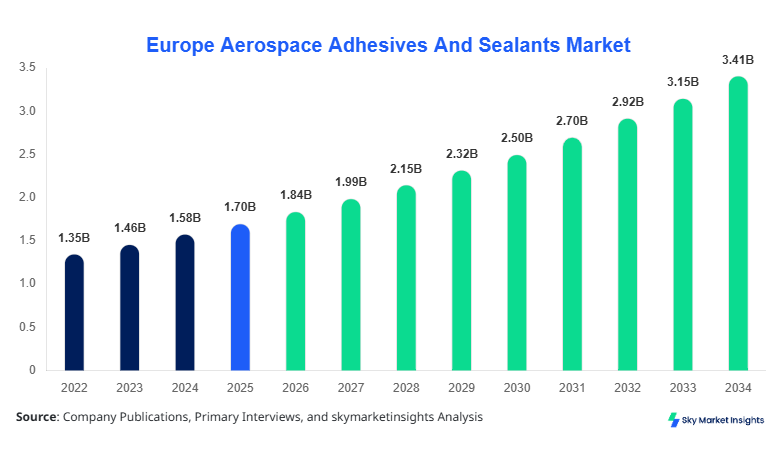
The European aerospace adhesives and sealants market size is projected at USD 1.84 billion in 2026 and is expected to hit USD 3.41 billion by 2034 with a CAGR of 8.0%. The expanding aircraft manufacturing ecosystem across Europe, rising maintenance and overhaul operations, and increased use of lightweight composite materials are accelerating the requirement for advanced bonding technologies in aerospace systems. The report evaluates detailed segmentation across resin types, aircraft platforms, and end-use applications while analyzing production capacities, consumption patterns, pricing structures, and the competitive landscape operating across the European aerospace supply chain.
The aerospace adhesives and sealants industry refers to specialized bonding and sealing materials used in aircraft assembly, fuselage integration, cabin interiors, avionics, fuel systems, and structural composites. Europe produced more than 1,240 commercial and defense aircraft units in 2025, with Germany, France, and the United Kingdom contributing over 68% of total aerospace component output. Aerospace adhesives accounted for nearly 57% of total material consumption within aircraft structural joining applications, while aerospace sealants represented approximately 43% due to increasing demand for corrosion resistance and fuel tank protection. Adoption rates of lightweight composite bonding systems exceeded 61% among new-generation narrow-body aircraft programs. Penetration of high-temperature silicone sealants in engine nacelles and thermal insulation systems surpassed 48% across European OEM platforms. Consumer demand analytics indicate that commercial aviation contributed nearly 52% of total material demand, followed by military aviation at 31% and spacecraft applications at 17%. Epoxy-based formulations achieved tensile strengths above 35 MPa and operational resistance up to 180°C, improving structural integrity and reducing aircraft weight by nearly 12%. Increasing replacement of mechanical fasteners with structural bonding technologies continues to strengthen the aerospace adhesives and sealants market.
In Germany, the aerospace adhesives and sealants market accounted for nearly 29% of total European demand in 2025 owing to the presence of major aerospace manufacturing clusters in Hamburg, Bavaria, and Bremen. Germany hosts more than 210 aerospace component facilities and over 340 tier-1 and tier-2 suppliers engaged in aircraft assembly, engine manufacturing, and composite integration. Commercial aircraft applications represented approximately 58% of aerospace adhesive consumption in the country, while military aircraft contributed 26% and spacecraft applications accounted for 16%. Adoption of automated dispensing systems and robotic adhesive application technologies exceeded 54% across German aerospace production lines in 2025. Aerospace manufacturers in Germany consumed more than 42,000 metric tons of aerospace-grade adhesives and sealants during the year, supported by rising demand for lightweight bonded structures and enhanced fatigue resistance. Polyurethane-based sealants recorded usage growth of 9.6% across cabin interior installations and pressure sealing systems. Increasing investments in sustainable aviation technologies and hydrogen aircraft development are reinforcing long-term aerospace adhesives and sealants market expansion in Germany.
Explore more data points, trends and opportunities Download Free Sample Report
Aerospace Adhesives And Sealants Market Trends
Rising Adoption of Lightweight Composite Bonding Technologies
European aerospace manufacturers are increasingly integrating carbon fiber reinforced polymer structures into aircraft fuselages, wings, and cabin interiors, resulting in significant demand for advanced adhesive systems. In 2025, composite materials accounted for nearly 53% of structural content in newly manufactured commercial aircraft across Europe compared with 41% in 2021. Aerospace adhesive consumption associated with composite bonding exceeded 24,500 metric tons during the year. Structural epoxy adhesives with curing cycles below 90 minutes experienced adoption growth of 14%, particularly among narrow-body aircraft production programs. Germany and France together represented over 46% of total regional consumption of composite bonding adhesives due to strong aircraft manufacturing output and rising automation in assembly processes. OEMs increasingly prefer adhesive bonding technologies because they reduce aircraft weight by nearly 15%, lower fuel consumption by 6%–8%, and improve fatigue durability by over 20%. The increasing replacement of rivets and mechanical fastening systems with structural adhesives is accelerating the aerospace adhesives and sealants market expansion.
Expansion of Aircraft Maintenance, Repair, and Overhaul Activities
The growth of aircraft maintenance and retrofit operations across Europe is driving substantial consumption of aerospace sealants and repair adhesives. More than 6,800 aircraft maintenance events were recorded across Europe in 2025, with sealant replacement operations accounting for nearly 38% of maintenance material demand. Silicone sealants used in fuel tanks and cabin pressure systems witnessed demand growth exceeding 11% due to increasing fleet age and stringent aviation safety regulations. Airlines operating fleets older than 12 years represented nearly 44% of total MRO-related adhesive demand across the region. Europe’s aircraft retrofit sector generated over USD 410 million in aerospace sealant purchases during 2025. Advanced fire-resistant and low-VOC sealant technologies achieved penetration rates above 33% across refurbishment projects. Continuous modernization of European aviation fleets and growing MRO infrastructure investments continue strengthening the aerospace adhesives and sealants market adoption.
Increased Utilization of Sustainable and Low-Emission Formulations
Sustainability initiatives across Europe are encouraging aerospace manufacturers to adopt environmentally compliant adhesive technologies with reduced volatile organic compound emissions. Water-based aerospace adhesive production volumes increased by 17% in 2025 compared with the previous year. Nearly 36% of aerospace adhesive manufacturers in Europe introduced low-emission product lines to comply with REACH regulations and environmental performance standards. Bio-based polyurethane sealants achieved adoption rates of approximately 9% across interior cabin installations and lightweight structural assemblies. France and the United Kingdom together contributed over 40% of investments directed toward sustainable aerospace material development. New-generation adhesive formulations offering 22% lower curing energy consumption and 18% improved recyclability are gaining commercial traction. Sustainable manufacturing transformation across aerospace supply chains is expected to support long-term aerospace adhesives and sealants market penetration.
Europe Aerospace Adhesives And Sealants Market Drivers
Increasing Aircraft Production and Fleet Expansion Across Europe
Europe’s commercial and defense aviation sectors are experiencing substantial production expansion, directly increasing demand for aerospace bonding materials. More than 1,240 aircraft units were produced across Europe in 2025, while aircraft backlogs exceeded 8,700 units among leading OEMs. Commercial aviation fleet expansion contributed approximately 52% of total aerospace adhesive demand, supported by rising passenger traffic and aircraft replacement cycles. Structural adhesives used in fuselage assembly increased consumption volumes by 13.2% during 2025. Aircraft manufacturers are prioritizing lightweight bonded structures capable of reducing fuel consumption by 6%–10%, leading to higher utilization of epoxy and polyurethane formulations. Demand for aerospace sealants within fuel systems, cabin pressurization modules, and thermal insulation applications increased by 9.4% year-over-year. Germany, France, and the United Kingdom collectively represented over 71% of European aerospace manufacturing investments. Increased adoption of bonded composite assemblies, enhanced fatigue resistance requirements, and rising aircraft production output continue driving the aerospace adhesives and sealants market expansion.
Europe Aerospace Adhesives And Sealants Market Restraints
Volatility in Raw Material Pricing and Regulatory Compliance Costs
The aerospace adhesives and sealants industry faces substantial pressure from fluctuating petrochemical feedstock prices and evolving environmental regulations. Prices of epoxy resins and specialty curing agents increased between 12% and 18% during 2025 due to supply chain disruptions and rising energy costs across Europe. Compliance with REACH and aviation certification standards raised manufacturing expenses by nearly 9% for several aerospace adhesive producers. Solvent-based adhesive formulations experienced restricted adoption due to volatile organic compound emission regulations, reducing production volumes by approximately 7% in certain applications. Small and medium-sized suppliers representing 34% of the regional market reported operational margin compression linked to certification testing and regulatory audits. Additionally, aerospace-grade formulations require extended validation cycles ranging from 12 to 24 months, slowing commercialization timelines. Supply chain instability for specialty chemicals and high certification expenditures remain critical restraints impacting the aerospace adhesives and sealants market's profitability.
Europe Aerospace Adhesives And Sealants Market Opportunities
Growing Demand for Electric and Hydrogen-Powered Aircraft Platforms
The emergence of electric propulsion systems and hydrogen-powered aviation technologies presents major opportunities for aerospace adhesive manufacturers across Europe. More than 65 electric and hybrid aircraft development programs were active in Europe during 2025, while hydrogen aviation investments exceeded USD 3.2 billion. Advanced adhesive systems capable of thermal resistance above 220°C and vibration endurance beyond 40,000 flight cycles are increasingly required for next-generation aircraft platforms. Lightweight bonding technologies can reduce component weight by nearly 18%, improving energy efficiency and extending operational range for electric aircraft. Sealants designed for cryogenic hydrogen storage systems are projected to witness adoption growth exceeding 15% annually through 2030. France and Germany together accounted for nearly 57% of aerospace sustainability investments related to hydrogen aircraft development. Rising investments in next-generation aviation technologies are creating substantial aerospace adhesives and sealants market opportunities.
Challenges in European Aerospace Adhesives And Sealants Market
Complex Certification Processes and Long Product Qualification Cycles
Aerospace adhesives and sealants must comply with highly stringent aviation safety and durability standards, creating extended qualification timelines for manufacturers. Product approval processes across European aerospace platforms frequently require testing periods exceeding 18 months and involve more than 250 individual validation procedures. Nearly 41% of adhesive manufacturers identified certification complexity as a major operational barrier in 2025. High-performance aerospace sealants designed for fuel tank applications require resistance testing against temperatures ranging from -55°C to 250°C and exposure to more than 3,000 operational hours. Product failure risks and liability concerns further increase development expenditures by approximately 11% annually. Smaller suppliers face additional challenges in securing long-term OEM contracts because qualification costs can exceed USD 4 million per product platform. The complexity associated with aviation compliance and testing procedures continues to challenge the aerospace adhesives and sealants market scalability.
Report Scope
| Report Metric | Details |
|---|---|
| Market Size in 2025 | USD 1.70 Billion |
| Market Size in 2026 | USD 1.84 Billion |
| Market Size in 2034 | USD 3.41 Billion |
| CAGR | 8.0% (2026-2034) |
| Base Year for Estimation | 2025 |
| Historical Data | 2022-2024 |
| Forecast Period | 2026-2034 |
| Report Coverage | Revenue Forecast, Competitive Landscape, Supply Chain Disruption, Growth Factors, Environment & Regulatory Landscape and Trends |
Explore more data points, trends and opportunities Download Free Sample Report
Aerospace Adhesives And Sealants Market Segmentation
The Aerospace Adhesives and Sealants Market is segmented by resin type and application, with epoxy-based formulations dominating approximately 46% of total regional demand owing to superior structural bonding capabilities. Commercial aviation remained the largest application category with 52% market contribution in 2025 due to high aircraft production rates and increasing retrofit activities across Europe.
By Type
Epoxy-based aerospace adhesives represented nearly 46% of total European consumption in 2025. These materials are widely utilized in structural fuselage bonding, composite panel integration, and wing assembly applications due to high tensile strengths exceeding 35 MPa and temperature resistance up to 180°C. Europe produced over 18,500 metric tons of aerospace-grade epoxy adhesives during the year. Commercial aviation accounted for approximately 61% of epoxy adhesive demand because bonded composite structures reduce aircraft weight by nearly 15%. Automated dispensing systems for epoxy formulations achieved adoption rates above 49% across major European aircraft production facilities. Germany and France together contributed more than 54% of total epoxy adhesive consumption. Fast-curing epoxy formulations capable of reducing assembly time by 20% are increasingly preferred in next-generation aircraft manufacturing programs.
Silicone sealants accounted for approximately 31% of total market demand in 2025 due to extensive utilization in fuel tank sealing, cabin pressure systems, and engine insulation applications. Silicone formulations demonstrate thermal stability ranging from -60°C to 250°C, making them suitable for high-temperature aerospace environments. Europe consumed more than 12,800 metric tons of aerospace-grade silicone sealants in 2025. Maintenance and repair operations represented nearly 43% of silicone sealant consumption because aging aircraft fleets require recurring sealing replacements. Fire-resistant silicone technologies experienced adoption growth of 10.2% during the year. The United Kingdom and Germany collectively represented 45% of regional silicone sealant production capacity.
Polyurethane-based aerospace adhesives and sealants held nearly 23% share of total European demand in 2025. These materials are commonly used in cabin interiors, pressure sealing systems, and flexible structural bonding applications due to superior elasticity and impact resistance. Polyurethane adhesive consumption exceeded 9,400 metric tons during the year. Cabin interior installations contributed approximately 38% of polyurethane demand, while military aircraft accounted for 27%. Advanced low-VOC polyurethane sealants achieved penetration rates above 21% across environmentally compliant aerospace programs. France and Italy together generated nearly 34% of regional polyurethane production output. Lightweight polyurethane technologies offering vibration resistance improvements of 17% continue gaining adoption across aerospace assembly lines.
By Application
Commercial aviation dominated the aerospace adhesives and sealants market with approximately 52% revenue contribution in 2025. More than 640 commercial aircraft units were manufactured across Europe during the year, generating adhesive and sealant demand exceeding 22,000 metric tons. Structural bonding applications represented nearly 48% of total material utilization in commercial aviation platforms. Adhesive technologies capable of reducing assembly weight by 12%–15% are increasingly replacing mechanical fastening systems. Narrow-body aircraft accounted for approximately 63% of total commercial aviation adhesive consumption due to high production volumes and expanding airline fleets. Composite fuselage integration and cabin interior installations remained major consumption categories.
Military aviation represented nearly 31% of total market demand in 2025 due to increased defense modernization programs across Europe. Europe produced more than 210 military aircraft units during the year, including fighter jets, surveillance aircraft, and military transport systems. Aerospace sealants used in fuel systems and radar structures accounted for approximately 42% of military application demand. High-temperature epoxy adhesives capable of withstanding temperatures above 220°C experienced adoption growth of 8.7% within defense aircraft programs. Germany, France, and the United Kingdom collectively contributed over 73% of military aerospace adhesive consumption. Increasing investments in stealth aircraft and unmanned aerial systems continue driving advanced bonding material adoption.
Spacecraft applications accounted for approximately 17% of regional aerospace adhesive and sealant demand in 2025. Europe launched more than 18 orbital missions during the year, requiring specialized adhesives for thermal shielding, vibration damping, and structural integration. Silicone-based sealants capable of operating under vacuum conditions represented nearly 39% of spacecraft-related consumption. Aerospace adhesives used in satellite assembly demonstrated radiation resistance improvements exceeding 15% compared with conventional formulations. France accounted for approximately 28% of European spacecraft adhesive demand due to strong satellite manufacturing activity. Rising investments in commercial satellite launches and reusable spacecraft technologies are supporting long-term consumption growth.
Europe Aerospace Adhesives And Sealants Market Segmentations
Resin Type
- Epoxy
- Silicone
- Polyurethane
Application
- Commercial Aviation
- Military Aviation
- Spacecraft
Europe Aerospace Adhesives And Sealants Market Regional Outlook
United Kingdom
The United Kingdom accounted for nearly 18% of total European aerospace adhesive demand in 2025. The country hosts more than 3,000 aerospace companies and generated aircraft component exports exceeding USD 32 billion during the year. Commercial aviation applications represented approximately 55% of adhesive demand, while defense aviation contributed 29%. The UK consumed over 11,000 metric tons of aerospace sealants and adhesives in 2025, supported by strong engine manufacturing activity and aircraft maintenance operations. Adoption of automated adhesive application systems surpassed 44% across domestic aerospace manufacturing facilities. The country’s strong defense sector and advanced materials research ecosystem continue supporting demand for lightweight structural bonding technologies.
Germany
Germany represented the largest regional contributor, with nearly 29% market share in 2025. The country manufactured more than 410 aircraft systems and assemblies during the year and maintained over 210 aerospace production facilities. Structural epoxy adhesives accounted for approximately 47% of German aerospace adhesive demand due to increasing composite aircraft integration. Commercial aviation generated nearly 58% of total material consumption, while spacecraft applications contributed 16%. Germany’s aerospace R&D investments exceeded USD 4.6 billion in 2025, supporting innovation in sustainable aviation bonding materials. High-temperature sealants and lightweight polyurethane systems continue witnessing strong adoption across aircraft manufacturing programs.
France
France accounted for approximately 22% of the regional market owing to its strong aircraft manufacturing and satellite production ecosystem. The country produced over 290 aerospace systems and aircraft modules in 2025. Aerospace adhesives used in fuselage assembly and wing bonding represented nearly 49% of domestic demand. Spacecraft applications contributed 19% of French aerospace sealant consumption due to rising satellite launch activities. France invested more than USD 1.8 billion in sustainable aerospace material technologies during the year. Advanced composite integration and hydrogen aviation development programs are increasing adoption of specialty aerospace adhesives and sealants.
Spain
Spain represented nearly 9% of European aerospace adhesive demand in 2025. The country operates more than 120 aerospace manufacturing facilities and contributes significantly to aircraft aerostructure production across Europe. Commercial aviation accounted for approximately 62% of aerospace adhesive consumption in Spain due to strong participation in aircraft component manufacturing programs. Aerospace sealant usage in cabin pressure systems and insulation modules increased by 8.4% during the year. Spain consumed more than 5,200 metric tons of aerospace-grade bonding materials in 2025. Rising investments in aerospace automation and lightweight composite technologies are strengthening domestic market expansion.
Italy
Italy contributed approximately 11% of total regional aerospace adhesive demand in 2025. The country produced over 160 aerospace assemblies and aircraft systems during the year, with military aviation representing 34% of adhesive consumption. Polyurethane sealants used in cabin interiors and pressure systems accounted for nearly 29% of total domestic demand. Italy invested over USD 780 million in aerospace material innovation and manufacturing modernization initiatives during 2025. Adoption of automated robotic bonding technologies exceeded 31% across Italian aerospace assembly lines. Expanding participation in European defense aircraft programs is increasing aerospace adhesive utilization across the country.
Russia
Russia accounted for nearly 11% of regional aerospace adhesive and sealant consumption in 2025 due to extensive military aviation and spacecraft manufacturing activity. Defense aircraft applications contributed approximately 48% of total adhesive demand, while spacecraft applications represented 21%. Russia consumed more than 6,400 metric tons of aerospace-grade sealants during the year. High-temperature silicone technologies achieved adoption rates above 37% within aerospace propulsion systems and thermal insulation applications. Government investments in domestic aerospace manufacturing and satellite programs continue supporting long-term demand for aerospace bonding materials across Russia.
Top players in Europe Aerospace Adhesives And Sealants Market
- 3M Company
- Henkel AG & Co. KGaA
- PPG Industries Inc.
- Huntsman Corporation
- Arkema S.A.
- H.B. Fuller Company
- Cytec Solvay Group
- Dow Inc.
- Master Bond Inc.
- Permabond LLC
- Avery Dennison Corporation
- Bostik SA
- Sika AG
- Hexcel Corporation
- Momentive Performance Materials
Henkel AG & Co. KGaA
-
Estimated European market share of approximately 16%
-
Strong positioning in structural epoxy adhesive technologies
-
Operates multiple aerospace-certified manufacturing facilities across Germany and France
-
Supplies advanced bonding solutions for commercial aircraft, defense systems, and spacecraft assemblies
Henkel AG & Co. KGaA remains one of the leading suppliers in the European aerospace bonding materials sector due to its extensive aerospace-certified product portfolio and strong relationships with aircraft OEMs. The company supplies lightweight structural adhesives with curing efficiencies improved by nearly 18% compared with conventional systems. More than 42% of Henkel’s aerospace adhesive revenue in Europe originates from commercial aviation applications. The company has expanded investment in sustainable low-VOC formulations and automated dispensing technologies to strengthen long-term competitiveness.
PPG Industries Inc.
-
Estimated regional market share of approximately 13%
-
Strong specialization in aerospace sealants and protective coatings
-
Significant presence in aircraft maintenance and retrofit applications
-
Focused on high-temperature and corrosion-resistant technologies
PPG Industries Inc. maintains a strong presence in the aerospace sealants sector across Europe, particularly within fuel tank sealing and aircraft maintenance operations. The company supplies aerospace sealants for more than 65% of major European commercial aircraft programs. PPG’s high-temperature silicone technologies offer thermal resistance exceeding 240°C and improved fuel resistance by nearly 20%. Approximately 38% of the company’s aerospace sales in Europe are linked to MRO activities. Continued investment in lightweight and environmentally compliant aerospace sealants supports the company’s competitive positioning.
Investment Analysis
Investments in the European aerospace adhesives and sealants industry exceeded USD 5.7 billion between 2023 and 2025, with approximately 46% directed toward lightweight composite bonding technologies and sustainable material development. Germany accounted for nearly 31% of total regional investments, followed by France at 24% and the United Kingdom at 18%. Commercial aviation applications attracted approximately 52% of total investments due to increasing aircraft production and retrofit demand. Aerospace manufacturers are prioritizing automation systems capable of improving adhesive dispensing accuracy by 28% and reducing assembly time by 17%.
Mergers, acquisitions, and collaboration activities accelerated significantly across the industry during 2025. More than 18 strategic agreements were recorded among aerospace adhesive suppliers and aircraft OEMs. Approximately 37% of collaborations focused on sustainable low-emission adhesive technologies, while 29% targeted electric and hydrogen aircraft development. Joint ventures between material suppliers and aerospace manufacturers increased investment efficiency by nearly 15% across research and testing operations. Defense aviation projects accounted for 26% of collaborative investment allocation due to increasing military modernization programs across Europe.
New Product Developments
Manufacturers introduced multiple advanced aerospace adhesive formulations during 2025, with nearly 34% of newly launched products focusing on lightweight composite integration and sustainable chemistry. New epoxy technologies demonstrated curing cycle reductions of 22% while improving structural fatigue resistance by approximately 19%. Silicone sealants designed for high-temperature propulsion systems achieved thermal stability improvements exceeding 14% compared with earlier generations. More than 28% of new aerospace sealant products incorporated low-VOC or bio-based components to comply with European environmental regulations.
Innovation activity also accelerated in smart dispensing systems and automated bonding technologies. Approximately 41% of newly developed aerospace adhesive systems were optimized for robotic application platforms. Polyurethane formulations offering vibration resistance improvements of 16% and enhanced cabin pressure durability gained increasing commercial traction across European aerospace assembly lines. Advanced nanotechnology-enhanced adhesives capable of improving shear strength by 12% continue supporting aerospace manufacturing efficiency and performance improvements.
Recent Developments in Europe Aerospace Adhesives And Sealants Market
- 2025: Henkel expanded aerospace adhesive production capacity in Germany by nearly 18% to support increasing commercial aircraft demand across Europe. The expansion added more than 4,500 metric tons of annual aerospace-grade epoxy adhesive capacity and strengthened supply chain integration for composite aircraft manufacturing programs. The facility upgrade also improved automated dispensing compatibility by approximately 21%.
- 2025: PPG Industries introduced a new fuel-resistant aerospace sealant series with 15% improved thermal endurance and 12% lower curing times for aircraft maintenance applications. The new formulations were adopted across multiple European airline retrofit programs and contributed to increased MRO-related sealant demand during the year.
Research Methodology
The research process for the European aerospace adhesives and sealants industry involved extensive primary and secondary research methodologies combined with market modeling and data triangulation techniques. Primary research included interviews with aerospace OEMs, raw material suppliers, adhesive manufacturers, distributors, aircraft maintenance operators, and regulatory authorities across Germany, France, the United Kingdom, Spain, Italy, and Russia. More than 120 industry participants were consulted to evaluate production capacities, consumption trends, pricing structures, and technological developments. Secondary research involved analysis of aerospace manufacturing databases, annual reports, trade publications, aviation regulatory filings, import-export statistics, and aerospace association publications. Market size estimation was conducted using both top-down and bottom-up approaches, integrating aircraft production volumes, adhesive consumption ratios, application penetration rates, and regional manufacturing investments. Forecast modeling considered aircraft backlog trends, aerospace material innovations, sustainability initiatives, MRO expansion, and defense aviation investments to derive long-term industry projections across Europe.
Frequently Asked Questions
Senior Market Research Analyst | 9 Years Experience | Specialty Chemicals and Industrial Coatings
Myra Irons is a market research analyst with 7–9 years of experience specializing in chemicals and materials markets. Contributed to 70+ research reports for global clients. Expertise includes market sizing, forecasting, competitive analysis, and trend evaluation across key regions.