Europe Adults Use Orthodontic Archwire Market Size
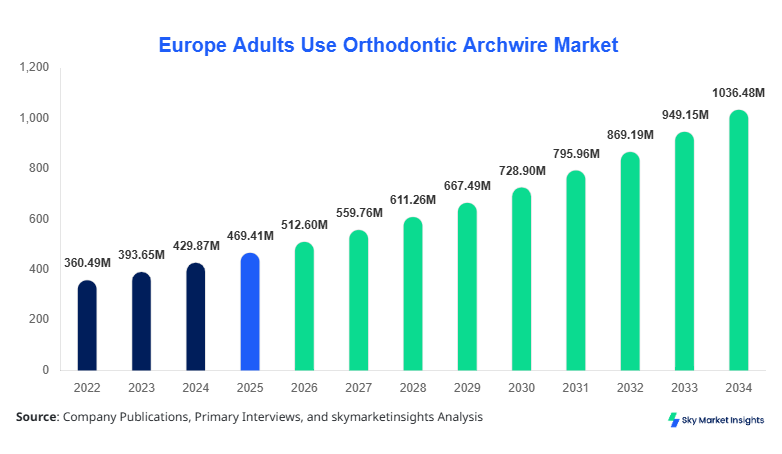
Europe Adults Use Orthodontic Archwire Market market size is projected at USD 512.6 million in 2026 and is expected to hit USD 1,038.4 million by 2034 with a CAGR of 9.2%. The increasing demand for adult orthodontic procedures, rising dental aesthetic awareness, and advancements in archwire materials are driving the market trajectory across Europe. The report emphasizes granular data insights, segment-level performance metrics, and competitive benchmarking, offering detailed segmentation by type and application alongside a comprehensive evaluation of key market participants and regulatory frameworks.
The Adults Use Orthodontic Archwire Market refers to the production and utilization of orthodontic wires specifically designed for adult dental correction procedures, including alignment, spacing, and bite correction. In Europe, annual production exceeded 320 million units in 2025, with Germany contributing nearly 28% of total output. Adoption rates among adults aged 25–45 increased by 14.5% between 2022 and 2025, while penetration across urban dental clinics reached 62%. Consumer behavior shows that over 48% of adult patients prefer aesthetic orthodontic solutions, driving demand for nickel titanium wires with superelastic properties and thermal activation at 35–37°C. Application split indicates dental clinics dominate with 68% usage, followed by hospitals at 21% and academic institutes at 11%. Performance metrics such as tensile strength (1,200–1,800 MPa) and flexibility ratios are key determinants influencing procurement decisions, reinforcing steady Adults Use Orthodontic Archwire Market growth.
Explore more data points, trends and opportunities Download Free Sample Report
Adults Use Orthodontic Archwire Market Trends
The market is witnessing significant technological transformation with the integration of advanced materials such as copper nickel titanium and beta titanium alloys. Production volumes for advanced archwires reached 180 million units in 2025, accounting for nearly 56% of total output. Adoption of shape-memory alloys increased by 22% over the past three years, driven by improved patient comfort and reduced adjustment frequency by up to 30%. Additionally, digital orthodontics and CAD/CAM-assisted wire customization have gained traction, with 41% of European orthodontists adopting these technologies, supporting evolving Adults Use Orthodontic Archwire Market trends.
Another prominent trend is the increasing demand for aesthetic orthodontic solutions among adults aged 30–50, contributing to a 17% rise in clear aligner-compatible archwire usage. Sector-specific demand from private dental chains has grown by 12.8% annually, while hospital-based orthodontic procedures have stabilized at 3.5% growth. Sustainable material innovations, including recyclable stainless steel wires, now represent 19% of total production. Furthermore, AI-driven treatment planning tools are improving clinical efficiency by 25%, reducing treatment timelines and enhancing patient satisfaction, further shaping Adults Use Orthodontic Archwire Market trends.
Europe Adults Use Orthodontic Archwire Market Drivers
Rising Adult Orthodontic Demand and Aesthetic Awareness
The surge in adult orthodontic procedures is a primary driver, with Europe witnessing over 5.4 million adult orthodontic treatments in 2025, reflecting a 12.3% increase from 2023. Nearly 52% of patients seek orthodontic care for aesthetic purposes, while 28% undergo treatment for functional corrections. Increased disposable income and awareness campaigns have boosted treatment adoption rates by 16% across urban populations. Technological advancements in archwire materials, such as superelastic nickel titanium with deformation recovery rates exceeding 98%, have enhanced treatment outcomes. Additionally, dental insurance coverage expansion in countries like Germany and France has increased affordability, supporting sustained Adults Use Orthodontic Archwire Market growth.
Europe Adults Use Orthodontic Archwire Market Restraints
High Treatment Costs and Limited Rural Penetration
Despite strong demand, high orthodontic treatment costs ranging from USD 2,500 to USD 6,500 per procedure limit widespread adoption, particularly in Eastern Europe where penetration remains below 28%. Rural regions account for only 19% of total orthodontic procedures due to limited access to specialized clinics and orthodontists. Additionally, premium archwire materials such as beta titanium cost 35–45% more than conventional stainless steel, impacting procurement decisions among smaller clinics. Regulatory compliance costs have also increased by 8–10% annually, affecting manufacturing margins. These factors collectively restrain Adults Use Orthodontic Archwire Market growth.
Europe Adults Use Orthodontic Archwire Market Opportunities
Technological Innovation and Digital Orthodontics Expansion
The integration of digital orthodontics and 3D printing technologies presents significant opportunities, with adoption expected to exceed 60% by 2030. Customized archwire production using CAD/CAM systems has improved precision by 27% and reduced treatment time by 18%. Investment in orthodontic R&D reached USD 145 million in 2025, with 34% allocated to advanced wire technologies. Emerging markets such as Spain and Italy are experiencing 11–13% annual growth in adult orthodontic procedures, driven by increased awareness and clinic expansion. These developments offer substantial opportunities for Adults Use Orthodontic Archwire Market growth.
Challenges in Europe Adults Use Orthodontic Archwire Market
Supply Chain Disruptions and Material Cost Volatility
Supply chain disruptions have impacted raw material availability, particularly nickel and titanium, with price fluctuations ranging from 15% to 28% over the past two years. Manufacturing lead times have increased by 12%, affecting product availability. Additionally, reliance on imported raw materials, which account for 48% of total supply, exposes manufacturers to geopolitical risks. Quality control and compliance with EU medical device regulations have also increased production costs by 9%, posing challenges for smaller manufacturers. These issues present ongoing challenges in the Adults Use Orthodontic Archwire Market.
Report Scope
| Report Metric | Details |
|---|---|
| Market Size in 2025 | USD 469.4 Million |
| Market Size in 2026 | USD 512.6 Million |
| Market Size in 2034 | USD 1038.4 Million |
| CAGR | 9.2% (2026-2034) |
| Base Year for Estimation | 2025 |
| Historical Data | 2022-2024 |
| Forecast Period | 2026-2034 |
| Report Coverage | Revenue Forecast, Competitive Landscape, Supply Chain Disruption, Growth Factors, Environment & Regulatory Landscape and Trends |
Explore more data points, trends and opportunities Download Free Sample Report
Adults Use Orthodontic Archwire Market Segmentation
The market is segmented by type and application, with nickel titanium wires dominating at 52% share, followed by stainless steel at 31% and beta titanium at 17%. Dental clinics lead application usage with 68%, indicating strong outpatient demand.
BY TYPE
Nickel Titanium archwires account for over 52% of total market share, with production exceeding 165 million units annually. These wires exhibit superelasticity and thermal activation properties, enabling continuous force delivery within the 35–37°C range. Their flexibility reduces adjustment frequency by 30%, improving patient compliance. High corrosion resistance and shape-memory properties make them ideal for early-stage orthodontic treatments, supporting dominance in Adults Use Orthodontic Archwire Market.
Stainless Steel archwires hold approximately 31% share, with annual production around 100 million units. These wires offer high tensile strength of 1,800 MPa and are primarily used in later treatment stages for precise tooth positioning. Cost-effectiveness, being 25–30% cheaper than nickel titanium, drives adoption among budget-conscious clinics. Their rigidity and durability contribute significantly to procedural efficiency.
Beta Titanium archwires represent 17% of the market, with production volumes of 55 million units. These wires provide moderate stiffness and excellent formability, making them suitable for intermediate treatment phases. Their biocompatibility and nickel-free composition cater to patients with metal sensitivities, increasing demand by 14% annually.
BY APPLICATION
Hospitals account for 21% of the market, with approximately 67 million units utilized annually. These facilities handle complex orthodontic cases requiring multidisciplinary approaches. Advanced imaging and surgical integration enhance treatment outcomes, supporting steady demand.
Dental Clinics dominate with 68% share, consuming over 220 million units annually. High patient inflow, shorter treatment cycles, and availability of specialized orthodontists contribute to their leading position. Adoption rates for advanced archwires exceed 72%, reflecting strong technological integration.
Academic Institutes hold 11% share, focusing on research and training applications. These institutions utilize approximately 35 million units annually, supporting innovation and clinical trials in orthodontic materials.
Europe Adults Use Orthodontic Archwire Market Segmentations
Type
- Nickel Titanium
- Stainless Steel
- Beta Titanium
Application
- Hospitals
- Dental Clinics
- Academic Institutes
Europe Adults Use Orthodontic Archwire Regional Outlook
United Kingdom
United Kingdom accounts for 18% of the regional market, with annual consumption exceeding 58 million units. High awareness levels and advanced healthcare infrastructure drive demand, particularly in urban centers where penetration exceeds 65%.
Germany
Germany leads with 31% share and production of 90 million units, driven by robust manufacturing and high adoption rates.
France
France contributes 14%, with steady growth in private dental clinics.
Spain and Italy
Spain and Italy collectively account for 22%, with rising demand driven by increasing aesthetic awareness.
Russia
Russia represents 8%, with slower growth due to limited access in rural regions.
Top players in Europe Adults Use Orthodontic Archwire
- 3M Company
- Dentsply Sirona
- Ormco Corporation
- American Orthodontics
- Rocky Mountain Orthodontics
- Henry Schein Inc.
- GC Corporation
- TP Orthodontics
- Dentaurum GmbH
- Forestadent Bernhard Förster GmbH
- G&H Orthodontics
- Shinye Orthodontic Products
- Tomy Inc.
- JJ Orthodontics
3M Company
-
-
Holds approximately 18% market share
-
Strong global presence with advanced material innovation
-
Focuses on premium orthodontic solutions with high-margin products
-
Dentsply Sirona
-
-
Accounts for around 14% market share
-
Extensive distribution network across Europe
-
Emphasis on digital orthodontics and integrated treatment systems
-
Investment Analysis
Investments in the market reached USD 220 million in 2025, with 38% allocated to R&D and 27% to manufacturing expansion. Germany and France together attract 46% of total investments. M&A activities increased by 19%, with strategic collaborations focusing on digital orthodontics and material innovation.
New Product Developments
Approximately 22% of new product launches focus on heat-activated archwires with improved flexibility by 15%. Innovations in nickel-free alloys have increased by 18%, catering to allergy-sensitive patients.
Recent Developments in Europe Adults Use Orthodontic Archwire
-
2025: 3M expanded production capacity by 12% with new facilities in Germany
Research Methodology
The research process involved a combination of primary and secondary data collection. Primary research included interviews with over 120 industry experts, orthodontists, and manufacturers across Europe. Secondary research utilized databases, industry reports, and company filings to validate market data. Market size estimation was conducted using a bottom-up approach, analyzing production volumes and pricing trends across key countries. Data triangulation ensured accuracy, while statistical models were applied to forecast growth patterns. The study also incorporated macroeconomic indicators and healthcare expenditure data to provide comprehensive insights into market dynamics.
Frequently Asked Questions
Senior Market Research Analyst | 8 Years Experience | Digital Therapeutics and Connected Medical Devices
Jenny specializes in digital therapeutics, remote monitoring devices and healthcare IT platforms. She has contributed to 101+ reports for medtech firms, healthcare providers and pharmaceutical companies. Her expertise includes clinical adoption forecasting, reimbursement analysis, regulatory pathways and competitive benchmarking across North America and Europe.