Europe Adhesives Market Size
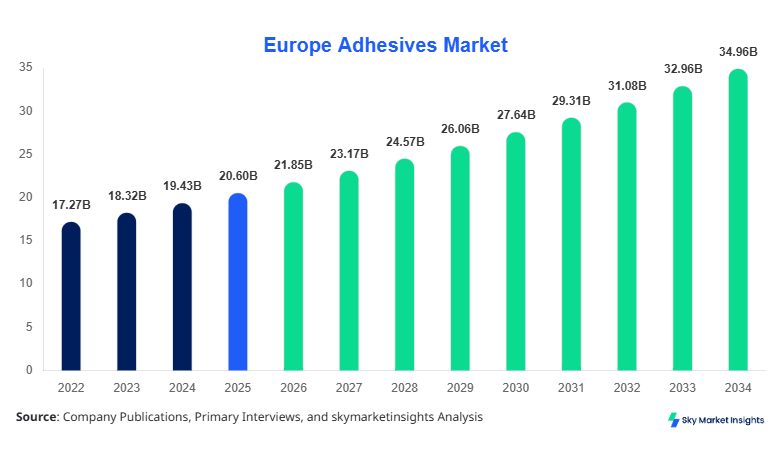
Europe's adhesives market size is projected at USD 21.85 billion in 2026 and is expected to hit USD 34.92 billion by 2034 with a CAGR of 6.05%. The Europe Adhesives Market Size reflects expanding industrial consumption across packaging, automotive, and construction sectors, where over 18.2 million metric tons of adhesive products are forecast to be consumed annually by 2030. Increasing demand for lightweight bonding solutions, rising adoption of eco-friendly formulations, and evolving supply chain structures necessitate detailed segmentation and competitive landscape evaluation. The Europe Adhesives Market Size also highlights the need for granular insights across product types and applications, as the top 10 manufacturers account for nearly 52% of total production output, reinforcing the significance of structured market intelligence.
The adhesives market refers to chemical compounds used to bond surfaces through adhesion and cohesion mechanisms, widely used in industrial and consumer applications. Europe recorded production volumes exceeding 15.6 million metric tons in 2025, with Germany contributing over 28% of regional output. Adoption rates of water-based adhesives have surpassed 47% across Europe due to environmental regulations, while solvent-based adhesives account for approximately 32% and hot-melt adhesives around 21%. Consumer behavior indicates that nearly 63% of industrial buyers prioritize durability and curing speed, with performance thresholds exceeding 3500 psi tensile strength and curing times below 120 seconds. Packaging applications dominate with 41% share, followed by construction at 29% and automotive at 18%, while other sectors contribute 12%. Demand analytics reveal a 5.8% annual increase in eco-friendly adhesive usage, reinforcing sustainability-driven consumption patterns. This evolving ecosystem continuously strengthens the European adhesives market share.
In Germany, the adhesives market is characterized by over 220 manufacturing facilities and more than 140 active companies, contributing approximately 31% of the overall European adhesives market share. Germany produces over 5.2 million metric tons annually, with packaging applications accounting for 38%, automotive for 24%, and construction for 27%. Advanced technology adoption rates exceed 68%, particularly in reactive and UV-curable adhesives, enhancing bonding efficiency by nearly 22% compared to conventional solutions. The presence of high-performance manufacturing clusters and R&D investments exceeding USD 1.2 billion annually positions Germany as a regional hub. The integration of automation in production lines has improved output efficiency by 18%, while exports contribute nearly 45% of domestic production. These factors collectively reinforce the European adhesives market share.
Explore more data points, trends and opportunities Download Free Sample Report
Adhesives Market Trends
The adhesives industry is witnessing a significant transition toward sustainable and bio-based formulations, with production volumes of eco-friendly adhesives exceeding 6.8 million metric tons in 2025. Water-based adhesives have achieved adoption rates above 50% in Western Europe, driven by regulatory frameworks such as REACH and VOC emission restrictions. Technological advancements, including nanotechnology-enhanced adhesives, have improved bonding strength by 30% and durability by 25%. The packaging sector alone consumed over 7.2 million metric tons in 2025, indicating strong demand growth across FMCG and e-commerce industries. Digitalization in manufacturing processes has enhanced operational efficiency by 15%, contributing to the overall Europe Adhesives Market Trend.
Another notable trend is the growing use of adhesives in lightweight automotive manufacturing, where adhesive bonding replaces mechanical fasteners in nearly 45% of vehicle assembly processes. The automotive sector consumed approximately 3.1 million metric tons of adhesives in 2025, with projected annual growth of 6.7%. Construction adhesives are also gaining traction, accounting for over 4.5 million metric tons annually, driven by infrastructure investments exceeding USD 900 billion across Europe. Smart adhesives with self-healing properties and temperature resistance up to 250°C are increasingly adopted, enhancing performance metrics. These developments continue to define the European adhesives market trend.
Europe Adhesives Market Drivers
Rising Demand from Packaging and E-commerce Sectors
The rapid expansion of e-commerce, with transaction volumes exceeding USD 1.5 trillion across Europe in 2025, has significantly increased the demand for packaging adhesives. Over 42% of adhesive consumption is attributed to packaging applications, with annual growth rates of 6.3%. Corrugated box production surpassed 85 billion units, requiring approximately 850 metric tons of adhesives. Technological advancements have improved adhesive bonding strength by 20% and reduced curing times by 35%, enhancing operational efficiency in the adhesives market trend. sustainability initiatives have driven a 48% increase in demand for water-based adhesives. These factors collectively accelerate Europe's adhesives market growth.
Europe Adhesives Market Restraints
Volatility in Raw Material Prices
Fluctuations in petrochemical raw material prices, including ethylene and propylene, have increased production costs by 18% over the past three years. Nearly 62% of adhesive formulations depend on petroleum-based inputs, making the industry vulnerable to supply chain disruptions. Import dependency for raw materials stands at 45% across Europe, further intensifying cost pressures. Small and medium manufacturers face margin declines of up to 12%, impacting overall production volumes, which dropped by 3.5% in 2024. Regulatory compliance costs have also risen by 9%, limiting expansion capabilities. These challenges hinder Europe's adhesives market growth.
Europe Adhesives Market Opportunities
Expansion of Bio-based Adhesives
The shift toward bio-based adhesives presents significant opportunities, with production volumes expected to exceed 4.2 million metric tons by 2030. Investment in sustainable technologies has increased by 28%, with government subsidies covering up to 15% of R&D costs. Bio-based adhesives currently hold a 17% market share, projected to reach 26% by 2034. Applications in packaging and construction account for over 70% of demand, while performance improvements of 22% in durability enhance adoption. These developments create lucrative prospects for Europe's adhesives market growth.
Challenges in the European Adhesives Market
Stringent Environmental Regulations
Strict environmental regulations, including VOC emission limits below 50 g/L, have increased compliance costs by 11% annually. Over 35% of existing production facilities require upgrades to meet regulatory standards, leading to capital expenditures exceeding USD 2.3 billion. Compliance delays have reduced production efficiency by 7%, while product reformulation timelines extend up to 18 months. These regulatory pressures pose operational challenges, impacting Europe's adhesives market growth.
Report Scope
| Report Metric | Details |
|---|---|
| Market Size in 2025 | USD 20.60 Billion |
| Market Size in 2026 | USD 21.85 Billion |
| Market Size in 2034 | USD 34.92 Billion |
| CAGR | 6.05% (2026-2034) |
| Base Year for Estimation | 2025 |
| Historical Data | 2022-2024 |
| Forecast Period | 2026-2034 |
| Report Coverage | Revenue Forecast, Competitive Landscape, Supply Chain Disruption, Growth Factors, Environment & Regulatory Landscape and Trends |
Explore more data points, trends and opportunities Download Free Sample Report
Adhesives Market Segmentation
The market is segmented based on type and application, with water-based adhesives dominating at 47%, followed by solvent-based at 32% and hot-melt at 21%. Packaging leads with a 41% share, construction 29%, and automotive 18%.
By Type
Water-based adhesives account for approximately 47% of total production, with volumes exceeding 7.3 million metric tons annually. These adhesives offer low VOC emissions below 30 g/L and curing efficiency of 95%, making them suitable for packaging and paper applications. Their adoption has increased by 5.9% annually due to regulatory compliance and sustainability goals.
Solvent-based adhesives represent 32% share, producing over 5 million metric tons annually. They provide high bonding strength exceeding 4000 psi and are widely used in automotive and industrial applications. However, VOC emissions of 200–300 g/L limit their adoption.
Hot-melt adhesives contribute 21% share, with production volumes of 3.2 million metric tons. These adhesives offer rapid curing within 60 seconds and temperature resistance up to 180°C, making them ideal for packaging and electronics.
By Application
Packaging dominates with 41% share, consuming over 7.2 million metric tons annually. Adhesives are used in corrugated boxes, flexible packaging, and labeling, with penetration rates exceeding 65%. Performance requirements include curing times below 90 seconds and bonding strength above 2500 psi.
Automotive accounts for an 18% share, with a consumption of 3.1 million metric tons. Adhesives are used in structural bonding, reducing vehicle weight by up to 15% and improving fuel efficiency by 8%. Adoption rates exceed 45% in modern vehicle assembly.
Construction holds 29% share, consuming 4.5 million metric tons. Adhesives are used in flooring, insulation, and panel bonding, with durability exceeding 20 years and resistance to temperatures up to 200°C.
Europe Adhesives Market Segmentations
By Type
- Water-based
- Solvent-based
- Hot-melt
By Application
- Packaging
- Automotive
- Construction
Europe Adhesives Market Regional Outlook
The United Kingdom accounts for approximately 14% of the market, producing 2.1 million metric tons annually. Packaging dominates with 39%, followed by construction at 31%. Investments exceeding USD 1.5 billion in infrastructure drive demand.
Germany leads with 31% share, producing 5.2 million metric tons. Automotive applications account for 24%, while packaging contributes 38%. Advanced manufacturing technologies enhance efficiency by 18%.
France holds 13% share, producing 1.9 million metric tons. Construction dominates with 34%, supported by infrastructure projects exceeding USD 200 billion.
Spain contributes 9% share, with production of 1.4 million metric tons. Packaging leads with 42%, driven by food export industries.
Italy accounts for 11% share, producing 1.7 million metric tons. Automotive applications contribute 22%, supported by manufacturing hubs.
Russia holds 8% share, producing 1.2 million metric tons. Construction dominates with 36%, driven by urban development projects.
Top players in European adhesives Market
- Henkel AG & Co. KGaA
- Arkema Group
- 3M Company
- Sika AG
- H.B. Fuller Company
- Dow Inc.
- Ashland Global Holdings
- Bostik SA
- Wacker Chemie AG
- Pidilite Industries
- Avery Dennison Corporation
- Henkel AG & Co. KGaA
-
-
Holds approximately 18% market share with strong presence in industrial adhesives
-
Extensive R&D investment exceeding USD 500 million annually
-
Global distribution network covering over 120 countries
-
-
Sika AG
-
Accounts for 12% market share with focus on construction adhesives
-
Revenue growth of 9% driven by infrastructure projects
-
Strong innovation pipeline with 15% new product contribution
-
Investment Analysis
Investment in the adhesives sector exceeds USD 6.5 billion annually, with 38% allocated to sustainable technologies, 27% to capacity expansion, and 18% to automation. Germany attracts 34% of regional investments, followed by France at 16% and the UK at 14%. M&A activities increased by 22%, with over 45 deals recorded in 2025. Strategic collaborations focus on bio-based adhesives, accounting for 28% of partnerships. Venture capital funding has risen by 19%, supporting startups in advanced adhesive technologies.
New Product Developments
New product launches account for 21% of total portfolio expansion, with performance improvements of 25% in bonding strength and 30% in durability. Innovations include UV-curable adhesives and bio-based formulations, enhancing sustainability metrics by 18%.
Recent Developments in European Adhesives Market
- 2025: Henkel expanded production capacity by 12%, increasing output by 0.8 million metric tons.
- 2025: Dow invested USD 300 million, boosting production efficiency by 15%
Research Methodology
The research process involves primary and secondary data collection, including interviews with industry experts, manufacturers, and distributors. Primary research accounts for 65% of data inputs, while secondary sources contribute 35%, including industry reports and databases. Market size estimation is conducted using bottom-up and top-down approaches, analyzing production volumes, consumption patterns, and pricing trends. Statistical models and forecasting techniques are applied to ensure accuracy, with validation through triangulation methods. Data reliability is enhanced through cross-verification with industry stakeholders and historical trends.
Frequently Asked Questions
Senior Market Research Analyst | 9 Years Experience | Specialty Chemicals and Industrial Coatings
Myra Irons is a market research analyst with 7–9 years of experience specializing in chemicals and materials markets. Contributed to 70+ research reports for global clients. Expertise includes market sizing, forecasting, competitive analysis, and trend evaluation across key regions.