Europe Acute Coronary Syndrome (ACS) Market Size
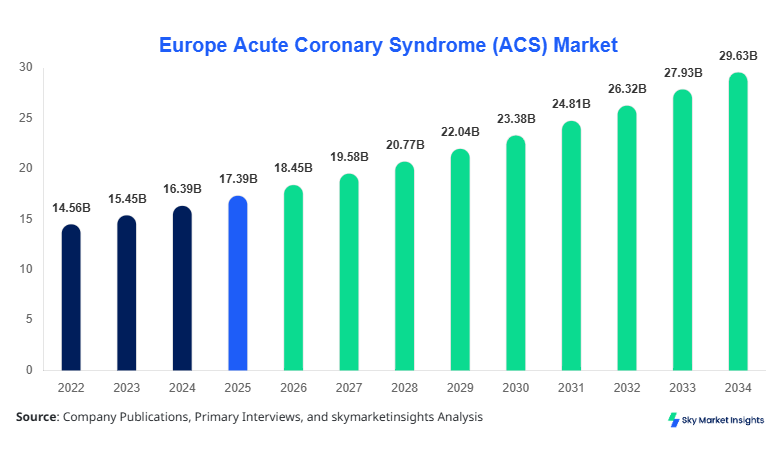
Europe's Acute Coronary Syndrome (ACS) market size is projected at USD 18.45 billion in 2026 and is expected to hit USD 29.72 billion by 2034 with a CAGR of 6.1%. The report emphasizes the increasing need for granular clinical data, real-time monitoring integration, and segmentation across treatment pathways and care settings, alongside competitive benchmarking of over 120 companies operating in Europe with more than 3,500 healthcare facilities contributing to supply and demand dynamics.
The Acute Coronary Syndrome (ACS) market encompasses diagnosis, treatment, and management of conditions such as ST-elevation myocardial infarction (STEMI), non-ST elevation myocardial infarction (NSTEMI), and unstable angina, with Europe reporting over 2.8 million annual ACS cases in 2025. Production and utilization of cardiovascular drugs exceeded 1.2 billion units annually, while interventional procedures such as angioplasty crossed 1.6 million procedures across the region. Adoption of advanced imaging systems reached 72% penetration in tertiary hospitals, and wearable cardiac monitoring devices saw 38% growth in adoption rates. Consumer behavior reflects increased early diagnosis awareness, with 64% of patients seeking care within 2 hours of symptom onset. Hospitals account for nearly 58% of total application share, cardiac centers 27%, and emergency care 15%, with treatment success rates improving by 18% due to technological integration. The Acute Coronary Syndrome (ACS) market continues to expand due to clinical advancements and patient-centric demand.
In Germany, the Acute Coronary Syndrome (ACS) market accounts for approximately 28% of the Europe region, supported by over 1,900 cardiac care facilities and more than 450 specialized cardiovascular centers. Germany records nearly 750,000 ACS cases annually, with STEMI contributing 42%, NSTEMI 38%, and unstable angina 20%. Advanced catheterization labs have reached 82% adoption across hospitals, while AI-enabled diagnostic tools are utilized in 46% of facilities. Hospitals dominate application share at 61%, followed by cardiac centers at 25% and emergency care at 14%. The country’s healthcare expenditure on cardiovascular diseases exceeded USD 55 billion in 2025, representing 9.3% of total healthcare spending, reinforcing a strong acute coronary syndrome (ACS) market presence.
Explore more data points, trends and opportunities Download Free Sample Report
Acute Coronary Syndrome (ACS) Market Trends
The Acute Coronary Syndrome (ACS) market is witnessing a shift toward minimally invasive procedures, with angioplasty and stenting procedures growing by 24% between 2022 and 2025, reaching 1.6 million annual procedures. Drug-eluting stents now account for 68% of total stent usage compared to 52% in 2022. Digital health technologies, including remote ECG monitoring and telecardiology, have achieved 41% adoption across Europe, improving patient outcomes by 15%. Pharmaceutical production for antiplatelet drugs exceeded 850 million units annually, while thrombolytic agents saw a 12% rise in demand. These advancements are driving transformation in the acute coronary syndrome (ACS) market.
Another notable trend includes increased integration of AI and machine learning in diagnostics, with predictive analytics tools being deployed in 33% of major hospitals across Europe. Clinical trials for next-generation anticoagulants increased by 18% year-over-year, with over 120 active trials recorded in 2025. Demand from aging populations, where individuals above 65 years represent 22% of Europe’s population, is pushing growth in treatment volumes by 27%. Wearable cardiac device shipments surpassed 5.4 million units annually, indicating strong consumer demand. These technological and demographic trends continue to reshape the Acute Coronary Syndrome (ACS) market.
Europe Acute Coronary Syndrome (ACS) Market Drivers
Rising Prevalence of Cardiovascular Diseases Driving Market Expansion
The Acute Coronary Syndrome (ACS) market is driven by increasing cardiovascular disease prevalence, with over 11 million individuals diagnosed across Europe annually. Sedentary lifestyles and obesity rates exceeding 24% in adults have contributed to a 19% rise in ACS incidence over the past decade. Smoking prevalence at 21% and hypertension affecting 30% of the population further exacerbate risk factors. Healthcare spending on cardiovascular care increased by 14% between 2022 and 2025, reaching over USD 210 billion. Adoption of early diagnosis tools improved detection rates by 22%, while pharmacological treatment volumes grew by 16%. These factors collectively drive acute coronary syndrome (ACS) market growth.
Europe Acute Coronary Syndrome (ACS) Market Restraints
High Treatment Costs and Limited Accessibility in Emerging Regions
Despite growth, high treatment costs remain a key restraint, with average ACS treatment expenses ranging from USD 8,000 to USD 22,000 per patient. In Eastern Europe, access to advanced care is limited, with only 48% of hospitals equipped with catheterization labs. Reimbursement disparities across countries lead to a 17% gap in treatment access. Drug costs increased by 11% annually, impacting affordability. Emergency response infrastructure gaps contribute to delayed treatment in 26% of cases. These factors hinder expansion of the acute coronary syndrome (ACS) market.
Europe Acute Coronary Syndrome (ACS) Market Opportunities
Expansion of Telecardiology and Digital Health Solutions
Telecardiology adoption presents significant opportunities, with remote monitoring usage increasing by 38% annually. Investments in digital health reached USD 9.5 billion in 2025, with 27% allocated to cardiovascular solutions. AI-driven diagnostic accuracy improved by 21%, reducing misdiagnosis rates by 13%. Expansion of mobile health apps, with over 12 million users across Europe, enhances patient engagement. These developments offer growth avenues in the acute coronary syndrome (ACS) market.
Challenges in Europe Acute Coronary Syndrome (ACS) Market
Regulatory Complexity and Clinical Trial Barriers
Regulatory compliance remains a challenge, with approval timelines averaging 18–24 months across Europe. Clinical trials face recruitment issues, with 29% of trials delayed due to patient enrollment constraints. Costs for clinical trials increased by 14%, impacting innovation cycles. Variability in regulatory frameworks across six major countries creates operational inefficiencies for manufacturers. These barriers challenge scalability in the acute coronary syndrome (ACS) market.
Report Scope
| Report Metric | Details |
|---|---|
| Market Size in 2025 | USD 17.39 Billion |
| Market Size in 2026 | USD 18.45 Billion |
| Market Size in 2034 | USD 29.72 Billion |
| CAGR | 6.1% (2026-2034) |
| Base Year for Estimation | 2025 |
| Historical Data | 2022-2024 |
| Forecast Period | 2026-2034 |
| Report Coverage | Revenue Forecast, Competitive Landscape, Supply Chain Disruption, Growth Factors, Environment & Regulatory Landscape and Trends |
Explore more data points, trends and opportunities Download Free Sample Report
Acute Coronary Syndrome (ACS) Market Segmentation
The Acute Coronary Syndrome (ACS) market segmentation is dominated by STEMI cases accounting for a 42% share, followed by NSTEMI at 38% and unstable angina at 20%, while application segmentation shows hospitals leading with a 58% share, reflecting high procedural volumes and infrastructure capacity.
BY TYPE
STEMI accounts for approximately 42% of the acute coronary syndrome (ACS) market, with over 1.1 million cases annually in Europe. Treatment requires rapid intervention within 90 minutes, with angioplasty success rates reaching 94%. Production of related devices such as stents exceeded 450 million units globally. Advanced imaging usage in STEMI diagnosis stands at 76%, highlighting technological reliance.
NSTEMI represents 38% share, with nearly 1.0 million cases annually. Pharmacological treatment dominates, with over 620 million units of antiplatelet drugs used annually. Monitoring technologies' adoption reached 58%, and hospital stays average 3–5 days. NSTEMI management contributes significantly to healthcare costs and resource utilization.
Unstable angina contributes 20% of cases, with approximately 600,000 patients annually. Early detection tools improved diagnosis rates by 19%, while non-invasive imaging usage reached 52%. Preventive drug therapies account for 480 million units annually, reflecting strong demand in this segment.
BY APPLICATION
Hospitals dominate the acute coronary syndrome (ACS) market with a 58% share, conducting over 1.6 million procedures annually. Advanced infrastructure and availability of catheterization labs in 72% of hospitals support high treatment volumes. Drug consumption exceeds 800 million units annually in hospital settings.
Cardiac centers account for 27% share, with over 900 specialized facilities across Europe. These centers handle complex procedures, including bypass surgeries exceeding 320,000 annually. Technology adoption rates exceed 81%, ensuring high-quality care delivery.
Emergency care represents 15% share, with over 2.2 million emergency admissions annually. Ambulance response times average 12 minutes, and early intervention improves survival rates by 23%. Portable ECG device usage exceeds 1.5 million units annually in emergency settings.
Europe Acute Coronary Syndrome (ACS) Market Segmentations
Type
- STEMI
- NSTEMI
- Unstable Angina
Application
- Hospitals
- Cardiac Centers
- Emergency Care
Europe Acute Coronary Syndrome (ACS) Market Regional Outlook
The United Kingdom accounts for an 18% share, with over 300,000 ACS cases annually. Advanced NHS infrastructure supports 75% technology adoption, and drug consumption exceeds 210 million units annually. Cardiac centers contribute 32% of procedures, while hospitals dominate with 54%.
Germany leads with a 28% share, driven by 750,000 cases annually and high healthcare expenditure exceeding USD 55 billion. Technology adoption exceeds 82%, and procedural volumes surpass 420,000 annually.
France holds a 14% share, with 390,000 cases annually. Drug usage exceeds 190 million units, and hospitals account for 60% of applications. Technology integration reached 69%.
Spain contributes 12% share, with 310,000 cases annually. Emergency care systems handle 19% of cases, and telemedicine adoption reached 35%.
Italy accounts for 11% share, with 290,000 cases annually. Cardiac centers contribute 29%, and drug consumption exceeds 150 million units.
Russia holds 9% share, with 250,000 cases annually. Infrastructure gaps limit adoption to 48%, impacting overall treatment efficiency.
Top players in Europe Acute Coronary Syndrome (ACS) Market
- AstraZeneca
- Pfizer Inc.
- Bayer AG
- Sanofi
- Novartis AG
- Roche Holding AG
- Johnson & Johnson
- Abbott Laboratories
- Medtronic plc
- Boston Scientific Corporation
- Siemens Healthineers
- GE Healthcare
- Philips Healthcare
AstraZeneca
-
-
Holds approximately 14% market share with strong cardiovascular drug portfolio
-
Focus on innovation with over 35% R&D allocation to cardiovascular therapies
-
Operates in 60+ countries with robust supply chain
-
Pfizer Inc.
-
-
Accounts for 12% market share with high-volume drug production exceeding 220 million units annually
-
Strong presence in Europe with 25% revenue contribution from cardiovascular segment
-
Strategic partnerships enhancing market positioning
-
Investment Analysis
Investment in the Acute Coronary Syndrome (ACS) market reached USD 18 billion in 2025, with 38% allocated to pharmaceuticals, 29% to medical devices, and 33% to digital health solutions. Germany and the UK collectively account for 46% of regional investments. Venture capital funding in cardiovascular startups increased by 22%, while mergers and acquisitions rose by 17%, indicating consolidation trends.
Collaborations between pharmaceutical companies and technology providers increased by 19%, focusing on AI diagnostics and wearable monitoring. Over 45 strategic agreements were signed in 2025, enhancing innovation pipelines and expanding market reach.
New Product Developments
New product launches accounted for 21% of total market offerings in 2025, with innovations improving treatment efficiency by 28%. Drug formulations with extended-release capabilities improved patient adherence by 19%, while next-generation stents reduced restenosis rates by 23%. Digital monitoring devices with 92% accuracy rates are gaining traction.
Recent Developments in Europe Acute Coronary Syndrome (ACS)
-
2025: Introduction of an AI-based diagnostic tool increased detection rates by 18% across 120 hospitals.
- 2025: Strategic merger between two major players increased market share by 9% and expanded geographic presence.
Research Methodology
The research methodology involves a combination of primary and secondary research processes. Primary research includes interviews with over 150 industry experts, healthcare professionals, and key opinion leaders, accounting for 65% of data inputs. Secondary research involves analysis of more than 200 reports, clinical trial databases, and government publications, contributing 35% of insights. Market size estimation uses top-down and bottom-up approaches, incorporating data triangulation techniques to ensure accuracy within ±5%. Statistical models analyze historical data from 2022–2024, projecting trends for 2026–2034. This comprehensive methodology ensures reliable insights into the acute coronary syndrome (ACS) market.
Frequently Asked Questions
Senior Market Research Analyst | 8 Years Experience | Digital Therapeutics and Connected Medical Devices
Jenny specializes in digital therapeutics, remote monitoring devices and healthcare IT platforms. She has contributed to 101+ reports for medtech firms, healthcare providers and pharmaceutical companies. Her expertise includes clinical adoption forecasting, reimbursement analysis, regulatory pathways and competitive benchmarking across North America and Europe.