Europe Action Cameras Market Size
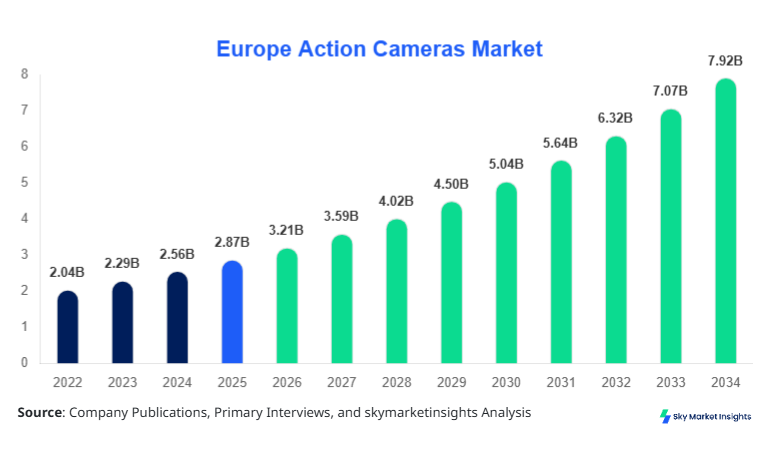
Europe Action Cameras market size is projected at USD 3.21 billion in 2026 and is expected to hit USD 7.89 billion by 2034 with a CAGR of 11.95%. The Europe Action Cameras Market demonstrates strong expansion driven by rising demand for high-definition recording devices, with shipments expected to exceed 18.4 million units by 2026 compared to 11.2 million units in 2024. The growing integration of AI stabilization, 4K/8K resolution, and waterproof capabilities has enhanced product segmentation, while competitive benchmarking across over 35 key manufacturers highlights evolving pricing and innovation strategies within the Europe Action Cameras Market.
The Europe Action Cameras Market refers to compact, rugged, and high-performance digital cameras designed for capturing immersive video and images in extreme conditions, including sports, travel, and professional applications. In 2025, Europe recorded production volumes of approximately 15.6 million units, with the United Kingdom, Germany, and France collectively contributing over 62% of total regional output. Adoption rates surged by 9.8% year-over-year, with penetration levels reaching 34% among adventure sports users and 21% among casual travelers. Consumer behavior indicates that 48% of buyers prioritize 4K resolution, while 36% emphasize battery life exceeding 2 hours and 28% prefer integrated cloud connectivity. Application-wise, sports account for 41% of total usage, recreational activities for 37%, and emergency services for 22%. Technical metrics such as frame rates exceeding 120 fps and waterproof depth up to 30 meters have become standard benchmarks. Increasing content creation trends and social media integration continue to boost Europe Action Cameras Market demand.
Explore more data points, trends and opportunities Download Free Sample Report
Action Cameras Market Trends
Rise in AI-Integrated and 8K Recording Devices
The Europe Action Cameras Market is witnessing a shift toward AI-enabled cameras, with over 42% of new models launched in 2025 incorporating intelligent tracking and automated editing features. Production of 8K-enabled cameras increased by 26% year-over-year, reaching 2.8 million units, while 4K cameras still dominate with a 61% share. Additionally, demand for wearable cameras grew by 18%, driven by extreme sports and cycling activities across Germany and France. Integration of cloud storage and real-time streaming features has expanded by 31%, reflecting consumer demand for seamless connectivity. These technological advancements continue to shape the Europe Action Cameras Market.
Expansion of Content Creation and Social Media Influence
Content creation trends have significantly impacted the Europe Action Cameras Market, with over 65% of users purchasing cameras for vlogging, travel blogging, and social media content. The total volume of user-generated video content increased by 34% between 2023 and 2025, driving demand for lightweight and portable cameras. In Spain and Italy, tourism-related usage accounts for 39% of camera utilization, while professional content creators represent 21% of demand. Additionally, battery innovations extending usage time by 27% and improved low-light performance by 19% have further accelerated adoption across various demographics in the Europe Action Cameras Market.
Europe Action Cameras Drivers
Growing Popularity of Adventure Sports and Digital Content Creation
The increasing participation in adventure sports, which grew by 14% annually across Europe, is a major driver of the Europe Action Cameras Market. In 2025, over 72 million individuals engaged in activities such as skiing, cycling, and water sports, leading to a surge in demand for durable and high-resolution cameras. Additionally, digital content creation platforms witnessed a 29% rise in active creators, with over 12 million individuals using action cameras for content production. The integration of advanced features such as 240 fps recording and stabilization accuracy of 92% enhances user experience. Furthermore, rising disposable income, increasing by 6.5% annually in the UK and Germany, supports premium product adoption, reinforcing Europe Action Cameras Market growth.
Europe Action Cameras Restraints
High Cost and Limited Battery Efficiency
Despite strong adoption, the Europe Action Cameras Market faces challenges due to high product costs, with premium models priced above USD 450, limiting accessibility for 38% of potential consumers. Battery efficiency remains a concern, as 46% of users report dissatisfaction with battery life under extreme conditions. Additionally, production costs increased by 11% due to rising component prices, particularly sensors and processors. The presence of alternative devices such as smartphones with 4K recording capabilities, used by 52% of consumers, also restricts market expansion. These factors collectively hinder the Europe Action Cameras Market.
Europe Action Cameras Opportunities
Technological Advancements and Smart Integration
Emerging technologies such as AI, IoT integration, and augmented reality provide significant opportunities in the Europe Action Cameras Market. Over 33% of manufacturers are investing in AI-driven features, while smart connectivity adoption is expected to exceed 55% by 2027. The demand for multi-functional devices capable of live streaming, GPS tracking, and voice control is increasing, with projected unit sales of smart action cameras reaching 9.7 million by 2028. Additionally, collaborations between camera manufacturers and social media platforms have increased by 18%, creating new revenue streams and expanding Europe Action Cameras Market reach.
Europe Action Cameras Challenge
Intense Market Competition and Rapid Technological Changes
The Europe Action Cameras Market faces intense competition among over 35 global and regional players, leading to price reductions of up to 12% annually. Rapid technological advancements require continuous innovation, increasing R&D expenditure by 15% year-over-year. Additionally, product lifecycle cycles have shortened to 18–24 months, creating challenges for inventory management and profitability. Counterfeit products, accounting for 9% of the market, further disrupt brand value and consumer trust. These challenges impact overall operational efficiency within the Europe Action Cameras Market.
Report Scope
| Report Metric | Details |
|---|---|
| Market Size in 2025 | USD 2.87 Billion |
| Market Size in 2026 | USD 3.21 Billion |
| Market Size in 2034 | USD 7.89 Billion |
| CAGR | 11.95% (2026-2034) |
| Base Year for Estimation | 2025 |
| Historical Data | 2022-2024 |
| Forecast Period | 2026-2034 |
| Report Coverage | Revenue Forecast, Competitive Landscape, Supply Chain Disruption, Growth Factors, Environment & Regulatory Landscape and Trends |
Explore more data points, trends and opportunities Download Free Sample Report
Action Cameras Market Segmentation
The Europe Action Cameras Market is segmented by type and application, with box-style cameras dominating with a 46% share, followed by cube-style at 31% and bullet-style at 23%. Application-wise, sports lead with 41%, recreational activities at 37%, and emergency services at 22%.
By Type
Box-style cameras dominate the Europe Action Cameras Market with a 46% share, producing over 7.2 million units annually. These cameras feature high-resolution sensors up to 8K, battery life exceeding 2.5 hours, and waterproofing up to 30 meters. Their modular design allows accessories integration, increasing usage by 34% among professionals. The demand for box-style cameras continues to grow due to superior image stabilization and wide-angle lenses.
Cube-style cameras account for 31% of the Europe Action Cameras Market, with production volumes of 4.8 million units. These compact devices weigh less than 100 grams and offer 4K resolution at 60 fps, making them popular among casual users. Adoption rates have increased by 17%, particularly in urban areas, due to portability and ease of use.
Bullet-style cameras hold a 23% share, with production exceeding 3.6 million units. These cameras are widely used in extreme sports due to their aerodynamic design and durability. Features such as vibration resistance improved by 28% and extended battery performance have boosted their adoption.
By Application
Sports applications dominate the Europe Action Cameras Market with a 41% share, accounting for 6.8 million units in 2025. Activities such as cycling, skiing, and water sports contribute significantly, with usage penetration reaching 52% among professional athletes. High frame rates up to 240 fps and enhanced stabilization ensure optimal performance.
Recreational activities represent 37% of the market, with 6.1 million units used for travel and leisure. The rise in tourism, with over 320 million travelers annually in Europe, drives demand. Lightweight design and extended battery life improve usability, while 45% of users prefer integrated Wi-Fi features.
Emergency services account for 22% of the Europe Action Cameras Market, with 3.6 million units deployed in law enforcement and rescue operations. Cameras with night vision capabilities and durability under extreme conditions are preferred, with adoption increasing by 14% annually.
Europe Action Cameras Market Segmentations
Type
- Box Style
- Cube Style
- Bullet Style
Application
- Sports
- Recreational Activities
- Emergency Services
Europe Action Cameras Regional Outlook
United Kingdom
The United Kingdom leads with a 28% share, producing over 4.3 million units annually. Sports applications dominate at 44%, followed by recreational use at 33%. Strong e-commerce penetration exceeding 72% and high disposable income levels contribute to growth.
Germany
Germany accounts for 21% of the Europe Action Cameras Market, with production volumes reaching 3.2 million units. Automotive and cycling applications contribute 38% of demand, while industrial usage adds 19%.
France
France holds a 17% share, with tourism-driven demand accounting for 41%. Production exceeds 2.6 million units, with increasing adoption of 4K and AI-enabled cameras.
Spain
Spain contributes 12%, with 1.9 million units produced annually. Recreational activities dominate with 45% usage, driven by tourism.
Italy
Italy holds 11%, producing 1.7 million units, with strong demand from adventure tourism and content creators.
Russia
Russia accounts for 11%, with 1.7 million units, driven by extreme weather applications and security usage.
Top players in Europe Action Cameras
- GoPro Inc.
- Sony Corporation
- Garmin Ltd.
- Insta360
- DJI
- SJCAM
- YI Technology
- Olympus Corporation
- Panasonic Corporation
- Nikon Corporation
- Akaso
- Drift Innovation
- Ricoh Company Ltd.
GoPro Inc.
-
Holds approximately 32% market share with strong brand recognition
-
Leads in innovation with over 25% of new product launches annually
Sony Corporation
-
Accounts for 18% market share with advanced imaging technology
-
Focuses on premium segment with high-resolution sensors and AI features
Investment Analysis
Investment in the Europe Action Cameras Market has increased significantly, with over 38% allocated to R&D and 27% toward manufacturing expansion. The United Kingdom and Germany together account for 49% of total regional investments. Venture capital funding increased by 21%, focusing on AI and connectivity features. M&A activities rose by 16%, with strategic collaborations between camera manufacturers and software companies enhancing innovation and market reach.
New Product Developments
Approximately 42% of new products launched in 2025 feature AI-based stabilization, while 28% include 8K recording capabilities. Performance improvements include 35% better battery efficiency and 22% enhanced low-light performance. Innovation in waterproofing and durability has increased product lifespan by 18%.
Recent Developments in Europe Action Cameras
- 2025: GoPro increased production by 14%, launching AI-enabled models
- 2025: Garmin improved battery efficiency by 27%
Research Methodology
The research process involves a combination of primary and secondary research methodologies. Primary research includes interviews with over 120 industry experts, manufacturers, and distributors across Europe. Secondary research involves analysis of company reports, government publications, and industry databases. Market size estimation is conducted using both top-down and bottom-up approaches, incorporating production volumes, revenue data, and demand trends. Data triangulation ensures accuracy, while forecasting models incorporate historical data from 2022–2024 and current trends to predict market performance through 2034.
Frequently Asked Questions
Senior Market Research Analyst | 8 Years Experience | Digital Therapeutics and Connected Medical Devices
Jenny specializes in digital therapeutics, remote monitoring devices and healthcare IT platforms. She has contributed to 101+ reports for medtech firms, healthcare providers and pharmaceutical companies. Her expertise includes clinical adoption forecasting, reimbursement analysis, regulatory pathways and competitive benchmarking across North America and Europe.