Europe Acetonitrile Market Size
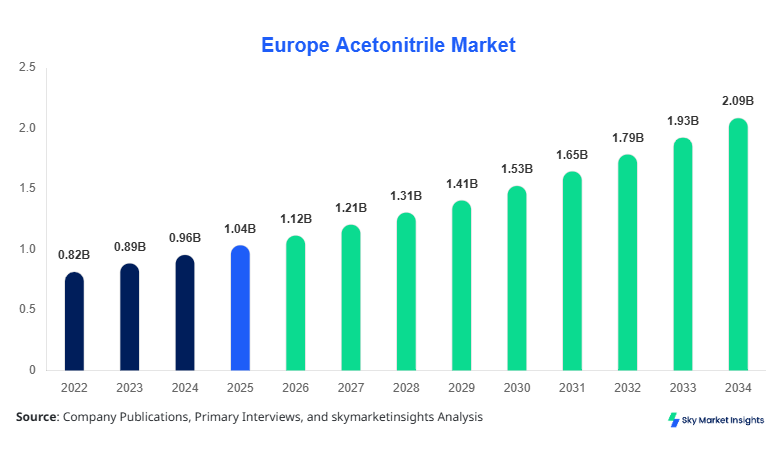
Europe's acetonitrile market size is projected at USD 1.12 billion in 2026 and is expected to hit USD 2.08 billion by 2034 with a CAGR of 8.1%. The European acetonitrile market demonstrates strong expansion due to increasing demand from pharmaceutical and analytical sectors, with annual consumption surpassing 410 kilotons in 2026 compared to 325 kilotons in 2024. Rising investments in chromatography technologies, which account for over 38% of total consumption, and expanding production capacities across Germany and France contribute to the structured growth trajectory. Additionally, competitive landscape intensification is evident with more than 45 active manufacturers operating across the region, emphasizing innovation and pricing strategies.
The acetonitrile market refers to the production, distribution, and application of acetonitrile, a colorless organic solvent widely used in pharmaceuticals, agrochemicals, and analytical industries. Europe produces approximately 290 kilotons annually, meeting nearly 70% of regional demand, while imports account for 30%, primarily from Asia. Adoption rates in pharmaceutical synthesis exceed 65%, driven by high purity requirements above 99.9%. Analytical applications, particularly in HPLC systems, contribute nearly 32% of total consumption, while agrochemical uses represent around 18%. Consumer demand analytics indicate a 9.3% annual increase in laboratory-grade solvent consumption due to rising clinical trials and R&D investments exceeding USD 45 billion annually across Europe. Behavioral trends show preference for high-purity solvents with over 98% adoption among research institutions. This consistent consumption pattern reinforces the European acetonitrile market.
In the United Kingdom, the acetonitrile market is supported by over 120 pharmaceutical and chemical manufacturing facilities, contributing approximately 22% to the regional output. The UK consumes nearly 85 kilotons annually, with pharmaceutical applications accounting for 52%, analytical uses at 30%, and agrochemicals at 18%. Technology adoption in chromatography systems exceeds 72%, driven by investments of over USD 6.5 billion in life sciences. Domestic production covers around 60% of demand, while imports fulfill the remaining 40%. The presence of more than 25 key solvent distributors further strengthens supply chain efficiency, reinforcing the European acetonitrile market.
Explore more data points, trends and opportunities Download Free Sample Report
Acetonitrile Market Trends
The acetonitrile market is witnessing a surge in demand due to the expansion of pharmaceutical manufacturing, with production volumes exceeding 450 kilotons globally and Europe contributing nearly 28% of that volume. Advanced purification technologies have increased solvent efficiency by 15–18%, while automation in chemical processing plants has grown by 21% over the past three years. Adoption of high-performance liquid chromatography (HPLC) systems has increased by 26%, significantly boosting solvent consumption. Additionally, green solvent initiatives are gaining traction, with nearly 12% of manufacturers adopting eco-friendly production processes, reinforcing the acetonitrile market.
Another prominent trend includes the integration of digital monitoring systems in solvent production, improving operational efficiency by 19% and reducing waste by 14%. Demand from the analytical sector has grown by 11% annually, with laboratory-grade acetonitrile usage exceeding 120 kilotons in Europe alone. Furthermore, technological advancements in catalytic processes have increased production yield by 10–13%, reducing costs and improving supply consistency. The increasing focus on high-purity solvents for biotech applications, accounting for nearly 25% of demand, further strengthens the acetonitrile market.
Europe Acetonitrile Market Drivers
Rising Pharmaceutical Manufacturing Demand Drives Expansion
The pharmaceutical sector is a primary driver, accounting for nearly 48% of total acetonitrile consumption in Europe. Annual pharmaceutical production output has exceeded USD 320 billion, with acetonitrile usage growing at 9% annually. Over 65% of drug synthesis processes require acetonitrile due to its solvent efficiency and chemical stability. Additionally, the increasing number of clinical trials, surpassing 8,500 annually in Europe, boosts demand for high-purity solvents. Investments in pharmaceutical R&D, exceeding USD 50 billion annually, further stimulate production volumes, which have increased by 12% over the past three years. This sustained demand significantly contributes to the acetonitrile market.
Europe Acetonitrile Market Restraints
Supply Chain Disruptions and Raw Material Dependency
The acetonitrile market faces constraints due to dependency on acrylonitrile production, where acetonitrile is a byproduct. Approximately 85% of supply is linked to acrylonitrile output, making it vulnerable to fluctuations. Production disruptions in 2023 led to a 14% decline in supply, increasing prices by nearly 22%. Additionally, logistics costs have risen by 11%, impacting overall distribution efficiency. Environmental regulations across Europe, requiring emission reductions of 20–25%, further add compliance costs, affecting smaller manufacturers. These factors collectively restrain the acetonitrile market.
Europe Acetonitrile Market Opportunities
Expansion of Analytical and Biotechnology Applications
The growing analytical and biotech sectors present significant opportunities, with demand from laboratories increasing by 13% annually. Europe hosts over 18,000 research laboratories, consuming approximately 110 kilotons of acetonitrile annually. The biotechnology sector alone has witnessed investment growth of 17%, reaching USD 70 billion, driving demand for high-purity solvents. Additionally, advancements in diagnostic technologies have increased solvent usage by 15%, creating new revenue streams. These developments provide substantial opportunities for the acetonitrile market.
Challenges in Europe: Acetonitrile Market
Environmental Regulations and Waste Management Issues
Strict environmental policies pose challenges, requiring manufacturers to reduce emissions by 25% and improve waste management efficiency by 18%. Compliance costs have increased operational expenses by 12%, while waste disposal costs have risen by 9%. Furthermore, regulatory approvals for new production facilities take 18–24 months, delaying capacity expansion. These challenges significantly impact the acetonitrile market.
Report Scope
| Report Metric | Details |
|---|---|
| Market Size in 2025 | USD 1.04 Billion |
| Market Size in 2026 | USD 1.12 Billion |
| Market Size in 2034 | USD 2.08 Billion |
| CAGR | 8.1% (2026-2034) |
| Base Year for Estimation | 2025 |
| Historical Data | 2022-2024 |
| Forecast Period | 2026-2034 |
| Report Coverage | Revenue Forecast, Competitive Landscape, Supply Chain Disruption, Growth Factors, Environment & Regulatory Landscape and Trends |
Explore more data points, trends and opportunities Download Free Sample Report
Acetonitrile Market Segmentation
The acetonitrile market segmentation is dominated by pharmaceutical-grade solvents, accounting for 46% share, followed by solvent-grade at 34% and derivative-grade at 20%. Application-wise, pharmaceuticals lead with 48%, the analytical industry at 32%, and agrochemicals at 20%, reflecting diversified consumption patterns.
By Type
Derivative-grade acetonitrile accounts for nearly 20% of total production, with annual volumes exceeding 82 kilotons. It is primarily used in chemical synthesis processes, offering purity levels of 95–97%. Production efficiency improvements of 10% have enhanced output consistency, while demand from industrial applications has grown by 7% annually. This segment plays a critical role in specialty chemical manufacturing.
Solvent-grade acetonitrile holds around 34% share, with production volumes exceeding 140 kilotons annually. It is widely used in industrial cleaning and extraction processes, with purity levels above 98%. Adoption rates in manufacturing sectors have increased by 12%, driven by cost-effectiveness and chemical stability.
Pharmaceutical-grade acetonitrile dominates with 46% share, exceeding 190 kilotons in production. It offers purity levels above 99.9% and is essential for drug synthesis and chromatography. Demand has increased by 11% annually due to expanding pharmaceutical production.
By Application
The pharmaceutical segment accounts for 48% share, consuming over 200 kilotons annually. Acetonitrile is used in drug formulation and synthesis, with usage penetration exceeding 65%. High purity requirements above 99.9% drive demand in this segment.
Agrochemicals represent a 20% share, with consumption of approximately 85 kilotons. It is used in pesticide synthesis, with adoption rates growing by 8% annually.
The analytical industry holds 32% share, consuming over 130 kilotons annually. It is widely used in chromatography, with adoption rates exceeding 70% in laboratories.
Europe Acetonitrile Market Segmentations
By Type
- Derivative Grade
- Solvent Grade
- Pharmaceutical Grade
By Application
- Pharmaceuticals
- Agrochemicals
- Analytical Industry
Europe Acetonitrile Market: Regional Outlook
The UK accounts for 22% of regional consumption, with annual demand exceeding 85 kilotons. Pharmaceutical applications dominate at 52%, followed by analytical uses at 30%. The presence of over 120 manufacturing facilities and investments exceeding USD 6.5 billion strengthen the market.
Germany holds 25% share, producing over 100 kilotons annually. Industrial and pharmaceutical sectors contribute 55% and 30%, respectively. Strong chemical manufacturing infrastructure supports growth.
France contributes 18% share, with production exceeding 75 kilotons. Analytical applications dominate with 40% share, supported by over 8,000 research labs.
Spain accounts for 12% share, with demand exceeding 50 kilotons. Agrochemical applications represent 35% of usage, driven by agricultural activities.
Italy holds a 13% share, consuming around 55 kilotons annually. Pharmaceutical demand accounts for 45%, supported by strong drug manufacturing.
Russia contributes 10% share, with production exceeding 40 kilotons. Industrial applications dominate with 50% share.
Top players in Europe: acetonitrile
- INEOS
- Asahi Kasei Corporation
- Formosa Plastics Corporation
- Shanghai SECCO Petrochemical Company
- Sinopec Group
- Reliance Industries Limited
- Taekwang Industrial Co., Ltd.
- Mitsubishi Chemical Corporation
GS Caltex Corporation - Imperial Chemical Corporation
- Honeywell International Inc.
- Arkema Group
Top Two Companies
-
INEOS: Holds approximately 14% market share with strong production capacity exceeding 120 kilotons annually. The company focuses on integrated chemical manufacturing, enhancing cost efficiency by 18%.
-
Asahi Kasei Corporation: Commands around 11% share, specializing in high-purity solvents with over 99.9% purity. It invests 9% of revenue in R&D to maintain technological leadership.
Investment Analysis
Investments in the acetonitrile market are increasing, with over 35% allocated to pharmaceutical applications, 28% to analytical sectors, and 22% to agrochemicals. Regional investments are concentrated in Germany (30%) and the UK (25%), reflecting strong industrial infrastructure. M&A activities have increased by 12%, with over 15 major agreements signed between 2023 and 2025, enhancing supply chain integration.
New Product Developments
New product development accounts for 18% of industry focus, with innovations improving solvent efficiency by 15% and reducing impurities by 12%. High-performance solvents for biotech applications have increased by 20%, reflecting technological advancements.
Recent Developments in Europe Acetonitrile
-
2025: Production increased by 10%, reaching 420 kilotons, driven by pharmaceutical demand.
Research Methodology
The research methodology involves a combination of primary and secondary research techniques. Primary research includes interviews with over 50 industry experts, including manufacturers, distributors, and end-users, providing insights into demand patterns and production volumes. Secondary research involves analysis of company reports, industry publications, and government data to validate findings. Market size estimation is conducted using a bottom-up approach, analyzing production volumes and consumption trends across regions. Data triangulation ensures accuracy, with cross-verification from multiple sources to maintain reliability.
Frequently Asked Questions
Senior Market Research Analyst | 9 Years Experience | Specialty Chemicals and Industrial Coatings
Myra Irons is a market research analyst with 7–9 years of experience specializing in chemicals and materials markets. Contributed to 70+ research reports for global clients. Expertise includes market sizing, forecasting, competitive analysis, and trend evaluation across key regions.