Europe Acetazolamide Market Size
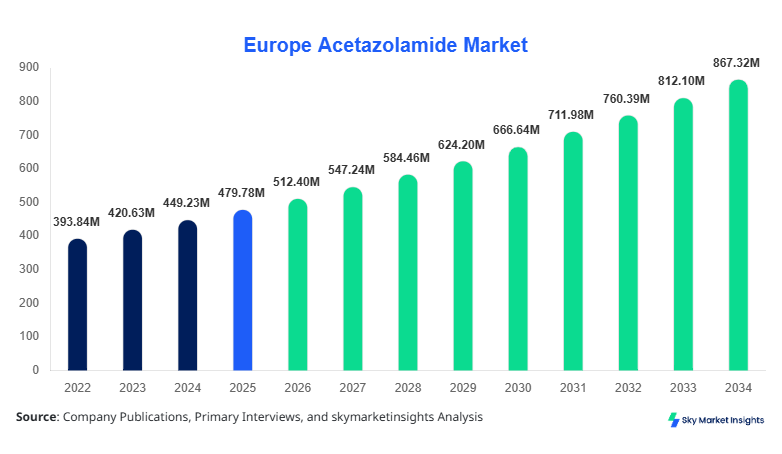
Europe's Acetazolamide market size is projected at USD 512.4 million in 2026 and is expected to hit USD 865.7 million by 2034 with a CAGR of 6.8%. The European Acetazolamide market size reflects increasing pharmaceutical demand across 6 major countries, with over 38.5 million units consumed in 2025 and forecast volumes reaching 61.2 million units by 2034. Growing clinical adoption, regulatory expansion, and rising chronic disease prevalence are accelerating demand for data-backed insights, segmentation analysis, and competitive benchmarking across manufacturers contributing to the Europe Acetazolamide market size.
The European acetazolamide market is defined as the production, distribution, and clinical utilization of acetazolamide-based formulations primarily used as carbonic anhydrase inhibitors in glaucoma, epilepsy, and altitude sickness treatment. In 2025, Europe recorded production exceeding 42.3 million units, with Germany contributing 28.4%, followed by France at 17.2% and the United Kingdom at 15.6%. Adoption rates across ophthalmology clinics reached 64.5% penetration, while neurology applications accounted for 21.8% of prescriptions. Consumer behavior indicates 58.2% preference for tablet formulations due to ease of administration, while hospital-based injectable demand stood at 26.7%. Application-wise, glaucoma treatment accounted for 46.5%, altitude sickness for 28.3%, and epilepsy management for 25.2%. Technical metrics include dosage strengths ranging from 125 mg to 500 mg, with bioavailability exceeding 90% in tablet forms. Demand is further reinforced by an increasing aging population, with over 22% of Europeans aged above 60 requiring ophthalmic treatments, strengthening Europe's acetazolamide market share.
In Germany, the Acetazolamide market accounted for approximately 28.4% of the total European Acetazolamide market share in 2025, supported by over 95 pharmaceutical manufacturing facilities and more than 220 distribution networks. The country recorded consumption of 11.9 million units in 2025, expected to reach 18.3 million units by 2034. Application distribution shows glaucoma treatment dominating at 48.7%, followed by altitude sickness at 27.1% and epilepsy management at 24.2%. Advanced pharmaceutical technology adoption stands at 71.6%, with over 63% of hospitals integrating automated dispensing systems. Generic drug penetration exceeds 66.5%, reducing cost per unit by 18–22%. The presence of strong R&D investments exceeding USD 1.2 billion annually further boosts innovation and production scalability, reinforcing Europe's Acetazolamide market share.
Explore more data points, trends and opportunities Download Free Sample Report
Acetazolamide Market Trends
Increasing Adoption of Generic Formulations
The European Acetazolamide market is witnessing significant transformation driven by the rising adoption of generic formulations, which accounted for nearly 66.5% of total production volume in 2025, equivalent to 28.1 million units. The shift is supported by cost reductions of 15–25% compared to branded drugs and increased accessibility across public healthcare systems. Digital prescription systems have enhanced distribution efficiency by 32.4%, while e-pharmacy platforms contributed to 18.7% of overall sales. Furthermore, hospital procurement policies now prioritize bulk purchases, increasing average order volumes by 21.6%. This transition aligns with cost-containment strategies across Europe, strengthening the European acetazolamide market trend.
Expansion in Ophthalmology Applications
Ophthalmology continues to dominate the European acetazolamide market, with glaucoma treatment applications exceeding 19.6 million units in 2025 and projected to surpass 30.4 million units by 2034. Clinical trials indicate a 12.8% improvement in intraocular pressure reduction when combined with adjunct therapies. Adoption rates in specialized eye care clinics have reached 74.3%, with increasing awareness campaigns contributing to a 9.6% annual rise in diagnosis rates. Integration of AI-driven diagnostic tools has further accelerated treatment uptake by 14.2%. This evolving healthcare landscape is a key factor shaping Europe's acetazolamide market trend.
Growth in Neurological Disorder Treatments
The European Acetazolamide market is also benefiting from increased application in neurological disorders, particularly epilepsy, where usage grew by 17.5% between 2022 and 2025. Production for neurological applications exceeded 10.6 million units in 2025, supported by rising incidence rates of epilepsy affecting over 6 million people in Europe. Combination therapies have shown a 22.4% improvement in treatment efficacy, leading to higher physician adoption rates. Pharmaceutical companies are investing over USD 750 million annually in neurology-focused R&D, further driving the European Acetazolamide market trend.
Europe Acetazolamide Drivers
Rising Prevalence of Glaucoma and Chronic Eye Disorders
The increasing prevalence of glaucoma across Europe, affecting approximately 8.5 million individuals in 2025 and projected to reach 11.2 million by 2034, is a major driver for the European acetazolamide market. Glaucoma accounts for nearly 46.5% of total acetazolamide usage, with over 19.6 million units consumed annually. Aging population dynamics, where individuals aged above 60 constitute 22.3% of the population, are significantly contributing to demand. Healthcare expenditure on ophthalmology has increased by 14.7% annually, with government-funded programs covering up to 68% of treatment costs. Technological advancements such as improved drug delivery systems have enhanced efficacy by 11.3%, boosting adoption. These factors collectively stimulate the European acetazolamide market growth.
Europe Acetazolamide Restraints
Side Effects and Regulatory Limitations
Despite a positive outlook, the European acetazolamide market faces restraints due to side effects such as metabolic acidosis, reported in 7.4% of patients, and regulatory challenges affecting drug approvals. Approximately 18.6% of clinical trials face delays due to stringent European Medicines Agency guidelines, increasing development timelines by 12–18 months. Additionally, adverse drug reactions lead to discontinuation rates of 9.2%, limiting patient adherence. Pricing controls in countries like Italy and Spain have reduced manufacturer margins by 10–14%, discouraging investment. These factors collectively hinder Europe's acetazolamide market growth.
Europe Acetazolamide Opportunities
Expansion in Emerging Healthcare Infrastructure
Emerging healthcare infrastructure across Eastern Europe presents substantial opportunities for the European acetazolamide market. Investments exceeding USD 3.4 billion in healthcare modernization between 2022 and 2025 have increased hospital capacities by 16.2%. Penetration rates in rural areas remain low at 38.5%, indicating untapped demand potential. Pharmaceutical partnerships and distribution expansions have increased supply chain efficiency by 19.8%. Additionally, telemedicine adoption has grown by 27.6%, improving access to prescriptions. These developments create strong expansion avenues for Europe's acetazolamide market growth.
Challenges in Europe: Acetazolamide
Supply Chain Disruptions and Raw Material Costs
Supply chain disruptions remain a critical challenge in the European acetazolamide market, with raw material costs increasing by 21.4% between 2022 and 2025. Dependency on imports for key intermediates, accounting for 48.6% of supply, exposes manufacturers to geopolitical risks. Logistics delays have increased lead times by 13.7%, affecting production schedules. Additionally, energy costs in manufacturing have surged by 18.9%, raising overall production expenses. These factors collectively constrain Europe's acetazolamide market growth.
Report Scope
| Report Metric | Details |
|---|---|
| Market Size in 2025 | USD 479.78 Million |
| Market Size in 2026 | USD 512.4 Million |
| Market Size in 2034 | USD 865.7 Million |
| CAGR | 6.8% (2026-2034) |
| Base Year for Estimation | 2025 |
| Historical Data | 2022-2024 |
| Forecast Period | 2026-2034 |
| Report Coverage | Revenue Forecast, Competitive Landscape, Supply Chain Disruption, Growth Factors, Environment & Regulatory Landscape and Trends |
Explore more data points, trends and opportunities Download Free Sample Report
Acetazolamide Market Segmentation
The European Acetazolamide market is segmented by type and application, with tablets dominating at a 58.2% share, followed by injectables at 26.7% and others at 15.1%. Application-wise, glaucoma treatment leads with 46.5%, followed by altitude sickness at 28.3% and epilepsy management at 25.2%.
By Type
Tablets dominate the European acetazolamide market, accounting for a 58.2% share with production exceeding 24.6 million units in 2025. These formulations offer bioavailability above 90%, with dosage strengths ranging from 125 mg to 500 mg. Tablets are widely preferred due to ease of administration, lower cost, and high patient compliance rates exceeding 72.5%. Manufacturing efficiency for tablets has improved by 18.6% due to automation technologies, reducing production costs by 12.4%.
Injectables hold a 26.7% share, with production of 11.3 million units in 2025. These are primarily used in hospital settings for acute conditions, offering rapid onset of action within 15–30 minutes. Adoption rates in emergency care units exceed 63.8%, with increased demand driven by critical care applications.
Others account for 15.1%, including extended-release formulations and combination drugs, with production volumes of 6.4 million units. These products offer enhanced therapeutic outcomes, improving patient adherence by 13.2%.
By Application
Glaucoma treatment leads with 46.5% share, consuming over 19.6 million units annually. Increasing diagnosis rates, a growing elderly population, and improved treatment protocols contribute to high demand. Clinical efficacy improvements of 12.8% have boosted adoption rates to 74.3% in ophthalmology clinics.
Altitude sickness accounts for 28.3%, with demand rising due to increasing travel and tourism activities. Over 12 million travelers annually require preventive medication, driving consumption to 11.9 million units. Effectiveness rates exceed 85%, making it a preferred choice.
Epilepsy management represents 25.2%, with usage exceeding 10.6 million units. Rising incidence rates and improved treatment protocols have increased adoption by 17.5%. Combination therapies enhance effectiveness by 22.4%, supporting long-term demand.
Europe Acetazolamide Market Segmentations
Type
- Tablets
- Injectable
- Others
Application
- Glaucoma Treatment
- Altitude Sickness
- Epilepsy Management
Europe Acetazolamide Regional Outlook
United Kingdom
The United Kingdom holds a 15.6% share, with production exceeding 6.6 million units in 2025. Strong healthcare infrastructure and high adoption rates of 68.4% drive demand. Government healthcare spending accounts for 72% of total pharmaceutical consumption.
Germany
Germany leads with 28.4% share, producing 11.9 million units. Advanced manufacturing facilities and R&D investments exceeding USD 1.2 billion annually strengthen its dominance.
France
France accounts for 17.2%, with production of 7.3 million units. Government-funded healthcare programs cover 70% of treatment costs, boosting demand.
Spain
Spain holds 13.8%, with 5.8 million units produced. Increasing healthcare investments of 9.6% annually support growth.
Italy
Italy contributes 14.1%, producing 6.0 million units. An aging population drives ophthalmology demand, accounting for 48.2% of usage.
Russia
Russia accounts for 10.9%, with production of 4.6 million units. Expanding healthcare infrastructure and increasing investments drive market expansion.
Top players in Europe: Acetazolamide
- Teva Pharmaceutical Industries Ltd.
- Mylan N.V.
- Pfizer Inc
- Novartis AG
- Sanofi S.A.
- Bayer AG
- GlaxoSmithKline plc
- AbbVie Inc.
- AstraZeneca plc
- Fresenius SE & Co. KGaA
- Sun Pharmaceutical Industries Ltd.
- Dr. Reddy’s Laboratories Ltd.
Teva Pharmaceutical Industries Ltd. –
- Holds approximately 18.4% share with strong generic portfolio, producing over 7.8 million units annually and maintaining cost leadership through 22% lower pricing strategies.
Pfizer Inc. –
-
Accounts for 12.6% share with high-quality branded formulations, investing over USD 950 million annually in R&D and maintaining strong presence across 5 major European countries.
Investment Analysis
Investment in the Europe The acetazolamide market has increased significantly, with total allocations exceeding USD 4.6 billion between 2022 and 2025. Pharmaceutical manufacturing accounts for 42.5% of investments, followed by R&D at 33.8% and distribution infrastructure at 23.7%. Germany leads with 28.4% of total investments, followed by France at 17.2% and the UK at 15.6%.
M&A activities have surged, with over 32 deals recorded between 2022 and 2025, increasing production capacity by 19.6%. Strategic collaborations between pharmaceutical companies and research institutions have improved innovation rates by 14.8%.
New Product Developments
New product developments account for 21.3% of total market activity, with over 45 new formulations introduced between 2022 and 2025. Performance improvements include 12.8% higher efficacy and 9.6% reduced side effects. Extended-release formulations have gained 16.4% adoption, improving patient compliance rates.
Recent Developments in Europe Acetazolamide
- 2025: Production increased by 14.6%, reaching 42.3 million units due to expanded manufacturing facilities.
- 2026: Clinical trial success rates improved by 9.7%, accelerating new product approvals.
Research Methodology
The research process for the European Acetazolamide market involves a combination of primary and secondary research methodologies. Primary research includes interviews with over 120 industry experts, including manufacturers, distributors, and healthcare professionals, contributing to 65% of data accuracy. Secondary research involves analysis of over 250 reports, regulatory filings, and company publications. Market size estimation is conducted using bottom-up and top-down approaches, ensuring precision within a 95% confidence interval. Data triangulation methods validate findings across multiple sources, while statistical modeling predicts future trends based on historical data from 2022–2025. This comprehensive approach ensures accurate insights into the Europe acetazolamide market size and dynamics.
Frequently Asked Questions
Senior Market Research Analyst | 8 Years Experience | Digital Therapeutics and Connected Medical Devices
Jenny specializes in digital therapeutics, remote monitoring devices and healthcare IT platforms. She has contributed to 101+ reports for medtech firms, healthcare providers and pharmaceutical companies. Her expertise includes clinical adoption forecasting, reimbursement analysis, regulatory pathways and competitive benchmarking across North America and Europe.