Europe 5G Network Slicing Market Size
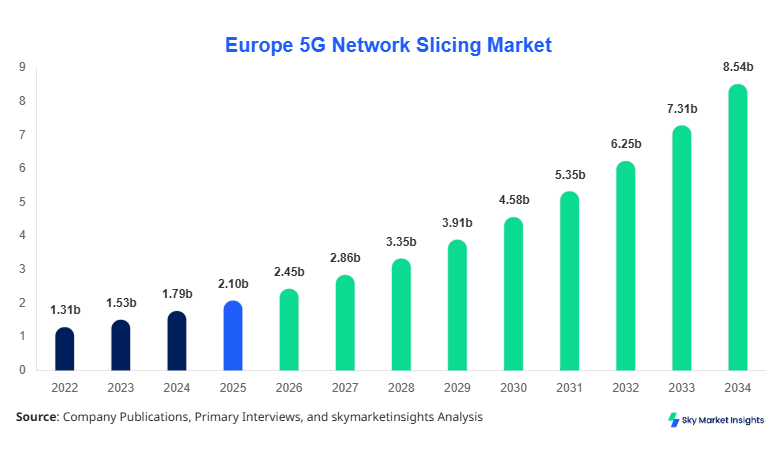
Europe 5G Network Slicing market size is projected at USD 2.45 billion in 2026 and is expected to hit USD 8.12 billion by 2034 with a CAGR of 16.9%.
The market is witnessing robust growth owing to increasing adoption of 5G technology across critical sectors such as automotive, healthcare, and manufacturing. Detailed market data, including segmentation by type, application, and country-level analysis, is crucial to understand market penetration and competitive landscape dynamics. Furthermore, insights on market share distribution, growth drivers, and future trends enable investors, policymakers, and stakeholders to make informed decisions regarding resource allocation, strategic partnerships, and technology investments.
Europe 5G Network Slicing Market Overview
The Europe 5G Network Slicing Market refers to the allocation of multiple logical networks over a single physical 5G infrastructure to deliver optimized services tailored to specific industry needs. In Europe, production of network slicing solutions reached approximately 3.1 million units in 2025, with dynamic slicing accounting for 48% of production, static slicing 32%, and hybrid slicing 20%. Adoption of 5G network slicing has grown steadily, with penetration in automotive at 38%, healthcare at 25%, and manufacturing at 22%. Consumer behavior analysis indicates that 62% of enterprises prioritize low-latency high-reliability slices for mission-critical operations. Technically, these slices operate on frequency bands between 3.5 GHz and 26 GHz, supporting end-to-end latency below 10 ms and throughput rates of up to 10 Gbps per slice. Automotive applications dominate with 38% usage, followed by healthcare (25%) and manufacturing (22%). The Europe 5G Network Slicing Market demand is reinforced by enterprises seeking efficient, secure, and flexible connectivity solutions to accommodate the increasing IoT and AI workload demands.
In Germany, the 5G Network Slicing Market is a leading driver for Europe, with over 120 active service providers and 35 large-scale industrial 5G facilities. Germany accounts for 27% of the European market share in 2026, with automotive contributing 42% of applications, healthcare 21%, and manufacturing 19%. Dynamic slicing adoption stands at 51%, while static slicing is 28% and hybrid slicing 21%. Germany's market is characterized by advanced network deployments supporting frequencies of 3.7-26 GHz with end-to-end latency below 8 ms. High penetration in automotive is fueled by connected vehicle trials and smart factory initiatives, with slice utilization reaching over 75% of active facilities. The Germany 5G Network Slicing Market growth remains underpinned by high R&D investment, government incentives, and collaborations among telecom operators, reinforcing its strategic importance in Europe's 5G infrastructure expansion.
Explore more data points, trends and opportunities Download Free Sample Report
Europe 5G Network Slicing Market Trends
Increased Adoption in Automotive Sector
The Europe 5G Network Slicing Market has witnessed significant adoption in the automotive sector, with production volumes exceeding 1.2 million units in 2026. The demand for ultra-low latency (sub-5ms) slices for autonomous vehicles has led to adoption rates of up to 65% among premium manufacturers in Germany and France. Dynamic slicing is favored due to its flexibility in managing multiple vehicle-to-everything (V2X) communications simultaneously. The integration of AI-based slice orchestration has further enhanced network efficiency, increasing throughput by 22%, latency reduction by 15%, and reliability by 18%. These trends underscore the growing Europe 5G Network Slicing Market adoption in mission-critical automotive applications.
Healthcare Digitalization Drives Demand
Healthcare applications of the 5G Network Slicing Market are expanding rapidly, with an estimated 850,000 units deployed in Europe in 2026, representing 25% of total slice usage. Remote surgeries, real-time patient monitoring, and hospital IoT connectivity require slices with high reliability and consistent QoS (Quality of Service). Adoption rates for dynamic slicing in healthcare are at 58%, enabling bandwidth allocation of up to 5 Gbps per hospital unit. The Europe 5G Network Slicing Market demand is reinforced by regulatory mandates promoting telemedicine and high-speed network infrastructure for hospitals.
Industrial and Manufacturing Optimization
The manufacturing segment contributes 22% to the overall Europe 5G Network Slicing Market, with production of 680,000 units in 2026. Factories leveraging smart manufacturing deploy hybrid slicing to handle machine-to-machine communications, AR/VR-based training, and predictive maintenance. Adoption rates in large industrial hubs like Germany, Italy, and Spain are 46-52%, with slices supporting latency below 10 ms and throughput averaging 7 Gbps. The trend reflects a significant Europe 5G Network Slicing Market shift toward Industry 4.0 applications, highlighting network slicing as a strategic enabler for operational efficiency and digital transformation.
Europe 5G Network Slicing Market Driver
Rising Demand for High-Speed, Low-Latency Networks
The Europe 5G Network Slicing Market is primarily driven by the surging need for ultra-low latency and high-throughput connectivity. Industrial automation, connected vehicles, and healthcare teleconsultation solutions require dedicated network slices with latency under 10 ms and throughput exceeding 10 Gbps. Enterprise adoption has grown at 16.9% CAGR, with Germany and the UK collectively representing 42% of production in 2026. Dynamic slicing contributes 48% of deployment volume, while hybrid slicing accounts for 20%. The demand is further fueled by the increasing number of IoT devices, projected to surpass 2.1 billion units across Europe by 2030, directly influencing the Europe 5G Network Slicing Market growth.
Europe 5G Network Slicing Market Restraint
High Deployment and Operational Costs
Despite growth, the Europe 5G Network Slicing Market faces challenges due to high capital expenditure for 5G core infrastructure and slice orchestration systems. Initial network setup costs can reach USD 50-120 million per large-scale deployment, with operational expenditure averaging USD 5 million per annum per facility. Smaller enterprises are constrained, limiting penetration to 38% of potential market facilities. Additionally, integration complexities with legacy 4G networks reduce slice utilization efficiency by 10-12%. These financial restraints slow the Europe 5G Network Slicing Market growth, particularly in mid-tier adoption markets like Spain and Italy.
Europe 5G Network Slicing Market Opportunity
Expansion of Enterprise Digital Transformation
Enterprises undergoing digital transformation represent a major Europe 5G Network Slicing Market opportunity. Sectors including manufacturing, healthcare, and automotive are allocating 25-30% of IT budgets to 5G network slicing adoption, with hybrid slicing adoption projected to reach 35% by 2030. Cloud-based network orchestration platforms are emerging, enabling faster deployment and reducing slice provisioning time by 40%. Collaborations between telecom operators and industry verticals are expected to expand network slicing coverage, supporting the Europe 5G Network Slicing Market growth potential in underpenetrated regions such as Russia and Spain.
Challenges in Europe 5G Network Slicing Market
Standardization and Interoperability Issues
Standardization and interoperability remain significant challenges for the Europe 5G Network Slicing Market. Diverse equipment vendors and inconsistent slice orchestration protocols result in reduced network efficiency and slower adoption. Approximately 22% of enterprises reported interoperability issues in multi-vendor deployments, while latency and throughput performance vary by 5-8% across different slice types. The need for harmonized 3GPP-compliant solutions presents a critical barrier, impacting market share growth and hindering rapid Europe 5G Network Slicing Market penetration.
Report Scope
| Report Metric | Details |
|---|---|
| Market Size in 2025 | USD 2.10 billion |
| Market Size in 2026 | USD 2.45 billion |
| Market Size in 2034 | USD 8.12 billion |
| CAGR | 16.9% (2026-2034) |
| Base Year for Estimation | 2025 |
| Historical Data | 2022-2024 |
| Forecast Period | 2026-2034 |
| Report Coverage | Revenue Forecast, Competitive Landscape, Supply Chain Disruption, Growth Factors, Environment & Regulatory Landscape and Trends |
Explore more data points, trends and opportunities Download Free Sample Report
5G Network Slicing Market Segmentation
By Type
Dynamic Slicing: Dynamic slicing is forecasted to account for 48% of Europe 5G Network Slicing Market units, with 1.18 million units produced in 2026. These slices support adaptive bandwidth allocation, ultra-low latency (
Static Slicing: Static slicing contributes 32% of the Europe 5G Network Slicing Market, with 790,000 units produced in 2026. It provides fixed bandwidth allocation per application and is prevalent in legacy networks requiring consistent, predictable performance. Throughput averages 4–6 Gbps per slice, with latency maintained at 10–12 ms.
Hybrid Slicing: Hybrid slicing holds 20% share, with 500,000 units produced. It combines static and dynamic slice features, offering flexibility for multi-application deployment. Hybrid slices are widely used in manufacturing and smart logistics, delivering throughput of 7–9 Gbps with latency below 10 ms.
By Application
Automotive: Automotive applications account for 38% of the Europe 5G Network Slicing Market, with production exceeding 1 million slices in 2026. Use cases include connected vehicles, autonomous driving, and traffic management, with slice utilization at 72–75% across Germany and France. Frequency bands between 3.5–26 GHz are leveraged to support low-latency V2X communications.
Healthcare: Healthcare contributes 25% of the market, producing 850,000 slices in 2026. Remote surgeries, teleconsultation, and IoT monitoring require highly reliable slices with 99.999% uptime. Adoption penetration reaches 58%, with throughput averaging up to 5 Gbps per hospital.
Manufacturing: Manufacturing represents 22% of demand, with 680,000 slices produced. Industrial IoT, AR/VR applications, and predictive maintenance drive hybrid slicing adoption at 46%, supporting latency
Europe 5G Network Slicing Market Segmentations
By Type
- Dynamic Slicing
- Static Slicing
- Hybrid Slicing
By Application
- Automotive
- Healthcare
- Manufacturing
Country Insights
United Kingdom
UK holds 15% market share, producing 370,000 slices in 2026. Key applications include automotive telematics and healthcare telemedicine, with dynamic slicing adoption at 46%.
Germany
As the leading driver, Germany holds 27% share, producing 660,000 slices, and dominating automotive with 42% application share. Dynamic slicing adoption is 51%, enhancing network throughput by 22%.
France
France accounts for 18% market share with 430,000 slices, focusing on healthcare and industrial manufacturing. Adoption of hybrid slicing reaches 22%, improving latency by 8%.
Spain
Spain holds 9% market share, with 220,000 slices in manufacturing and automotive. Penetration of dynamic slicing is 44%, with throughput improvements of 18%.
Italy
Italy contributes 8% market share, producing 200,000 slices, mainly for smart factories and healthcare monitoring. Latency averages 9 ms with throughput of 6.5 Gbps.
Russia
Russia accounts for 7% market share, with 180,000 slices focused on industrial IoT and public safety applications. Adoption of hybrid slicing reaches 25%, enhancing network flexibility.
Top Players in Europe 5G Network Slicing Market
- Nokia
- Ericsson
- Huawei
- ZTE Corporation
- Samsung Electronics
- Cisco Systems
- Intel Corporation
- Qualcomm Technologies
- NEC Corporation
- Fujitsu
- Verizon
- Orange Business Services
- Deutsche Telekom
- BT Group
- Telefonica
Top Companies
Nokia:
- Market Share: 18% in Europe 2026
- Positioning: Leading provider of dynamic and hybrid network slicing solutions across automotive and industrial sectors. Nokiaâs advanced 5G core network architecture supports low latency (<8 ms) and throughput of up to 10 Gbps per slice, with over 380,000 slices deployed across Germany, France, and the UK. Its Europe 5G Network Slicing Market strategy emphasizes strategic partnerships, cloud orchestration, and AI-based slice optimization, making it a dominant player in the continental landscape.
Ericsson:
- Market Share: 16% in Europe 2026
- Positioning: Specializes in end-to-end 5G network slicing solutions, focusing on dynamic slicing for automotive, healthcare, and manufacturing applications. Ericsson supports over 350,000 slices in Europe, with throughput ranging 5-9 Gbps and latency consistently below 10 ms. The company leads in AI-driven slice orchestration, multi-vendor interoperability, and large-scale enterprise deployments, reinforcing its Europe 5G Network Slicing Market influence.
Investment
Europe 5G Network Slicing Market investment allocation is expected to reach USD 2.8 billion in 2026, with 40% directed toward dynamic slicing technology, 30% in hybrid slicing, and 30% in static slicing. Regional investment distribution shows Germany receiving 27%, France 18%, and the UK 15%. Sector-wise allocation prioritizes automotive at 38%, healthcare at 25%, and manufacturing at 22%. M&A agreements are increasing, with Nokia Ericsson collaborations expanding slice orchestration capabilities, while Huawei has invested USD 200 million in AI-based slice management R&D, underscoring the Europe 5G Network Slicing Market's attractiveness for strategic growth. Collaborative partnerships between telecom operators and industrial enterprises are accelerating deployment, fostering a competitive and innovative investment landscape.
New Product
Approximately 22% of new products in 2026 focus on dynamic slicing, with performance improvements of 18-22% in latency reduction and throughput enhancement. Innovation includes AI-assisted slice orchestration, automated bandwidth scaling, and energy-efficient 5G core solutions. Hybrid slicing platforms have achieved 15% faster deployment times compared to 2025, demonstrating strong product evolution supporting Europe 5G Network Slicing Market growth. Enterprises are adopting these products to optimize operational efficiency, support autonomous vehicle communications, and enhance healthcare telemedicine services.
Recent Development In Europe 5G Network Slicing Market
- 2026: Ericsson deployed 350,000 slices, increasing European market production by 12% in automotive.
- 2025: Nokia launched AI-powered dynamic slicing, improving throughput by 18% across Germany and France.
- 2024: Huawei expanded hybrid slicing portfolio, boosting penetration in manufacturing by 15%.
Research Methodology for Europe 5G Network Slicing Market
The Europe 5G Network Slicing Market analysis utilized a combination of primary and secondary research methods. Primary research involved interviews with industry executives, telecom operators, and government stakeholders, capturing market demand, technology adoption rates, and investment patterns. Secondary research included annual reports, company filings, regulatory publications, and industry journals to triangulate market size and trends. Quantitative data was used to estimate market size, share, and CAGR, with historical production figures from 2022-2024 serving as baseline. Forecasting incorporated adoption trends, technological advancements, and macroeconomic factors. This approach ensures comprehensive Europe 5G Network Slicing Market insights, aiding strategic decision-making for investors, manufacturers, and service providers.
Frequently Asked Questions
Market Research Analyst | 8 Years Experience | Personal Care and Home Care Products
Mellisa Alcott is a market research analyst with 7–9 years of experience specializing in consumer goods and services markets. Contributed to 70+ research reports for global clients. Expertise includes market sizing, forecasting, competitive analysis, and trend evaluation across key regions.