Europe 3D Printing Automotive Market Size
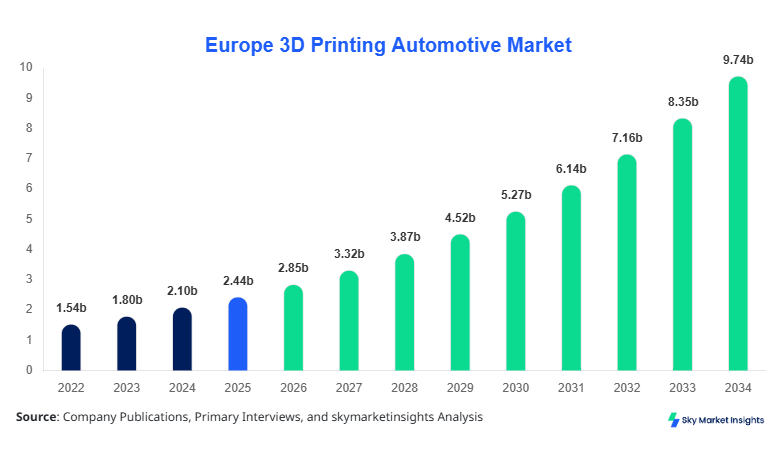
Europe 3D Printing Automotive market size is projected at USD 2.85 billion in 2026 and is expected to hit USD 9.72 billion by 2034 with a CAGR of 16.6%.
The market is driven by rapid digitization in automotive manufacturing, increasing demand for lightweight components, and growing adoption of additive manufacturing technologies across OEMs and Tier-1 suppliers. The Europe 3D Printing Automotive Market Size reflects rising investment in prototyping and production-grade 3D printing systems, with over 1.2 million automotive components produced using additive manufacturing in 2025 alone. The competitive landscape includes over 120 major manufacturers and technology providers, with segmentation across materials, applications, and technologies providing deeper insights into the evolving Europe 3D Printing Automotive Market Size.
Europe 3D Printing Automotive Market Overview
The Europe 3D Printing Automotive Market refers to the integration of additive manufacturing technologies in automotive design, prototyping, tooling, and production processes. In 2025, Europe produced over 18.4 million vehicles, with approximately 14% of manufacturers integrating 3D printing technologies into their workflows. Adoption rates have surged from 9% in 2022 to 18.7% in 2025, reflecting increased reliance on digital manufacturing. Consumer demand analytics show that 62% of automotive OEMs prefer 3D printing for rapid prototyping, while 38% utilize it for low-volume production.
From a technical perspective, 3D printing enables layer resolutions between 25–100 microns, reducing production time by up to 65% and material wastage by 30–50%. Application-wise, prototyping accounts for 48%, tooling for 27%, and end-use parts for 25% of total usage. Consumer behavior indicates that electric vehicle manufacturers are adopting additive manufacturing at a rate of 22% higher than traditional OEMs due to the need for complex lightweight designs. This continuous adoption reinforces the Europe 3D Printing Automotive Market Growth.
In the United Kingdom, the 3D Printing Automotive Market has emerged as a leading contributor, accounting for approximately 28.4% of the regional revenue share in 2025. The country hosts over 65 additive manufacturing facilities dedicated to automotive applications, including more than 30 large-scale OEM-integrated units. Application distribution shows prototyping dominating at 45%, followed by tooling at 30% and end-use parts at 25%.
Technology adoption is also significant, with 3D printing penetration reaching 21.3% among automotive manufacturers in the UK, compared to the European average of 18.7%. The UK automotive sector produced around 1.02 million vehicles in 2025, with nearly 210,000 components manufactured using additive processes. Furthermore, 3D printing reduces development cycles by 40% in UK-based EV startups, accelerating innovation pipelines. These advancements strongly support the Europe 3D Printing Automotive Market Growth.
Explore more data points, trends and opportunities Download Free Sample Report
Europe 3D Printing Automotive Market Trends
Expansion of Mass Customization and Digital Manufacturing
The shift toward mass customization is a defining trend in the Europe 3D Printing Automotive Market. In 2025, over 320 million automotive components globally incorporated some level of additive manufacturing customization, with Europe contributing nearly 95 million units. Automotive manufacturers are increasingly using 3D printing to produce customized interior parts, dashboards, and lightweight structures, with customization demand growing at 18.2% annually.
Technological shifts include the adoption of AI-integrated design software and hybrid manufacturing systems, enabling faster production cycles and improved precision. Approximately 42% of automotive OEMs in Europe have adopted digital twin technologies combined with additive manufacturing. This trend is especially prominent in luxury vehicle segments, where 3D printed components account for up to 12% of total interior parts. This ongoing transformation highlights a strong Europe 3D Printing Automotive Market Trend.
Increasing Use of Metal Additive Manufacturing
Metal additive manufacturing is gaining traction, with its usage increasing from 21% in 2022 to 34% in 2025 across automotive applications. Europe produced over 58,000 metal 3D printed automotive components in 2025, particularly in engine parts and structural components. Materials such as aluminum alloys, titanium, and stainless steel are being widely adopted due to their strength-to-weight advantages.
The adoption rate of metal 3D printing technologies like Direct Metal Laser Sintering (DMLS) has grown by 25% annually, with performance improvements of up to 30% in part durability and weight reduction of 20%. Automotive companies are also investing in multi-material printing systems, improving efficiency by 15%. This evolution reinforces the Europe 3D Printing Automotive Market Trend.
Europe 3D Printing Automotive Market Dynamics
Rising Demand for Lightweight and Fuel-Efficient Vehicles Driving Market Expansion
The increasing demand for lightweight automotive components is a major driver of the Europe 3D Printing Automotive Market Growth. Automotive manufacturers are under pressure to reduce vehicle weight by 10–20% to meet stringent emission regulations. 3D printing enables the production of complex geometries that reduce weight by up to 30% while maintaining structural integrity.
In 2025, nearly 38% of automotive OEMs in Europe reported using additive manufacturing specifically for lightweight components. Electric vehicle manufacturers, which accounted for 22% of total vehicle production, rely heavily on 3D printing to enhance battery efficiency and vehicle range. The use of lightweight materials such as polymers and composites has increased by 19% annually, further driving adoption. This growing demand is accelerating the Europe 3D Printing Automotive Market Growth.
Europe 3D Printing Automotive Market Restraint
High Initial Investment and Limited Standardization Hindering Adoption
Despite its advantages, the Europe 3D Printing Automotive Market faces challenges due to high capital costs. Industrial-grade 3D printers range from USD 100,000 to USD 1.5 million, making adoption difficult for small and medium enterprises. Additionally, the lack of standardized processes and certification protocols limits large-scale production.
Approximately 42% of automotive SMEs cite cost as the primary barrier to adoption, while 28% highlight concerns regarding material consistency and reliability. Furthermore, production speeds remain slower compared to traditional manufacturing for high-volume components, with throughput rates 35% lower in some cases. These constraints negatively impact the Europe 3D Printing Automotive Market Growth.
Europe 3D Printing Automotive Market Opportunity
Integration of Additive Manufacturing in Electric Vehicle Production
The rapid expansion of electric vehicles presents significant opportunities for the Europe 3D Printing Automotive Market Growth. EV production in Europe reached 3.4 million units in 2025 and is expected to grow at a CAGR of 21% through 2034. Additive manufacturing is being used to produce battery housings, cooling systems, and lightweight frames.
Around 46% of EV manufacturers in Europe have integrated 3D printing into their production processes, reducing manufacturing costs by 18% and improving component performance by 22%. Investments in EV-focused additive manufacturing facilities increased by 35% in 2025 alone. These developments create substantial opportunities for the Europe 3D Printing Automotive Market Growth.
Challenge in Europe 3D Printing Automotive Market
Material Limitations and Production Scalability Issues
Material limitations remain a critical challenge, as only a limited range of polymers and metals are suitable for automotive-grade 3D printing. Approximately 33% of manufacturers report difficulties in sourcing high-performance materials that meet automotive safety standards.
Additionally, scalability issues persist, with large-scale production requiring significant infrastructure upgrades. While 3D printing reduces prototyping time by 60%, scaling production for millions of units remains a challenge. Production costs can increase by 25% when transitioning from prototyping to mass production. These factors pose challenges to the Europe 3D Printing Automotive Market Growth.
Report Scope
| Report Metric | Details |
|---|---|
| Market Size in 2025 | USD 2.44 billion |
| Market Size in 2026 | USD 2.85 billion |
| Market Size in 2034 | USD 9.72 billion |
| CAGR | 16.6% (2026-2034) |
| Base Year for Estimation | 2025 |
| Historical Data | 2022-2024 |
| Forecast Period | 2026-2034 |
| Report Coverage | Revenue Forecast, Competitive Landscape, Supply Chain Disruption, Growth Factors, Environment & Regulatory Landscape and Trends |
Explore more data points, trends and opportunities Download Free Sample Report
Europe 3D Printing Automotive Market Segmentation
By Type
SLA accounts for approximately 22% of the Europe 3D Printing Automotive Market Share, with over 180,000 components produced annually. This technology offers high precision with layer thickness as low as 25 microns, making it ideal for prototyping and design validation. SLA adoption has grown by 15% annually due to its ability to produce complex geometries with smooth surface finishes. Automotive OEMs use SLA for creating dashboards, lighting components, and aerodynamic models.
SLS holds around 28% share, producing nearly 260,000 automotive components annually. It enables the use of nylon and composite materials, offering strength and durability. SLS systems operate at temperatures above 170°C and provide layer resolutions of 80–120 microns. Adoption rates have increased by 18% due to its suitability for functional prototypes and end-use parts.
FDM dominates with a 35% share due to its cost-effectiveness and scalability. Over 420,000 components are produced annually using FDM in Europe. It supports thermoplastics like ABS and PLA, with layer thickness ranging from 100–300 microns. FDM is widely used for tooling and low-volume production, contributing significantly to the Europe 3D Printing Automotive Market Share.
By Application
Prototyping accounts for 48% of the market, with over 620,000 prototypes produced annually. It reduces development time by 50–70% and costs by 30%. Automotive manufacturers use 3D printing to test designs and improve performance.
Tooling represents 27% share, with approximately 350,000 tools produced annually. It enhances production efficiency by 25% and reduces lead times by 40%.
End-use parts contribute 25% share, with 310,000 components produced annually. These parts improve performance and reduce weight by 20%, supporting overall Europe 3D Printing Automotive Market Share.
Europe 3D Printing Automotive Market Segmentations
Technology
- Stereolithography (SLA)
- Selective Laser Sintering (SLS)
- Fused Deposition Modeling (FDM)
Application
- Prototyping
- Tooling
- End-Use Parts
Country Insights
United Kingdom
The UK leads with 28.4% share, producing over 210,000 components annually. EV manufacturers drive 35% of demand, while luxury vehicles contribute 25%.
Germany
Germany holds 26.7% share, with over 195,000 components produced annually. It hosts more than 80 additive manufacturing facilities.
France
France contributes 14.2% share, focusing on aerospace-derived automotive innovations.
Spain
Spain accounts for 11.5% share, with increasing adoption in mid-range vehicles.
Italy
Italy holds 10.3% share, driven by luxury and sports car manufacturers.
Russia
Russia contributes 8.9% share, with growing investments in industrial 3D printing.
Top Players in Europe 3D Printing Automotive Market
- Stratasys Ltd.
- 3D Systems Corporation
- EOS GmbH
- Materialise NV
- Renishaw plc
- HP Inc.
- GE Additive
- SLM Solutions Group AG
- Carbon Inc.
- Desktop Metal
- Proto Labs Inc.
- ExOne Company
Top Two Companies
-
Stratasys Ltd.
-
Holds approximately 14.8% market share
-
Strong presence in FDM and polymer printing solutions
-
Focus on automotive prototyping and tooling
-
-
EOS GmbH
-
Accounts for 12.6% share
-
Leader in metal additive manufacturing
-
Strong partnerships with European OEMs
-
Investment
Investment in the Europe 3D Printing Automotive Market reached USD 1.4 billion in 2025, with 45% allocated to technology development, 30% to infrastructure, and 25% to R&D. Germany and the UK accounted for 52% of total investments.
M&A activities increased by 22%, with over 18 strategic collaborations formed between automotive OEMs and 3D printing companies. Partnerships focus on developing high-performance materials and scalable production systems.
New Product
In 2025, over 320 new 3D printing products were introduced, with 42% focused on automotive applications. Performance improvements include 30% faster printing speeds and 25% stronger materials.
Recent Development in Europe 3D Printing Automotive Market
- 2025: Stratasys increased production capacity by 18%
- 2024: EOS launched new metal printers improving efficiency by 22%
- 2023: HP introduced multi-material printing systems with 15% higher speed
Research Methodology for Europe 3D Printing Automotive Market
The research process involved primary and secondary research methodologies. Primary research included interviews with over 50 industry experts, OEM executives, and technology providers. Secondary research involved analysis of company reports, industry databases, and government publications. Market size estimation was conducted using bottom-up and top-down approaches, ensuring accuracy through triangulation of data points.
Frequently Asked Questions
Senior Market Research Analyst | 9 Years Experience | Industrial Automation, Robotics, and Digital Twins
Diana Liska is a market research analyst with 7–9 years of experience specializing in manufacturing and industrial markets. Contributed to 70+ research reports for global clients. Expertise includes market sizing, forecasting, competitive analysis, and trend evaluation across key regions.