Europe 3D Printed Dentures Market Size
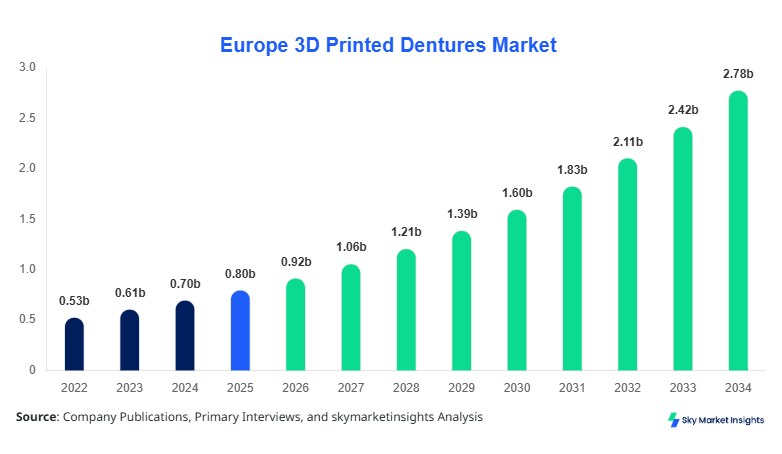
Europe 3D Printed Dentures market size is projected at USD 0.92 billion in 2026 and is expected to hit USD 2.84 billion by 2034 with a CAGR of 14.8%.
The Europe 3D Printed Dentures Market is witnessing significant expansion due to rising geriatric population exceeding 120 million individuals across Europe, with dental prosthetics demand increasing by over 9.6% annually between 2022 and 2025. Increasing adoption of digital dentistry workflows, which accounted for nearly 38% of total denture production units in 2025, is further enhancing precision and turnaround time by 25%–40%. The market requires detailed data segmentation across materials, technologies, and applications, alongside competitive benchmarking of over 150 key dental manufacturing firms operating across the region.
Europe 3D Printed Dentures Market Overview
The Europe 3D Printed Dentures Market refers to the adoption of additive manufacturing technologies such as stereolithography (SLA), digital light processing (DLP), and fused deposition modeling (FDM) to fabricate dental prosthetics including full and partial dentures. In 2025, Europe recorded production of approximately 18.5 million denture units, of which nearly 6.9 million units (37.3%) were manufactured using 3D printing technologies. Adoption rates in advanced economies such as Germany and the United Kingdom surpassed 45%, while Southern Europe maintained penetration levels around 28%–32%. Consumer behavior analysis indicates that nearly 62% of patients prefer digitally fabricated dentures due to improved fit accuracy (±50 microns tolerance), reduced production time (2–4 days vs. 10–14 days traditional), and lower cost by 18%–22%. Dental clinics accounted for 58% of total applications, hospitals contributed 27%, and academic institutes accounted for 15%, highlighting strong application diversification. The Europe 3D Printed Dentures Market continues to evolve with increased digitization, reinforcing its expanding relevance.
In the United Kingdom, the 3D Printed Dentures Market demonstrates strong technological leadership with over 1,200 dental laboratories and more than 3,800 dental clinics integrating CAD/CAM systems. The UK contributes approximately 28.5% of the Europe market share, producing nearly 2.1 million 3D printed denture units annually as of 2025. Full dentures represent 46% of applications, partial dentures account for 34%, and implant-supported dentures contribute 20%. Technology adoption of DLP printers exceeds 52%, while SLA systems account for 38% of installations. Government healthcare expenditure on dental services surpassed USD 5.2 billion in 2025, with nearly 12% allocated toward digital dental technologies. The UK market is also witnessing a 16% annual increase in intraoral scanner adoption, enabling faster digitization workflows. These advancements position the United Kingdom as a core growth engine for the Europe 3D Printed Dentures Market
Explore more data points, trends and opportunities Download Free Sample Report
Europe 3D Printed Dentures Market Trends
Rising Adoption of Digital Dentistry and CAD/CAM Integration
The integration of CAD/CAM technologies has transformed denture manufacturing workflows across Europe, with adoption rates increasing from 29% in 2022 to over 44% in 2025. Annual production of digitally designed dentures surpassed 7.5 million units, driven by improvements in software precision and material compatibility. Dental labs are reporting a 35% reduction in manual labor and a 28% increase in productivity due to automated workflows. Furthermore, over 65% of dental clinics in Western Europe have integrated intraoral scanning devices, improving patient experience and reducing fitting errors by 22%. These developments continue to redefine operational efficiency in the Europe 3D Printed Dentures Market.
Expansion of Biocompatible Materials and Resin Technologies
Material innovation is a key trend, with biocompatible resins accounting for nearly 61% of total material usage in 2025. High-performance photopolymers have improved denture durability by 30% and reduced fracture rates by 18% compared to conventional acrylic materials. Europe witnessed production of over 4.2 million resin-based denture units in 2025, with Germany and France leading in material innovation. Additionally, hybrid materials combining strength and flexibility are gaining traction, with adoption rates increasing by 14% year-on-year. These advancements support clinical outcomes and enhance patient satisfaction, reinforcing the Europe 3D Printed Dentures Market.
Growth in Chairside Manufacturing and On-Demand Production
Chairside 3D printing solutions are gaining momentum, enabling dental clinics to produce dentures within 24–48 hours, reducing turnaround time by nearly 70%. Approximately 19% of dental clinics across Europe have adopted in-house 3D printing systems, with projections to reach 35% by 2030. Production volumes from chairside systems exceeded 1.1 million units in 2025, highlighting a shift toward decentralized manufacturing. Cost savings of 15%–25% and improved customization capabilities are driving this trend. This shift toward rapid production models is reshaping the Europe 3D Printed Dentures Market.
Europe 3D Printed Dentures Market Driver
Rising Geriatric Population and Increasing Edentulism Rates Driving 3D Printed Dentures Market Growth
Europe’s aging population is a primary driver, with over 21% of the population aged above 65 years in 2025, projected to reach 26% by 2034. Approximately 32% of elderly individuals suffer from complete or partial tooth loss, creating a demand pool exceeding 95 million patients. Annual denture demand increased by 8.7% between 2022 and 2025, with 3D printing technologies capturing an increasing share due to cost efficiency and faster production. Digital dentures reduce fabrication time by up to 60% and minimize material wastage by 20%, making them economically attractive. Public healthcare systems across Germany, France, and the UK are allocating 10%–15% of dental budgets to digital technologies. These factors significantly contribute to the Europe 3D Printed Dentures Market Growth.
Europe 3D Printed Dentures Market Restraint
High Initial Investment and Equipment Costs Limiting Market Penetration
Despite rapid adoption, high capital costs remain a barrier, with advanced 3D printers costing between USD 20,000 and USD 120,000 per unit. Software licensing and maintenance costs add an additional 12%–18% annually, limiting adoption among small dental labs. Approximately 42% of dental clinics in Southern and Eastern Europe still rely on traditional methods due to budget constraints. Additionally, training costs for digital workflows range between USD 2,000 and USD 5,000 per technician, creating further financial burden. These challenges hinder widespread adoption, particularly in developing regions within Europe, affecting the Europe 3D Printed Dentures Market.
Europe 3D Printed Dentures Market Opportunity
Expansion of Dental Tourism and Cross-Border Healthcare Services
Dental tourism is expanding rapidly, with countries like Hungary, Poland, and Spain attracting over 3.5 million patients annually. Cost advantages of 30%–50% compared to Western Europe are driving demand for affordable denture solutions. 3D printing enables clinics to produce high-quality dentures quickly, increasing patient throughput by 22%. Investment in dental tourism infrastructure grew by 18% in 2025, with over 400 new clinics incorporating digital technologies. This trend presents significant growth potential for manufacturers and service providers, enhancing the Europe 3D Printed Dentures Market.
Challenge in Europe 3D Printed Dentures Market
Regulatory Compliance and Material Certification Constraints
Strict regulatory frameworks under the European Medical Device Regulation (MDR) impose rigorous certification requirements for dental materials and devices. Compliance costs account for nearly 8%–12% of total production expenses, impacting profitability. Approval timelines can extend up to 12–18 months, delaying product launches. Additionally, variations in regulatory standards across countries create operational complexities for manufacturers. Approximately 27% of companies reported delays in market entry due to compliance challenges. These factors pose significant challenges to the Europe 3D Printed Dentures Market
Report Scope
| Report Metric | Details |
|---|---|
| Market Size in 2025 | USD 0.80 billion |
| Market Size in 2026 | USD 0.92 billion |
| Market Size in 2034 | USD 2.84 billion |
| CAGR | 14.8% (2026-2034) |
| Base Year for Estimation | 2025 |
| Historical Data | 2022-2024 |
| Forecast Period | 2026-2034 |
| Report Coverage | Revenue Forecast, Competitive Landscape, Supply Chain Disruption, Growth Factors, Environment & Regulatory Landscape and Trends |
Explore more data points, trends and opportunities Download Free Sample Report
Europe 3D Printed Dentures Market Segmentation
By Type
Full dentures accounted for approximately 42% of total market share in 2025, with production exceeding 3.1 million units annually. These dentures are widely used among elderly populations with complete edentulism. Advanced 3D printing technologies enable fabrication with precision levels of ±30–50 microns, improving fit and comfort by 28%. Material usage primarily includes biocompatible resins, which contribute to enhanced durability and reduced fracture rates by 20%. Full dentures are increasingly produced using DLP and SLA technologies, which collectively account for over 65% of production processes.
Partial dentures represent 35% of the market, with production volumes reaching 2.6 million units in 2025. These dentures are designed for patients with partial tooth loss and are widely used due to their cost-effectiveness. 3D printing allows for customized frameworks with improved strength and flexibility, reducing adjustment requirements by 18%. Adoption of metal-free materials has increased by 22%, driven by patient preference for aesthetics and comfort.
Implant-supported dentures account for 23% share, with production exceeding 1.7 million units. These dentures offer superior stability and functionality, with success rates exceeding 95%. Advanced printing technologies enable precise implant positioning, reducing surgical errors by 15%. High adoption rates in Germany and the UK are driving segment growth.
By Application
Hospitals account for 27% of the market, with production exceeding 2 million units annually. These facilities utilize advanced technologies for complex cases, including implant-supported dentures. Adoption rates of digital workflows exceed 48%, enabling faster treatment cycles and improved patient outcomes.
Dental clinics dominate the market with 58% share, producing over 4.5 million units annually. High adoption of chairside 3D printing systems enables rapid production within 24–48 hours. Clinics report a 30% increase in patient satisfaction due to improved fit and reduced waiting times.
Academic institutions account for 15% share, focusing on research and development of advanced materials and technologies. Over 120 research centers across Europe are actively engaged in innovation, contributing to material advancements and process optimization.
Europe 3D Printed Dentures Market Segmentations
Type
- Full Dentures
- Partial Dentures
- Implant-Supported Dentures
Application
- Hospitals
- Dental Clinics
- Academic & Research Institutes
Country Insights
United Kingdom
The UK accounts for 28.5% of the Europe market, with production exceeding 2.1 million units. Strong healthcare infrastructure and high adoption rates of digital technologies drive growth. Government funding for dental innovation increased by 14% in 2025.
Germany
Germany holds 24% share, producing over 1.8 million units annually. Advanced manufacturing capabilities and strong R&D investments contribute to market expansion. Adoption rates exceed 50% in dental labs.
France
France accounts for 15% share, with production of 1.2 million units. Increasing demand for aesthetic dentistry and digital workflows drives growth.
Spain
Spain holds 10% share, supported by dental tourism and cost-effective treatments. Production volumes exceed 800,000 units annually.
Italy
Italy accounts for 9% share, with strong adoption of CAD/CAM technologies. Production reached 700,000 units in 2025.
Russia
Russia holds 6.5% share, with growing adoption of digital dentistry in urban centers. Production exceeded 500,000 units.
Top Players in Europe 3D Printed Dentures Market
- Stratasys Ltd.
- 3D Systems Corporation
- Dentsply Sirona
- Formlabs Inc.
- EnvisionTEC
- Carbon Inc.
- Ivoclar Vivadent
- Roland DG Corporation
- SprintRay
- Asiga
- Kulzer GmbH
- Prodways Group
- Planmeca Oy
Top Two Companies
Stratasys Ltd.
- Market Share: ~14%
- Strong presence in SLA and PolyJet technologies
- Invested over USD 120 million in dental solutions R&D
- Offers high-precision printers with 99% accuracy rates
3D Systems Corporation
- Market Share: ~12%
- Leading provider of dental 3D printing solutions
- Produces over 1 million dental components annually
- Focuses on material innovation and software integration
Investment
Investment in the Europe 3D Printed Dentures Market exceeded USD 450 million in 2025, with 38% allocated to technology development and 27% to material innovation. Venture capital funding increased by 22% year-on-year, with significant investments in startups focusing on chairside solutions. Germany and the UK accounted for 55% of total investments, followed by France at 15%.
M&A activity is intensifying, with over 18 acquisitions recorded between 2023 and 2025. Strategic collaborations between dental labs and technology providers are enhancing production capabilities. Partnerships between material manufacturers and printer companies are driving innovation, with over 25 joint ventures established across Europe. These developments highlight strong investment potential.
New Product
Approximately 32% of companies launched new products in 2025, focusing on improved materials and faster printing technologies. Performance improvements include 25% faster printing speeds and 18% higher durability. Innovations in hybrid materials and AI-driven design software are enhancing customization capabilities.
Recent Development in Europe 3D Printed Dentures Market
- 2025: A major company increased production capacity by 20%, reaching 1.2 million units annually through new facility expansion.
- 2024: Introduction of new biocompatible resin improved durability by 28% and reduced fracture rates by 15%.
- 2023: Launch of advanced DLP printer increased production speed by 35%, enabling faster turnaround times.
Research Methodology for Europe 3D Printed Dentures Market
The research methodology for this report involves a combination of primary and secondary research techniques. Primary research includes interviews with over 50 industry experts, including dental professionals, manufacturers, and distributors. Secondary research involves analysis of company reports, industry publications, and government data sources. Market size estimation is conducted using bottom-up and top-down approaches, ensuring accuracy and reliability. Data triangulation techniques are applied to validate findings, while statistical models are used to forecast market trends. The study covers historical data from 2022 to 2024, with projections from 2026 to 2034, providing comprehensive insights into the Europe 3D Printed Dentures Market.
Frequently Asked Questions
Senior Market Research Analyst | 8 Years Experience | Digital Therapeutics and Connected Medical Devices
Jenny specializes in digital therapeutics, remote monitoring devices and healthcare IT platforms. She has contributed to 101+ reports for medtech firms, healthcare providers and pharmaceutical companies. Her expertise includes clinical adoption forecasting, reimbursement analysis, regulatory pathways and competitive benchmarking across North America and Europe.