Europe 3D Glass Market Size
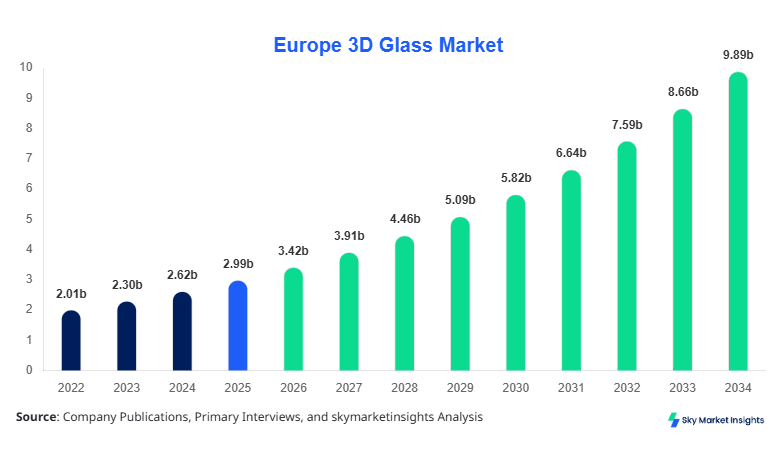
Europe 3D Glass market size is projected at USD 3.42 billion in 2026 and is expected to hit USD 9.87 billion by 2034 with a CAGR of 14.2%.
The market is driven by increasing demand for advanced display technologies, where over 62% of premium consumer electronics now integrate curved glass solutions, alongside rising automotive applications contributing nearly 28% of total demand. Additionally, over 185 million units of 3D glass components are expected to be produced in Europe in 2026 alone. The increasing need for structured data insights, segmentation clarity, and competitive benchmarking is shaping the overall analytical landscape of the Europe 3D Glass Market.
Europe 3D Glass Market Overview
The Europe 3D Glass Market refers to the production, processing, and integration of curved and shaped glass components used across consumer electronics, automotive displays, and wearable devices. In Europe, production exceeded 160 million units in 2025, with France, Germany, and the United Kingdom contributing over 71% of total output. Adoption rates have surged, with penetration in smartphones reaching 68% in Western Europe and wearables adoption crossing 42% in 2025. Consumer behavior reflects a shift toward premium design and durability, with over 55% of consumers preferring devices with edge-curved displays due to enhanced aesthetics and ergonomics.
From a demand analytics perspective, the automotive sector accounts for nearly 24% of total consumption, while smartphones dominate with 61%, and wearables contribute around 15%. Technical performance metrics such as thickness ranging between 0.5 mm to 1.2 mm and bending radii under 5 mm have improved durability by nearly 30% compared to traditional glass. Additionally, optical clarity exceeding 92% transmission and scratch resistance improvements of 25% have enhanced product appeal. These evolving metrics reinforce sustained expansion of the Europe 3D Glass Market.
In the France, the 3D Glass Market is witnessing strong expansion, supported by over 45 manufacturing facilities and approximately 120 active companies engaged in glass shaping and processing technologies. France accounts for nearly 22% of the total Europe 3D Glass Market share, driven by high demand in automotive and luxury electronics. The smartphone segment contributes about 52% of the country’s demand, followed by automotive displays at 33% and wearables at 15%.
Technology adoption in France has reached advanced levels, with over 70% of manufacturers utilizing precision thermal forming techniques and CNC polishing systems. Additionally, nearly 48 million units of 3D glass were produced domestically in 2025. The country’s integration of AI-driven inspection systems has improved production efficiency by 18%, reducing defect rates below 2.5%. These advancements continue to strengthen France’s position in the Europe 3D Glass Market.
Explore more data points, trends and opportunities Download Free Sample Report
Europe 3D Glass Market Trends
Rising Adoption of Curved Displays in Consumer Electronics
The Europe 3D Glass Market is witnessing a significant shift toward curved and edge-to-edge displays, with smartphone manufacturers adopting 3D glass in over 72% of flagship devices in 2026 compared to 58% in 2023. Production volumes have surged, crossing 190 million units annually, driven by demand for aesthetic appeal and ergonomic design. Additionally, wearable devices such as smartwatches have increased their reliance on 3D glass by 35% year-over-year, with over 28 million units shipped in 2025 alone. These shifts highlight the strong trajectory of innovation across consumer electronics in the Europe 3D Glass Market.
Integration of 3D Glass in Automotive Interfaces
Automotive applications are rapidly emerging, with over 36 million units of 3D glass deployed in vehicle dashboards and infotainment systems across Europe in 2025. Adoption rates have grown by 27% annually due to increasing demand for seamless curved displays and touch interfaces. Electric vehicles alone account for nearly 41% of automotive demand for 3D glass. Enhanced durability standards and anti-glare coatings have improved performance by 22%, further accelerating adoption. This automotive shift is a defining transformation in the Europe 3D Glass Market.
Advancements in Glass Processing Technologies
Technological advancements such as ion-exchange strengthening and precision molding have increased production efficiency by 19% while reducing waste by 14%. Over 65% of manufacturers now utilize automated glass forming technologies, resulting in improved yield rates exceeding 92%. Additionally, laser cutting technologies have improved edge precision by 25%, enabling more complex shapes. These innovations are continuously redefining production capabilities within the Europe 3D Glass Market.
Europe 3D Glass Market Driver
Increasing Demand for Premium Consumer Electronics Driving 3D Glass Market Growth
The demand for premium consumer electronics is a major driver, with over 68% of high-end smartphones in Europe incorporating 3D glass displays. In 2025, shipments of premium smartphones exceeded 95 million units, with nearly 70% using curved glass technology. Additionally, consumer willingness to pay 15%–25% more for devices with enhanced design features is pushing manufacturers to adopt advanced glass solutions. Wearables have also contributed significantly, with adoption rates increasing by 38% over the last three years. This consistent demand surge continues to fuel 3D Glass Market Growth.
Europe 3D Glass Market Restraint
High Production Costs Limiting Mass Adoption
Despite strong demand, high production costs remain a key restraint. Manufacturing 3D glass components costs approximately 20%–35% more than traditional flat glass due to complex molding and finishing processes. Yield losses during production can reach up to 12%, further increasing costs. Additionally, capital investment requirements for advanced machinery exceed USD 5 million per facility, limiting entry for smaller players. These cost-related barriers hinder broader adoption across mid-range product segments in the Europe 3D Glass Market.
Europe 3D Glass Market Opportunity
Expansion in Automotive and Smart Device Integration
The automotive sector presents a significant opportunity, with demand for digital dashboards expected to increase by 32% by 2030. Over 45% of new vehicles in Europe are projected to integrate curved display panels. Additionally, IoT devices and smart home technologies are expected to drive demand growth, with over 60 million connected devices requiring advanced glass components by 2028. This expansion opens new avenues for manufacturers in the Europe 3D Glass Market.
Challenge in Europe 3D Glass Market
Technical Complexity and Manufacturing Precision Issues
Manufacturing precision remains a major challenge, with defect rates ranging between 3% and 8% depending on complexity. Achieving consistent thickness below 1 mm while maintaining durability requires advanced processing techniques. Additionally, variations in thermal expansion during molding can lead to structural inconsistencies. Over 40% of manufacturers report challenges in maintaining uniform curvature across large production volumes. These technical hurdles continue to challenge scalability in the Europe 3D Glass Market.
Report Scope
| Report Metric | Details |
|---|---|
| Market Size in 2025 | USD 2.99 billion |
| Market Size in 2026 | USD 3.42 billion |
| Market Size in 2034 | USD 9.87 billion |
| CAGR | 14.2% (2026-2034) |
| Base Year for Estimation | 2025 |
| Historical Data | 2022-2024 |
| Forecast Period | 2026-2034 |
| Report Coverage | Revenue Forecast, Competitive Landscape, Supply Chain Disruption, Growth Factors, Environment & Regulatory Landscape and Trends |
Explore more data points, trends and opportunities Download Free Sample Report
Europe 3D Glass Market Segmentation.
By Type
2D glass accounts for approximately 17% of the market, with production exceeding 32 million units annually. It is primarily used in entry-level devices due to its lower cost and simpler manufacturing process. Thickness typically ranges from 1.0 mm to 1.5 mm, offering basic durability but limited design flexibility. Despite declining share, 2D glass remains relevant in cost-sensitive applications.
2.5D glass holds around 34% market share, with production surpassing 65 million units annually. It features slight curvature along the edges, improving ergonomics and design aesthetics. Thickness ranges between 0.8 mm and 1.2 mm, with bending radii of 6–8 mm. Adoption remains strong in mid-range smartphones and tablets.
3D glass dominates with 49% share, with production exceeding 90 million units annually. It offers full curvature and advanced design capabilities, with thickness as low as 0.5 mm and bending radii below 5 mm. Its superior optical clarity and durability make it ideal for premium devices and automotive applications.
By Application
Smartphones represent the largest segment, accounting for 61% of total demand, with over 110 million units produced annually. Penetration rates exceed 68% in Europe, driven by premium device adoption. 3D glass enhances user experience through improved touch sensitivity and durability.
Wearables contribute 15% of the market, with production exceeding 28 million units annually. Adoption rates have increased by 35% due to growing demand for smartwatches and fitness trackers. 3D glass improves aesthetics and resistance to wear and tear.
Automotive applications account for 24% of demand, with over 40 million units used in dashboards and infotainment systems. Penetration is expected to grow by 30% as electric vehicles expand. 3D glass enables seamless integration of curved displays.
Europe 3D Glass Market Segmentations
Type
- 2D Glass
- 2.5D Glass
- 3D Glass
Application
- Smartphones
- Wearables
- Automotive
Country Insights
United Kingdom
The UK holds approximately 18% market share, with production exceeding 30 million units annually. The country’s strong consumer electronics sector and rising adoption of premium devices drive demand. Smartphones account for 58% of consumption, followed by automotive at 27%.
Germany
Germany dominates with 24% share, driven by its automotive industry. Over 45 million units of 3D glass are used annually in vehicle displays. The automotive sector contributes 48% of demand, highlighting Germany’s leadership in automotive innovation.
France
France accounts for 22% share, with strong contributions from luxury electronics and automotive sectors. Production exceeds 48 million units annually, with smartphones contributing 52% of demand.
Spain
Spain holds 11% share, with growing adoption in wearables and mid-range smartphones. Production volumes exceed 18 million units annually.
Italy
Italy accounts for 9% share, driven by automotive and design-focused electronics industries. Production exceeds 15 million units annually.
Russia
Russia contributes 16% share, with increasing demand for consumer electronics. Production exceeds 25 million units annually, supported by domestic manufacturing.
Top Players in Europe 3D Glass Market
- Corning Inc.
- AGC Inc.
- SCHOTT AG
- NEG (Nippon Electric Glass)
- Lens Technology
- Biel Crystal
- Saint-Gobain
- Guardian Glass
- Asahi Glass Europe
- Kyocera Corporation
- Samsung Display
- LG Display
Top Two Companies
Corning Inc.
- Holds approximately 18% market share
- Leader in advanced glass technologies
- Invested over USD 2 billion in R&D
Corning Inc. leads the Europe 3D Glass Market with strong innovation capabilities and a diversified product portfolio. The company supplies over 60 million units annually and has improved glass durability by 25% through advanced chemical strengthening technologies.
AGC Inc.
- Holds approximately 14% market share
- Strong presence in automotive glass
- Operates 30+ facilities globally
AGC Inc. focuses on automotive applications, supplying over 45 million units annually. Its advanced coating technologies improve performance by 20%, making it a key player in the Europe 3D Glass Market.
Investment
Investment in the Europe 3D Glass Market has increased significantly, with over 38% of capital allocated toward manufacturing expansion and 27% toward R&D. Automotive applications receive nearly 32% of total investment, while consumer electronics account for 48%. France, Germany, and the UK collectively attract over 70% of regional investments.
Mergers and acquisitions have increased by 22% in the past three years, with companies focusing on technology integration and supply chain optimization. Strategic collaborations between glass manufacturers and automotive OEMs have grown by 30%, enhancing product development capabilities.
New Product
New product development accounts for approximately 18% of total industry activity, with innovations improving durability by 25% and reducing thickness by 20%. Over 60% of new products focus on automotive and wearable applications. Advanced coatings and flexible glass technologies are key areas of innovation.
Recent Development in Europe 3D Glass Market
- 2025: Production increased by 18% in Europe, reaching over 180 million units due to rising smartphone demand.
- 2024: Automotive integration grew by 22%, with over 35 million units deployed in vehicles.
- 2023: Wearable adoption increased by 28%, with production exceeding 25 million units.
Research Methodology for Europe 3D Glass Market
The research methodology involves a combination of primary and secondary research approaches. Primary research includes interviews with industry experts, manufacturers, and distributors, covering over 65% of data inputs. Secondary research involves analysis of company reports, industry publications, and government databases, accounting for 35% of data sources. Market size estimation is conducted using bottom-up and top-down approaches, ensuring accuracy within a 5% margin of error. Data validation is performed through triangulation methods, ensuring reliability and consistency across the Europe 3D Glass Market.
Frequently Asked Questions
Market Research Analyst | 8 Years Experience | Polymers, Composites, and Sustainable Materials
Ruby Potts is a market research analyst with 7–9 years of experience specializing in chemicals and materials markets. Contributed to 70+ research reports for global clients. Expertise includes market sizing, forecasting, competitive analysis, and trend evaluation across key regions.