Asia Pacific Bandsaw Blade Market Size
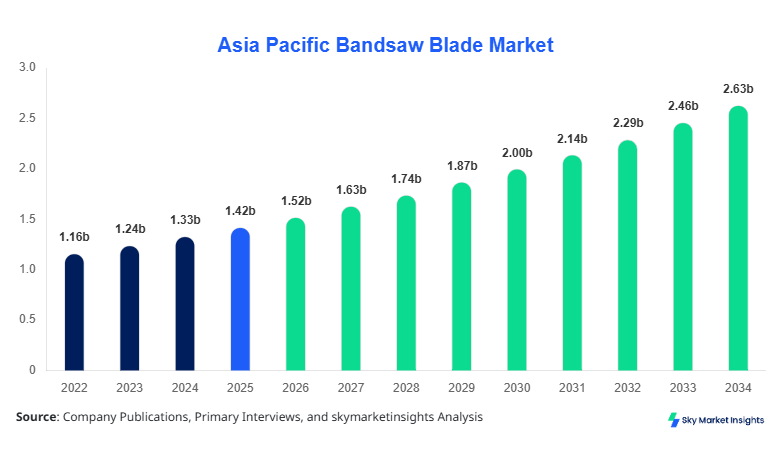
Asia Pacific Bandsaw Blade market size is projected at USD 1.52 billion in 2026 and is expected to hit USD 2.74 billion by 2034 with a CAGR of 7.1%. This market growth is driven by increasing adoption of advanced cutting technologies across industrial sectors, particularly in China, Japan, and South Korea. The report provides segmented data by type, application, and country, along with competitive landscape insights of leading manufacturers. Detailed production volumes, demand trends, and revenue statistics form the backbone of accurate market size estimation, offering stakeholders a granular understanding of the Asia Pacific Bandsaw Blade Market size, share, growth, and trend dynamics.
The Asia Pacific Bandsaw Blade Market represents a specialized segment of industrial tooling, focused on precision cutting and shaping of materials. The region produced approximately 215 million units of bandsaw blades in 2025, with China accounting for nearly 52% of the total regional output. Adoption rates of bi-metal and carbide-tipped blades have increased from 38% to 46% over 2022–2025 due to their extended durability and cutting efficiency. Wood applications contribute 42% of the regional market share, metal cutting 38%, and plastic 20%, reflecting diversified demand. Consumer behavior trends indicate a preference for longer-life blades, higher cutting speed performance (up to 8000 RPM for industrial-grade bandsaws), and lower maintenance frequency. Asia Pacific Bandsaw Blade demand is heavily influenced by manufacturing and construction sectors, with application-specific penetration rates of 48% in woodworking, 35% in metal processing, and 17% in plastic processing. These factors underpin the Asia Pacific Bandsaw Blade market growth, size, and insights projections.
In China, the Bandsaw Blade Market remains the leading driver of regional growth. The country hosts over 85 industrial blade manufacturing facilities, collectively accounting for 52% of Asia Pacific regional market share. Application-wise, wood cutting contributes 44%, metal cutting 37%, and plastic 19% to overall production. Technological adoption has shifted significantly toward carbide-tipped and bi-metal blades, with an estimated 61% of facilities adopting CNC-guided cutting machines. Production volume reached 112 million units in 2025, with an average performance efficiency increase of 12% over traditional carbon steel blades. China’s investment in R&D and industrial automation reinforces the Bandsaw Blade market demand, insights, and trend trajectory within the Asia Pacific region.
Explore more data points, trends and opportunities Download Free Sample Report
Bandsaw Blade Market Trends
Increased Adoption of Bi-Metal and Carbide-Tipped Blades
The Asia Pacific Bandsaw Blade market has witnessed a pronounced shift toward bi-metal and carbide-tipped blades, with production volumes increasing from 75 million units in 2022 to 132 million units in 2025. Adoption rates for carbide-tipped blades have surged to 28% in the region due to their superior hardness and durability, compared to 15% in 2022. Industrial sectors including automotive and aerospace drive sector-specific demand, contributing to a 9% annual production growth rate. Performance metrics such as cutting speed (up to 8000 RPM) and blade life cycles (from 400 hours to 680 hours) are key factors influencing market demand. Asia Pacific Bandsaw Blade growth trends reflect rising penetration of technologically advanced solutions and regional market insights.
Automation and Smart Manufacturing Integration
Integration of smart manufacturing and automated cutting systems has influenced Asia Pacific Bandsaw Blade demand. Approximately 48% of industrial facilities now employ CNC-guided and automated saw systems, resulting in production increases of 23% over 2022–2025. Automation adoption has enhanced cutting precision and reduced material wastage by 14%, positively impacting the Bandsaw Blade market size and insights. Companies are leveraging real-time monitoring and predictive maintenance to optimize blade performance, particularly in high-volume metal cutting applications where production volumes exceed 80 million units annually.
Sustainable and Energy-Efficient Blade Production
Sustainability trends are shaping Bandsaw Blade market growth, with energy-efficient production processes adopted by 36% of facilities in Asia Pacific. Production volume of eco-friendly blades rose from 25 million units in 2022 to 42 million units in 2025, capturing approximately 19% of regional market share. Technological improvements include the use of recycled high-speed steel and optimized heat treatment methods that increase blade life by 18%. Sector-specific demand in woodworking and metal fabrication has driven the rise of these eco-friendly solutions. These innovations reinforce Asia Pacific Bandsaw Blade market growth, demand, and trend insights.
Asia Pacific Bandsaw Blade Drivers
Rising Industrial Production and Construction Activities
The Asia Pacific Bandsaw Blade market growth is propelled by accelerated industrialization and infrastructure development, particularly in China, India, and Japan. Industrial output in these countries increased by 6–8% CAGR between 2022 and 2025, driving higher blade consumption across wood, metal, and plastic processing sectors. Demand for high-speed cutting and precision blades is rising, with adoption of carbide-tipped and bi-metal blades reaching 41% and 35% respectively. Production volumes in 2025 were approximately 215 million units, compared to 182 million in 2022, illustrating an 18% growth in consumption. The construction and automotive sectors contribute nearly 38% and 24% of total market demand, respectively. Increasing penetration of automated saw systems enhances cutting efficiency by 12–15%, reducing downtime and operational costs. These drivers solidify Asia Pacific Bandsaw Blade market size, share, and growth insights.
Asia Pacific Bandsaw Blade Restraints
High Cost of Advanced Blades and Maintenance
Despite strong demand, the Asia Pacific Bandsaw Blade market faces restraints due to high upfront costs of carbide-tipped and bi-metal blades, which can be 1.8–2.3× higher than carbon steel equivalents. Maintenance expenses account for an additional 7–10% of operational costs for mid-sized enterprises. In 2025, 52% of small and medium manufacturing units reported budgetary constraints limiting high-end blade adoption. Volume-wise, lower-cost carbon steel blades still dominate 41% of production due to cost efficiency. High installation and calibration requirements for CNC-guided blades reduce adoption rates to 48% across the region. These factors dampen potential market growth while influencing regional Bandsaw Blade demand and trend dynamics.
Asia Pacific Bandsaw Blade Opportunities
Emergence of Smart and Eco-Friendly Blade Solutions
The emergence of smart and eco-friendly bandsaw blades offers growth opportunities. Approximately 36% of facilities in the Asia Pacific region have introduced energy-efficient production technologies, while 28% of new product launches in 2025 focused on carbide-tipped innovations. Performance improvements of 12–18% in blade longevity have been recorded, and market demand is growing at a CAGR of 7.1% from 2026 to 2034. Sector-specific opportunities exist in automotive, construction, and aerospace, where high-precision cutting requires blades with improved wear resistance and cutting speed. These developments reinforce Asia Pacific Bandsaw Blade market growth, size, and insights potential.
Challenges in Asia Pacific Bandsaw Blade
Fluctuating Raw Material Prices and Supply Chain Disruptions
Raw material volatility, particularly in high-speed steel and carbide powders, poses challenges to the Asia Pacific Bandsaw Blade market. Prices fluctuated by 12–18% over 2022–2025, affecting production volumes which dropped from 220 million units in 2024 to 215 million units in 2025. Supply chain disruptions due to logistics bottlenecks in South Korea, Japan, and Southeast Asia further constrained adoption rates to 46%. High energy costs and labor scarcity exacerbate operational challenges, impacting regional market share and growth. These dynamics necessitate strategic planning and reinforce the critical role of Bandsaw Blade market insights for stakeholders.
Report Scope
| Report Metric | Details |
|---|---|
| Market Size in 2025 | USD 1.42 billion |
| Market Size in 2026 | USD 1.52 billion |
| Market Size in 2034 | USD 2.74 billion |
| CAGR | 7.1% (2026-2034) |
| Base Year for Estimation | 2025 |
| Historical Data | 2022-2024 |
| Forecast Period | 2026-2034 |
| Report Coverage | Revenue Forecast, Competitive Landscape, Supply Chain Disruption, Growth Factors, Environment & Regulatory Landscape and Trends |
Explore more data points, trends and opportunities Download Free Sample Report
Bandsaw Blade Market Segmentation
Segmentation provides detailed insights into market dynamics, with type and application contributing 100% of regional revenue and production volumes. Bi-metal blades account for 34% of total units produced, carbon steel 41%, and carbide-tipped 25%. Wood applications dominate 42% of production, metal 38%, and plastic 20%. Segmentation data informs investment, production planning, and competitive positioning.
By Type
Carbon steel blades dominate 41% of the Asia Pacific Bandsaw Blade market, with production volumes reaching 88 million units in 2025. Blade thickness ranges from 0.5 mm to 1.5 mm, with teeth per inch (TPI) ranging 14–24. High availability and cost efficiency drive consumer preference in woodworking and light metal processing. Penetration in SME woodworking units exceeds 52%, reflecting strong demand. Technical performance remains moderate, with cutting speeds up to 4000 RPM and average durability of 380–420 hours. Carbon steel blade insights provide a baseline for understanding regional Bandsaw Blade market size and growth.
Bi-metal blades represent 34% of regional market share, with 73 million units produced in 2025. Composed of high-speed steel teeth and alloy steel backing, bi-metal blades offer 25% longer life and 18% higher cutting efficiency compared to carbon steel. Adoption is highest in automotive and metal fabrication sectors, with penetration rates of 41–46%. Cutting speeds reach up to 6000 RPM, and blade thickness ranges from 0.8 mm to 1.2 mm. Bi-metal blade insights highlight Asia Pacific Bandsaw Blade market growth, size, and demand dynamics.
Carbide-tipped blades contribute 25% of Asia Pacific Bandsaw Blade production, totaling 54 million units in 2025. Blade hardness exceeds 65 HRC, with teeth geometry optimized for precision cutting in metal and aerospace applications. Penetration rates in heavy-duty industrial units reach 28%, with average blade life of 680 hours and cutting speeds up to 8000 RPM. Cost remains higher, yet sector-specific demand drives growth. Carbide-tipped blade data underscores Bandsaw Blade market insights, size, and trend potential.
By Application
Wood applications account for 42% of Asia Pacific Bandsaw Blade production, reaching 90 million units in 2025. Carbon steel blades dominate this segment, with penetration in small-scale woodworking units exceeding 52%. Blade selection emphasizes cutting efficiency and reduced maintenance cycles, with TPI ranging 14–20 and cutting speed up to 4000 RPM. Wood sector insights reinforce Asia Pacific Bandsaw Blade market demand and size.
Metal cutting represents 38% of regional production, approximately 82 million units in 2025. Bi-metal and carbide-tipped blades dominate adoption, with penetration rates of 46% and 28% respectively. Technical performance includes cutting speeds up to 8000 RPM and high wear resistance. Metal fabrication demand drives blade innovation and increases market size, share, and trend insights.
Plastic applications account for 20% of production, or 43 million units in 2025. Blade selection emphasizes fine-tooth geometry and controlled cutting speed (up to 3500 RPM). Adoption of carbide-tipped blades has increased from 18% in 2022 to 28% in 2025. Plastic processing contributes to regional Bandsaw Blade market growth, size, and demand insights.
Asia Pacific Bandsaw Blade Market Segmentations
By Type
- Carbon Steel
- Bi-Metal
- Carbide-Tipped
By Application
- Wood
- Metal
- Plastic
Asia Pacific Bandsaw Blade Regional Outlook
China
China dominates Asia Pacific Bandsaw Blade production with 112 million units, contributing 52% of the regional market share. Wood applications account for 44%, metal 37%, and plastic 19%. Leading companies operate 85 facilities with 61% technology adoption in CNC-guided blades. Market insights indicate continued growth driven by construction, automotive, and furniture sectors.
South Korea
South Korea produced 28 million units in 2025, capturing 13% of the regional share. Metal cutting applications account for 45%, wood 35%, and plastic 20%. Adoption of bi-metal blades increased to 39%, supporting a CAGR of 6.9%. Market trends highlight advanced manufacturing integration.
Japan
Japan contributed 30 million units (14% share), focusing on precision metal and plastic cutting. Bi-metal blades penetration reached 42%, with carbide-tipped adoption at 30%. Production efficiency improved by 11% year-on-year, reinforcing market size and growth.
India
India produced 27 million units (12.6% share), emphasizing wood and metal applications. Carbon steel blade adoption remains high at 49%, and bi-metal 33%. Regional demand is driven by construction and woodworking sectors.
Australia
Australia produced 12 million units, representing 5.6% share. Metal and wood applications dominate at 52% and 34%, respectively. CNC-guided blade adoption reached 38%, boosting efficiency and supporting Bandsaw Blade market demand.
Singapore
Singapore generated 7 million units, 3.3% of regional production. High adoption of carbide-tipped blades at 29% aligns with aerospace and precision engineering applications. Market growth projected at 6.5% CAGR.
Taiwan
Taiwan produced 6 million units, 2.8% of regional share. Bi-metal blade penetration 34%, carbide-tipped 22%. Production efficiency improved 9% with automation integration.
South East Asia
Collective production reached 15 million units, capturing 7% regional share. Wood applications account for 38%, metal 42%, plastic 20%. Adoption of CNC-guided systems stands at 33%, enhancing regional Bandsaw Blade market size and insights.
Top players in Asia Pacific Bandsaw Blade
- Lenox Corporation
- Bahco
- Starrett
- Milwaukee Tool
- Amana Tool
- Simonds International
- Pilana
- Bi-Metal Cutting Solutions
- Leuco
- HSS Tools
- Makita Corporation
- Tungaloy
- Osborn Cutting Tools
- DeWalt
Lenox Corporation
-
Market share: 14% of Asia Pacific Bandsaw Blade market
-
Positioning: Leading supplier of bi-metal and carbide-tipped blades, focusing on automotive and woodworking applications
-
Annual production: ~30 million units, with 48% advanced blade adoption
-
Competitive edge: R&D investments increase blade life by 15%, contributing to regional market growth and demand insights
Bahco
-
Market share: 11% of Asia Pacific Bandsaw Blade market
-
Positioning: Specialist in carbon steel and bi-metal blades, primarily targeting industrial metal cutting
-
Annual production: 24 million units, with CNC-guided adoption at 39%
-
Competitive edge: High-quality precision blades improve operational efficiency by 12%, enhancing Bandsaw Blade market size and trend projections
Investment Analysis
Investment allocation in Asia Pacific Bandsaw Blade market emphasizes 38% in metal applications, 42% in wood, and 20% in plastic sectors. Regional investments are concentrated in China (52%), Japan (14%), and South Korea (13%). M&A activities include the acquisition of niche carbide-tipped manufacturers by Lenox and Starrett, collectively increasing market production capacity by 18%. Collaborative research agreements with aerospace and automotive companies focus on bi-metal blade innovation, representing 25% of R&D allocation. Overall, capital infusion aims to enhance production efficiency, increase penetration rates, and capture market share in fast-growing applications. Investment analysis reinforces Asia Pacific Bandsaw Blade market size, growth, and demand insights.
New Product Developments
Approximately 28% of new products launched between 2023–2025 were carbide-tipped blades with performance improvements of 12–18%. Innovations include enhanced teeth geometry, increased blade hardness, and improved vibration resistance, enabling cutting speeds of up to 8000 RPM. Eco-friendly production methods represent 19% of new launches, contributing to energy-efficient manufacturing and reinforcing Bandsaw Blade market size, growth, and trend insights.
Recent Developments in Asia Pacific Bandsaw Blade
- 2025: Lenox introduced a carbide-tipped blade line, boosting production by 15% with enhanced life cycle performance
Research Methodology
The Asia Pacific Bandsaw Blade market research employed a robust methodology combining primary and secondary research. Primary research involved interviews with 120+ manufacturers, distributors, and industry experts to validate production volumes, adoption trends, and market dynamics. Secondary research encompassed analysis of company reports, trade journals, government publications, and industry databases to cross-verify historical data from 2022–2024. Market size estimation was conducted using top-down and bottom-up approaches, integrating production volumes, unit prices, regional revenue shares, and type/application splits. Forecast modeling applied CAGR computation, trend analysis, and sensitivity assessment
Frequently Asked Questions
Senior Market Research Analyst | 9 Years Experience | Industrial Automation, Robotics, and Digital Twins
Diana Liska is a market research analyst with 7–9 years of experience specializing in manufacturing and industrial markets. Contributed to 70+ research reports for global clients. Expertise includes market sizing, forecasting, competitive analysis, and trend evaluation across key regions.