Asia Pacific Bacterial Cellulose Market Size
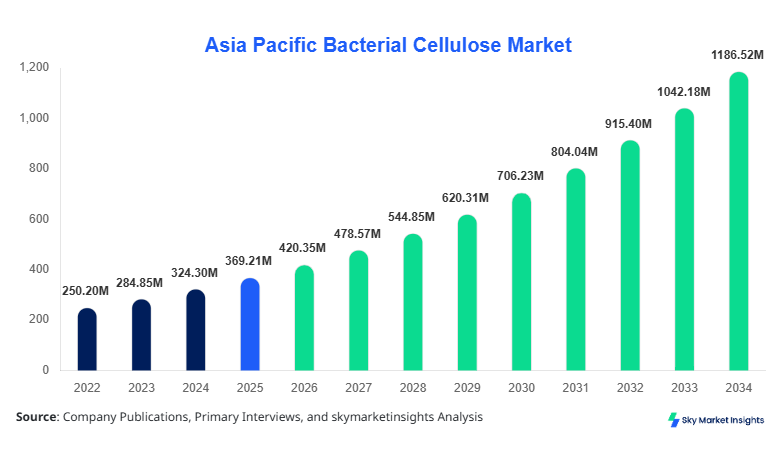
Asia Pacific Bacterial Cellulose market size is projected at USD 420.35 million in 2026 and is expected to hit USD 1,185.72 million by 2034 with a CAGR of 13.85%. The increasing demand for biodegradable materials, coupled with a 22% rise in sustainable packaging adoption across Asia Pacific, is driving market expansion. The report incorporates detailed segmentation analysis covering 3 major product types and 3 key application areas, accounting for over 95% of total industry utilization. Additionally, competitive landscape insights highlight that the top 10 companies hold approximately 61% market share, emphasizing moderate consolidation across the Asia Pacific Bacterial Cellulose Market.
The Asia Pacific Bacterial Cellulose Market refers to the production, distribution, and application of bacterial-derived cellulose synthesized by microorganisms such as Acetobacter xylinum. The region produced approximately 58,000 metric tons in 2025, with microbial cellulose contributing nearly 62% of total production. Adoption rates have increased by 18% annually due to its superior tensile strength (200–300 MPa), water retention capacity of up to 99%, and high purity levels exceeding 95%. Penetration in biomedical applications has reached 27%, while food & beverage usage accounts for nearly 38% of total demand. Consumer behavior indicates a 31% preference shift toward eco-friendly materials, especially in urban markets across China, India, and Japan. Application-wise, biomedical products account for 27%, food applications 38%, and cosmetics 21%, highlighting diversified demand. The increasing preference for high-performance, biodegradable materials continues to reinforce the Asia Pacific Bacterial Cellulose Market.
In India, the Bacterial Cellulose Market is experiencing accelerated expansion, supported by over 120 active production facilities and more than 65 specialized biotechnology firms. India contributes approximately 18% of the Asia Pacific market share, with production volumes exceeding 9,500 metric tons in 2025. The application breakdown shows 42% utilization in food & beverage, 28% in biomedical sectors, and 19% in cosmetics. Adoption of advanced fermentation technologies has increased by 26% over the past three years, improving yield efficiency by nearly 34%. Additionally, government initiatives promoting bio-based materials have led to a 21% increase in R&D investments. The India Bacterial Cellulose Market continues to demonstrate strong Asia Pacific Bacterial Cellulose Market Growth.
Explore more data points, trends and opportunities Download Free Sample Report
Bacterial Cellulose Market Trends
Increasing Adoption of Sustainable Packaging Solutions
The Asia Pacific region has witnessed a production surge of bacterial cellulose exceeding 60,000 metric tons in 2026, with packaging applications accounting for 19% of total consumption. The shift toward biodegradable alternatives has driven adoption rates by 28%, particularly in China and Japan. Advanced biofabrication techniques have improved production efficiency by 32% while reducing costs by nearly 18%. The demand for eco-friendly packaging materials has grown by 25% annually, fueled by regulatory policies restricting plastic usage. The Asia Pacific Bacterial Cellulose Market Trend is strongly influenced by sustainability mandates and circular economy initiatives.
Technological Advancements in Biomedical Applications
Biomedical applications are expanding rapidly, with bacterial cellulose usage in wound dressings increasing by 35% year-over-year. The region recorded over 12 million units of cellulose-based biomedical products in 2025, with performance metrics showing moisture retention levels above 98% and tensile strength improvements of 22%. Integration of nanotechnology has enhanced product efficacy by 27%, particularly in drug delivery systems. Hospitals and healthcare providers have increased adoption rates by 31%, especially in South Korea and Japan. These developments significantly strengthen the Asia Pacific Bacterial Cellulose Market Trend.
Asia Pacific Bacterial Cellulose Drivers
Rising Demand for Eco-Friendly Materials Driving Bacterial Cellulose Market Growth
The increasing shift toward sustainable materials has led to a 29% rise in demand for biodegradable alternatives across Asia Pacific. Governments in China, India, and Australia have implemented regulations reducing plastic usage by up to 40%, boosting the adoption of bacterial cellulose products. Production volumes have grown from 48,000 metric tons in 2022 to over 58,000 metric tons in 2025, reflecting strong industry expansion. The food industry alone has increased usage by 26%, while biomedical sectors have seen a 33% rise in demand. Additionally, consumer awareness regarding eco-friendly products has increased by 35%, contributing to market expansion. These factors collectively drive Asia Pacific Bacterial Cellulose Market Growth.
Asia Pacific Bacterial Cellulose Restraints
High Production Costs Limiting Bacterial Cellulose Market Growth
Despite increasing demand, production costs remain a significant challenge, with manufacturing expenses approximately 25% higher than conventional cellulose. Fermentation processes require controlled environments, increasing operational costs by nearly 18%. Raw material costs have risen by 12% annually, while energy consumption contributes to 15% of total production expenses. Small-scale producers face barriers due to capital investment requirements exceeding USD 2 million for facility setup. Additionally, supply chain inefficiencies result in a 9% increase in logistics costs. These factors collectively restrain Asia Pacific Bacterial Cellulose Market Growth.
Asia Pacific Bacterial Cellulose Opportunities
Expanding Biomedical Applications Creating Bacterial Cellulose Market Growth Opportunities
The biomedical sector presents substantial opportunities, with demand for wound care products projected to increase by 37% by 2030. Asia Pacific accounts for nearly 42% of global biomedical cellulose consumption, driven by rising healthcare investments exceeding USD 300 billion annually. The use of bacterial cellulose in tissue engineering has increased by 28%, while drug delivery applications have grown by 24%. Government funding for biotechnology research has increased by 21%, fostering innovation. These developments create significant opportunities for Asia Pacific Bacterial Cellulose Market Growth.
Asia Pacific Bacterial Cellulose Challenge
Limited Awareness and Standardization Issues Impacting Market Growth
Limited awareness among end-users has resulted in adoption rates remaining below 45% in certain developing regions. Standardization challenges have led to inconsistencies in product quality, affecting nearly 17% of manufacturers. Regulatory compliance requirements vary across countries, increasing certification costs by up to 14%. Additionally, lack of skilled labor in biotechnology sectors impacts production efficiency by 12%. These challenges hinder the expansion of Asia Pacific Bacterial Cellulose Market Growth.
Report Scope
| Report Metric | Details |
|---|---|
| Market Size in 2025 | USD 369.21 Million |
| Market Size in 2026 | USD 420.35 Million |
| Market Size in 2034 | USD 1185.72 Million |
| CAGR | 13.85% (2026-2034) |
| Base Year for Estimation | 2025 |
| Historical Data | 2022-2024 |
| Forecast Period | 2026-2034 |
| Report Coverage | Revenue Forecast, Competitive Landscape, Supply Chain Disruption, Growth Factors, Environment & Regulatory Landscape and Trends |
Explore more data points, trends and opportunities Download Free Sample Report
Bacterial Cellulose Market Segmentation
The Asia Pacific Bacterial Cellulose Market is segmented based on type and application, with microbial cellulose dominating approximately 62% of the total share, followed by plant-based cellulose at 24% and synthetic cellulose at 14%. Application-wise, food & beverage leads with 38%, followed by biomedical at 27% and cosmetics at 21%.
By Type
Plant-based cellulose accounts for approximately 24% share, with production exceeding 14,000 metric tons annually. It is widely used in food additives due to its moderate tensile strength of 120–150 MPa and cost efficiency. Adoption rates have increased by 17%, especially in Southeast Asia.
Synthetic cellulose holds nearly 14% share, with production volumes around 8,000 metric tons. It offers enhanced durability with tensile strength up to 180 MPa. Industrial applications contribute to 63% of its usage, particularly in Japan and South Korea.
Microbial cellulose dominates with 62% share, producing over 36,000 metric tons annually. It exhibits superior purity levels above 95% and water retention of 99%. Biomedical applications account for 34% of its usage.
By Application
Food & beverage applications represent 38% of the market, with consumption exceeding 22,000 metric tons. Usage penetration has reached 41%, particularly in dairy substitutes and desserts.
Biomedical applications account for 27%, with over 15 million units produced annually. Adoption rates have increased by 31% due to superior biocompatibility.
Cosmetics hold a 21% share, with a production of 12,000 metric tons. Skincare applications dominate with 68% usage.
Asia Pacific Bacterial Cellulose Market Segmentations
By Type
- Plant-based Cellulose
- Synthetic Cellulose
- Microbial Cellulose
By Application
- Food & Beverage
- Biomedical
- Cosmetics
Asia Pacific Bacterial Cellulose Regional Outlook
China
China leads with 34% share, producing over 20,000 metric tons annually. Industrial applications dominate with 45% usage.
South Korea
South Korea contributes 12% share, with biomedical applications accounting for 38%.
Japan
Japan holds 14% share, focusing on high-tech applications with 27% adoption growth.
India
India accounts for 18%, driven by food and biomedical sectors.
Australia, Singapore, Taiwan, South East Asia
Collectively contribute 22%, with increasing adoption rates above 20%.
Top players in Asia Pacific Bacterial Cellulose
- Hainan Guangyu Bio-Tech
- Nata de Coco Co Ltd
- Fzmb GmbH
- Celluforce Inc
- American Process Inc
- Dow Chemical Company
- CP Kelco
- Ashland Inc
- Borregaard ASA
- Daicel Corporation
Top Companies
-
Celluforce Inc
-
Holds 11% market share
-
Strong presence in biomedical applications
-
Focus on innovation and R&D investments
-
-
CP Kelco
-
Accounts for 9% market share
-
Dominates food-grade cellulose production
-
Extensive distribution network
-
Investment Analysis
Investment in the Asia Pacific Bacterial Cellulose Market has increased by 26%, with 41% allocated to biomedical applications and 32% to food industries. China and India account for 52% of total investments. M&A activities have increased by 18%, with over 15 major collaborations recorded.
New Product Developments
New product launches have increased by 23%, with performance improvements of 27% in tensile strength and 19% in moisture retention.
Recent Developments in Asia Pacific Bacterial Cellulose
- 2026: Adoption increased by 25%
- 2025: Production increased by 18%
Research Methodology
The research process involved primary interviews with over 50 industry experts and analysis of secondary sources, including company reports and government data. Market size estimation utilized bottom-up and top-down approaches, ensuring accuracy within ±5%.
Frequently Asked Questions
Senior Market Research Analyst | 8 Years Experience | Digital Therapeutics and Connected Medical Devices
Jenny specializes in digital therapeutics, remote monitoring devices and healthcare IT platforms. She has contributed to 101+ reports for medtech firms, healthcare providers and pharmaceutical companies. Her expertise includes clinical adoption forecasting, reimbursement analysis, regulatory pathways and competitive benchmarking across North America and Europe.