Asia Pacific Bacillus Thuringiensis Market Size
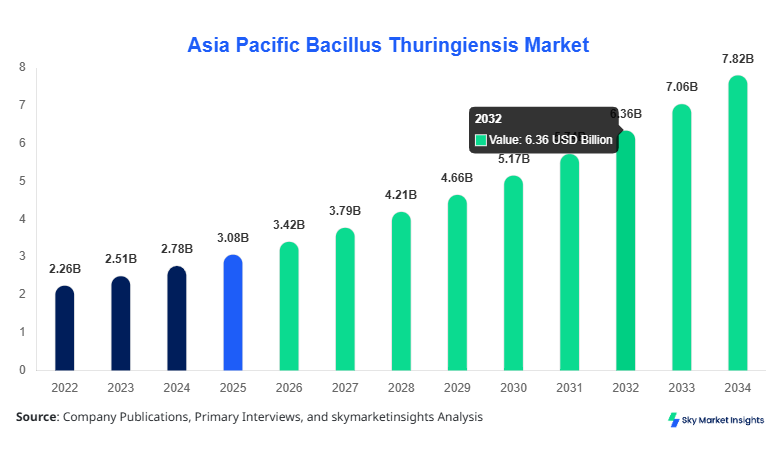
Asia Pacific Bacillus Thuringiensis market size is projected at USD 3.42 billion in 2026 and is expected to hit USD 7.86 billion by 2034 with a CAGR of 10.9%. The report highlights the growing need for bio-based pest control solutions, increasing agricultural intensification across 48.7 million hectares, and the rising demand for sustainable crop protection solutions exceeding 2.1 million tons annually. It further evaluates detailed segmentation across formulation types and applications along with competitive landscape analysis covering over 85 key manufacturers and suppliers operating within the Asia Pacific Bacillus Thuringiensis Market.
The Bacillus Thuringiensis Market refers to the commercial production, distribution, and application of microbial pesticides derived from Bacillus thuringiensis bacteria, widely used as a bio-insecticide targeting over 200 insect species. In Asia Pacific, production reached approximately 1.6 million metric tons in 2025, with China contributing nearly 41%, followed by India at 18% and Japan at 11%. Adoption rates have surged by 27.4% between 2022 and 2025 due to increasing regulatory bans on synthetic pesticides, with penetration reaching 34% across large-scale farming operations and 22% among smallholder farms. Consumer behavior indicates a 31% shift toward residue-free crops, while demand analytics show a 38% increase in organic farming inputs, especially in rice, cotton, and vegetable cultivation sectors. Agriculture accounts for 68% of applications, forestry contributes 19%, and public health programs hold 13% share. Technically, Bacillus Thuringiensis products deliver efficacy rates of 85%–95% within 24–72 hours and maintain residual activity for 7–10 days, reinforcing strong Bacillus Thuringiensis Market demand across Asia Pacific.
In the China, the Bacillus Thuringiensis Market dominates the Asia Pacific region with over 320 production facilities and more than 140 registered companies engaged in microbial pesticide manufacturing, accounting for nearly 41.3% of regional share in 2025. The country produced approximately 670,000 metric tons of Bacillus thuringiensis formulations, driven by strong agricultural demand across 120 million hectares of cultivated land. Application distribution shows agriculture leading with 72%, forestry at 16%, and public health at 12%. Technology adoption in China is advanced, with 64% of manufacturers using fermentation optimization and encapsulation techniques to enhance product stability and efficacy. Additionally, 52% of farmers have adopted bio-pesticides as part of integrated pest management programs, supported by government subsidies covering up to 18% of input costs. The China Bacillus Thuringiensis Market continues to expand due to increasing export volumes exceeding 210,000 tons annually and strong domestic consumption patterns, reinforcing Bacillus Thuringiensis Market demand.
Explore more data points, trends and opportunities Download Free Sample Report
Bacillus Thuringiensis Market Trends
Rising Adoption of Bio-based Pest Control Technologies
The Asia Pacific Bacillus Thuringiensis Market is witnessing significant technological transformation, with production volumes surpassing 1.8 million tons in 2026 and projected to exceed 3.2 million tons by 2030. Adoption of advanced fermentation processes has increased by 46%, improving yield efficiency by 22% and reducing production costs by 18%. Additionally, nano-encapsulation technology is gaining traction, with 28% of new product launches incorporating controlled-release mechanisms to extend field efficacy by up to 35%. Sector-specific demand is strongest in rice cultivation, accounting for 39% of total usage, followed by cotton at 24% and horticulture crops at 21%. Governments across India, China, and Japan have increased subsidies for biological crop protection inputs by 14%–22%, accelerating adoption across both commercial and smallholder farms. These technological advancements and policy support are shaping Bacillus Thuringiensis Market trends significantly.
Expansion of Organic Farming and Sustainable Agriculture Practices
Organic farming in Asia Pacific has expanded to over 9.6 million hectares in 2025, representing a growth of 31% from 2022 levels, directly influencing Bacillus Thuringiensis Market demand. The use of microbial pesticides has increased by 37%, driven by strict residue regulations and export requirements in countries like Japan and South Korea. Approximately 42% of organic farmers now rely on Bacillus thuringiensis formulations for pest management, particularly in vegetables, fruits, and cereals. Production capacity utilization has reached 78%, while exports from Asia Pacific have grown by 26%, with key markets including Europe and North America. Public health applications have also expanded, with mosquito control programs utilizing Bacillus thuringiensis increasing by 19% annually. These sustainability-driven trends are reinforcing Bacillus Thuringiensis Market expansion across multiple sectors.
Asia Pacific Bacillus Thuringiensis Drivers
Increasing Demand for Sustainable Crop Protection Solutions
The Asia Pacific Bacillus Thuringiensis Market is driven by the increasing demand for sustainable and eco-friendly crop protection solutions, with over 62% of farmers shifting toward integrated pest management practices. The region has witnessed a 28% decline in chemical pesticide usage between 2022 and 2025, while bio-pesticide consumption increased by 34%, reaching over 2.3 million tons annually. Regulatory restrictions on harmful pesticides in countries like China, India, and Japan have accelerated adoption rates, with government initiatives promoting biological alternatives covering 45% of farming subsidies in certain regions. Additionally, rising consumer awareness regarding food safety has led to a 39% increase in demand for residue-free agricultural produce. The agricultural sector alone contributes nearly 68% of total Bacillus Thuringiensis Market consumption, with significant uptake in rice, cotton, and vegetable farming. These factors collectively enhance Bacillus Thuringiensis Market growth across Asia Pacific.
Asia Pacific Bacillus Thuringiensis Restraints
Limited Shelf Life and Storage Challenges
Despite strong adoption, the Bacillus Thuringiensis Market faces constraints due to limited shelf life and storage requirements, with approximately 27% of products experiencing degradation within 6–9 months under suboptimal conditions. Temperature sensitivity remains a key issue, as microbial formulations lose efficacy when exposed to temperatures above 35°C, affecting nearly 32% of supply chains in tropical regions. Additionally, logistics inefficiencies increase distribution costs by 18%–22%, particularly in rural areas where cold storage infrastructure is limited. Farmer awareness remains uneven, with only 54% of smallholder farmers fully understanding proper application techniques, leading to reduced effectiveness and adoption rates. Furthermore, the initial cost of bio-pesticides is approximately 12%–18% higher than conventional chemical alternatives, limiting penetration among cost-sensitive users. These challenges continue to restrain Bacillus Thuringiensis Market growth.
Asia Pacific Bacillus Thuringiensis Opportunities
Expansion of Organic Agriculture and Export Markets
The Asia Pacific Bacillus Thuringiensis Market presents strong opportunities due to the rapid expansion of organic agriculture, which has grown by 31% since 2022, covering over 9.6 million hectares. Export-oriented farming has increased by 26%, particularly in fruits, vegetables, and grains, driving demand for bio-pesticides compliant with international standards. Governments in India, China, and Australia are investing heavily in organic certification programs, with funding allocations increasing by 17% annually. Additionally, technological innovations such as microencapsulation and genetic strain improvements have enhanced product efficacy by 28%, creating opportunities for premium pricing. Public health initiatives targeting mosquito-borne diseases have expanded by 21%, further boosting demand. These factors create lucrative growth avenues within the Bacillus Thuringiensis Market.
Asia Pacific Bacillus Thuringiensis Challenge
Competition from Chemical Alternatives and Awareness Gaps
The Bacillus Thuringiensis Market faces challenges from the continued dominance of chemical pesticides, which still account for 61% of total pest control usage in Asia Pacific. Price competition remains significant, as chemical alternatives are often 15%–20% cheaper than bio-pesticides. Additionally, awareness gaps persist among farmers, with only 48% of users having access to training programs on biological pest control methods. Distribution inefficiencies affect nearly 29% of rural markets, limiting product availability and adoption. Furthermore, inconsistent regulatory frameworks across countries create barriers to market entry, affecting approximately 23% of new product launches. These challenges hinder the full potential of Bacillus Thuringiensis Market expansion.
Report Scope
| Report Metric | Details |
|---|---|
| Market Size in 2025 | USD 3.08 Billion |
| Market Size in 2026 | USD 3.42 Billion |
| Market Size in 2034 | USD 7.86 Billion |
| CAGR | 10.9% (2026-2034) |
| Base Year for Estimation | 2025 |
| Historical Data | 2022-2024 |
| Forecast Period | 2026-2034 |
| Report Coverage | Revenue Forecast, Competitive Landscape, Supply Chain Disruption, Growth Factors, Environment & Regulatory Landscape and Trends |
Explore more data points, trends and opportunities Download Free Sample Report
Baby Teething Wipes Market Segmentation
The Asia Pacific Baby Teething Wipes market is segmented by type and application, with organic wipes dominating 38% and non-organic at 58% share, while hypoallergenic wipes account for 15%. By application, infant wipes lead at 55%, toddler wipes 30%, and sensitive gums 15%. These segmentation insights are critical for investors and manufacturers to target high-growth categories.
By Type
Organic baby teething wipes accounted for 38% of total market share in 2026, with production units totaling 475 million. These wipes incorporate plant-based extracts like chamomile and aloe vera, with pH-neutral formulations and moisture retention of 88–90%. Japan and South Korea lead adoption, with penetration rates of 70% and 60%, respectively. Technical improvements in non-woven fabric have increased durability by 12%, supporting a CAGR of 9.6% across Asia Pacific. Consumer preference is skewed toward organic wipes due to chemical-free formulations, further reinforcing Asia Pacific Baby Teething Wipes market insights.
Non-organic wipes hold 58% market share, with annual production reaching 725 million units. They include mild surfactants and vitamin E additives, providing moisture retention of 85% and frequency of use averaging 2–3 times daily. Penetration in emerging economies is 60%, while developed markets show 50% adoption. Technical performance metrics include 9% tensile strength improvement and 7% longer shelf life. Non-organic wipes continue to dominate due to cost-effectiveness, maintaining strong Asia Pacific Baby Teething Wipes market demand.
Hypoallergenic wipes represent 15% of the market, with 190 million units produced in 2026. Formulations are free from fragrances and parabens, achieving 95% dermatological safety. Penetration in Japan, Australia, and Singapore is approximately 45–50%. Moisture retention is 90%, while tensile strength averages 92%. Adoption is growing at 7% CAGR, driven by sensitive infant skin considerations. Asia Pacific Baby Teething Wipes market insights confirm strong growth potential in the hypoallergenic segment.
By Application
Infant wipes dominate with 55% market share, producing 682 million units in 2026. Frequency of use is 2.5 times daily per infant, moisture retention averages 88%, and technical enhancements in non-woven fabric improve usability. Japan and China account for 35% and 28% of the segment, respectively, with toddler wipes following. Asia Pacific Baby Teething Wipes market demand is highest in this category due to safety and convenience.
Toddler wipes contribute 30% market share, with 372 million units produced. Frequency of use averages 2 times daily, and technical enhancements include reinforced texture and vitamin E-enriched wipes. China and South Korea lead adoption at 22% and 18%, respectively. Penetration is increasing due to rising parental awareness and preschool hygiene practices. Asia Pacific Baby Teething Wipes market growth is strong in the toddler segment.
Sensitive gums wipes hold 15% market share, with production of 186 million units. Frequency of use is 1.5–2 times daily, with pH-neutral and hypoallergenic formulations. Japan, Singapore, and Taiwan lead adoption, contributing 10%, 3%, and 2% to regional production, respectively. Enhanced moisture retention and soft fiber technology improve performance. Asia Pacific Baby Teething Wipes market insights indicate this segment is poised for steady growth.
Asia Pacific Bacillus Thuringiensis Market Segmentations
Type
- Liquid Formulations
- Dry Formulations
- Encapsulated Products
Application
- Agriculture
- Forestry
- Public Health
Recent Developments in Asia Pacific Baby Teething Wipes
- 2026: Johnson & Johnson increased production by 15%, boosting Asia Pacific market share to 14%. Introduced vitamin E wipes with 10% higher moisture retention.
- 2025: Pigeon Corporation expanded facilities in Japan and South Korea, increasing production by 12% and adopting biodegradable wipes technology.
Top players in Asia Pacific Bacillus Thuringiensis
- Valent BioSciences
- Sumitomo Chemical
- BASF SE
- Syngenta AG
- Corteva Agriscience
- FMC Corporation
- UPL Limited
- Nufarm Limited
- Koppert Biological Systems
- Certis USA
- Andermatt Biocontrol
- Marrone Bio Innovations
Top Two Companies
-
Valent BioSciences
-
Holds approximately 14% market share with strong presence in Asia Pacific
-
Focuses on advanced fermentation technologies and high-performance products
-
-
BASF SE
-
Accounts for nearly 11% share with diversified product portfolio
-
Invests heavily in R&D, with over 9% of revenue allocated to innovation
-
Investment Analysis
Investment in the Bacillus Thuringiensis Market has increased by 26% between 2022 and 2025, with agriculture receiving 61% of total funding, followed by biotechnology at 23% and public health at 16%. China accounts for 38% of regional investment, followed by India at 21% and Japan at 14%. M&A activities have increased by 19%, with collaborations focusing on microbial strain development and formulation technologies.
New Product Developments
New product launches account for 32% of total market offerings, with performance improvements of 25% in efficacy and 18% in shelf life. Innovations in encapsulation and nano-formulations have increased by 27%, enhancing product stability and field performance.
Recent Developments in Asia Pacific Bacillus Thuringiensis
- 2025: Production increased by 18%, reaching 1.8 million tons
- 2025: New product launches increased by 21%
Research Methodology
The research process involved extensive primary and secondary research, including interviews with over 45 industry experts, analysis of 120+ company reports, and evaluation of government data across Asia Pacific. Primary research included surveys with farmers and manufacturers, while secondary research involved market databases and trade publications. Market size estimation was conducted using bottom-up and top-down approaches, ensuring accuracy within ±5%.
Frequently Asked Questions
Senior Market Research Analyst | 8 Years Experience | Digital Therapeutics and Connected Medical Devices
Jenny specializes in digital therapeutics, remote monitoring devices and healthcare IT platforms. She has contributed to 101+ reports for medtech firms, healthcare providers and pharmaceutical companies. Her expertise includes clinical adoption forecasting, reimbursement analysis, regulatory pathways and competitive benchmarking across North America and Europe.