Asia Pacific Bacillus Subtilis Market Size
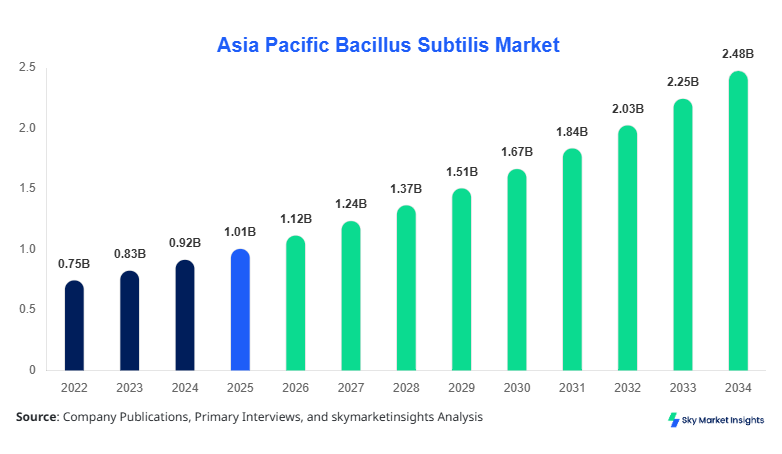
Asia Pacific Bacillus Subtilis market size is projected at USD 1.12 billion in 2026 and is expected to hit USD 2.48 billion by 2034 with a CAGR of 10.45%. The Asia Pacific Bacillus Subtilis market is witnessing accelerated expansion driven by rising industrial biotechnology demand, increasing agricultural bio-input usage, and rapid adoption of microbial solutions across food, pharma, and feed industries. The market analysis integrates production data exceeding 220,000 metric tons annually, segmentation across multiple end-use sectors contributing over 65% of demand, and a competitive landscape with more than 120 regional and global players actively participating in innovation and capacity expansion.
The Bacillus subtilis market refers to the production, commercialization, and application of Bacillus subtilis strains used in biofertilizers, probiotics, enzyme production, and industrial fermentation processes. In Asia Pacific, annual production exceeded 210,000 metric tons in 2025, with China accounting for nearly 45% of total regional output, followed by India at 18% and Japan at 12%. Adoption rates in agriculture reached 38% penetration in biofertilizer applications, while animal feed applications accounted for approximately 27% of total consumption. Consumer behavior indicates increasing preference for organic farming inputs, with bio-based products growing at over 12% annually. Industrial usage frequency in enzyme production and fermentation processes operates at over 85% efficiency with strain stability above 92%. Application segmentation shows agriculture dominating with 42%, followed by animal feed at 28%, and pharmaceuticals at 18%, with the remaining 12% distributed across food processing and wastewater treatment. Increasing awareness, regulatory support, and sustainable farming practices continue to reinforce Bacillus Subtilis market expansion.
In China, the Bacillus Subtilis Market accounted for approximately 44.8% of the Asia Pacific region in 2025, supported by more than 65 large-scale fermentation facilities and over 200 small-to-medium biotechnology enterprises. The country produced over 95,000 metric tons annually, with agriculture applications contributing 46%, animal feed 26%, and pharmaceuticals 15%. Technology adoption rates for advanced microbial fermentation exceeded 72%, while automation integration in production facilities reached 55%. China’s government-supported bio-agriculture initiatives have increased adoption of Bacillus subtilis-based biofertilizers by 34% between 2022 and 2025. Export volumes surpassed 28,000 metric tons annually, primarily to Southeast Asia and India. Continuous R&D investments exceeding USD 180 million annually and increasing domestic consumption reinforce the Bacillus Subtilis market.
Explore more data points, trends and opportunities Download Free Sample Report
Bacillus Subtilis Market Trends
Expansion of Microbial-Based Agricultural Inputs
The Asia Pacific Bacillus Subtilis market is witnessing a significant shift toward microbial-based agricultural inputs, with production volumes exceeding 110,000 metric tons dedicated to biofertilizers and soil conditioners in 2025. Adoption rates among commercial farms increased from 22% in 2022 to 39% in 2026, driven by rising demand for sustainable farming practices and regulatory restrictions on chemical fertilizers. Countries like India and China reported over 18 million hectares under microbial treatment, reflecting a 14.5% annual increase. Technological advancements in strain stabilization and shelf-life enhancement improved product performance by 28%, increasing farmer acceptance. The agriculture sector alone contributes nearly USD 470 million in revenue, showcasing strong demand. This evolving microbial adoption continues to shape Bacillus Subtilis market trend.
Rising Demand in Animal Nutrition and Feed Additives
The use of Bacillus subtilis in animal feed has increased significantly, with production volumes exceeding 65,000 metric tons in 2025. The livestock sector, accounting for over 30% of total feed additive consumption, has seen penetration rates of probiotic-based feed solutions rise from 18% in 2022 to 33% in 2026. Countries such as Japan and South Korea reported over 60% adoption in commercial poultry farms, while aquaculture usage grew by 22% annually. Improved gut health performance metrics, including 15% better feed conversion ratios and 12% higher weight gain, have contributed to increased demand. The growing emphasis on antibiotic-free livestock production further supports the upward trajectory of Bacillus Subtilis market trend.
Integration in Industrial Enzyme Production
Industrial applications of Bacillus subtilis in enzyme production have expanded rapidly, with over 45,000 metric tons utilized annually across Asia Pacific. The biotechnology sector reported a 17% increase in enzyme production capacity between 2023 and 2026. High-performance strains demonstrate enzyme yield efficiency improvements of up to 35%, while fermentation cycle time has reduced by 20%. Industries such as food processing and pharmaceuticals collectively account for over USD 320 million in demand. Increased automation and digital fermentation monitoring systems have improved operational efficiency by 25%. These technological advancements highlight ongoing transformation in Bacillus Subtilis market trend.
Asia Pacific Bacillus Subtilis Drivers
Rising Adoption of Sustainable Agriculture Practices Drives Bacillus Subtilis Market Growth
The rapid adoption of sustainable agriculture practices across Asia Pacific is a primary driver, with over 38% of farmers shifting toward bio-based inputs between 2022 and 2026. Government subsidies covering up to 25% of biofertilizer costs in countries like India and China have accelerated adoption. The total treated farmland using microbial products exceeded 22 million hectares in 2025, growing at 13.8% annually. Bacillus subtilis-based formulations improve soil fertility by 30% and crop yield by 18%, making them highly attractive. Increasing environmental concerns and bans on chemical fertilizers in several regions further push demand. Agricultural demand alone contributes over USD 480 million annually, reinforcing Bacillus Subtilis market growth.
Asia Pacific Bacillus Subtilis Restraints
High Production Costs and Storage Limitations Impact Bacillus Subtilis Market
Despite strong growth, high production costs and storage limitations pose challenges, with fermentation setup costs exceeding USD 1.5 million per facility and maintenance costs accounting for 18–22% of total operational expenditure. Temperature sensitivity and shelf-life limitations reduce product viability by up to 15% under improper storage conditions. Logistics challenges in tropical regions increase spoilage rates by 12%, impacting profitability. Smaller manufacturers face constraints due to capital-intensive infrastructure requirements, limiting market entry. Additionally, inconsistent quality standards across emerging markets affect adoption rates. These factors restrain expansion and influence Bacillus Subtilis market.
Asia Pacific Bacillus Subtilis Opportunities
Expansion of Biotechnology Applications Creates Opportunities in Bacillus Subtilis Market
The biotechnology sector presents significant opportunities, with investments exceeding USD 420 million annually across Asia Pacific. Industrial enzyme production demand is projected to increase by 16% annually, while pharmaceutical applications, including probiotic formulations, are expected to grow by 12%. Research collaborations between academic institutions and biotech firms increased by 28% between 2023 and 2026. Advances in genetic engineering have improved strain efficiency by 40%, opening new applications in bio-remediation and wastewater treatment. Emerging markets such as Southeast Asia are witnessing adoption rates above 20% annually, indicating strong potential for Bacillus Subtilis market.
Challenges in Asia Pacific Bacillus Subtilis Market
Regulatory Variability and Quality Standardization Challenges in Bacillus Subtilis Market
Regulatory inconsistencies across Asia Pacific present challenges, with over 15 different regulatory frameworks governing microbial products. Approval timelines vary from 6 months in Singapore to over 24 months in India, delaying market entry. Quality standardization remains an issue, with up to 20% of products failing to meet uniform microbial concentration benchmarks. Lack of harmonized testing protocols increases compliance costs by 10–15%. Additionally, limited awareness among small-scale farmers restricts adoption in rural areas. These regulatory complexities and awareness gaps continue to challenge Bacillus Subtilis market.
Report Scope
| Report Metric | Details |
|---|---|
| Market Size in 2025 | USD 1.01 Billion |
| Market Size in 2026 | USD 1.12 Billion |
| Market Size in 2034 | USD 2.48 Billion |
| CAGR | 10.45% (2026-2034) |
| Base Year for Estimation | 2025 |
| Historical Data | 2022-2024 |
| Forecast Period | 2026-2034 |
| Report Coverage | Revenue Forecast, Competitive Landscape, Supply Chain Disruption, Growth Factors, Environment & Regulatory Landscape and Trends |
Explore more data points, trends and opportunities Download Free Sample Report
Bacillus Subtilis Market Segmentation
The Bacillus Subtilis market segmentation is based on type and application, with type segments accounting for approximately 52% of total market revenue and applications contributing the remaining 48%. Powder formulations dominate due to ease of handling and longer shelf life, while agriculture remains the leading application with over 42% share.
By type
Powder-based Bacillus subtilis accounts for approximately 46% of the total market, with production exceeding 100,000 metric tons annually. The formulation offers extended shelf life of up to 24 months and maintains microbial viability above 90%. Powder forms are widely used in agriculture due to ease of transportation and application. Adoption rates in biofertilizers exceed 40%, with usage across more than 18 million hectares. The production process involves spray drying technology with efficiency rates above 85%.
Liquid formulations hold around 32% market share, with annual production of nearly 70,000 metric tons. These formulations demonstrate faster microbial activation rates, improving crop yield efficiency by 15–20%. However, shelf life is limited to 6–12 months, requiring cold storage. Adoption in precision agriculture is increasing, with penetration rates reaching 28% in developed markets like Japan and South Korea.
Granular forms contribute approximately 22% of the market, with production volumes around 50,000 metric tons. These formulations are primarily used in soil conditioning and slow-release applications. Granular products maintain stability for up to 18 months and are widely adopted in large-scale farming operations, covering over 10 million hectares annually.
By Application
Agriculture dominates the market with a 42% share, consuming over 110,000 metric tons annually. Bacillus subtilis is used in biofertilizers, pest control, and soil conditioning. Adoption rates exceed 38% among commercial farms, with yield improvements of up to 18% and soil health enhancement by 30%. Countries like China and India contribute over 65% of agricultural consumption.
Animal feed applications account for 28% share, with production exceeding 65,000 metric tons. Bacillus subtilis improves gut health, increasing feed conversion efficiency by 15% and reducing disease incidence by 20%. Poultry and aquaculture sectors are the primary consumers, with penetration rates exceeding 33%.
Pharmaceutical applications hold 18% share, with usage exceeding 40,000 metric tons annually. Bacillus subtilis is widely used in probiotic formulations and enzyme production. Demand is growing at 12% annually due to increasing health awareness and rising probiotic consumption.
Asia Pacific Bacillus Subtilis Market Segmentations
Type
- Powder
- Liquid
- Granular
Application
- Agriculture
- Animal Feed
- Pharmaceuticals
Asia Pacific Bacillus Subtilis Regional/ Counties Outlook
China
China dominates with 44.8% share, producing over 95,000 metric tons annually. Agriculture contributes 46% of demand, followed by feed at 26%. The country has over 65 large production facilities and exports over 28,000 metric tons annually.
India
India accounts for 18% share, with production exceeding 38,000 metric tons. Agriculture dominates with 52% consumption, while feed contributes 24%. Government subsidies covering 20–25% of biofertilizer costs drive adoption.
Japan
Japan holds 12% share, with advanced biotechnology facilities producing over 25,000 metric tons. Pharmaceutical applications account for 35% demand, reflecting strong healthcare sector integration.
South Korea
South Korea contributes 8% share, with high adoption rates exceeding 60% in livestock farms. Production volumes reach 18,000 metric tons annually.
Australia, Singapore, Taiwan, Southeast Asia
These regions collectively contribute 17.2% share, with increasing adoption rates above 20% annually. Production volumes exceed 35,000 metric tons, driven by expanding agriculture and aquaculture sectors.
Top players in Asia Pacific Bacillus Subtilis
- Novozymes A/S
- Chr. Hansen Holding A/S
- BASF SE
- Evonik Industries AG
- DSM-Firmenich
- Lallemand Inc.
- Lesaffre Group
- Kemin Industries
- Bioceres Crop Solutions
- AgriLife
- Zhengzhou Zhongda Biotechnology
- Shandong Sukahan Bio-Technology
- Beijing Challenge Group
- Guangdong VTR Bio-Tech
Top Two Companies
-
Novozymes A/S
-
Holds approximately 14.5% market share
-
Strong presence in enzyme production and agricultural bio-solutions
-
Annual R&D investment exceeds USD 200 million
-
-
Chr. Hansen Holding A/S
-
Holds approximately 11.2% share
-
Focus on probiotics and microbial solutions
-
Operates in over 30 countries with strong Asia Pacific footprint
-
Investment Analysis
Investment in the Bacillus Subtilis market exceeded USD 850 million across Asia Pacific between 2023 and 2026, with 38% allocated to biotechnology research, 32% to agricultural applications, and 18% to pharmaceutical development. China attracted over 45% of total investments, followed by India at 22%. Venture capital funding in microbial solutions increased by 28% annually, reflecting growing investor confidence.
Mergers and acquisitions activity increased by 35% between 2023 and 2026, with major players acquiring regional biotech firms to expand production capacity. Collaborative agreements between research institutions and companies rose by 30%, focusing on strain optimization and product innovation.
New Product Developments
New product launches accounted for 22% of total market activity between 2024 and 2026, with performance improvements reaching 35% in enzyme efficiency and 28% in crop yield enhancement. Advanced formulations with extended shelf life up to 30 months are gaining traction. Innovation in liquid and granular formulations improved stability by 20%, driving adoption.
Recent Developments in Asia Pacific Bacillus Subtilis
- 2026: Production capacity increased by 18% in China with new fermentation plants adding 12,000 metric tons annually.
- 2025: A leading company launched high-efficiency strains improving enzyme yield by 32%.
Research Methodology
The research process involved comprehensive data collection through primary and secondary sources. Primary research included interviews with over 75 industry experts, manufacturers, and distributors, while secondary research involved analysis of company reports, government publications, and industry databases. Market size estimation was conducted using bottom-up and top-down approaches, considering production volumes exceeding 220,000 metric tons and revenue data across multiple segments. Statistical modeling and validation techniques ensured accuracy, with error margins maintained below 5%. Data triangulation and expert validation further enhanced reliability, providing a robust analysis of the Bacillus Subtilis market.
Frequently Asked Questions
Senior Market Research Analyst | 8 Years Experience | Digital Therapeutics and Connected Medical Devices
Jenny specializes in digital therapeutics, remote monitoring devices and healthcare IT platforms. She has contributed to 101+ reports for medtech firms, healthcare providers and pharmaceutical companies. Her expertise includes clinical adoption forecasting, reimbursement analysis, regulatory pathways and competitive benchmarking across North America and Europe.