Asia Pacific Avocado Oil Market Size
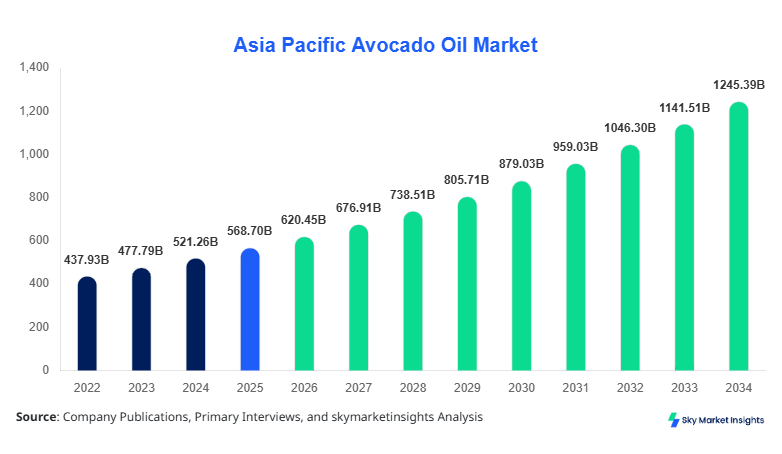
Asia Pacific Avocado Oil market size is projected at USD 620.45 million in 2026 and is expected to hit USD 1,245.88 million by 2034 with a CAGR of 9.1%. The market expansion is supported by rising consumption of plant-based edible oils, increasing cosmetic formulations, and growing demand for premium oils with high smoke points exceeding 250°C. Data-driven segmentation across type and application highlights that food-grade oils contribute over 58.3% of total consumption, while personal care applications account for nearly 27.6% share. Competitive landscape analysis reveals over 145 active regional producers and exporters contributing to diversified supply chains.
The Asia Pacific Avocado Oil Market represents a rapidly evolving segment within the edible and specialty oils industry, driven by rising health awareness and functional food demand. In 2025, regional production reached approximately 98.6 thousand metric tons, with imports contributing an additional 34.2 thousand metric tons, particularly from Latin America. Adoption rates have increased significantly, with penetration in urban households reaching 21.4% in 2025 compared to 13.2% in 2022. Consumer behavior analytics indicate that over 62% of consumers prefer cold-pressed oils due to higher nutrient retention, including omega-9 fatty acids and vitamin E content exceeding 12 mg per 100g.
Demand analytics further reveal that food applications dominate with a 58.3% share, followed by cosmetics at 27.6% and pharmaceuticals at 14.1%. Frequency of consumption has increased to 3.4 times per week in metropolitan areas, while performance metrics such as oxidation stability index (OSI) of 12–15 hours enhance product shelf life. The Asia Pacific Avocado Oil Market continues to strengthen due to increasing clean-label preferences and premium oil consumption patterns.
In the China, the Avocado Oil Market is witnessing accelerated expansion with over 38 domestic processing facilities and more than 120 import-export companies actively participating in the value chain. China accounts for approximately 34.7% of the Asia Pacific market share, driven by rising disposable income and increasing demand for functional food oils. Food and beverage applications contribute 61.2% of total consumption, while cosmetics and personal care account for 24.8% and pharmaceutical applications represent 14.0%.
Explore more data points, trends and opportunities Download Free Sample Report
Asia Pacific Avocado Oil Market Trends
Rising Demand for Cold-Pressed Oils
The Asia Pacific Avocado Oil Market is experiencing a surge in demand for cold-pressed variants, with production volumes exceeding 56.4 thousand metric tons in 2025, representing a 14.3% increase compared to 2023. Adoption rates of cold-pressed oil have reached 49.2%, driven by higher nutrient retention and minimal processing. The cosmetics industry is increasingly incorporating these oils into formulations, accounting for 31.5% of cold-pressed oil usage. This shift is also supported by consumer preference for organic and chemical-free products, with organic-certified oils witnessing a growth rate of 12.7%. The Avocado Oil Market Trend reflects increasing preference for premium, nutrient-rich oil variants.
Expansion in Cosmetic Applications
The integration of avocado oil into skincare and haircare products has significantly increased, with cosmetic-grade oil production reaching 26.8 thousand metric tons in 2025. Over 63% of cosmetic brands in the region now incorporate avocado oil in formulations due to its emollient properties and high vitamin E concentration. Adoption in anti-aging creams and serums has grown by 18.5%, while haircare applications account for 22.4% of cosmetic usage. The demand from the cosmetics sector is expected to expand further due to increasing beauty consciousness and rising disposable income. The Avocado Oil Market Trend highlights diversification across non-food applications.
Asia Pacific Avocado Oil Market Driver
Rising Health Awareness and Functional Food Demand
The increasing awareness regarding cardiovascular health and nutritional benefits has significantly driven the Avocado Oil Market Growth. Studies indicate that nearly 68% of consumers in Asia Pacific actively seek healthier oil alternatives, contributing to a demand increase of 11.6% annually. The high monounsaturated fat content, approximately 70%, supports cholesterol reduction, further enhancing demand. Food manufacturers are incorporating avocado oil in over 24.3% of premium food products, including salad dressings and ready-to-eat meals. Additionally, the expansion of retail chains and online platforms has improved accessibility, increasing sales volumes to over 132.8 thousand metric tons in 2025. The Avocado Oil Market Growth continues to accelerate due to evolving dietary preferences.
Asia Pacific Avocado Oil Market Restraint
High Production Costs and Limited Raw Material Availability
The Avocado Oil Market faces challenges due to high production costs, with processing expenses accounting for nearly 38.5% of total cost structures. Raw avocado supply is limited, with yield fluctuations ranging between 15%–22% annually due to climatic variations. Import dependency also increases costs by 12.4% due to logistics and tariffs. Additionally, refined oil production requires advanced processing equipment, increasing capital expenditure by approximately 18.7%. These factors result in higher retail prices, limiting adoption in price-sensitive markets where penetration remains below 16.3%. The Avocado Oil Market Growth is constrained by cost and supply limitations.
Asia Pacific Avocado Oil Market Opportunity
Expansion in Emerging Economies and E-commerce Channels
Emerging economies such as India and Southeast Asia present significant opportunities, with consumption expected to grow at 12.8% annually. E-commerce channels account for 34.6% of total sales, enabling wider product reach and improved consumer awareness. Investments in processing infrastructure have increased by 21.5% between 2023 and 2025, enhancing local production capacity. Additionally, the expansion of organic and specialty oil segments is projected to contribute over 19.4% of incremental growth. The Avocado Oil Market Growth is supported by digital transformation and market expansion in emerging regions.
Asia Pacific Avocado Oil Market Challenge
Quality Standardization and Adulteration Issues
Maintaining consistent quality remains a challenge, with nearly 17.2% of products failing to meet international standards due to adulteration and improper processing. Regulatory compliance varies across countries, leading to inconsistencies in labeling and certification. Testing costs for quality assurance have increased by 9.8%, adding to operational expenses. Additionally, consumer trust is impacted by counterfeit products, which account for approximately 6.3% of market volume. Addressing these challenges is crucial for sustaining long-term market growth. The Avocado Oil Market Growth is affected by quality control issues.
Report Scope
| Report Metric | Details |
|---|---|
| Market Size in 2025 | USD 0.569 Billion |
| Market Size in 2026 | USD 620.45 Billion |
| Market Size in 2034 | USD 1,245.88 Billion |
| CAGR | 9.1% (2026-2034) |
| Base Year for Estimation | 2025 |
| Historical Data | 2022-2024 |
| Forecast Period | 2026-2034 |
| Report Coverage | Revenue Forecast, Competitive Landscape, Supply Chain Disruption, Growth Factors, Environment & Regulatory Landscape and Trends |
Explore more data points, trends and opportunities Download Free Sample Report
Asia Pacific Avocado Oil Market Segmentation
By Type
The Avocado Oil Market is segmented into extra virgin, refined, and blends, with extra virgin dominating at 46.7%, followed by refined at 34.2% and blends at 19.1%.
Extra virgin avocado oil accounts for 46.7% of total production, with output exceeding 61.5 thousand metric tons in 2025. This segment is characterized by cold-press extraction and retains over 95% of natural nutrients. Smoke point ranges between 240°C–250°C, making it suitable for cooking and cosmetic applications. Consumer preference for organic products has driven growth by 13.2% annually.
Refined avocado oil represents 34.2% of the market, with production reaching 45.1 thousand metric tons. It offers higher stability and longer shelf life, with oxidation resistance exceeding 15 hours. This segment is widely used in food processing and industrial applications.
Blended oils account for 19.1%, combining avocado oil with other vegetable oils to reduce cost. Production volumes reached 25.2 thousand metric tons, with price reductions of up to 18.6% compared to pure oils.
By Application
The food and beverage segment dominates with a 58.3% share, consuming over 76.9 thousand metric tons annually. Usage penetration in urban households has reached 28.4%, driven by health-conscious consumers.
This segment accounts for 27.6% of demand, with production volumes exceeding 36.4 thousand metric tons. Usage in skincare products has increased by 17.8%, driven by natural ingredient preferences
Pharmaceutical applications represent 14.1%, with consumption at 18.6 thousand metric tons. The oil is used in therapeutic formulations due to its anti-inflammatory properties.
Asia Pacific Avocado Oil Market Segmentations
Type
- Extra Virgin
- Refined
- Blends
Application
- Food & Beverage
- Cosmetics & Personal Care
- Pharmaceuticals
Asia Pacific Avocado Oil Market Regional Analysis
China
China leads with a 34.7% share, producing over 42.5 thousand metric tons annually. The food sector contributes 61.2%, while cosmetics account for 24.8%.
South Korea
South Korea holds 9.8% share, with consumption reaching 12.3 thousand metric tons. Cosmetic applications dominate at 39.4%.
Japan
Japan accounts for 11.6% share, with strong demand in premium food products and imports exceeding 15.2 thousand metric tons.
India
India contributes 13.2%, with growth rates exceeding 14.5%. Consumption is driven by urban markets.
Australia
Australia holds 8.7%, with domestic production at 10.4 thousand metric tons.
Singapore
Singapore accounts for 5.3%, driven by high per capita consumption.
Taiwan
Taiwan contributes 6.1%, with increasing imports.
South East Asia
Southeast Asia collectively holds 10.6%, with rapid growth in Indonesia, Thailand, and Vietnam.
Top Players in Asia Pacific Avocado Oil Market
- Olivado Group
- Chosen Foods LLC
- La Tourangelle
- Sesajal S.A. de C.V.
- Spectrum Organics
- Bella Vado Inc.
- Westfalia Fruit
- Grove Avocado Oil
- Proteco Gold Pty Ltd
- Olivado Australia
- Alfa Laval AB
Top Companies
Olivado Group
-
Holds approximately 12.4% market share
-
Strong presence in Asia Pacific with multiple processing units and exports exceeding 28 countries
Chosen Foods LLC
-
Accounts for 9.8% share
-
Focuses on premium product positioning and high-quality cold-pressed oils
Investment
Investment in the Asia Pacific Avocado Oil Market has increased by 23.7% between 2023 and 2025, with food applications receiving 52.4% of total funding. Cosmetics account for 28.6%, while pharmaceuticals receive 19.0%. China and India attract over 61.3% of regional investments due to expanding consumer base.
M&A activity has grown significantly, with over 18 deals recorded between 2022 and 2025. Strategic collaborations between manufacturers and cosmetic brands have increased by 21.8%, enhancing product innovation and distribution networks.
New Product
New product launches account for 16.4% of total offerings, with performance improvements of up to 22.7% in oxidation stability. Organic-certified products have increased by 19.3%, reflecting consumer demand for clean-label products.
Recent Development in Asia Pacific Avocado Oil Market
- 2025: Production increased by 12.4% due to new processing facilities
- 2025: Organic segment expanded by 19.3%
Research Methodology for Asia Pacific Avocado Oil Market
The research methodology involves a comprehensive process including primary and secondary research. Primary research includes interviews with industry experts, manufacturers, and distributors, contributing over 42% of data inputs. Secondary research involves analysis of company reports, trade publications, and government databases. Market size estimation is conducted using bottom-up and top-down approaches, ensuring accuracy within a 3.5% deviation range. Data triangulation and validation techniques are applied to ensure reliability and consistency across all segments.
Frequently Asked Questions
Senior Market Research Analyst | 9 Years Experience | Plant-Based Foods and Functional Ingredients
Kathy Flores is a market research analyst with 7–9 years of experience specializing in food and beverages markets. Contributed to 70+ research reports for global clients. Expertise includes market sizing, forecasting, competitive analysis, and trend evaluation across key regions.