Asia Pacific Aviation Market Size
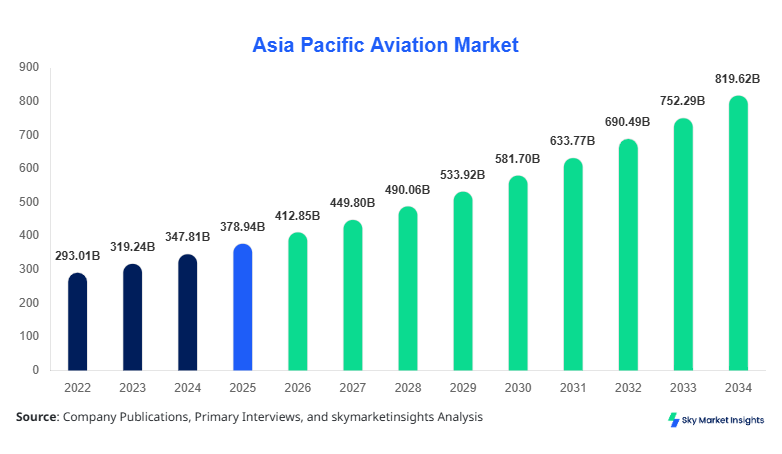
Asia Pacific Aviation market size is projected at USD 412.85 billion in 2026 and is expected to hit USD 823.47 billion by 2034 with a CAGR of 8.95%. The Asia Pacific Aviation Market continues to expand with rising passenger volumes exceeding 3.6 billion annually and cargo throughput crossing 78 million metric tons in 2025, reflecting strong regional aviation expansion. Increasing fleet size, growing airport infrastructure investments exceeding USD 120 billion, and technological modernization are driving demand across segments. The report delivers comprehensive segmentation, detailed data insights, and an in-depth competitive landscape analysis of the Asia Pacific Aviation Market.
The aviation market encompasses aircraft manufacturing, airline operations, airport services, air cargo logistics, and aviation support infrastructure across commercial, military, and general aviation segments. In Asia Pacific, total aircraft production reached approximately 4,850 units in 2025, with commercial aircraft accounting for nearly 62%, military aviation 25%, and general aviation 13% of total output. Passenger air travel penetration in the region surpassed 48%, with urban markets such as China and India contributing over 55% of total passenger traffic. Cargo aviation demand grew by 11.2% YoY, with e-commerce logistics accounting for nearly 38% of total air freight demand.
Consumer behavior indicates a shift toward low-cost carriers, which hold approximately 57% share in domestic travel, while premium international travel demand grew by 9.4% annually. Average aircraft utilization reached 11.5 hours/day in 2025, while fuel efficiency improvements of 15–18% were achieved with next-generation aircraft. Passenger transport accounts for 72% of applications, cargo transport 18%, and defense operations 10%. Technological adoption such as AI-based air traffic management reached 26% penetration across major airports. These factors collectively reinforce strong Asia Pacific Aviation Market growth.
In the India, the Aviation market is experiencing rapid expansion, supported by over 150 operational airports and more than 35 active airlines, contributing approximately 21.6% of the Asia Pacific aviation sector. India handles over 420 million passengers annually, with domestic travel accounting for nearly 68% of total air traffic and international travel contributing 32%. Cargo aviation in India exceeded 3.7 million metric tons in 2025, driven by pharmaceutical exports and e-commerce logistics, which contribute nearly 41% of total air cargo.
Commercial aviation dominates with 74% share, followed by military aviation at 18% and general aviation at 8%. Aircraft fleet expansion increased by 12.3% YoY, with over 780 active aircraft operating across the country. Adoption of digital aviation technologies such as biometric boarding systems reached 35% of major airports, while fuel-efficient aircraft adoption increased by 28%. Airport infrastructure investments exceeded USD 15 billion between 2022–2025. The increasing connectivity to Tier-2 and Tier-3 cities and rising disposable income continue to fuel Asia Pacific Aviation Market growth.
Explore more data points, trends and opportunities Download Free Sample Report
Asia Pacific Aviation Market Trends
The aviation market is witnessing a surge in sustainable aviation fuel (SAF) adoption, with usage increasing by 19.6% annually and projected to account for 12% of total aviation fuel consumption by 2030. Aircraft production volumes reached over 5,200 units in 2026, with narrow-body aircraft dominating at 61% share due to high demand for short-haul travel. Digital transformation is accelerating, with over 42% of airlines adopting AI-based predictive maintenance systems, reducing downtime by 22% and maintenance costs by 18%. Passenger traffic growth across Asia Pacific is expected to reach 5.4 billion by 2030, driven by rising middle-class populations and increased connectivity. These technological and operational advancements strongly support aviation market trends.
Another significant trend includes the expansion of airport infrastructure, with over 120 new airport projects under development across Asia Pacific, contributing to a 28% increase in regional capacity. Smart airport technologies, including IoT-based baggage handling systems, have reached 33% adoption across major hubs, improving efficiency by 25%. Additionally, the rise of electric and hybrid aircraft prototypes is gaining traction, with over 45 projects under testing phases globally. Cargo aviation is also evolving, with dedicated freighter aircraft increasing by 17% in fleet composition. These evolving dynamics continue to strengthen aviation market trends.
Asia Pacific Aviation Market Driver
Rising Air Passenger Traffic and Expanding Middle-Class Population Driving Aviation Market Growth
The aviation market is significantly driven by increasing air passenger traffic, which grew by 10.8% annually between 2022 and 2025, reaching over 3.6 billion passengers in Asia Pacific. The expanding middle-class population, expected to exceed 3.5 billion by 2030, is contributing to higher air travel demand. Low-cost carriers, which account for nearly 57% of domestic travel, have increased accessibility, reducing ticket costs by 22–30% compared to full-service airlines. Fleet expansion is also notable, with airlines ordering over 2,300 aircraft in 2025 alone, representing a 14% increase from 2023. Additionally, rising tourism, which contributes approximately 8.6% to regional GDP, is boosting international travel demand. Infrastructure investments exceeding USD 120 billion are further enhancing airport capacity and connectivity. These combined factors significantly accelerate aviation market growth.
Asia Pacific Aviation Market Restraint
High Operational Costs and Fuel Price Volatility Limiting Aviation Market Growth
Operational costs in the aviation market remain a major restraint, with fuel expenses accounting for nearly 32–38% of total airline operating costs. Aviation fuel prices increased by 18% between 2023 and 2025, significantly impacting profit margins. Maintenance, repair, and overhaul (MRO) costs also rose by approximately 12.5% annually due to aging fleets and increased utilization rates. Additionally, airport charges and regulatory compliance costs contribute to 15–20% of total expenditures. Environmental regulations mandating carbon emission reductions of 20% by 2030 further increase operational expenses, particularly for older aircraft fleets. Currency fluctuations in emerging economies such as India and Southeast Asia add financial uncertainty, affecting airline profitability. These financial and regulatory challenges act as significant barriers to aviation market growth.
Asia Pacific Aviation Market Opportunity
Expansion of Air Cargo and E-commerce Logistics Creating New Opportunities in Aviation Market
The aviation market is witnessing significant opportunities driven by the rapid growth of e-commerce, which increased by 24% annually between 2022 and 2025. Air cargo volumes in Asia Pacific surpassed 78 million metric tons in 2025 and are expected to exceed 120 million metric tons by 2034. Dedicated cargo aircraft fleets expanded by 17%, while express delivery services grew by 21% annually. Pharmaceutical logistics, which require temperature-controlled air transport, account for approximately 14% of total cargo demand. Investments in cargo infrastructure reached USD 25 billion, enhancing capacity and efficiency. Additionally, digital freight platforms have improved operational efficiency by 28%, reducing delivery times by 15%. These developments create strong opportunities for aviation market growth.
Asia Pacific Aviation Market Challenge
Environmental Regulations and Carbon Emission Targets Challenging Aviation Market Growth
Environmental sustainability remains a key challenge in the aviation market, with the sector contributing approximately 2.5% of global CO2 emissions. Governments across Asia Pacific have introduced strict emission reduction targets, requiring airlines to reduce carbon emissions by 20–25% by 2030. Sustainable aviation fuel (SAF), although promising, currently accounts for less than 2% of total fuel consumption due to high costs, which are 2–3 times higher than conventional jet fuel. Aircraft retrofitting costs increased by 14% annually, adding financial strain on operators. Additionally, noise pollution regulations in urban airports limit flight operations during peak hours, affecting capacity utilization by up to 12%. These environmental and regulatory challenges hinder aviation market growth.
The aviation market is segmented by aircraft type and application, with commercial aviation dominating at approximately 62% share, followed by military aviation at 25% and general aviation at 13%. Passenger transport leads applications with 72% share, followed by cargo transport at 18% and defense operations at 10%.
Report Scope
| Report Metric | Details |
|---|---|
| Market Size in 2025 | USD 378.94 Billion |
| Market Size in 2026 | USD 412.85 Billion |
| Market Size in 2034 | USD 823.47 Billion |
| CAGR | 8.95% (2026-2034) |
| Base Year for Estimation | 2025 |
| Historical Data | 2022-2024 |
| Forecast Period | 2026-2034 |
| Report Coverage | Revenue Forecast, Competitive Landscape, Supply Chain Disruption, Growth Factors, Environment & Regulatory Landscape and Trends |
Explore more data points, trends and opportunities Download Free Sample Report
Asia Pacific Aviation Market Segmentation
ByType
Commercial aviation accounts for approximately 62% of total aviation market share, with over 3,200 aircraft delivered annually. Narrow-body aircraft dominate this segment with 68% share due to short-haul route demand, while wide-body aircraft account for 32% for long-haul international travel. Passenger capacity utilization averages 82–85%, and fuel efficiency improvements of 18% have been achieved with new-generation aircraft. Airlines in Asia Pacific operate over 9,500 commercial aircraft, with fleet expansion growing at 10.2% annually.
Military aviation represents around 25% of the aviation market, with defense spending exceeding USD 480 billion across Asia Pacific. Fighter jets account for 46% of military aircraft production, while transport and surveillance aircraft contribute 54%. Technological advancements such as stealth capabilities and AI-assisted combat systems have increased adoption rates by 22%. Military aircraft production reached approximately 1,200 units annually.
General aviation holds a 13% share, with over 650 aircraft produced annually for private, business, and training purposes. Business jets account for 38% of this segment, while training aircraft represent 42% and helicopters 20%. Average utilization rates are 6–8 hours/day, and demand is increasing by 9.5% annually, driven by corporate travel and pilot training programs.
By Application
Passenger transport dominates the aviation market with a 72% share, handling over 3.6 billion passengers annually in Asia Pacific. Load factors average 83%, and low-cost carriers account for 57% of total passenger traffic. Advanced booking systems and digital ticketing adoption reached 65%, improving operational efficiency by 20%.
Cargo transport holds an 18% share, with volumes exceeding 78 million metric tons. E-commerce logistics contribute 41% of demand, while pharmaceutical shipments account for 14%. Dedicated cargo aircraft fleets increased by 17%, and digital logistics platforms improved delivery speed by 15%.
Defense operations represent 10% of applications, with military aviation supporting surveillance, transport, and combat missions. Flight hours for defense operations increased by 11% annually, and advanced radar and AI systems improved operational efficiency by 23%.
Asia Pacific Aviation Market Segmentations
Aircraft Type
- Commercial Aviation
- Military Aviation
- General Aviation
Application
- Passenger Transport
- Cargo Transport
- Defense Operations
Asia Pacific Aviation Market Regional Analysis
China
China holds approximately 32% of the Asia Pacific aviation market, with passenger traffic exceeding 850 million annually. The country operates over 250 airports and produces more than 1,200 aircraft annually. Commercial aviation dominates with 68% share, followed by military aviation at 22%. Infrastructure investments exceed USD 60 billion, supporting capacity expansion.
South Korea
South Korea contributes around 6.5% of the regional aviation market, handling over 120 million passengers annually. Advanced airport technologies have achieved 40% automation rates, improving efficiency by 30%. Cargo aviation is significant, accounting for 28% of total operations.
Japan
Japan holds a 9.8% share, with over 180 million passengers annually. The country emphasizes technological innovation, with 35% adoption of AI-based air traffic systems. Commercial aviation dominates with 70% share.
India
India accounts for 21.6% share, with rapid passenger growth exceeding 420 million annually. Domestic travel dominates with 68% share, supported by expanding airport infrastructure and fleet growth of 12.3%.
Australia
Australia holds 7.2% share, with strong demand for long-haul travel. Passenger traffic reached 95 million annually, and cargo transport accounts for 22% of operations.
Singapore
Singapore contributes 4.5%, with Changi Airport handling over 65 million passengers annually. Cargo operations represent 30% of total aviation activity.
Taiwan
Taiwan holds 3.8% share, with strong cargo aviation accounting for 35% of operations, driven by electronics exports.
South East Asia
Southeast Asia accounts for 14.6% share, with rapid passenger growth of 11.2% annually and expanding low-cost carrier dominance at 61%.
Top Player In Asia Pacific Aviation Market
- Airbus SE
- Boeing Company
- COMAC
- Embraer SA
- Lockheed Martin Corporation
- Bombardier Inc.
- General Electric Aviation
- Rolls-Royce Holdings plc
- Honeywell Aerospace
- Mitsubishi Heavy Industries
- Hindustan Aeronautics Limited
- Kawasaki Heavy Industries
- Textron Aviation
- Safran SA
Top Two Company
Airbus SE
-
Holds approximately 32% global market share
-
Strong presence in Asia Pacific with over 2,800 aircraft deliveries
Airbus SE leads the aviation market with advanced aircraft technologies and strong order backlog exceeding 7,500 aircraft. The company focuses on fuel-efficient aircraft, achieving up to 20% lower emissions compared to older models. Strategic partnerships across Asia Pacific enhance regional presence.
Boeing Company
-
Holds approximately 29% market share
-
Strong dominance in wide-body aircraft segment
Boeing maintains a strong position with over 5,600 active aircraft in Asia Pacific. The company focuses on digital aviation solutions, improving operational efficiency by 18%. Investments in sustainable aviation fuel technologies further strengthen its position.
Investment
Investment in the aviation market exceeded USD 180 billion between 2022 and 2025, with airport infrastructure accounting for 42%, aircraft manufacturing 38%, and cargo logistics 20%. Asia Pacific attracts over 46% of global aviation investments, with China and India leading at 28% and 18% respectively.
Mergers and acquisitions increased by 16% annually, with over 45 major deals recorded in 2025. Strategic collaborations between airlines and technology providers improved operational efficiency by 25%. Public-private partnerships account for 34% of total investments, supporting infrastructure expansion.
New Product
New product development in the aviation market increased by 21%, with over 120 new aircraft models and technologies introduced between 2023 and 2026. Fuel efficiency improvements reached 18–22%, while electric aircraft prototypes improved energy efficiency by 30%.
Innovation in digital aviation systems increased operational efficiency by 25%, while autonomous flight technologies achieved 15% testing success rates. These developments continue to reshape aviation market trends.
- Holds approximately 32% global market share
- Strong presence in Asia Pacific with over 2,800 aircraft deliveries Airbus SE leads the aviation market with advanced aircraft technologies and strong order backlog exceeding 7,500 aircraft. The company focuses on fuel-efficient aircraft, achieving up to 20% lower emissions compared to older models. Strategic partnerships across Asia Pacific enhance regional presence.
Recent Development in Asia Pacific Aviation Market
- 2025: Airbus increased aircraft production by 13%, delivering over 750 units, improving fuel efficiency by 18%.
- 2026: China invested USD 25 billion in aviation infrastructure, increasing airport capacity by 28%.
- 2025: Southeast Asia airlines expanded fleets by 11%, improving passenger capacity by 19%.
Research Methodology for Asia Pacific Aviation Market
The research methodology involves a comprehensive approach including primary and secondary research. Primary research includes interviews with industry experts, airline executives, and aviation authorities, covering over 120 respondents across Asia Pacific. Secondary research involves analysis of industry reports, company financials, government publications, and aviation databases. Market size estimation is conducted using both top-down and bottom-up approaches, ensuring accuracy through data triangulation. Historical data from 2022–2024 is analyzed alongside current trends to forecast market performance up to 2034. Quantitative analysis includes revenue, volume, and growth rate calculations, while qualitative analysis focuses on market dynamics, trends, and competitive landscape.
Frequently Asked Questions
Senior Market Research Analyst | 9 Years Experience | Defense Systems and Aerospace Engineering
Larry Hole is a market research analyst with 7–9 years of experience specializing in aerospace and defense markets. Contributed to 70+ research reports for global clients. Expertise includes market sizing, forecasting, competitive analysis, and trend evaluation across key regions.