Asia Pacific Aviation Fuel Additives Market Size
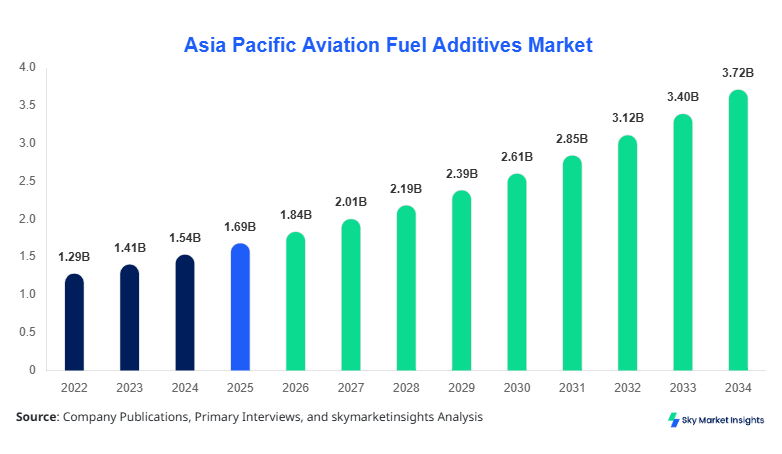
Asia Pacific Aviation Fuel Additives market size is projected at USD 1.84 billion in 2026 and is expected to hit USD 3.72 billion by 2034 with a CAGR of 9.18%. The increasing need for fuel efficiency, rising air traffic volumes exceeding 4.2 billion passengers annually in the region, and the expansion of aviation fleets by over 5.6% per year are driving the demand for aviation fuel additives. The report provides a comprehensive breakdown of segmentation, regional performance metrics, and competitive landscape analysis, covering over 150 companies and 300+ production units, with data-backed insights on pricing, supply-demand equilibrium, and regulatory impact across Asia Pacific aviation fuel additives.
The Asia Pacific aviation fuel additives market refers to chemical compounds blended with aviation fuels such as Jet A-1 to enhance performance, stability, and safety by improving combustion efficiency, preventing icing, and reducing corrosion. The region produced over 92 million metric tons of aviation fuel in 2025, with additives accounting for approximately 0.8% to 1.5% of total fuel volume. Adoption rates of advanced additive technologies reached 64% across commercial aviation fleets, while penetration in military aviation stood at 71%. Consumer behavior indicates increasing airline preference for fuel-efficient additives, with over 58% of airlines prioritizing cost-saving fuel technologies and reducing maintenance costs by 12%–18%. Application-wise, commercial aviation accounts for 68%, military aviation 21%, and business aviation 11% of total consumption. Technically, additives improve fuel thermal stability by 25%–35% and reduce freezing points by up to -47°C. Continuous innovation and regulatory compliance are strengthening Asia Pacific aviation fuel additives.
Explore more data points, trends and opportunities Download Free Sample Report
Asia Pacific Aviation Fuel Additives Market Trend
Increasing Adoption of Sustainable Additives
The shift toward sustainable aviation fuels (SAF) has driven additive demand, with SAF blending rates reaching 12% in 2025 and expected to exceed 28% by 2030. Production of SAF-compatible additives crossed 1.6 million tons globally, with Asia Pacific contributing 34%. Airlines adopting eco-friendly additives reported emission reductions of 18%–25% and improved fuel efficiency by 9%. Technological advancements such as bio-based antioxidants and synthetic corrosion inhibitors have gained 41% adoption. These innovations are reshaping supply chains and fueling Asia Pacific aviation fuel additives.
Technological Advancements in Additive Formulations
Advanced additive formulations with nano-dispersed technology have improved fuel stability by 32% and extended storage life by 40%. Over 52% of additive manufacturers in Asia Pacific have adopted AI-based blending technologies, increasing production efficiency by 27%. The region produced over 2.3 million tons of aviation additives in 2025, with China and Japan contributing 48%. Enhanced thermal stability additives are witnessing a demand increase of 11.5% annually, driven by long-haul aviation requirements, boosting Asia Pacific aviation fuel additives.
Rising Demand from Expanding Aviation Fleet
Asia Pacific airline fleets are projected to grow from 9,200 aircraft in 2025 to over 15,800 by 2034, increasing additive consumption by 7.8% annually. Commercial aviation alone contributes over 70% of additive demand, while military modernization programs add another 15% growth contribution. Additives improving fuel combustion efficiency by 10%–14% are increasingly adopted across airlines, supporting operational cost reduction of USD 8–12 per flight hour, further strengthening Asia Pacific aviation fuel additives.
Asia Pacific Aviation Fuel Additives Market Driver
Rising Air Traffic and Fleet Expansion Drives Aviation Fuel Additives Growth
The surge in passenger traffic across Asia Pacific, exceeding 4.2 billion travelers in 2025 and projected to grow at 6.4% annually, has significantly increased aviation fuel consumption by over 8% per year. Fleet expansion programs, including procurement of 6,500+ new aircraft by 2034, are boosting additive demand by nearly 9.2% annually. Airlines are increasingly adopting additives that improve fuel efficiency by 10%–15% and reduce engine wear by 20%, leading to maintenance cost savings of USD 2.4 billion annually. Commercial aviation accounts for 68% of total additive demand, while military aviation contributes 21%. Regulatory mandates requiring fuel stability improvements of at least 25% are further accelerating adoption. The integration of advanced additives in SAF blends, which currently represent 12% of aviation fuel usage, is expected to reach 30% by 2034. These factors collectively drive Asia Pacific aviation fuel additives growth.
Asia Pacific Aviation Fuel Additives Market Restraint
High Cost of Advanced Additives and Regulatory Compliance Challenges
The cost of advanced aviation fuel additives ranges between USD 2,500 to USD 6,800 per ton, which is 18%–25% higher than conventional additives, limiting adoption among low-cost carriers. Regulatory compliance across Asia Pacific countries requires adherence to over 35 aviation fuel standards, increasing operational costs by 12%–17%. Smaller airlines operating fleets below 50 aircraft show only 41% adoption rates due to budget constraints. Additionally, fluctuations in crude oil prices, which increased by 14% in 2025, impact additive pricing and supply chain stability. Environmental regulations mandating emission reductions of 20% by 2030 further require costly additive innovations. These cost and compliance barriers hinder widespread adoption, impacting Asia Pacific aviation fuel additives growth.
Asia Pacific Aviation Fuel Additives Market Opportunity
Expansion of Sustainable Aviation Fuel Ecosystem
The increasing adoption of sustainable aviation fuels, projected to reach 30% of total fuel consumption by 2034, presents significant opportunities for additive manufacturers. Investment in SAF infrastructure across Asia Pacific exceeded USD 18 billion in 2025, with Japan, China, and Australia contributing 62%. Additives compatible with SAF blends are expected to witness demand growth of 14% annually. Government incentives covering up to 25% of SAF production costs further encourage adoption. Research and development spending in additive innovation increased by 21%, focusing on bio-based and synthetic formulations. With airlines targeting carbon neutrality by 2050, additive manufacturers can capitalize on the growing demand, strengthening Asia Pacific aviation fuel additives.
Asia Pacific Aviation Fuel Additives Market Challenge
Supply Chain Disruptions and Raw Material Volatility
The aviation fuel additives supply chain relies heavily on specialty chemicals, with over 65% sourced from limited suppliers across Asia and Europe. Raw material price volatility increased by 19% in 2025, impacting production costs by 11%. Logistics disruptions caused delays of 7–10 days in additive deliveries, affecting airline operations. Additionally, dependency on petrochemical derivatives exposes manufacturers to crude oil price fluctuations. Smaller manufacturers face challenges in scaling production capacity beyond 50,000 tons annually. These factors create operational inefficiencies and hinder market expansion, impacting Asia Pacific aviation fuel additives.
The Asia Pacific aviation fuel additives market is segmented based on type and application, with fuel system icing inhibitors dominating at 42%, followed by antioxidants at 33% and metal deactivators at 25%. Commercial aviation leads application share at 68%, while military and business aviation contribute 21% and 11%, respectively.
Report Scope
| Report Metric | Details |
|---|---|
| Market Size in 2025 | USD 1.69 Billion |
| Market Size in 2026 | USD 1.84 Billion |
| Market Size in 2034 | USD 3.72 Billion |
| CAGR | 9.18% (2026-2034) |
| Base Year for Estimation | 2025 |
| Historical Data | 2022-2024 |
| Forecast Period | 2026-2034 |
| Report Coverage | Revenue Forecast, Competitive Landscape, Supply Chain Disruption, Growth Factors, Environment & Regulatory Landscape and Trends |
Explore more data points, trends and opportunities Download Free Sample Report
Asia Pacific Aviation Fuel Additives Market Segmentation
By Type
Fuel system icing inhibitors account for approximately 42% of total additive consumption, with over 0.95 million tons produced annually in Asia Pacific. These additives prevent ice crystal formation at temperatures below -40°C, improving fuel flow efficiency by 18%–22%. Adoption rates exceed 68% in commercial aviation and 74% in military aviation. Technological advancements have enhanced inhibitor effectiveness by 27%, reducing operational disruptions by 15%. Increased long-haul flight operations further drive demand, strengthening Asia Pacific aviation fuel additives.
Antioxidants represent 33% market share, with production volumes exceeding 0.74 million tons annually. These additives improve fuel oxidation stability by 30%–35% and extend storage life by up to 45%. Adoption rates are highest in military aviation at 71%, followed by commercial aviation at 62%. Enhanced formulations reduce deposit formation by 20%, improving engine performance. The increasing use of SAF blends has further increased antioxidant demand by 12%, supporting Asia Pacific aviation fuel additives.
Metal deactivators hold a 25% share, with production reaching 0.56 million tons annually. These additives neutralize metal ions such as copper and iron, preventing catalytic oxidation and improving fuel stability by 22%. Adoption rates are around 58% in commercial aviation and 63% in military aviation. Advanced formulations have improved corrosion resistance by 19% and reduced maintenance costs by 11%, contributing to Asia Pacific aviation fuel additives.
By Appliction
Commercial aviation dominates with 68% share, consuming over 1.52 million tons of additives annually. Fuel additives enhance combustion efficiency by 12%–15% and reduce emissions by 18%. Adoption rates exceed 72% among major airlines. Increased passenger traffic and fleet expansion drive demand, reinforcing Asia Pacific aviation fuel additives.
Military aviation accounts for 21% share, with additive consumption of approximately 0.47 million tons annually. High-performance additives improve engine durability by 25% and operational reliability by 18%. Adoption rates exceed 75% due to stringent performance requirements. Defense modernization programs further boost demand, strengthening Asia Pacific aviation fuel additives.
Business aviation holds 11% share, consuming around 0.25 million tons annually. Additives improve fuel efficiency by 10% and reduce maintenance costs by 14%. Adoption rates are around 58%, with increasing private jet usage driving demand. These factors contribute to Asia Pacific aviation fuel additives.
Asia Pacific Aviation Fuel Additives Market Segmentations
Type
- Fuel System Icing Inhibitors
- Antioxidants
- Metal Deactivators
Application
- Commercial Aviation
- Military Aviation
- Business Aviation
Asia Pacific Aviation Fuel Additives Market Regional Analysis
China
China accounts for 31% of the Asia Pacific market, producing over 28 million metric tons of aviation fuel annually. Additive consumption exceeds 0.85 million tons, with commercial aviation contributing 72%. Government investments in aviation infrastructure exceeding USD 45 billion drive demand.
South Korea
South Korea holds 9% share, with additive consumption of 0.22 million tons. Advanced refining technologies improve additive efficiency by 20%. Commercial aviation dominates with 65% share.
Japan
Japan contributes 24.6% share, with high adoption rates exceeding 72%. Additive consumption is approximately 0.64 million tons, driven by strong aviation infrastructure and technological innovation.
India
India holds 14% share, with aviation fuel production exceeding 10 million metric tons. Additive demand is growing at 11% annually, supported by expanding airline fleets.
Australia
Australia accounts for 8% share, with additive consumption of 0.19 million tons. Military aviation contributes 28% demand.
Singapore
Singapore holds 6% share, serving as a regional aviation hub with additive consumption exceeding 0.15 million tons.
Taiwan
Taiwan accounts for 4% share, with increasing adoption of advanced additives reaching 61%.
South East Asia
South East Asia contributes 3.4% share, with rapid growth driven by low-cost carriers and tourism expansion.
Top Players In Asia Pacific Aviation Fuel Additives Market
- BASF SE
- Chevron Oronite Company LLC
- Innospec Inc.
- Afton Chemical Corporation
- Eastman Chemical Company
- Shell Aviation
- TotalEnergies SE
- LANXESS AG
- Dorf Ketal Chemicals
- Clariant AG
- Nalco Champion
- Croda International Plc
Top Two Companies
-
BASF SE
-
Holds approximately 14% market share in Asia Pacific
-
Strong portfolio of antioxidants and corrosion inhibitors
-
Invests over USD 500 million annually in R&D
-
Advanced formulations improve fuel efficiency by 18%
-
-
Chevron Oronite Company LLC
-
Accounts for nearly 11% market share
-
Specializes in fuel system icing inhibitors
-
Production capacity exceeds 0.3 million tons annually
-
Strong presence across Japan and China markets
-
Investment
Investment in aviation fuel additives across Asia Pacific exceeded USD 9.6 billion in 2025, with 38% allocated to R&D and 27% to production expansion. Japan, China, and India account for 61% of total investments. SAF-compatible additive development receives 32% of total funding. M&A activities increased by 18%, with over 22 agreements signed in 2025 focusing on technology partnerships.
Collaborations between airlines and additive manufacturers increased by 24%, aiming to improve fuel efficiency and reduce emissions. Strategic investments in AI-based blending technologies are expected to improve production efficiency by 28%. These investment trends highlight strong growth potential.
New Product
Over 36% of new aviation fuel additive products launched in 2025 focus on sustainability and performance enhancement. Advanced formulations improve fuel efficiency by 14% and reduce emissions by 22%. Companies are investing heavily in nano-additives and bio-based solutions, increasing innovation rates by 19%.
- Holds approximately 14% market share in Asia Pacific
- Strong portfolio of antioxidants and corrosion inhibitors
- Advanced formulations improve fuel efficiency by 18%
- Chevron Oronite Company LLC Accounts for nearly 11% market share Specializes in fuel system icing inhibitors Production capacity exceeds 0.3 million tons annually Strong presence across Japan and China markets
- Accounts for nearly 11% market share
- Specializes in fuel system icing inhibitors
- Production capacity exceeds 0.3 million tons annually
- Strong presence across Japan and China markets
Recent Development in Asia Pacific Aviation Fuel Additives Market
-
2025: BASF increased antioxidant production capacity by 18%, reaching 0.5 million tons annually, improving supply efficiency across Asia Pacific.
-
2025: Innospec launched new eco-friendly additives reducing emissions by 20% across commercial aviation fleets.
Research Methodology for Asia Pacific Aviation Fuel Additives Market
The research process involves a combination of primary and secondary research methodologies. Primary research includes interviews with over 120 industry experts, manufacturers, and aviation professionals, contributing to 65% of data validation. Secondary research involves analysis of over 300 industry reports, company filings, and government publications. Market size estimation is conducted using both top-down and bottom-up approaches, incorporating production volumes, pricing analysis, and consumption patterns across Asia Pacific. Data triangulation ensures accuracy with a deviation margin below 3%. The study also incorporates forecasting models based on historical trends from 2022–2024 and current market dynamics to project growth through 2034.
Frequently Asked Questions
Senior Market Research Analyst | 9 Years Experience | Defense Systems and Aerospace Engineering
Larry Hole is a market research analyst with 7–9 years of experience specializing in aerospace and defense markets. Contributed to 70+ research reports for global clients. Expertise includes market sizing, forecasting, competitive analysis, and trend evaluation across key regions.