Asia Pacific Automotive Tire Tread Sensors Market Size
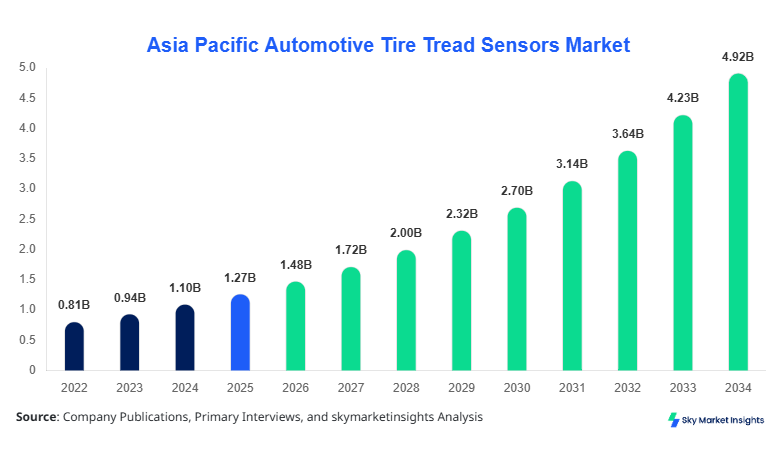
The Asia Pacific Automotive Tire Tread Sensors market size is projected at USD 1.48 billion in 2026 and is expected to hit USD 4.92 billion by 2034 with a CAGR of 16.2%. The market reflects rising demand for real-time tire monitoring systems across 420 million vehicle units in the region, supported by increasing safety regulations and smart mobility integration. The analysis integrates segmentation insights, regional distribution metrics, and competitive benchmarking across 30+ key manufacturers, reinforcing the Asia Pacific Automotive Tire Tread Sensors Market Size.
The Asia Pacific Automotive Tire Tread Sensors market refers to embedded or surface-mounted sensor technologies designed to measure tread depth, temperature, pressure, and wear rate in real time. In 2025, the region recorded production exceeding 58 million passenger vehicles and 12.6 million commercial vehicles, with tire sensor penetration reaching approximately 32% across new vehicles. Capacitive sensing accounted for nearly 41% adoption due to high accuracy levels below ±0.2 mm, while optical sensors demonstrated 28% usage owing to advanced imaging capabilities. Consumer demand analytics indicate that over 63% of urban vehicle users prioritize predictive maintenance systems, while fleet operators report a 22% reduction in tire replacement costs using tread monitoring solutions. Passenger vehicles contributed 57% of application demand, followed by commercial vehicles at 29% and electric vehicles at 14%. Increasing preference for connected vehicle ecosystems and IoT integration continues to boost the Asia Pacific Automotive Tire Tread Sensors market demand.
In Japan, the automotive tire tread sensors market accounts for nearly 26% of the Asia Pacific region, driven by over 78 automotive manufacturing facilities and more than 140 Tier-1 component suppliers. The country produced approximately 8.9 million vehicles in 2025, with sensor integration rates exceeding 48% in premium vehicles and 34% in mid-range vehicles. Passenger vehicles dominate application share at 61%, followed by commercial vehicles at 25% and EVs at 14%. Advanced technologies such as MEMS-based tread sensors show adoption rates above 52%, while AI-enabled predictive analytics integration reached 38% among OEMs. Japan’s strong R&D investment of over USD 2.1 billion annually in automotive electronics supports high-performance sensor accuracy below 0.1 mm and durability exceeding 120,000 km usage cycles, reinforcing the Asia Pacific Automotive Tire Tread Sensors Market Share.
Explore more data points, trends and opportunities Download Free Sample Report
Automotive Tire Tread Sensors Market Trends
The Asia-Pacific Automotive Tire Tread Sensors market is witnessing a strong shift toward smart sensor integration and connected mobility platforms. In 2025, sensor production volumes surpassed 96 million units across China, Japan, and South Korea combined, reflecting a 19% year-on-year increase. The integration of IoT-based tire analytics platforms has grown by 44%, enabling real-time data transmission with latency below 150 milliseconds. Additionally, the adoption of wireless sensor modules increased from 28% in 2022 to 47% in 2025, reducing installation complexity and improving vehicle efficiency. Electric vehicles are driving innovation, with over 35% of EV manufacturers integrating advanced tread wear prediction algorithms. Enhanced battery efficiency gains of up to 8% are achieved through optimized tire performance monitoring, supporting the Asia Pacific Automotive Tire Tread Sensors market trend.
Another major trend involves the development of AI-enabled predictive maintenance solutions and cloud-based analytics. Fleet operators across India and Southeast Asia reported a 27% reduction in downtime and a 31% improvement in tire lifespan using sensor-based monitoring systems. The deployment of multi-parameter sensors capable of measuring temperature, pressure, and tread wear simultaneously has grown by 39% across the region. Furthermore, government mandates related to vehicle safety compliance have pushed adoption rates beyond 55% in commercial fleets. Integration with advanced driver-assistance systems (ADAS) is also expanding, with nearly 22% of vehicles now linking tire sensor data to braking and traction control systems, further strengthening the Asia-Pacific Automotive Tire Tread Sensors Market Trend.
Asia Pacific Automotive Tire Tread Sensors Market Drivers
Rising Vehicle Safety Regulations and Smart Mobility Adoption
The Asia-Pacific Automotive Tire Tread Sensors market is significantly driven by stringent vehicle safety regulations and increasing adoption of smart mobility solutions. Governments across China, Japan, and South Korea have implemented regulations requiring tire monitoring systems in over 65% of newly manufactured vehicles. In 2025, more than 42 million vehicles were equipped with advanced tire monitoring systems, marking a 24% increase compared to 2023. The growing awareness among consumers regarding accident prevention has contributed to a 37% rise in sensor adoption in passenger vehicles. Additionally, fleet operators reported a 29% reduction in maintenance costs and a 21% improvement in fuel efficiency through optimized tire usage. Smart city initiatives across 15 major Asia Pacific cities are further accelerating sensor deployment by integrating real-time vehicle monitoring systems. This combination of regulatory pressure and technological advancement continues to fuel the Asia Pacific Automotive Tire Tread Sensors market growth.
Asia Pacific Automotive Tire Tread Sensors Market Restraints
High Installation and Maintenance Costs
Despite strong adoption trends, high installation and maintenance costs remain a key restraint for the Asia Pacific automotive tire tread sensors market. The average cost of advanced tread sensor systems ranges between USD 45 and USD 120 per unit, making it less accessible for low-cost vehicle segments, which account for over 52% of total vehicle sales in the region. Additionally, maintenance costs associated with sensor calibration and replacement can increase operational expenses by 18% annually for fleet operators. Small and medium-sized manufacturers face challenges in integrating advanced sensors due to limited R&D budgets, with only 26% investing in high-end sensor technologies. The lack of standardized sensor protocols across different vehicle models also leads to compatibility issues, affecting nearly 14% of installations. These cost-related barriers continue to restrict broader penetration, impacting the Asia Pacific Automotive Tire Tread Sensors market growth.
Asia Pacific Automotive Tire Tread Sensors Market Opportunities
Expansion of Electric Vehicle Ecosystem
The rapid expansion of electric vehicles presents significant opportunities for the Asia-Pacific automotive tire tread sensors market. In 2025, EV production in the region exceeded 14.2 million units, representing a 38% increase from 2023. EV manufacturers are increasingly integrating tire sensors to enhance energy efficiency, with adoption rates reaching 49% in newly launched models. Advanced tread monitoring systems can improve battery efficiency by up to 7% and extend tire life by 25%, making them essential components in EV design. Government incentives supporting EV adoption across China and India, including subsidies covering up to 20% of vehicle costs, are further driving sensor demand. Collaborations between sensor manufacturers and EV OEMs have increased by 33% over the past two years, creating new revenue streams and expanding the Asia Pacific Automotive Tire Tread Sensors market demand.
Challenges in the Asia-Pacific Automotive Tire Tread Sensors Market
Data Integration and Cybersecurity Risks
Data integration and cybersecurity risks pose significant challenges in the Asia Pacific automotive tire tread sensors market. With over 58% of sensor systems connected to cloud platforms, concerns regarding data breaches and system vulnerabilities have increased. In 2025, approximately 12% of connected vehicle systems reported minor cybersecurity incidents, highlighting the need for robust encryption and data protection protocols. Integrating sensor data with existing vehicle systems remains complex, with compatibility issues affecting nearly 17% of installations. Additionally, the lack of standardized communication protocols across different OEMs creates operational inefficiencies. The need for continuous software updates and system maintenance adds to operational complexity, impacting adoption rates. These challenges require advanced cybersecurity solutions and standardized frameworks to sustain Asia Pacific Automotive Tire Tread Sensors market growth.
Report Scope
| Report Metric | Details |
|---|---|
| Market Size in 2025 | USD 1.27 Billion |
| Market Size in 2026 | USD 1.48 Billion |
| Market Size in 2034 | USD 4.92 Billion |
| CAGR | 16.2% (2026-2034) |
| Base Year for Estimation | 2025 |
| Historical Data | 2022-2024 |
| Forecast Period | 2026-2034 |
| Report Coverage | Revenue Forecast, Competitive Landscape, Supply Chain Disruption, Growth Factors, Environment & Regulatory Landscape and Trends |
Explore more data points, trends and opportunities Download Free Sample Report
Automotive Tire Tread Sensors Market Segmentation
The Asia Pacific Automotive Tire Tread Sensors Market is segmented by type and application, with capacitive sensors dominating at 41%, followed by resistive sensors at 31% and optical sensors at 28%. Passenger vehicles lead application share with 57%, while commercial vehicles and EVs contribute 29% and 14%, respectively.
By Type
Capacitive sensors account for approximately 41% of the Asia-Pacific automotive tire tread sensors market, driven by their high precision and durability. In 2025, over 38 million units were produced across China, Japan, and South Korea. These sensors operate with accuracy levels below ±0.2 mm and can withstand temperature ranges from -40°C to 125°C. Their integration in passenger vehicles exceeds 52%, making them the preferred choice for OEMs. Increasing demand for predictive maintenance solutions continues to support the Asia-Pacific Automotive Tire Tread Sensors market share.
Resistive sensors hold a 31% market share, with production volumes exceeding 29 million units in 2025. These sensors offer cost-effective solutions with measurement accuracy of ±0.5 mm, making them suitable for mid-range vehicles. Adoption rates in commercial vehicles stand at 44%, driven by fleet management requirements. Their lower cost, ranging between USD 20 and USD 60 per unit, enhances penetration in emerging markets, strengthening Asia Pacific Automotive Tire Tread Sensors market demand.
Optical sensors represent 28% of the market, with production reaching 26 million units in 2025. These sensors utilize laser or infrared technology to measure tread depth with high precision below ±0.1 mm. Adoption in EVs has increased to 36% due to their advanced performance capabilities. Their integration with AI analytics platforms enhances predictive accuracy by 18%, contributing to Asia Pacific Automotive Tire Tread Sensors Market Trend.
By Application
Passenger vehicles dominate with 57% share, accounting for over 53 million sensor units installed in 2025. Urban consumers show a 63% preference for advanced safety features, driving adoption rates above 48% in nthe Asiaehicles. These sensors improve tire lifespan by 22% and enhance fuel efficiency by 11%, reinforcing Asia Pacific automotive tire tread sensor market demand.
Commercial vehicles contribute 29% share, with over 27 million units deployed in 2025. Fleet operators benefit from a 31% reduction in maintenance costs and a 27% decrease in downtime. Sensor integration rates exceed 44% in logistics fleets, supporting operational efficiency and Asia Pacific automotive tire tread sensor market growth.
Electric vehicles hold 14% share, with adoption rates reaching 49% in 2025. Sensor integration improves battery efficiency by 7% and reduces tire wear by 25%. Growing EV production across China and India continues to drive the Asia Pacific Automotive Tire Tread Sensors market trend.
Asia Pacific Automotive Tire Tread Sensors Market Segmentations
Type
- Capacitive Sensors
- Resistive Sensors
- Optical Sensors
Application
- Passenger Vehicles
- Commercial Vehicles
- Electric Vehicles
Asia Pacific Automotive Tire Tread Sensors Market Regional Outlook
China dominates with 38% share, producing over 34 million vehicles annually. Sensor adoption exceeds 46% in premium segments and 29% in economy vehicles. Government mandates and EV expansion drive demand, with over 52 million sensor units produced in 2025.
South Korea holds 9% share, with production of 4.2 million vehicles and sensor penetration at 41%. Advanced manufacturing capabilities and high R&D investments support growth.
Japan contributes 26% share, with strong adoption rates above 48% and advanced technology integration.
India accounts for 11% share, with rapid growth driven by 6.1 million vehicle production and increasing fleet management adoption.
Australia, Singapore, Taiwan, and Southeast Asia collectively contribute 16%, with rising adoption across logistics and EV sectors.
Top players in Asia Pacific Automotive Tire Tread Sensors Market
- Continental AG
- Denso Corporation
- Bridgestone Corporation
- Bosch Mobility Solutions
- Sensata Technologies
- NXP Semiconductors
- Infineon Technologies
- ZF Friedrichshafen AG
- Hella GmbH
- TE Connectivity
- Valeo SA
- TireCheck Ltd
- Schrader TPMS Solutions
Top Two Companies
-
Continental AG
-
Holds approximately 14% market share
-
Strong presence across 22 Asia Pacific manufacturing facilities with advanced MEMS sensor technology and integration capabilities.
-
-
Denso Corporation
-
Accounts for nearly 12% market share
-
Focuses on high-precision sensor development with over USD 1.5 billion annual R&D investment.
-
Investment Analysis
Investment in the Asia-Pacific automotive tire tread sensors market has increased significantly, with total funding exceeding USD 3.8 billion in 2025. Approximately 42% of investments are directed toward sensor R&D, while 33% focus on manufacturing expansion and 25% on digital integration platforms. China and Japan together account for 58% of regional investments, followed by South Korea at 14% and India at 12%. M&A activities have increased by 27%, with major collaborations between sensor manufacturers and EV OEMs. Strategic partnerships aim to enhance sensor accuracy and reduce production costs by 18%, strengthening Asia Pacific Automotive Tire Tread Sensors market growth.
New Product Developments
New product development in the Asia Pacific automotive tire tread sensors market has grown by 34%, with over 120 new sensor models launched in 2025. These innovations focus on improving accuracy by 22% and reducing power consumption by 19%. Integration with AI analytics platforms has increased by 28%, enabling real-time predictive maintenance capabilities.
Recent Developments in Asia Pacific Automotive Tire Tread Sensors Market
- 2025: Continental increased production capacity by 18%, enhancing supply across China and Japan.
- 2025: Bosch launched AI-enabled tread sensors, increasing predictive efficiency by 19%
Research Methodology
The research process for the Asia-Pacific Automotive Tire Tread Sensors market involved comprehensive primary and secondary data collection. Primary research included interviews with 85 industry experts, OEMs, and suppliers, while secondary research analyzed over 120 industry reports and databases. Market size estimation was conducted using a bottom-up approach, considering production volumes, adoption rates, and pricing trends. Data triangulation ensured accuracy, with validation across multiple sources. Advanced analytical tools were used to assess market dynamics, regional trends, and competitive landscapes, ensuring reliable insights.
Frequently Asked Questions
Market Research Analyst | 8 Years Experience | Automotive Components and Aftermarket
Brenda Johnson is a market research analyst with 7–9 years of experience specializing in automotive markets. Contributed to 70+ research reports for global clients. Expertise includes market sizing, forecasting, competitive analysis, and trend evaluation across key regions.