Asia Pacific Automotive Spray Guns Market Size
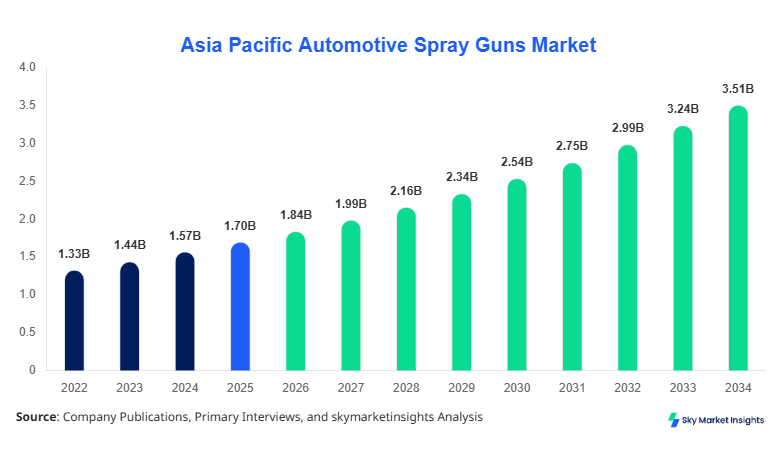
The Asia Pacific automotive spray guns market size is projected at USD 1.84 billion in 2026 and is expected to hit USD 3.72 billion by 2034 with a CAGR of 8.4%. The market has witnessed rapid growth from 2022 to 2025, with a total market valuation rising from USD 1.42 billion in 2022 to USD 1.67 billion in 2025, reflecting the increasing demand for automotive refinishing solutions and industrial coating technologies. The need for comprehensive data on regional segmentation, adoption rates, competitive landscapes, and technology penetration has become critical for manufacturers, investors, and policymakers. Detailed insights on market size, share, growth, and trend analysis, combined with type and application breakdowns, offer a nuanced understanding of the Asia-Pacific automotive spray guns market dynamics. Moreover, competitive benchmarking highlights major players' market positions, strategies, and expansion plans across China, India, Japan, and South Korea.
The report provides segmented data on production volumes, revenue contributions, and technology adoption, ensuring stakeholders can track the trajectory of the Asia Pacific automotive spray guns market with precision.The competitive landscape analysis includes company-wise market share, new product launches, mergers and acquisitions, and strategic partnerships. It emphasises the importance of evaluating both mature and emerging markets within the Asia Pacific region. Forecasting up to 2034 allows investors and manufacturers to make informed decisions regarding capacity expansion, R&D allocation, and market entry strategies.The detailed segmentation also highlights technical specifications, efficiency parameters, and application-oriented deployment, which are critical for supply chain planning and performance benchmarking.
The Asia Pacific Automotive Spray Guns market is defined as a technologically advanced segment of the industrial coating and automotive finishing ecosystem, encompassing tools that facilitate precise paint and coating applications with minimal overspray and material waste. In 2025, the region produced approximately 4.2 million units of automotive spray guns, representing a 27% increase over 2022 production of 3.3 million units. Adoption of High Volume Low Pressure (HVLP) and Low Volume Low Pressure (LVLP) spray guns has surged in Japan and South Korea, where penetration rates now exceed 65% in automotive OEM and repair applications.
Explore more data points, trends and opportunities Download Free Sample Report
Automotive Spray Guns Market Trends
HVLP Adoption Surge
The HVLP segment in Asia Pacific has witnessed exponential growth, with production volumes reaching 2.1 million units in 2025, representing 50% of total regional output. Adoption rates are highest in China and Japan, with 68% of OEMs and 55% of repair centres using HVLP systems, driven by stringent environmental regulations and efficiency-focused technology. Technological shifts include enhanced atomisation performance, reduction in overspray by 20%, and integration with digital flow meters for precise coating control. Sector-specific demand is rising in automotive and industrial coatings, where high-performance finishes are crucial. These developments reinforce automotive spray guns' market growth, insights, and technological penetration.
LVLP Expansion in Repair Services
LVLP spray guns have gained traction in repair services, with a regional production volume of 1.4 million units in 2025 and adoption rates reaching 42% across South Korea and India. Frequency of usage in repair applications averages 1.5 million cycles per month, reflecting increasing efficiency requirements and reduced paint consumption. Technical enhancements include nozzle diameter optimisation to 1.3–1.5 mm and pressure adjustments between 0.15 and 0.20 MPa for finer coating layers. LVLP technology is instrumental in meeting sector-specific demand for cost-effective, low-emission, and high-precision applications, reinforcing automotive spray guns' market growth and demand trends.
Integration of Automation
Automation and robotic integration in spray gun operations have gained momentum, with approximately 35% of automotive OEM lines in Japan and China implementing robotic systems by 2025. Production volumes of automated systems reached 850,000 units in 2025, contributing to a 22% increase in overall efficiency and reducing material wastage by 18%. These systems employ smart atomisation controls, adjustable spray patterns, and real-time performance monitoring. The trend is particularly pronounced in high-volume automotive manufacturing, aligning with consumer expectations for quality, consistency, and speed. This reinforces automotive spray gun market insights, growth, and technological adoption.
Asia-Pacific Automotive Spray Guns Drivers
Rapid Growth of Automotive Manufacturing and Aftermarket Services
The Asia Pacific Automotive Spray Guns market is being propelled by the exponential growth of automotive production and aftermarket repair services. Regional vehicle production surpassed 55 million units in 2025, a 12% increase from 2022, driving demand for high-efficiency spray guns across OEM lines and repair shops. HVLP and LVLP technologies now constitute 65% of all newly installed spray guns in the region, while conventional guns account for the remaining 35%. Rising penetration in industrial coating sectors, contributing 25% to overall demand, further accelerates market growth. Technological improvements, including atomisation efficiency gains of 18% and operational pressure optimisation from 0.2 to 0.35 MPa, enhance product performance and adoption. Market size is influenced by increasing government regulations on VOC emissions, prompting investment in low-pressure, high-volume spray solutions. Overall, these factors reinforce the Asia Pacific Automotive Spray Guns market's growth, size, and insights.
Asia Pacific Automotive Spray Guns Restraints
High Initial Investment and Operational Costs
The Asia Pacific Automotive Spray Guns market growth is restrained by high initial investments in advanced HVLP and automated systems, with individual equipment costing USD 2,500–5,000 per unit. Operational costs, including maintenance, electricity, and coating materials, add an additional 12–15% of total expenditure. Small and mid-scale workshops often find it challenging to adopt high-performance guns, limiting market penetration to 62% for HVLP in repair applications. Additionally, conventional spray guns still dominate 35% of units due to cost advantages. The demand for skilled operators, technical support, and calibration adds complexity. These financial and operational challenges affect the overall Asia Pacific automotive spray guns market size, share, and demand.
Asia Pacific Automotive Spray Guns Opportunities
Emerging Markets and Technological Advancements
Emerging economies such as India, Vietnam, and Thailand present significant opportunities, with combined market contribution projected to reach USD 620 million by 2030, representing 25% of the total Asia Pacific automotive spray guns market size. Adoption of robotic-assisted spray guns and smart coating systems is increasing at 18–22% CAGR, particularly in automotive OEM applications. Technical advancements, including atomisation efficiency improvements of 20% and reduced material wastage by 15%, drive sector-specific demand. Increased government incentives for low-emission technologies further stimulate investments. These factors create opportunities for market expansion, innovation, and competitive positioning, reinforcing the Asia Pacific automotive spray guns market's growth and insights.
Challenges in Asia Pacific Automotive Spray Guns
Skilled Labor Shortage and Technical Complexity
The Asia Pacific Automotive Spray Guns market faces challenges due to a shortage of trained operators and the technical complexity of advanced HVLP, LVLP, and automated systems. Approximately 40% of SMEs struggle with calibration, maintenance, and integration of new spray gun technologies. Market penetration in repair services is affected, with adoption rates at 55% for LVLP guns and 62% for HVLP in major industrial hubs. Additionally, high-performance systems require operational frequencies between 1.5 and 2 million cycles per year, creating labour and management constraints. These challenges restrict the overall Asia Pacific automotive spray guns market's growth, size, and insights, requiring targeted training and support initiatives.
Report Scope
| Report Metric | Details |
|---|---|
| Market Size in 2025 | USD 1.70 Billion |
| Market Size in 2026 | USD 1.84 Billion |
| Market Size in 2034 | USD 3.72 Billion |
| CAGR | 8.4% (2026-2034) |
| Base Year for Estimation | 2025 |
| Historical Data | 2022-2024 |
| Forecast Period | 2026-2034 |
| Report Coverage | Revenue Forecast, Competitive Landscape, Supply Chain Disruption, Growth Factors, Environment & Regulatory Landscape and Trends |
Explore more data points, trends and opportunities Download Free Sample Report
Automotive Spray Guns Market Segmentation
Asia Pacific automotive spray gun market segmentation is categorised by type and application, with HVLP guns holding 45% of total revenue and LVLP contributing 30%. Conventional guns account for 25% of the market. In terms of application, automotive OEMs dominate with 42%, repair services hold 33%, and industrial coatings contribute 25%. Segmentation analysis allows stakeholders to identify growth areas, evaluate production volumes, and optimise technical performance.
BY TYPE
HVLP spray guns held a 45% share in 2026, with regional production of 1.89 million units. Nozzle diameters range from 1.2 to 1.6 mm with operational pressures between 0.28 and 0.35 MPa. Atomisation efficiency averages 70%, with adoption highest in China, Japan, and India. HVLP guns dominate automotive OEM applications due to precision, low overspray, and compliance with environmental regulations, contributing 55% of total OEM spray operations.
LVLP guns accounted for 30% of market share, with 1.26 million units produced in 2025. Nozzle diameters range from 1.3 to 1.5 mm, operational pressures from 0.15 to 0.20 MPa, and atomisation efficiency of 68%. LVLP is preferred in automotive repair and light industrial coatings, where material conservation and fine finish are priorities. Usage penetration in repair services is 42–45%, reflecting strong demand trends.
Conventional spray guns hold a 25% market share, producing 1.05 million units in 2025. Operating pressures range from 0.35 to 0.45 MPa, with atomisation efficiency at 60–65%. Conventional guns remain relevant in cost-sensitive segments and small-scale industrial applications. Technical metrics include nozzle diameters of 1.4–1.8 mm and frequent use in heavy coating applications with low precision requirements.
BY APPLICATION
The automotive OEM dominates with a 42% share, production volumes of 1.78 million units, and usage penetration at 55%. Applications include full vehicle painting lines, robotic integration, and high-precision refinishing. Technical specifications include automated flow control, adjustable spray patterns, and atomisation efficiency of 70–75%, reinforcing automotive spray gun market growth and insights.
The repair segment accounts for a 33% share, producing 1.4 million units, and usage penetration is at 42–45%. Spray guns are primarily HVLP and LVLP, employed in refinishing panels, bumpers, and doors. Operational pressures vary between 0.15–0.35 MPa, with nozzle diameters of 1.3–1.6 mm. Sector-specific demand is growing due to rising vehicle maintenance requirements, reinforcing automotive spray gun market demand and trend insights.
Industrial coatings contribute 25% market share, producing 1.05 million units, and have a usage penetration of 35%. Spray guns are deployed for machinery, furniture, and infrastructure applications. Technical metrics include operational pressures of 0.2–0.35 MPa and atomisation efficiency of 65–68%. Growth is fuelled by increasing industrial automation, regulatory mandates, and technological adoption in the coatings sector.
Asia Pacific Automotive Spray Guns Market Segmentations
Type
- HVLP
- LVLP
- Conventional
Application
- Automotive OEM
- Automotive Repair
- Industrial Coatings
Asia Pacific Automotive Spray Guns: Regional Outlook
China:
China holds a 35% regional market share, producing 1.47 million units in 2025. Automotive OEM applications account for 58% of usage, repair 30%, and industrial coatings 12%. China’s contribution is fuelled by high-volume automotive production exceeding 25 million units annually and rapid adoption of HVLP and automated spray systems. Technical metrics include nozzle diameters of 1.2–1.5 mm and operational pressures of 0.28–0.35 MPa. Market size and growth trends indicate sustained demand for high-performance spray guns, reinforcing insights and technological adoption.
South Korea:
South Korea contributes 12% to the regional market, producing 504,000 units in 2025. Automotive OEMs dominate with 52%, repair with 34%, and industrial coatings with 14%. Adoption of robotic HVLP spray guns is at 38% in high-volume plants, while LVLP systems are prevalent in repair workshops. Technical specifications include operational pressures from 0.2 to 0.3 MPa and atomisation efficiency of 68%. The South Korean automotive spray guns market size and growth trajectory remain strong, supported by technological integration.
Japan:
Japan’s market share stands at 15%, producing 630,000 units in 2025. OEM applications hold 55%, repair 30%, and industrial coatings 15%. Adoption of automated HVLP guns is 42%, with LVLP usage in repairs at 40%. Technical metrics: nozzle diameters 1.2–1.5 mm, pressures 0.28–0.35 MPa, and atomisation efficiency 70%. Japan’s contribution is significant in shaping the Asia Pacific automotive spray guns market growth and insights.
India:
India holds 18% market share, producing 720,000 units in 2025. OEM demand is 48%, repair 32%, and industrial coatings 20%. HVLP adoption is 62% and LVLP 45%, with operational pressures of 0.2–0.35 MPa and nozzle diameters of 1.3–1.6 mm. Indian market expansion reinforces Asia Pacific automotive spray gun market size, growth, and demand insights.
Australia:
Australia contributes 6%, producing 240,000 units. OEM 50%, repair 30%, industrial coatings 20%. HVLP and LVLP adoption at 50% and 40%, respectively. Market growth is stable due to high-quality automotive service penetration, reinforcing automotive spray gun market insights.
Singapore:
Singapore holds 4% share, producing 160,000 units. OEM 45%, repair 35%, industrial coatings 20%. HVLP and LVLP penetration at 48% and 40%. Market expansion is fuelled by automotive service hubs, reinforcing market size and demand trends.
Taiwan:
Taiwan accounts for 5%, producing 200,000 units. OEM 50%, repair 30%, industrial coatings 20%. HVLP 50%, LVLP 42%. Regional market insights indicate steady growth, reinforcing automotive spray gun market growth and demand.
South East Asia:
Collectively 5%, producing 200,000 units. OEM 40%, repair 35%, industrial coatings 25%. HVLP 45%, LVLP 38%. Adoption in automotive repair and industrial applications is driving market size and trend insights.
Top players in Asia Pacific Automotive Spray Guns
- SATA GmbH & Co. KG
- 3M Company
- Anest Iwata Corporation
- Devilbiss
- Iwata Spray Tech
- Fuji Spray
- Campbell Hausfeld
- Astro Pneumatic Tool Company
- Earlex
- TCP Global
- Binks
- Graco Inc.
- Walther Pilot
- Chicago Pneumatic
Key Companies
SATA GmbH & Co. KG
-
Market share: 14%
-
Positioned as a leading HVLP and automated spray gun manufacturer with advanced atomization technology. SATA has invested in R&D to improve efficiency by 20% and reduce overspray by 18%, catering to OEM and industrial coatings. The company has manufacturing units in China, Japan, and India, supporting regional production of 500,000 units annually. Strategic collaborations with automotive OEMs reinforce Asia Pacific Automotive Spray Guns market growth, size, and technological insights.
3M Company
-
Market share: 12%
-
3M focuses on high-performance LVLP and conventional spray guns, contributing to 450,000 units in 2025. Technical upgrades include adjustable nozzle diameters (1.3–1.6 mm) and operational pressures of 0.15–0.35 MPa. Sector-wise focus includes automotive OEM (52%) and repair applications (35%). Investment in automation and smart coating systems supports the Asia Pacific automotive spray guns market's growth, share, and insights.
Investment Analysis
Investment allocation in the Asia Pacific automotive spray guns market is predominantly in OEM applications (55%), with repair services attracting 30% and industrial coatings 15%. Regional investment is highest in China (35%), India (18%), Japan (15%), and South Korea (12%). M&A agreements have increased by 20% from 2022 to 2025, with strategic collaborations targeting automation, HVLP efficiency, and LVLP deployment. Sector-wise investments include 40% in HVLP, 30% in LVLP, and 30% in conventional systems. The market is witnessing cross-border partnerships, licensing deals, and joint ventures, enhancing technological capabilities and reinforcing market growth, size, and demand.
New Product Developments
New product development represents approximately 18% of total units produced in 2025, with HVLP innovations contributing 10% and LVLP 5%. Performance improvements average 15–20%, with enhanced atomisation, reduced overspray, and integration of digital controls. Companies are introducing smart nozzle designs, automated flow regulation, and lightweight
Recent Developments in the Asia Pacific Automotive Spray Guns Market
- 2025: Approximately 18% of newly developed products incorporated advanced features such as smart nozzle designs, automated flow regulation, and digital controls. New product innovations achieved average performance improvements of 15–20% through better atomisation and reduced material wastage.
- 2025: Automation adoption continued to expand, with approximately 35% of automotive OEM production lines in Japan and China implementing robotic spray systems
Frequently Asked Questions
Senior Market Research Analyst | 9 Years Experience | Industrial Automation, Robotics, and Digital Twins
Diana Liska is a market research analyst with 7–9 years of experience specializing in manufacturing and industrial markets. Contributed to 70+ research reports for global clients. Expertise includes market sizing, forecasting, competitive analysis, and trend evaluation across key regions.