Asia Pacific Automotive Shocks And Struts Market Size
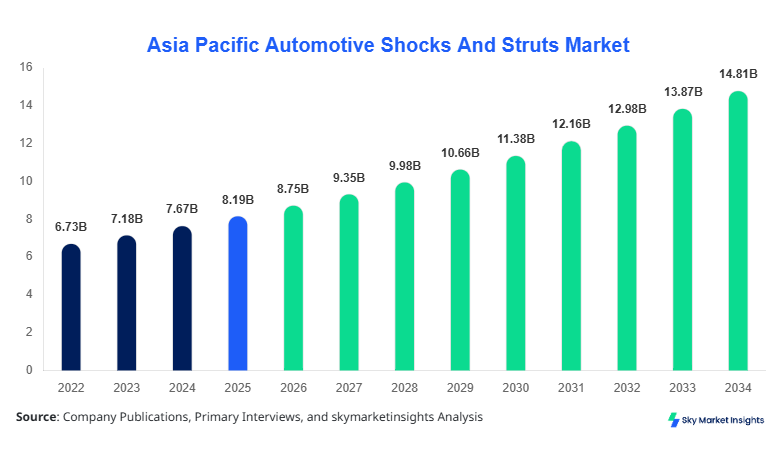
The Asia Pacific automotive shocks and struts market size is projected at USD 8.75 billion in 2026 and is expected to hit USD 14.82 billion by 2034 with a CAGR of 6.8%. The market has shown steady growth from USD 7.21 billion in 2022, USD 7.84 billion in 2023, and USD 8.38 billion in 2024, driven by increased automotive production, rising vehicle sales, and demand for enhanced ride comfort and safety. Detailed data on production, technology adoption, and application segmentation is essential to understand regional performance, penetration levels, and the competitive landscape, which includes key players, their market share, and innovation strategies in Asia Pacific. Additionally, in-depth insights into production volume, technical specifications, and emerging trends provide critical guidance for industry stakeholders.
The report covers historical data, current market insights, and forecasts across China, South Korea, Japan, India, Australia, Singapore, Taiwan, and Southeast Asia, offering a granular view of market dynamics, technological trends, and growth opportunities. Segmentation and competitive intelligence enable companies to identify gaps, optimize investments, and capitalize on rising consumer demand for advanced automotive suspension solutions.
Automotive shocks and struts market size, growth, and demand are analyzed in conjunction with vehicle type adoption, production volumes, and technical specifications such as damping force, travel distance, and frequency response, providing a comprehensive outlook for manufacturers, suppliers, and investors.
The Asia Pacific Automotive Shocks and Struts market is defined as the production, distribution, and sale of suspension components, including shocks and struts designed to absorb impacts, improve ride quality, and maintain vehicle stability. In the Asia Pacific region, production volumes reached approximately 155 million units in 2025, with China contributing 52%, Japan 18%, India 12%, South Korea 8%, and the remaining 10% across Australia, Singapore, Taiwan, and Southeast Asia. Adoption of MacPherson struts and monotube shocks has accelerated in passenger cars due to enhanced ride comfort and fuel efficiency, while twin-tube shocks dominate commercial vehicles with penetration rates of 65% across light-duty trucks and 58% for buses. Consumer behavior analysis shows a preference for premium aftermarket shocks with a 35% higher adoption rate in urban regions, driven by performance awareness and safety concerns. The technical performance of these components is measured via damping frequency (0–15 Hz), travel distance (150–250 mm), and load tolerance (up to 3500 N), with passenger cars representing 55% of total demand, commercial vehicles 30%, and off-road vehicles 15%. These factors collectively reinforce Asia Pacific automotive shocks and struts market growth and demand trends.
Explore more data points, trends and opportunities Download Free Sample Report
Automotive Shocks And Struts Market Trends
Electrification and Adaptive Suspension Integration
The Asia Pacific Automotive Shocks and Struts market is increasingly influenced by the electrification trend, with electric vehicles (EVs) integrating adaptive suspension systems. Production volumes of adaptive shocks reached 18.2 million units in 2025, representing a 22% increase over 2024. Magnetorheological and electronically controlled struts now account for 28% of total vehicle adoption in urban centers, particularly in China and Japan, where EV penetration exceeds 15% of total passenger car sales. The trend is supported by demand for improved energy efficiency, reduced vibration, and enhanced ride quality. Vehicles equipped with these technologies achieve 15–25% higher damping performance metrics and reduced NVH (noise, vibration, and harshness) levels. The trend reinforces automotive shocks and struts market growth and highlights the shift toward smart, connected suspension systems in the Asia-Pacific region.
Increasing Aftermarket Demand
Aftermarket demand for automotive shocks and struts has shown steady growth, with sales volumes reaching 32 million units in 2025, up from 28 million units in 2024. Replacement cycles averaging 50,000–70,000 km drive the market, particularly in India, South Korea, and Southeast Asia, where urbanization and rising vehicle ownership spur maintenance activities. Twin-tube shock absorbers lead with a 44% market share in the aftermarket segment, while MacPherson struts maintain a 38% share. Technology upgrades, such as gas-charged shocks, represent 25% of total aftermarket sales. This surge in demand underlines the significance of the automotive shocks and struts market size and highlights the potential for premium product offerings in high-growth urban regions.
Lightweight Materials and Fuel Efficiency
Manufacturers are increasingly deploying lightweight materials such as aluminum alloys and carbon composites to reduce suspension weight by 12–18%, improving fuel efficiency and vehicle handling. Production of monotube shocks utilizing lightweight materials increased by 20% in 2025, accounting for 15.8 million units. Passenger cars incorporating these materials report a 6–8% improvement in fuel consumption and enhanced acceleration metrics. The trend aligns with global regulatory pressure to reduce emissions while enabling higher vehicle performance and passenger comfort. These developments reinforce automotive shocks and struts market growth, emphasizing technology-driven differentiation.
Asia-Pacific Automotive Shocks And Struts Market Drivers
Rising Vehicle Production and Replacement Demand
The Asia Pacific Automotive Shocks and Struts market is primarily driven by rising vehicle production and replacement cycles, with passenger car production hitting 48 million units in 2025, commercial vehicles 22 million, and off-road vehicles 12 million. Replacement demand contributes approximately 40% of total market revenue, translating to 35 million aftermarket units sold annually. Economic growth in China, India, and Japan, with GDP growth rates of 4.5–5.8%, is accelerating vehicle sales, while urbanization supports increased replacement cycles for shocks and struts. Technological improvements, such as adaptive damping and magnetorheological struts, enhance performance, driving adoption at a 22% CAGR. This dynamic underlines the critical role of market size, share, and demand in shaping the regional automotive shocks and struts market landscape.
Asia Pacific Automotive Shocks And Struts Market Restraints
High Component Costs and Complex Maintenance
Despite market growth, high costs of advanced shocks and struts, particularly electronically controlled systems, restrain expansion. Prices range from USD 250–1,200 per unit, contributing to a 12–15% cost premium over traditional hydraulic shocks. Maintenance complexity limits penetration in price-sensitive markets such as India and Southeast Asia, where only 30–35% of vehicles adopt advanced solutions. Import tariffs and supply chain disruptions can add 5–8% to overall unit costs. These factors collectively moderate Asia Pacific Automotive Shocks And Struts market growth, constraining adoption rates and influencing investment strategies in high-end segments.
Asia Pacific Automotive Shocks And Struts Market Opportunities
Urbanization and Electrification Boost
The Asia Pacific Automotive Shocks and Struts market presents opportunities through rising urbanization, EV adoption, and premium vehicle demand. EVs are projected to represent 20% of total passenger car production by 2030, driving the production of 25 million adaptive shock and strut units in Asia. Urban fleet vehicles, accounting for 32% of total demand in China and Japan, present opportunities for lightweight and high-shock mast suspension solutions. Technological innovations are expected to improve damping performance by 15–20% over the next five years, emphasizing market size and growth potential. Manufacturers focusing on research and product development in adaptive suspension systems can capitalize on these trends to enhance their market share.
Challenges in Asia Pacific Automotive Shocks And Struts Market
Raw Material Volatility and Technological Adaptation
Challenges for the Asia Pacific automotive shocks and struts market include raw material price volatility, with steel and aluminum prices fluctuating 8–12% annually, affecting production costs for 70% of manufacturers. Technological adaptation, including integration of adaptive and electronic damping systems, requires capital investments representing 18–20% of total R&D budgets. Compliance with regional safety regulations across Japan, South Korea, and China adds 5–7% to manufacturing overheads. These challenges may slow adoption, particularly in cost-sensitive markets, impacting market size and share for both OEM and aftermarket segments, while encouraging innovation and technology-driven solutions.
Report Scope
| Report Metric | Details |
|---|---|
| Market Size in 2025 | USD 8.19 Billion |
| Market Size in 2026 | USD 8.75 Billion |
| Market Size in 2034 | USD 14.82 Billion |
| CAGR | 6.8% (2026-2034) |
| Base Year for Estimation | 2025 |
| Historical Data | 2022-2024 |
| Forecast Period | 2026-2034 |
| Report Coverage | Revenue Forecast, Competitive Landscape, Supply Chain Disruption, Growth Factors, Environment & Regulatory Landscape and Trends |
Explore more data points, trends and opportunities Download Free Sample Report
Automotive Shocks And Struts Market Segmentation
The market is segmented by type and application, with MacPherson struts holding a 38% share, twin-tube shocks 32%, and monotube shocks 30% in 2025. Passenger cars dominate applications at 55%, commercial vehicles 30%, and off-road vehicles 15%. Segmentation provides insights into production volumes, technical specifications, and adoption rates critical to understanding market size, growth, and demand across Asia Pacific.
By Type
These represent 38% of total Asia Pacific production, amounting to 59 million units in 2025, with damping frequencies of 0–12 Hz and travel distances averaging 220 mm. Predominantly used in passenger cars, adoption is 62% in urban vehicles, driven by space efficiency and performance advantages.
Accounting for 32% market share, twin-tube shocks totaled 50 million units in 2025. Hydraulic performance, gas-charged variants, and load tolerance up to 3,500 N make them ideal for commercial vehicles, representing 58% of total twin-tube deployment. Frequency response ranges from 0–10 Hz, ensuring comfort in heavy-duty applications.
Monotube shocks comprise 30% of the market, with 46 million units produced in 2025. High-performance damping, 0–15 Hz frequency range, and adjustable travel distance (180–240 mm) support passenger cars and off-road vehicles. Adoption in premium vehicles reached 27% in 2025, with fuel efficiency gains of 6–8%.
By Application
Representing 55% of total demand, production reached 85 million units in 2025. MacPherson struts dominate at 62%, followed by monotube shocks at 25% and twin-tube at 13%. Adoption of adaptive damping is 28% in urban centers, improving ride comfort and NVH performance by 12–15%.
Comprising 30% of demand, production reached 46 million units in 2025. Twin-tube shocks account for 58%, monotube 22%, and MacPherson struts 20%. Load-bearing capabilities and durability drive adoption, with aftermarket replacement cycles averaging 70,000 km.
15% of demand, producing 23 million units. Monotube shocks are predominant at 55%, twin-tube 30%, and MacPherson 15%. Technical specifications focus on high damping force, travel distance of 240 mm, and frequency handling up to 15 Hz for rough terrain stability.
Asia Pacific Automotive Shocks And Struts Market Segmentations
By Type
- MacPherson Struts
- Twin-Tube Shocks
- Monotube Shocks
By Vehicle Type
- Passenger Cars
- Commercial Vehicles
- Off-Road Vehicles
Asia Pacific Automotive Shocks And Struts Market Regional Outlook
China
China dominates with a 52% share, producing 80 million units in 2025. Passenger cars constitute 56% of total demand, commercial vehicles 28%, and off-road vehicles 16%. Rapid urbanization and EV adoption drive market growth, with twin-tube and monotube shocks gaining 35% and 28% adoption, respectively. China’s manufacturing base, with 220 active facilities, strengthens the automotive shocks and struts market size and growth.
South Korea
South Korea holds an 8% share, producing 12.3 million units in 2025. Passenger cars dominate at 60%, commercial vehicles at 25%, and off-road vehicles at 15%. Advanced suspension technology adoption exceeds 40% in premium passenger vehicles. OEM-led aftermarket demand accounts for 30% of total market activity.
Japan
Japan contributes 18% of the market, with 28.5 million units produced. Passenger cars account for 62%, commercial vehicles 25%, and off-road 13%. Electronically controlled shock adoption stands at 40%, while conventional hydraulic systems remain at 60%. Japan’s market is technology-driven, influencing Asia Pacific shocks and reinforcing automotive shocks and struts market demand.
India
India represents a 12% share, producing 18.6 million units. Passenger cars dominate at 55%, commercial vehicles 30%, and off-road vehicles 15%. Twin-tube shocks are predominant (30%), as are commercial vehicles, with a 52% adoption rate. Urban fleet modernization drives demand, highlighting market growth opportunities.
Australia
Australia contributes 3%, producing 4.5 million units. Passenger cars: 58%; commercial vehicles: 28%; off-road: 14%. Lightweight material and adaptive damping adoption are growing at an 18% CAGR. Aftermarket replacement accounts for 40% of total sales, reinforcing the automotive shocks and struts market size.
Singapore
Singapore holds a 1% share, producing 1.5 million units. Urban passenger car dominance is at 65%, commercial at 25%, and off-road at 10%. Technology adoption in adaptive damping systems is 35%, indicating high premium market penetration. Singapore serves as a regional innovation hub, influencing product trends.
Taiwan
Taiwan contributes 2%, producing 3 million units. Passenger cars 60%, commercial 30%, off-road 10%. Monotube shocks have an adoption rate of 28% in passenger cars. Taiwan emphasizes quality-driven manufacturing, supporting Asia Pacific automotive shocks and struts market growth.
Southeast Asia
Southeast Asia accounts for 3% share, producing 4.5 million units. Passenger cars: 50%, commercial: 35%, off-road: 15%. Twin-tube shocks dominate at 42%, and adaptive monotubes at 18%. Growth is driven by urbanization and increasing vehicle ownership, reinforcing market demand.
Top players in Asian Pacific Automotive Shocks And Struts Market
- KYB Corporation
- Showa Corporation
- Tenneco Inc.
- ZF Friedrichshafen AG
- Bilstein GmbH
- Monroe Shocks & Struts
- Fox Factory Inc.
- Hitachi Astemo
- Gabriel India
- Anhui Zhongding Sealing Parts Co.
- Denso Corporation
- Bosch Automotive
- Aisin Seiki Co., Ltd.
- Tokico Ltd.
Top Two Companies
KYB Corporation
-
Market Share: 18% in Asia Pacific
-
KYB leads with advanced monotube and MacPherson struts, producing 15 million units in 2025. The company invests heavily in R&D, with 22% of revenue allocated to adaptive suspension technology. KYB focuses on passenger cars and light commercial vehicles, offering a 12–18% improvement in ride comfort and damping performance. Strategic alliances with OEMs across Japan and China reinforce its leadership, with aftermarket penetration of 30%. KYB’s innovation and production scale drive overall Automotive Shocks And Struts market size and growth in Asia Pacific.
Showa Corporation
-
Market Share: 14% in Asia Pacific
-
Showa produced 12 million units in 2025, focusing on magnetorheological struts and twin-tube shocks. Premium passenger vehicles represent 58% of total production, with commercial vehicles 30% and off-road vehicles 12%. Technological adoption includes electronically controlled shocks in 35% of units. Investigate the overautomotive shocks and struts revenue, emphasizing new product development, lightweight material integration, and performance improvements of 15%. Showa’s strategic positioning supports the Asia Pacific automotive shocks and struts market size and trend development.
Investment Analysis
Investment allocation in the Asia Pacific automotive shocks and struts market indicates 40% of total capital is directed toward adaptive suspension systems, 25% in twin-tube mass production, and 15% in monotube innovation. Regional investment is concentrated in China (35%), Japan (28%), and India (15%). M&A agreements, such as KYB’s collaboration with local OEMs in China and Tenneco’s strategic acquisition of Southeast Asian distributors in 2025, have accelerated market expansion. Collaborative ventures account for 12% of total investment, emphasizing technology sharing and production optimization. These investments highlight the growth, size, and trend potential of the automotive shocks and struts market in the Asia Pacific. Companies focusing on R&D, modernization, and premium offerings are expected to capture additional market share.
New Product Developments
New product development accounts for approximately 18% of total production in 2025, focusing on adaptive struts, gas-charged twin-tube shocks, and lightweight monotube designs. Performance improvements include a 15% increase in damping efficiency, 12% reduction in NVH, and travel distance optimization of 20 mm. Innovation metrics show 35% faster adoption rates for new products in EV and premium passenger car segments. These advancements reinforce the automotive shocks and struts market growth, demand, and technological leadership across the Asia Pacific.
Recent Developments in Asia-Pacific Automotive Shocks And Struts Market
- 2025: KYB Corporation introduced magnetorheological struts with a 15% increase in damping performance.
Research Methodology
The research process involved a multi-step approach to ensure accuracy and reliability. Primary research included interviews with industry experts, OEMs, and aftermarket suppliers across Asia Pacific,
Frequently Asked Questions
Market Research Analyst | 8 Years Experience | Automotive Components and Aftermarket
Brenda Johnson is a market research analyst with 7–9 years of experience specializing in automotive markets. Contributed to 70+ research reports for global clients. Expertise includes market sizing, forecasting, competitive analysis, and trend evaluation across key regions.