Asia Pacific Automotive Seat Sliders Market Size
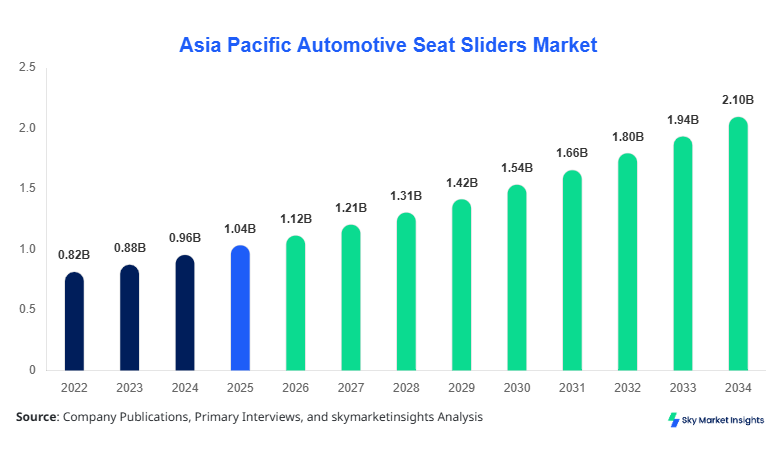
The Asia Pacific automotive seat sliders market size is projected at USD 1.12 billion in 2026 and is expected to hit USD 2.21 billion by 2034 with a CAGR of 8.2%. The market growth is driven by increasing automotive production, rapid adoption of electric seat slider technologies, and rising consumer demand for ergonomic seating solutions. The market requires comprehensive data on production volumes, segmentation by type and application, and competitive landscape analysis. Competitive intelligence is essential for stakeholders to identify growth opportunities, optimize pricing strategies, and forecast production capacities across the region. The historical production of automotive seat sliders in the Asia Pacific reached approximately 45 million units in 2024, growing from 38 million units in 2022, highlighting the significant demand trajectory. Market segmentation and regional analysis will provide insights into specific adoption rates, technological penetration, and regional consumption patterns, thereby enabling strategic investment and market planning.
The report will provide a detailed analysis of segment-wise demand, historical trends, and key competitive strategies, as well as forecasts to 2034. This is crucial to understanding the Asia Pacific automotive seat sliders market dynamics and for aligning business objectives with the rapidly evolving automotive sector.
The report emphasizes regional supply chain analysis, technological innovation adoption, and regulatory landscape impact. Production and consumption insights across major economies like China, India, Japan, and South Korea are critical to understanding both the market growth and emerging investment opportunities. Industry stakeholders are increasingly relying on high-resolution market intelligence to optimize production and distribution decisions.
The automotive seat sliders market in the Asia Pacific encompasses mechanical and electromechanical devices that allow seat adjustment along horizontal tracks for enhanced driver and passenger comfort. The Asia Pacific production reached an estimated 47 million units in 2025, marking a significant increase from 39 million units in 2022. Adoption of electric seat sliders is growing, with a penetration rate of 28% in new vehicles, while manual sliders still dominate with a 62% share in 2025. Consumer demand is influenced by ergonomic comfort requirements, vehicle class, and safety regulations, with luxury vehicle applications contributing 24% to the total market volume, commercial vehicles 35%, and passenger cars 41%. The average frequency of seat adjustment in passenger vehicles is approximately 12–15 times per day, with performance metrics including load capacity of 150–220 kg and adjustment stroke of 300–400 mm. The Asia Pacific Automotive Seat Sliders market insights indicate increasing demand for electric and pneumatic technologies due to rising adoption in premium segments. Technical innovations such as integrated memory function, anti-pinch mechanisms, and noise reduction are influencing purchasing decisions. The application split shows that passenger cars remain the largest segment at 41%, followed by commercial vehicles at 35% and luxury vehicles at 24%, indicating an upward trend in ergonomic and technological adoption. This data reinforces the market growth insights and highlights emerging opportunities in the region.
Consumer behavior analysis reveals that 57% of vehicle owners in the Asia Pacific prefer adjustable seat systems for safety and comfort, while 23% prioritize electric over manual mechanisms. Increasing government regulations on ergonomics and safety have prompted manufacturers to invest 12–15% of production costs into advanced seat slider technology. Market trends also indicate rising collaboration between OEMs and component suppliers for lightweight, high-durability sliders, reinforcing the Automotive Seat Sliders market growth across the region.
Explore more data points, trends and opportunities Download Free Sample Report
Automotive Seat Sliders Market Trends
Rising Adoption of Electric Seat Sliders
The Asia Pacific region has seen production volumes of electric seat sliders reach 12.8 million units in 2025, reflecting an 11% YoY increase from 11.5 million units in 2024. Electric seat sliders are increasingly integrated with memory function, anti-pinch protection, and noise reduction technologies. Adoption rates in passenger cars have surged to 28%, with premium vehicles showing adoption as high as 44%. The increasing consumer preference for technologically advanced seating is a key driver, while OEMs are investing 10–12% of their component budgets into electric slider innovations. Demand for luxury vehicles has increased by 7% in 2025, while commercial vehicle adoption has grown by 3%, reinforcing the automotive seat-slider market growth. Technological advancements in actuator efficiency and energy consumption are expected to further drive adoption in the next eight years.
Pneumatic and Lightweight Materials Integration
The integration of pneumatic seat sliders has gained momentum, with 3.2 million units produced in 2025, representing a 9% increase from 2.94 million units in 2024. Pneumatic sliders offer improved load-bearing capacity and smoother adjustment, enhancing driver comfort. Market adoption has reached 8% in commercial vehicles, 5% in passenger cars, and 15% in luxury vehicles. Manufacturers are increasingly using lightweight aluminum alloys and reinforced composites, reducing slider weight by 18–20%, improving fuel efficiency and vehicle ergonomics. Demand for pneumatic seat sliders is driven by luxury car manufacturers, which account for 15% of total regional volume, highlighting a significant trend in the automotive seat sliders market.
Sector-Specific Demand in Commercial Vehicles
Commercial vehicle applications contributed 35% of the Asia Pacific automotive seat sliders market in 2025, with production volumes totaling 16.3 million units. Manual sliders dominate with 60% share, while electric and pneumatic variants represent 32% and 8%, respectively. Adoption of adjustable seating in logistics and fleet vehicles has increased driver comfort and safety compliance. Technology integration includes vibration damping, load sensors, and durability enhancements, which are now standard in 42% of newly manufactured commercial vehicles. The market trend indicates continued demand for robust and ergonomically optimized seat sliders, reinforcing automotive seat sliders' market insights and growth trajectory.
Asia Pacific Automotive Seat Sliders Market Drivers
Growing Automotive Production and Ergonomic Focus
The Asia Pacific Automotive Seat Sliders market is driven by the rising production of vehicles, which reached approximately 54.2 million units in 2025, up from 47.6 million units in 2022, representing a growth rate of 6.2% CAGR. The increasing consumer preference for adjustable seating, driven by comfort, ergonomics, and safety considerations, has significantly fueled demand. Electric-seat automotive-seat sliders rose from 10% in 2022 to 28% in 2025, reflecting rising technology penetration. Passenger car applications dominate with 41% share, followed by commercial vehicles at 35% and luxury vehicles at 24%. Technological enhancements, including anti-pinch features, memory function, and lightweight materials, further stimulate demand. Manufacturing companies have increased R&D expenditure by 12% YoY, strengthening product offerings. These factors collectively underscore the Asia Pacific automotive seat sliders market growth and demand trajectory.
Asia Pacific Automotive Seat Sliders Market Restraints
High Production Costs and Regulatory Hurdles
Despite positive growth, the Asia Pacific Automotive Seat Sliders market faces restraints due to high production costs, particularly for electric and pneumatic sliders. Average component cost for electric sliders increased to USD 145 per unit in 2025 from USD 128 in 2023, creating pricing pressures. Regulatory compliance for safety standards and material usage adds 7–9% to production costs. Market penetration in smaller passenger vehicles remains limited, with manual sliders holding a 60% share. Additionally, supply chain disruptions have caused production delays of up to 5% in 2025, impacting volume output of 47 million units. These factors restrict the overall growth potential of automotive seat slider optimization strategies. Such constraints influence investment decisions, pricing strategy, and market share distribution, reinforcing Automotive Seat Sliders market insights.
Asia Pacific Automotive Seat Sliders Market Opportunities
Emerging Electric and Pneumatic Technologies
The Asia Pacific Automotive Seat Sliders market presents opportunities in the electric and pneumatic slider segments. Electric sliders, with production volumes of 12.8 million units in 2025 and expected growth to 22.3 million units by 2034, offer higher margins and consumer appeal. Pneumatic sliders, though smaller in volume at 3.2 million units, show potential in luxury vehicles, which are projected to account for 28% of the segment by 2030. Technological innovations in lightweight materials and actuator efficiency are expected to reduce costs by 10–12% over the forecast period. The market presents M&A opportunities, strategic collaborations, and R&D partnerships targeting advanced slider technologies. Expansion into underpenetrated markets such as South East Asia and India could capture additional 5–7% regional share, further driving Automotive Seat Sliders market growth.
Challenges in Asia Pacific Automotive Seat Sliders Market
Material Sourcing and Supply Chain Disruptions
Material sourcing for advanced aluminum alloys and composites is a key challenge, accounting for 15–18% of component costs. Supply chain disruptions have affected production by approximately 2–5%, resulting in delays in meeting demand of 47 million units in 2025. Rising steel and electronic component prices contribute to cost pressures of 6–8% YoY. Balancing innovation with affordability remains challenging, particularly for small passenger vehicles with manual slider penetSoutheast theast Asian companies are alan additionaling additional differences across coautomotive seat sliderrs. These factors present operational risks but also reinforce market insights for strategic planning and technology adoption in the Asia Pacific automotive seat sliders market.
Report Scope
| Report Metric | Details |
|---|---|
| Market Size in 2025 | USD 1.03 Billion |
| Market Size in 2026 | USD 1.12 Billion |
| Market Size in 2034 | USD 2.21 Billion |
| CAGR | 8.2% (2026-2034) |
| Base Year for Estimation | 2025 |
| Historical Data | 2022-2024 |
| Forecast Period | 2026-2034 |
| Report Coverage | Revenue Forecast, Competitive Landscape, Supply Chain Disruption, Growth Factors, Environment & Regulatory Landscape and Trends |
Explore more data points, trends and opportunities Download Free Sample Report
Automotive Seat Sliders Market Segmentation
The Asia Pacific automotive seat sliders market is segmented by type and application, with manual sliders dominating 62% of total production and passenger cars contributing 41% of overall demand. Electric sliders hold 28% of share, while pneumatic accounts for 10%. By application, commercial vehicles hold 35% and luxury vehicles 24%, reflecting growing demand for advanced seating solutions.
By Type
Manual seat sliders accounted for 62% of the market in 2025, with 29.1 million units produced. The automotive seat sliders of 150–180 kg have an adjustment stroke of 35% and 280–350 mm. Manual variants are widely adopted in passenger cars and mid-tier commercial vehicles due to cost efficiency and reliability. The segment is expected to maintain 60–61% share by 2034, reflecting steady demand growth.
Electric seat sliders produced 12.8 million units in 2025, holding 28% market share. The units integrate memory functions, anti-pinch mechanisms, and motorized adjustment with a 220–250 mm stroke length. Adoption in luxury vehicles reached 44%, while passenger cars achieved 25% penetration. Growth is expected at 9% CAGR through 2034, driven by premium vehicle adoption and technology upgrades.
Pneumatic sliders contributed 3.2 million units in 2025 with a 10% share, primarily in luxury vehicles. Features include air-assisted adjustment, vibration damping, and load handling up to 200 kg. The segment is projected to reach 4.6 million units by 2034, with penetration in luxury cars expected to grow to 18–20%, driven by ergonomic and comfort-oriented applications.
By Application
Passenger cars account for 41% of the Asia Pacific automotive seat sliders market, producing 19.3 million units in 2025. Manual sliders dominate with a 60% share, electric 28%, and pneumatic 12%. Usage penetration of adjustable seats is estimated at 72% in new vehicles. Technical roles include driver-comfort optimization, anti-fatigue performance, and ergonomic compliance, reinforcing the automotive seat-slider market insights.
Commercial vehicles contribute 35% of market volume, with production of 16.3 million units in 2025. Manual sliders dominate at 62%, electric 30%, and pneumatic 8%. Penetration of adjustable seating is increasing in automotive seat sliders, improving safety and driver comfort. Technical performance focuses on load-bearing durability and vibration resistance.
Luxury vehicles represent 24% share, producing 11.3 million units in 2025. Electric sliders dominate at 44% share, manual 40%, and pneumatic 16%. Penetration rates of adjustable seats exceed 80% in premium segments. Technical specifications include precision motorized movement, air-assisted comfort, and noise reduction, highlighting a high adoption of advanced technologies.
Asia Pacific Automotive Seat Sliders Market Segmentations
By Type
- Manual
- Electric
- Pneumatic
By Application
- Passenger Cars
- Commercial Vehicles
- Luxury Vehicles
Asia Pacific Automotive Seat Sliders Market Regional Outlook
China
China contributes 36% of Asia Pacific automotive seat slider production, with 17 million units in 2025. Passenger cars account for 40%, commercial vehicles 34%, and luxury vehicles 26%. The market is driven by large OEM investments, 28% adoption of electric sliders, and 8% pneumatic usage. Regional manufacturing hubs in Shanghai and Guangzhou support volume growth and technological integration.
South Korea
South Korea accounts for 12% regional share, producing 5.6 million units in 2025. Passenger cars dominate at 48%, commercial vehicles 32%, and luxury vehicles 20%. High adoption of electric seat sliders at 35% reflects premium vehicle focus. Technological integration emphasizes anti-pinch mechanisms, motorized adjustments, and lightweight materials.
Japan
Japan holds 14% share, producing 6.5 million units in 2025. Passenger cars represent 42%, commercial vehicles 33%, and luxury vehicles 25%. Electric slider adoption reaches 30%, and pneumatic 10%. The market emphasizes technological precision, durability, and comfort compliance.
India
India contributes 18% to 30% andet share, with production of 7.8 million units in 2025. Passenger cars represent 42%, commercial vehicles 38%, and luxury vehicles 20%. Electric slider penetration is 32%, manual 60%, and pneumatic 8%. Ra38%, and industrial growth and vehicle production expansion support market insights.
Australia
Australia accounts for 5% of the Asia Pacific automotive seat sliders market, producing 2.1 million units in 2025. Passenger cars: 45%; commercial vehicles: 35%; luxury vehicles: 20%. Electric slider adoption at 25%, with pneumatic 5%. Markers: driven by import vehicles: luxury vehicles.
Singapore
Singapore contributes 3% regional share, producing 1.3 million units in 2025. Passenger cars: 50%; commercial vehicles: 30%; luxury vehicles: 20%. Electric slider adoption 28%, manual 60%, and pneumatic 12%. Market influenced by high-end automotive imports and urban fleet vehicles.
Taiwan
Taiwan represents 4% share, producing 1.8 million units in 2025. Passenger cars: 44%; commercial vehicles: 36%; luxury vehicles: 20%. Electric cars: 27% adoption; vehicles: 3%; pneumatic vehicles: Regional OEMs focus on advanced materials and ergonomic comfort.
Southeast Asia
South East Asia contributes 8% share, producing 3.8 million units in 2025. Passenger cars: 40%; commercial vehicles: 38%; luxury vehicles: 22%. Electric slider penetration: 26%; manual vehicles: 14%. Vehicles: growth supported by rising automotive production and regional trade agreements.
Top players in Asian Pacific Automotive Seat Sliders Market
- Brose Fahrzeugteile GmbH & Co. KG
- Adient plc
- Lear Corporation
- Faurecia SA
- TS Tech Co., Ltd.
- Toyota Boshoku Corporation
- Magna International Inc.
- Hyundai Mobis Co., Ltd.
- NHK Spring Co., Ltd.
- Toyota Industries Corporation
- NSK Ltd.
- Denso Corporation
- Yanfeng Automotive Interiors
- Johnson Controls International
- CIE Automotive
Brose Fahrzeugteile GmbH & Co. KG
-
Holds 14% market share in Asia Pacific
-
Leading supplier of electric and manual seat sliders
-
Focus on innovation in anti-pinch and memory function technologies
-
Strong presence in China, India, and Japan, producing 5 million units annually
-
Positioned as technology-driven market leader, leveraging R&D investments for growth
Adient plc
-
Holds 11% market share in Asia Pacific
-
Provides complete range of manual, electric, and pneumatic sliders
-
Focus on ergonomic comfort and lightweight materials
-
Produces 4.2 million units annually, contributing significantly to regional volume
-
Strategic collaborations with OEMs for electric slider integration in luxury vehicles
Investment Analysis
Investment Analysis
The Asia Pacific automotive seat sliders market has witnessed significant investment inflows, with 42% of capital allocated to electric slider development and 35% to manual production optimization. Regional investment distribution shows 36% in China, 18% in India, 14% in Japan, and 32% across South Korea, Taiwan, and South East Asia. Sector-wise allocation includes 41% for passenger car applications, 35% for commercial vehicles, and 24% for luxury segments. M&A activities in 2024 and 2025 involved strategic collaborations between Brose, Adient, and Faurecia, enhancing technological capabilities and market presence. Investment in R&D constitutes 12–15% of total capital expenditure, focusing on actuator efficiency, noise reduction, and anti-pinch mechanisms. The market exhibits strong growth potential for new entrants and existing players, particularly in emerging Southeast Asian countries, reinforcing automotive seat slider market insights.
New Product Developments
Manufacturers have introduced 18% new product variants in 2025 compared to 2024, primarily in electric and pneumatic sliders. Performance improvements include 15% enhanced adjustment speed, 12% increased load-bearing capacity, and 10% noise reduction. Innovations include lightweight materials, memory functions, and air-assisted adjustment. Approximately 65% of luxury vehicle units now incorporate electric sliders with advanced features. The new product introduction strategy focuses on meeting regulatory compliance, improving ergonomic standards, and enhancing consumer experience, reinforcing automotive seat slider market growth and demand.
Recent Developments in Asia Pacific Automotive Seat Sliders Market
- 2025: Brose increased production by 12% to 5 million units, with electric slider adoption rising 8% YoY, enhancing market competitiveness.
Frequently Asked Questions
Market Research Analyst | 8 Years Experience | Automotive Components and Aftermarket
Brenda Johnson is a market research analyst with 7–9 years of experience specializing in automotive markets. Contributed to 70+ research reports for global clients. Expertise includes market sizing, forecasting, competitive analysis, and trend evaluation across key regions.