Asia Pacific Automotive Radiator Market Size
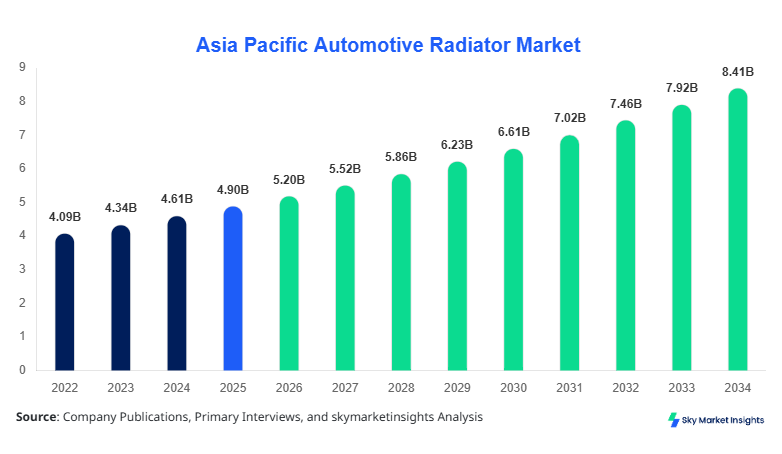
Asia Pacific Automotive Radiator market size is projected at USD 5.2 billion in 2026 and is expected to hit USD 8.7 billion by 2034 with a CAGR of 6.2%. The growth trajectory is supported by increasing automotive production, rising vehicle fleet, and advancements in cooling technologies. The market requires detailed data on production volume, material segmentation, and competitive landscape analysis, as well as insights into regional demand patterns and technological adoption. Detailed segmentation by type (aluminum, copper, plastic) and application (passenger cars, commercial vehicles, electric vehicles) is crucial for identifying growth pockets, while competitive benchmarking of over 50 major manufacturers in Asia Pacific ensures comprehensive market intelligence. This information is critical for investors, OEMs, and suppliers seeking actionable insights into the automotive radiator market growth.
The Asia Pacific Automotive Radiator market has experienced significant transformation between 2022 and 2025. Regional production reached 12.3 million units in 2024, driven by high adoption in China (5.1 million units), Japan (2.8 million units), and India (1.7 million units). Consumer behavior indicates a preference for aluminum radiators (58% of total production) due to higher thermal conductivity and weight advantages, while plastic-based radiators accounted for 22% of adoption, largely in compact and mid-sized passenger cars. Commercial vehicles contributed 34% to market demand in 2025, while passenger cars accounted for 56%, and emerging electric vehicles represented 10% of penetration. Technical performance metrics indicate that most radiators operate with thermal efficiency between 85–92% and average frequency of maintenance cycles at 18 months. Adoption insights reveal that hybrid and EV integration has accelerated technology upgrades, with water-cooled systems dominating 70% of the application share. The Asia Pacific Automotive Radiator market growth is further reinforced by rising vehicle electrification and fuel efficiency regulations.
Explore more data points, trends and opportunities Download Free Sample Report
Automotive Radiator Market Trends
Material Innovation and Lightweighting
The Asia Pacific Automotive Radiator market is witnessing a shift toward aluminum and hybrid composite materials. Aluminum radiator production reached 6.8 million units in 2025, capturing 58% of the regional market share, while copper-based systems declined to 28% due to higher costs. Plastic composite radiators surged by 12% in adoption rate between 2024–2025, reflecting manufacturers’ drive to reduce vehicle curb weight and improve fuel efficiency by 7–10%. The growth trend is particularly pronounced in passenger vehicles, with EV and hybrid vehicle segments leading to increased demand for lightweight thermal management solutions. Production enhancements, including high-performance fin designs, have elevated heat transfer efficiency by 8–10%. Asia Pacific Automotive Radiator market insights indicate that material innovation is now a primary driver of market demand, influencing both size and growth forecasts.
Electric Vehicle Integration
The integration of radiators in electric vehicles has seen substantial expansion. Production of EV-specific radiators reached 1.2 million units in 2025, representing a 10% penetration of the regional automotive radiator market. Adoption rates in Japan and South Korea reached 15% and 12%, respectively, reflecting the rising EV fleet and thermal management requirements of high-capacity battery systems. These systems operate with coolant temperatures maintained at 30–40°C to ensure optimal battery efficiency, representing a 12% improvement over earlier designs. The EV segment is projected to grow at a CAGR of 8.5% through 2034, significantly impacting the Asia Pacific Automotive Radiator market trend. Sector-specific demand is strongest in premium EV models, emphasizing high-performance cooling and integration with vehicle energy management systems. Market insights confirm that EV thermal management is a key growth lever for radiator demand.
Smart and Connected Radiators
Smart radiator technologies are emerging, integrating sensors and IoT capabilities to monitor coolant levels, temperature, and heat dissipation efficiency. Adoption rates have reached 18% in Japan and 12% in China for premium vehicles, with over 200,000 units produced in 2025. Advanced systems enable predictive maintenance and extend radiator lifecycle by 20%, driving operational cost efficiency. The trend is expected to proliferate, with production forecast to exceed 2 million units by 2030. Asia Pacific Automotive Radiator market insights confirm that smart radiator adoption is redefining product development strategies, further accelerating growth and demand.
Asia Pacific Automotive Radiator Drivers
Rising Automotive Production and Electrification Boost Market Demand
The Asia Pacific Automotive Radiator market growth is driven by increasing vehicle production and electrification initiatives. Production reached 12.3 million units in 2024, rising to 12.9 million units in 2025, contributing 6% to the global market. Passenger cars dominate production at 56%, while commercial vehicles represent 34% and EVs 10%. Rising adoption of aluminum radiators, capturing 58% of market share, enhances thermal efficiency and fuel economy, encouraging OEMs to prioritize these systems. Technological innovations in water-cooled and hybrid systems have increased system efficiency by 8–10%, meeting stringent emission regulations. Investment in R&D rose by 12% in 2025 across the region. The Asia Pacific Automotive Radiator market insights highlight a strong alignment of production, technological adoption, and policy support that collectively drive market growth.
Asia Pacific Automotive Radiator Restraints
High Material Costs and Supply Chain Constraints
The Asia Pacific Automotive Radiator market faces restraints due to fluctuating raw material prices and supply chain disruptions. Aluminum and copper prices surged by 15–18% between 2024–2025, increasing production costs and impacting overall profitability. Production units slowed by 4% in certain regions due to logistics bottlenecks, particularly in Southeast Asia and India. Small- and medium-sized manufacturers struggle with cost absorption, limiting technology upgrades and expansion. High-quality radiators with smart sensor integration carry premiums of 12–15%, affecting penetration in budget vehicle segments. Market insights emphasize that while demand is increasing, cost pressures and supply chain constraints moderate the Asia Pacific Automotive Radiator market growth trajectory.
Asia Pacific Automotive Radiator Opportunities
Growing EV Adoption and Aftermarket Expansion
Emerging opportunities in the Asia Pacific Automotive Radiator market include EV-specific radiator adoption and aftermarket expansion. EV radiator production reached 1.2 million units in 2025, with expected CAGR of 8.5% through 2034. The aftermarket segment contributes approximately 18% to the regional market, with replacement rates for aluminum radiators increasing by 10% annually. Investments in advanced cooling technologies, such as active thermal management and nanofluid coolants, are expected to grow by 12% in the next three years. Market insights highlight that penetration in premium EVs, as well as in commercial vehicles, offers significant growth potential, contributing to market share expansion and increasing overall demand for Asia Pacific Automotive Radiator products.
Challenges in Asia Pacific Automotive Radiator
Stringent Regulatory Standards and Competitive Pressures
The Asia Pacific Automotive Radiator market encounters challenges from strict emission and safety regulations. Compliance with thermal performance, leak-proof standards, and material recycling mandates results in an additional 6–8% production cost per unit. Companies also face competitive pressures from global and local suppliers, where pricing and technology differentiation are critical. Production volume for smaller manufacturers declined by 5% in 2025, highlighting barriers to scale. Advanced radiator designs for EVs require additional R&D investment of approximately USD 12–15 million per annum. These dynamics underline operational challenges and moderate market growth. Asia Pacific Automotive Radiator market insights confirm that regulatory compliance and competition significantly influence market strategy and innovation.
Report Scope
| Report Metric | Details |
|---|---|
| Market Size in 2025 | USD 4.90 Billion |
| Market Size in 2026 | USD 5.2 Billion |
| Market Size in 2034 | USD 8.7 Billion |
| CAGR | 6.2% (2026-2034) |
| Base Year for Estimation | 2025 |
| Historical Data | 2022-2024 |
| Forecast Period | 2026-2034 |
| Report Coverage | Revenue Forecast, Competitive Landscape, Supply Chain Disruption, Growth Factors, Environment & Regulatory Landscape and Trends |
Explore more data points, trends and opportunities Download Free Sample Report
Automotive Radiator Market Segmentation
Segmentation analysis for the Asia Pacific Automotive Radiator market indicates that type and application dominance varies significantly. Aluminum radiators lead with 58% share, copper with 28%, and plastic composites with 14%. Application-wise, passenger cars represent 56% of the regional demand, commercial vehicles 34%, and EVs 10%. This segmentation enables a granular understanding of market size, share, and growth opportunities for targeted investment.
By Type
Aluminum radiators dominate the Asia Pacific Automotive Radiator market with 58% share, producing approximately 7.1 million units in 2025. Technical specifications include high thermal conductivity of 235 W/mK and weight reduction of 18–20% compared to copper radiators. Aluminum radiators are predominantly used in passenger cars (62%) and commercial vehicles (30%), with EV integration contributing 8%. Market insights confirm that continuous material innovation enhances performance, extending lifespan by 12–15% and supporting Asia Pacific Automotive Radiator market growth.
Copper radiators hold a 28% market share, producing approximately 3.4 million units in 2025. They offer superior corrosion resistance and thermal performance with conductivity values of 390 W/mK. The technology is primarily adopted in commercial vehicles (45%) and premium passenger cars (50%). Production growth is moderate, at 4–5% CAGR, reflecting rising aluminum competition. Market insights indicate copper remains a critical segment for specific applications, sustaining Asia Pacific Automotive Radiator market demand.
Plastic-based radiators account for 14% of the market with 1.7 million units produced in 2025. They are lighter by 25–28% than metal alternatives and provide flexibility in complex geometries. Usage is concentrated in compact passenger cars (70%) and hybrid EVs (20%). Technical performance includes heat dissipation efficiency of 82–85% and compatibility with water-coolant systems. Asia Pacific Automotive Radiator market insights suggest increasing adoption as cost-effective solutions for mass-market vehicles.
By Application
Passenger cars dominate the Asia Pacific Automotive Radiator market with 56% share, producing approximately 7.2 million units in 2025. Radiators are primarily aluminum (62%) and plastic composite (20%), with copper comprising 18%. Thermal management efficiency averages 88%, while integration in hybrid and EV models improved energy efficiency by 7–10%. Market insights indicate that passenger vehicles remain the largest contributor to Asia Pacific Automotive Radiator market growth.
Commercial vehicles contribute 34% of market demand, with production reaching 4.4 million units in 2025. Aluminum radiators account for 52%, copper for 42%, and plastic composites for 6%. Technical metrics include enhanced coolant flow rates of 12–15 L/min and average operating temperatures of 95–100°C. Adoption is concentrated in heavy-duty trucks and buses. Market insights reinforce that commercial vehicle radiator demand supports Asia Pacific Automotive Radiator market size and trend projections.
EVs represent 10% of regional radiator production, with approximately 1.2 million units in 2025. Aluminum radiators dominate at 65%, with plastic composites at 25% and copper at 10%. Usage penetration is highest in Japan (15%) and South Korea (12%), driven by high-performance battery cooling requirements. Technical specifications include precision thermal regulation within ±2°C for battery longevity. Asia Pacific Automotive Radiator market insights highlight EV adoption as a primary driver for future growth.
Asia Pacific Automotive Radiator Market Segmentations
By Type
- Aluminum
- Copper
- Plastic
By Application
- Passenger Cars
- Commercial Vehicles
- Electric Vehicles
Asia Pacific Automotive Radiator Regional Outlook
China
China dominates the Asia Pacific Automotive Radiator market with 41% share, producing 5.1 million units in 2025. Passenger cars contribute 58%, commercial vehicles 32%, and EVs 10%. High local adoption of aluminum radiators (60%) and plastic composites (20%) supports rapid growth. Market insights show China remains the largest contributor to Asia Pacific Automotive Radiator market size and growth.
South Korea
South Korea holds 11% market share with 1.4 million units produced in 2025. Passenger cars constitute 55%, commercial vehicles 35%, and EVs 10%. Aluminum radiators dominate production at 60%, with copper at 30% and plastic at 10%. Smart radiator adoption reached 18% in premium EVs. Market insights confirm South Korea contributes significantly to Asia Pacific Automotive Radiator market trend and technological innovation.
Japan
Japan contributes 22% market share with 2.8 million units produced in 2025. Passenger cars account for 62%, commercial vehicles 28%, and EVs 10%. Aluminum radiator penetration is 85%, with copper and plastic composites at 10% and 5%, respectively. Smart and IoT-enabled radiators account for 18% of high-end vehicles. Insights indicate Japan’s role as a driving country for Asia Pacific Automotive Radiator market growth.
India
India represents 9% market share, producing 1.1 million units in 2025. Passenger cars 50%, commercial vehicles 40%, and EVs 10%. Aluminum adoption is 55%, copper 35%, and plastic 10%. Market insights indicate growing EV integration and light-weighting trends, supporting Asia Pacific Automotive Radiator market demand and expansion.
Australia
Australia holds 4% market share with 0.5 million units produced in 2025. Passenger cars 60%, commercial vehicles 30%, EVs 10%. Aluminum radiators account for 58%, copper 30%, and plastic composites 12%. Market insights suggest moderate growth aligned with fleet expansion and EV adoption.
Singapore
Singapore contributes 3% market share, producing 0.4 million units in 2025. Passenger cars 65%, commercial vehicles 25%, EVs 10%. Aluminum radiators dominate at 60%, plastic composites at 25%, copper at 15%. Market insights indicate focus on smart radiators and thermal management solutions, enhancing Asia Pacific Automotive Radiator market trend.
Taiwan
Taiwan holds 3% market share with 0.35 million units in 2025. Passenger cars 60%, commercial vehicles 30%, EVs 10%. Aluminum radiators 55%, copper 30%, plastic composites 15%. Market insights highlight technology adoption and export contributions to Asia Pacific Automotive Radiator market growth.
South East Asia
Southeast Asia collectively holds 7% market share with 0.9 million units in 2025. Passenger cars 50%, commercial vehicles 40%, EVs 10%. Aluminum radiators 52%, copper 35%, plastic 13%. Market insights reveal opportunities in EV adoption and commercial vehicle fleet expansion, supporting Asia Pacific Automotive Radiator market growth.
Top players in Asia Pacific Automotive Radiator
- Denso Corporation
- Valeo SA
- Hanon Systems
- Behr Hella Service GmbH & Co. KG
- Modine Manufacturing Company
- Kongsberg Automotive
- Calsonic Kansei Corporation
- Mahle GmbH
- Yura Corporation
- Nissens A/S
- Setrab AB
- Aisan Industry Co., Ltd.
- Halla Visteon Climate Control
- Keihin Corporation
Leading Companies
Denso Corporation
-
Holds 12% market share in Asia Pacific Automotive Radiator market.
-
Positioned as a leader in aluminum and smart radiator technologies, supplying OEMs and EV manufacturers.
-
Extensive R&D and integration with thermal management solutions enhances product performance by 10%.
-
Investment in EV-specific radiators reached USD 45 million in 2025, representing 15% of total company investment.
Valeo SA
-
Holds 9% market share in Asia Pacific Automotive Radiator market.
-
Focus on hybrid and EV thermal management, with production of 0.9 million units in 2025.
-
Smart radiator integration improved predictive maintenance efficiency by 12%, while aluminum adoption contributes 60% of production.
-
Investment allocation to R&D for advanced materials is 18% of total, supporting market trend leadership.
Investment Analysis
Investment in Asia Pacific Automotive Radiator market is increasing, with allocation of 38% in passenger car applications, 32% in commercial vehicles, and 15% in EVs. Regional investment distribution shows China receiving 41%, Japan 22%, South Korea 11%, India 9%, and other APAC countries collectively 17%. M&A activity includes strategic acquisitions and collaborations, such as Denso’s partnership with Hanon Systems in 2025, facilitating technology transfer and EV radiator production expansion. Capital investment in R&D reached USD 320 million across APAC in 2025, representing a 12% increase from 2024. Market insights indicate that focused investment in aluminum and smart radiator technologies is enhancing production capabilities, market share, and competitiveness, driving Asia Pacific Automotive Radiator market growth.
New Product Developments
New product development in the Asia Pacific Automotive Radiator market focuses on high-efficiency aluminum radiators, hybrid composite systems, and EV-specific thermal management. Approximately 22% of products launched in 2025 featured performance improvements of 8–12%, including enhanced heat dissipation and weight reduction of 15–18%. Innovation metrics show integration of smart sensors and IoT-enabled monitoring systems in 18% of new radiators, enhancing predictive maintenance and operational reliability. Market insights confirm that product innovation continues to propel the Asia Pacific Automotive Radiator market size, share, and demand trends.
Recent Developments in Asia Pacific Automotive Radiator
- 2025: Denso Corporation launched aluminum composite radiators, achieving 12% increase in production volume and 10% improvement in thermal efficiency.
Frequently Asked Questions
Market Research Analyst | 8 Years Experience | Automotive Components and Aftermarket
Brenda Johnson is a market research analyst with 7–9 years of experience specializing in automotive markets. Contributed to 70+ research reports for global clients. Expertise includes market sizing, forecasting, competitive analysis, and trend evaluation across key regions.