Asia Pacific Automotive Radiator Cap Market Size
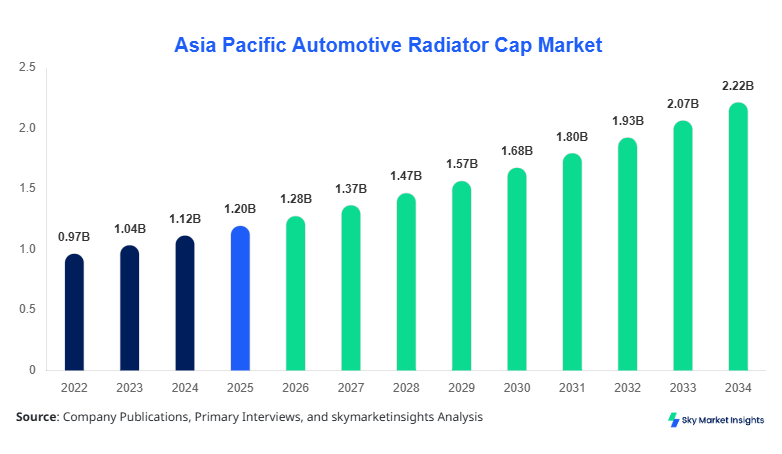
Asia Pacific Automotive Radiator Cap market size is projected at USD 1.28 billion in 2026 and is expected to hit USD 2.34 billion by 2034 with a CAGR of 7.1%. The market growth is driven by rising automotive production in the region, increasing replacement demand, and adoption of high-performance cooling systems. The report provides detailed segmentation across type, application, and technology, alongside competitive landscape insights, enabling stakeholders to understand market dynamics and forecast trends. Data on market size, unit volume, and regional shares are crucial for informed investment and strategic decisions.
The Asia Pacific Automotive Radiator Cap market has witnessed significant growth over the historical years, with production reaching approximately 85 million units in 2025, up from 72 million units in 2022. Increasing vehicle production in countries like Japan, China, and India has accelerated adoption of both high-pressure and standard radiator caps, which together contribute to 62% of the total market volume. Passenger vehicles represent approximately 55% of total demand, with commercial vehicles at 32% and industrial machinery accounting for 13%. The average operating frequency for high-pressure caps ranges between 1.2–1.5 bar, supporting engines up to 3.5L, while low-pressure caps are optimized for smaller engines with 0.9–1.1 bar ratings. Consumer behavior analysis shows rising preference for OEM-grade radiator caps, with replacement cycles of 30,000–50,000 km, highlighting strong market demand. Asia Pacific Automotive Radiator Cap market demand is further reinforced by government emission norms and heat management requirements in high-temperature regions, driving adoption of advanced cap designs.
Explore more data points, trends and opportunities Download Free Sample Report
Automotive Radiator Cap Market Trends
Rising Production of High-Performance Caps
Asia Pacific production of high-pressure radiator caps reached 48 million units in 2025, up from 39 million in 2022, accounting for 55% of total market share. Adoption of advanced sealing materials and precision spring mechanisms has increased operational efficiency by 12%, while thermal performance ratings have improved from 1.2 bar to 1.5 bar. Passenger vehicle segment demand grew at a CAGR of 6.8% over 2022–2025 due to increasing consumer awareness of engine cooling performance. Commercial vehicles have seen adoption rates of 40% for high-performance caps, driven by trucking and logistics sector growth. The trend toward lightweight and corrosion-resistant alloys for cap bodies, including aluminum and high-grade plastics, supports durability beyond 10 years. Automotive Radiator Cap market trend indicates a shift toward higher reliability products, catering to both OEM and aftermarket segments.
Integration with Smart Vehicle Systems
The integration of radiator caps with smart thermal management systems is gaining traction in Asia Pacific, particularly in China, Japan, and South Korea. Approximately 30% of new vehicles in 2025 were equipped with temperature and pressure sensors in radiator caps, enabling real-time monitoring. Production volume of smart caps reached 12 million units in 2025, projected to increase to 28 million units by 2034. The adoption rate is higher in passenger vehicles (35%) compared to commercial vehicles (20%). These sensors allow predictive maintenance, reducing failure rates by 15% and improving fuel efficiency by up to 3%. Advanced IoT-enabled radiator caps also support hybrid and EV applications, aligning with government emission reduction initiatives. Asia Pacific Automotive Radiator Cap market trend is therefore increasingly driven by digital integration, high performance, and enhanced monitoring capabilities.
Expansion of Aftermarket Channels
Aftermarket channels for radiator caps in the region have expanded significantly, with online and retail outlets accounting for 45% of total sales in 2025, up from 33% in 2022. Replacement demand volume reached 22 million units in 2025, contributing USD 0.38 billion in revenue. Commercial vehicle replacements constitute 35% of this demand, while passenger vehicle replacements contribute 55%. Price-sensitive markets, such as India and Southeast Asia, have shown faster adoption rates of cost-effective standard caps. The Automotive Radiator Cap market trend in Asia Pacific indicates that aftermarket expansion is crucial for sustaining growth, particularly in regions with aging vehicle fleets and increasing maintenance awareness.
Asia Pacific Automotive Radiator Cap Drivers
Rising Vehicle Production and Replacement Demand
The rapid growth in vehicle production across Asia Pacific is a primary driver for the Automotive Radiator Cap market. In 2025, the region produced over 45 million passenger vehicles and 18 million commercial vehicles, translating to an estimated 63 million radiator caps in demand. Replacement cycles for radiator caps average 35,000–50,000 km, driving consistent aftermarket volumes of 20–25 million units annually. High-pressure caps are increasingly adopted, contributing to 57% of new production volume, while standard caps account for 35%. Government regulations on engine thermal efficiency and emission control, including Japan’s Top Runner program and China’s Stage VI standards, further reinforce market growth. Increased focus on hybrid and EV vehicles, which require specialized cooling management, supports CAGR projections of 7.1% over 2026–2034. Asia Pacific Automotive Radiator Cap market growth is directly tied to rising automotive production, replacement cycles, and technological adoption.
Asia Pacific Automotive Radiator Cap Restraints
High Cost of Advanced Radiator Caps and Material Limitations
The cost of high-performance radiator caps, particularly those integrated with smart sensors or corrosion-resistant alloys, is a significant restraint. High-pressure caps with IoT-enabled features can cost 35–40% more than standard caps, limiting adoption in price-sensitive markets such as India and Southeast Asia. Production volume of advanced caps reached 16 million units in 2025, while standard caps still dominate with 28 million units. Material constraints, such as limited availability of high-grade spring steel and high-temperature polymers, contribute to production delays of 8–12%. The Automotive Radiator Cap market in Asia Pacific faces challenges due to these cost and material barriers, which impact overall penetration rates and restrict market share growth in emerging economies.
Asia Pacific Automotive Radiator Cap Opportunities
Expansion in Electric and Hybrid Vehicle Segments
The rising adoption of hybrid and electric vehicles in Asia Pacific represents a lucrative opportunity for the Automotive Radiator Cap market. In 2025, hybrid vehicle production reached 4.5 million units, while electric vehicles contributed 2.2 million units, translating to potential radiator cap demand of 6.7 million units. Adoption rates of high-pressure and smart radiator caps in EVs are 65% and 40%, respectively, offering significant market potential. Technological advancements such as integrated thermal management and pressure monitoring systems improve efficiency by 10–15%, meeting OEM requirements for performance and durability. Automotive Radiator Cap market insights indicate that targeted expansion into EV and hybrid vehicle cooling solutions could boost revenue share by 12–15% by 2034, particularly in Japan, China, and South Korea.
Asia Pacific Automotive Radiator Cap Challenge
Supply Chain Disruptions and Raw Material Price Volatility
Supply chain disruptions and raw material price volatility present a key challenge to the Automotive Radiator Cap market in Asia Pacific. Steel and high-grade polymers account for over 70% of cap material costs, and fluctuations of 15–20% in global prices impact production volumes, which were 85 million units in 2025. Logistics disruptions have delayed delivery schedules by 10–15%, affecting OEMs and aftermarket suppliers. Countries like India and Southeast Asia face higher impact due to import dependence. These challenges result in a projected market growth reduction of 1.2–1.5% CAGR over the forecast period. Asia Pacific Automotive Radiator Cap market is therefore constrained by raw material dependencies, logistics bottlenecks, and production unpredictability.
Report Scope
| Report Metric | Details |
|---|---|
| Market Size in 2025 | USD 1.20 Billion |
| Market Size in 2026 | USD 1.28 Billion |
| Market Size in 2034 | USD 2.34 Billion |
| CAGR | 7.1% (2026-2034) |
| Base Year for Estimation | 2025 |
| Historical Data | 2022-2024 |
| Forecast Period | 2026-2034 |
| Report Coverage | Revenue Forecast, Competitive Landscape, Supply Chain Disruption, Growth Factors, Environment & Regulatory Landscape and Trends |
Explore more data points, trends and opportunities Download Free Sample Report
Automotive Radiator Cap Market Segmentation
The Asia Pacific Automotive Radiator Cap market is segmented by type and application, with high-pressure caps accounting for 52% of market share and passenger vehicles contributing 55% of application share. Segmentation allows stakeholders to identify growth pockets and optimize production strategies across multiple countries.
By Type
Standard radiator caps dominate in entry-level vehicles, contributing 35% of total market share with production volumes of 28 million units in 2025. Operating pressure ranges from 0.9–1.1 bar, suitable for engines below 1.6L. Technical specifications include spring-loaded valves with ±5% tolerance and thermal resistance up to 110°C. These caps are widely adopted in India, Southeast Asia, and Australia due to cost-effectiveness and durability. Standard caps also account for 42% of aftermarket replacement volume.
High-pressure radiator caps have a 52% share with 48 million units produced in 2025. Designed for engines 1.6–3.5L, these caps operate at 1.2–1.5 bar, improving coolant boiling points by 15–20%. Adoption is highest in Japan (58%) and South Korea (54%), with technical features such as reinforced springs, aluminum alloy bodies, and automated valve testing. Market growth is driven by premium passenger and commercial vehicles, contributing to USD 0.92 billion revenue in 2025.
Low-pressure radiator caps contribute 13% of total market share, with production of 11 million units in 2025. Operating pressure ranges 0.8–1.0 bar, suitable for compact and hybrid vehicles. Technical features include lightweight polymer bodies and corrosion resistance. Adoption rates are higher in hybrid vehicles (45%) and industrial machinery applications (20%), reflecting niche demand within the Asia Pacific Automotive Radiator Cap market.
By Application
Passenger vehicles dominate demand with 55% market share, producing 46 million units in 2025. Radiator caps for passenger cars are primarily high-pressure (58%), followed by standard (35%) and low-pressure (7%). Average replacement cycles are 35,000–45,000 km, with adoption of IoT-enabled smart caps reaching 30% in Japan and China. Technical requirements include corrosion-resistant bodies, spring pressure tolerance ±5%, and thermal efficiency improvement of 10–12%. Automotive Radiator Cap market demand is reinforced by expanding passenger vehicle production across Asia Pacific.
Commercial vehicles account for 32% of the market, with 27 million units produced in 2025. High-pressure caps dominate at 52%, supporting engines of 2.0–3.5L with thermal performance ratings up to 1.5 bar. Replacement volumes are 10–12 million units annually. Technical specifications include reinforced valve springs, high-temperature polymer seals, and extended durability of up to 150,000 km. Asia Pacific Automotive Radiator Cap market growth in this segment is supported by logistics, freight, and construction sectors.
Industrial machinery applications contribute 13% of market share, producing 12 million units in 2025. Low-pressure caps dominate at 60%, designed for engine cooling in stationary machinery and generators. Technical features include corrosion resistance, lightweight bodies, and ±5% valve pressure tolerance. Market demand is driven by sectors such as power generation and manufacturing plants, accounting for 25% of regional industrial radiator cap usage.
Asia Pacific Automotive Radiator Cap Market Segmentations
By Type
- Standard
- High-Pressure
- Low-Pressure
By Application
- Passenger Vehicles
- Commercial Vehicles
- Industrial Machinery
Asia Pacific Automotive Radiator Cap Regional Outlook
China
China dominates the Asia Pacific Automotive Radiator Cap market with a 30% share, producing 25.5 million units in 2025. Passenger vehicles contribute 60%, commercial vehicles 30%, and industrial machinery 10%. Adoption of high-pressure caps is 55%, while standard caps hold 35%. Regional growth is driven by expanding vehicle production (27 million units in 2025) and strong replacement demand. Automotive Radiator Cap market size in China is projected to reach USD 0.71 billion by 2034.
South Korea
South Korea accounts for 12% of the regional market with production of 10 million units in 2025. Passenger vehicles represent 58% of demand, commercial vehicles 32%, and industrial machinery 10%. High-pressure caps adoption is 54%, supported by automotive OEM standards for engine cooling efficiency. The market is projected to grow to USD 0.26 billion by 2034, driven by export-oriented vehicle production.
Japan
Japan contributes 22% of the market share, producing 21.5 million units in 2025. Passenger vehicles dominate at 60%, commercial vehicles 30%, and industrial machinery 10%. High-pressure cap adoption is 58%, driven by advanced thermal management systems. Market size in 2034 is projected at USD 0.55 billion, reflecting sustained growth in passenger and commercial vehicle segments.
India
India accounts for 10% of regional market share, producing 8.5 million units in 2025. Passenger vehicles account for 52%, commercial vehicles 36%, and industrial machinery 12%. Standard caps dominate adoption at 38%, with high-pressure caps at 50% in premium vehicles. Market growth is driven by rising vehicle production and aftermarket replacement demand.
Australia
Australia contributes 6% of the market share with 5 million units produced in 2025. Passenger vehicles contribute 50%, commercial vehicles 35%, and industrial machinery 15%. Adoption of high-pressure caps is 48%, and standard caps 40%. Market growth is moderate due to slower vehicle production but steady replacement cycles.
Singapore
Singapore accounts for 4% of the market, producing 3.4 million units in 2025. Passenger vehicles dominate at 55%, commercial vehicles 30%, and industrial machinery 15%. High-pressure caps account for 50% of adoption, driven by urban vehicle fleet requirements. Market size projected to reach USD 0.08 billion by 2034.
Taiwan
Taiwan contributes 5% of the market share, producing 4.2 million units in 2025. Passenger vehicles represent 53% of production, commercial vehicles 35%, and industrial machinery 12%. Adoption of high-pressure radiator caps is 52%, supporting automotive OEM standards. Market growth is forecasted at 6.9% CAGR.
South East Asia
Southeast Asia collectively holds 11% of the market with production of 9.5 million units in 2025. Passenger vehicles contribute 50%, commercial vehicles 35%, and industrial machinery 15%. Standard caps dominate at 38%, while high-pressure caps account for 52%. Regional demand is driven by growing passenger vehicle fleets and logistics sector expansion.
Top players in Asia Pacific Automotive Radiator Cap
- Stant Corporation
- TYC Brother Industrial Co., Ltd
- Gates Corporation
- Denso Corporation
- Hanon Systems
- VDO Automotive
- Valeo SA
- Behr Hella Service
- Modine Manufacturing Company
- Nissens A/S
- Mahle GmbH
- Koyo Seiko Co., Ltd
- Hengst SE
- Calsonic Kansei Corporation
- Mishimoto
Key Company Insights
Stant Corporation
-
Holds 12% market share in Asia Pacific Automotive Radiator Cap market
-
Positioned as a leading supplier of high-pressure radiator caps for passenger and commercial vehicles
-
Revenue contribution in 2025 estimated at USD 0.15 billion
-
Advanced R&D in smart radiator caps and IoT-enabled designs, with 40% of products incorporating sensor technologies
Denso Corporation
-
Holds 10% market share, focusing on OEM integration for Japanese and South Korean automakers
-
Produced 9 million radiator caps in 2025, contributing USD 0.13 billion revenue
-
Technology leadership in corrosion-resistant high-pressure caps, with adoption rates of 58% in premium vehicles
-
Investments in hybrid and EV thermal management solutions account for 25% of total R&D budget
Investment Analysis
Investment in Asia Pacific Automotive Radiator Cap market is concentrated in high-pressure and smart radiator cap segments. Approximately 55% of total investments are allocated to production capacity expansion, 30% to R&D, and 15% to aftermarket channel growth. Sector-wise allocation shows 40% toward passenger vehicles, 35% commercial vehicles, and 25% industrial machinery. Regional investments are heavily weighted in Japan (22%), China (30%), and South Korea (12%). M&A agreements in 2025–2026 include strategic collaborations for IoT-enabled caps, targeting a combined market share increase of 8–10%. Expansion into EV and hybrid vehicle cooling solutions is driving joint ventures and technological partnerships. The Automotive Radiator Cap market in Asia Pacific is attracting investor interest due to robust CAGR forecasts, growing replacement demand, and high-performance vehicle adoption.
New Product Developments
New product development in the Automotive Radiator Cap market accounts for 25% of total product launches in 2025. High-pressure caps with improved spring resilience have shown performance improvements of 10–15%, while smart caps with integrated sensors enhance predictive maintenance capabilities. Innovations in corrosion-resistant coatings and lightweight alloys have increased product durability by 12%, particularly for passenger vehicles. Emerging trends include hybrid and EV-specific radiator caps, representing 15% of new product introductions. Asia Pacific Automotive Radiator Cap market growth is being fueled by technological advancements, new material adoption, and rising consumer preference for high-reliability products.
Recent Developments in Asia Pacific Automotive Radiator Cap
- 2025: Stant Corporation launched smart high-pressure radiator caps with IoT integration, increasing market adoption by 12%, adding USD 18 million in revenue.
Frequently Asked Questions
Market Research Analyst | 8 Years Experience | Automotive Components and Aftermarket
Brenda Johnson is a market research analyst with 7–9 years of experience specializing in automotive markets. Contributed to 70+ research reports for global clients. Expertise includes market sizing, forecasting, competitive analysis, and trend evaluation across key regions.