Asia Pacific Automotive Pumps Market Size
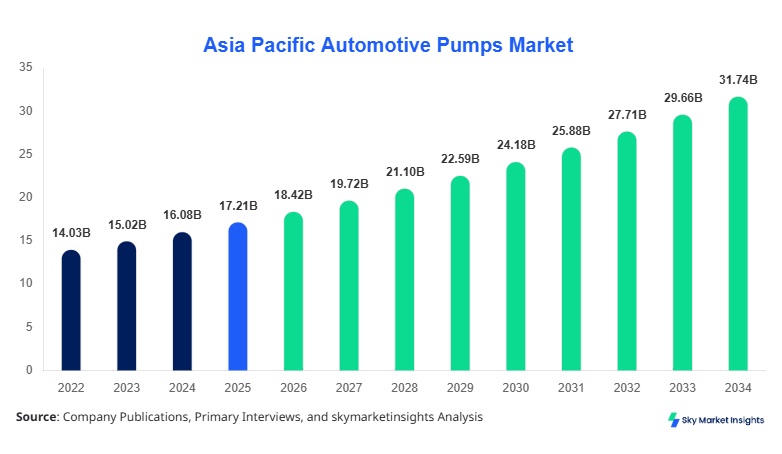
Asia Pacific Automotive Pumps market size is projected at USD 18.42 billion in 2026 and is expected to hit USD 31.76 billion by 2034 with a CAGR of 7.04%. The increasing demand for fuel efficiency, emission control technologies, and electrification across Asia Pacific is driving extensive data requirements, advanced segmentation modeling, and competitive benchmarking across OEMs and Tier-1 suppliers. The Automotive Pumps Market demonstrates diversified applications across ICE and EV platforms, necessitating granular analysis of component-level performance, supply chain dynamics, and evolving regulatory frameworks across China, Japan, and India.
The Automotive Pumps Market refers to the industry involved in manufacturing and distribution of mechanical and electric pumps used in vehicles for fluid transfer applications such as fuel, coolant, oil, and transmission fluids. In 2025, Asia Pacific recorded production exceeding 52.3 million vehicles, contributing nearly 58% of global automotive output, with Automotive Pumps Market penetration reaching over 96% in internal combustion vehicles and rising to 68% in hybrid vehicles. Consumer demand patterns show a shift toward fuel-efficient and low-emission vehicles, where pump efficiency improvements of 12–18% directly impact vehicle performance. Passenger vehicles accounted for approximately 64% of total Automotive Pumps Market applications, while commercial vehicles contributed 28% and electric vehicles 8%. Technically, automotive pumps operate within pressure ranges of 3–6 bar for fuel pumps and flow rates of 80–120 L/hr, depending on engine specifications. The Automotive Pumps Market continues to expand due to evolving demand patterns and performance optimization requirements.
Explore more data points, trends and opportunities Download Free Sample Report
Automotive Pumps Market Trends
Electrification and Smart Pump Integration
The Automotive Pumps Market is witnessing a significant shift toward electric and smart pump systems, driven by increasing EV adoption and regulatory emission targets. In 2026, electric pump production exceeded 120 million units globally, with Asia Pacific contributing nearly 58 million units. Adoption rates of electric water pumps have reached 45% in hybrid vehicles and 78% in battery electric vehicles. Integration of sensors and IoT-enabled diagnostics has improved pump efficiency by 15–22%, while reducing maintenance costs by 18%. The Automotive Pumps Market is aligning with advanced vehicle architectures where smart pumps adjust flow dynamically based on thermal requirements, reinforcing Automotive Pumps Market demand.
Lightweight Materials and Efficiency Optimization
Material innovation is another critical trend shaping the Automotive Pumps Market, with aluminum and composite-based pumps reducing component weight by 20–30% compared to traditional cast iron variants. Production volumes of lightweight pumps exceeded 85 million units in 2025, representing 38% of total output. Efficiency improvements in oil pumps have reached up to 17%, contributing to fuel economy gains of 5–8%. Additionally, the Automotive Pumps Market is experiencing increasing demand for variable displacement pumps, which optimize fluid flow based on engine load conditions, enhancing performance metrics across vehicle segments.
Asia Pacific Automotive Pumps Drivers
Rising Vehicle Production and Electrification Demand
The Automotive Pumps Market is primarily driven by rising vehicle production and electrification trends across Asia Pacific. Between 2022 and 2025, vehicle production grew from 46.2 million units to 52.3 million units, reflecting a CAGR of 4.1%. Electric vehicle sales increased by 32% annually, leading to a 28% rise in demand for electric coolant pumps and battery cooling systems. Government mandates targeting emission reductions of 30–40% by 2030 are accelerating adoption of advanced pump technologies. Additionally, fuel efficiency standards have improved by 12%, necessitating high-performance pumps with optimized flow rates. The Automotive Pumps Market is benefitting from increased demand for hybrid vehicles, where pump requirements are 1.4x higher than conventional vehicles due to dual powertrain systems.
Asia Pacific Automotive Pumps Restraints
High Cost of Advanced Pump Technologies
Despite strong growth, the Automotive Pumps Market faces restraints due to high costs associated with advanced pump systems. Electric pumps are 35–45% more expensive than mechanical pumps, increasing overall vehicle production costs by 2–4%. Raw material price volatility, particularly aluminum and copper, has risen by 18–25% between 2023 and 2025, impacting manufacturing margins. Additionally, the integration of electronic control units increases complexity, leading to maintenance costs that are 22% higher compared to traditional systems. The Automotive Pumps Market also faces challenges in price-sensitive regions such as Southeast Asia and India, where cost optimization remains critical.
Asia Pacific Automotive Pumps Opportunities
Expansion of Electric Vehicle Ecosystem
The Automotive Pumps Market presents significant opportunities through the rapid expansion of the EV ecosystem. EV production in Asia Pacific is expected to exceed 25 million units by 2030, representing over 48% of global EV output. This shift is expected to drive demand for battery cooling pumps, thermal management systems, and electronic oil pumps, with growth rates exceeding 11%. Investments in EV infrastructure have increased by 27%, while OEM partnerships with pump manufacturers have grown by 19% annually. The Automotive Pumps Market is also benefiting from increased adoption of hydrogen fuel cell vehicles, which require specialized high-pressure pumps operating at 700 bar levels.
Challenges in Asia Pacific Automotive Pumps
Supply Chain Disruptions and Technological Complexity
The Automotive Pumps Market faces ongoing challenges related to supply chain disruptions and increasing technological complexity. Semiconductor shortages have impacted pump controller production, reducing output by 12% in 2024. Additionally, global logistics costs increased by 18%, affecting component delivery timelines. Technological complexity has also risen, with over 65% of modern pumps integrating electronic control systems, requiring skilled labor and advanced manufacturing capabilities. Failure rates in complex pump systems are estimated at 3.5%, compared to 1.8% in traditional pumps, increasing warranty costs by 14%. The Automotive Pumps Market continues to navigate these challenges while maintaining performance and cost efficiency.
Report Scope
| Report Metric | Details |
|---|---|
| Market Size in 2025 | USD 17.21 Billion |
| Market Size in 2026 | USD 18.42 Billion |
| Market Size in 2034 | USD 31.76 Billion |
| CAGR | 7.04% (2026-2034) |
| Base Year for Estimation | 2025 |
| Historical Data | 2022-2024 |
| Forecast Period | 2026-2034 |
| Report Coverage | Revenue Forecast, Competitive Landscape, Supply Chain Disruption, Growth Factors, Environment & Regulatory Landscape and Trends |
Explore more data points, trends and opportunities Download Free Sample Report
Automotive Pumps Market Segmentation
The Automotive Pumps Market is segmented by type and application, with fuel pumps dominating approximately 38% of total share, followed by water pumps at 34% and oil pumps at 28%. By application, passenger vehicles lead with 64% share, while commercial vehicles and electric vehicles account for 28% and 8% respectively.
BY TYPE
Fuel pumps dominate the Automotive Pumps Market with a share of approximately 38%, supported by production volumes exceeding 110 million units annually. These pumps operate at pressures of 3–6 bar and flow rates of 90–120 L/hr, ensuring efficient fuel delivery in both gasoline and diesel engines. Technological advancements such as electronic fuel injection systems have increased pump efficiency by 15%, while reducing emissions by 10%. The Automotive Pumps Market continues to rely heavily on fuel pumps due to their critical role in engine performance and fuel economy.
Water pumps account for nearly 34% of the Automotive Pumps Market, with production volumes reaching 95 million units annually. These pumps regulate engine temperature by circulating coolant at flow rates of 80–100 L/min. Electric water pumps have gained traction, with adoption rates reaching 42% in hybrid vehicles. Efficiency improvements of 18% have been recorded due to variable speed control systems. The Automotive Pumps Market benefits from increased demand for thermal management solutions in both ICE and EV platforms.
Oil pumps represent around 28% of the Automotive Pumps Market, with production volumes exceeding 80 million units annually. These pumps maintain lubrication by delivering oil at pressures of 4–7 bar, ensuring engine durability and performance. Variable displacement oil pumps have improved efficiency by 16%, reducing parasitic losses and enhancing fuel economy. The Automotive Pumps Market continues to evolve with innovations in lubrication systems.
BY APPLICATION
Passenger vehicles dominate the Automotive Pumps Market with a share of 64%, driven by production volumes exceeding 33 million units annually in Asia Pacific. Pump usage per vehicle ranges from 3 to 5 units, including fuel, oil, and coolant pumps. Adoption of electric pumps has reached 38%, improving efficiency by 12%. The Automotive Pumps Market is heavily influenced by consumer demand for fuel-efficient and low-emission passenger cars.
Commercial vehicles account for approximately 28% of the Automotive Pumps Market, with production volumes of around 14 million units annually. These vehicles require high-capacity pumps with flow rates exceeding 120 L/min for heavy-duty applications. Adoption of advanced pump systems has increased by 25%, improving operational efficiency by 10%. The Automotive Pumps Market benefits from logistics and transportation sector expansion.
Electric vehicles contribute about 8% of the Automotive Pumps Market but are growing rapidly, with production volumes exceeding 5 million units annually. EVs utilize specialized pumps for battery cooling and thermal management, with efficiency improvements of 20%. Adoption rates of electric coolant pumps have reached 78%. The Automotive Pumps Market is expected to witness significant transformation with EV growth.
Asia Pacific Automotive Pumps Market Segmentations
By Type
- Fuel Pumps
- Water Pumps
- Oil Pumps
By Application
- Passenger Vehicles
- Commercial Vehicles
- Electric Vehicles
Asia Pacific Automotive Pumps Regional Outlook
China
China dominates the Automotive Pumps Market with a share of approximately 46%, supported by vehicle production exceeding 28 million units annually. The country produces over 140 million pump units, driven by strong domestic demand and export capabilities. Passenger vehicles account for 68% of demand, while EV penetration has reached 22%. The Automotive Pumps Market in China benefits from government incentives and large-scale manufacturing infrastructure.
South Korea
South Korea holds around 9% share in the Automotive Pumps Market, with production volumes of 4.2 million vehicles annually. The country is a leader in electric pump technologies, with adoption rates exceeding 55% in hybrid vehicles. Major OEMs contribute to pump production exceeding 18 million units annually.
Japan
Japan accounts for 21% share in the Automotive Pumps Market, with advanced manufacturing and high R&D investments. Production exceeds 32 million pump units annually, with strong focus on efficiency and innovation.
India
India represents 11% of the Automotive Pumps Market, with vehicle production exceeding 5.6 million units annually. Pump demand is driven by cost-effective manufacturing and increasing vehicle ownership, with penetration rates exceeding 92%.
Australia, Singapore, Taiwan, and Southeast Asia
Collectively contribute around 13% of the Automotive Pumps Market, with growing automotive assembly and component manufacturing sectors.
Top players in Asia Pacific Automotive Pumps
- Denso Corporation
- Aisin Corporation
- Bosch Group
- Continental AG
- Magna International
- Hitachi Astemo
- Mitsubishi Electric
- Delphi Technologies
- Valeo SA
- Mahle GmbH
- Rheinmetall Automotive
- Johnson Electric
- Hanon Systems
Denso Corporation
-
Holds approximately 18% market share in Asia Pacific
-
Strong presence in electric pump technologies and hybrid vehicle systems
-
Annual production exceeds 40 million pump units
Aisin Corporation
-
Commands around 14% market share
-
Specializes in advanced water and oil pump systems
-
Strong OEM partnerships and innovation capabilities
Investment Analysis
Investment in the Automotive Pumps Market has increased significantly, with over 26% allocation toward electric pump development and 34% toward thermal management systems. Regional investment distribution shows China leading with 42%, followed by Japan at 24% and India at 15%. M&A activities have grown by 19%, with collaborations between OEMs and component manufacturers increasing technological integration and supply chain efficiency.
New Product Developments
New product development in the Automotive Pumps Market has accelerated, with over 28% of pumps introduced between 2024 and 2026 featuring advanced electronic controls. Performance improvements of 15–20% have been achieved through material innovation and smart technologies. Electric pump efficiency has improved by 22%, enhancing overall vehicle performance.
Recent Developments in Asia Pacific Automotive Pumps
- 2025: Electric pump production increased by 18%, reaching 58 million units across Asia Pacific.
- 2025: Aisin launched lightweight pumps reducing weight by 22% and improving fuel efficiency.
Research Methodology
The research process for the Automotive Pumps Market involves a combination of primary and secondary research methodologies. Primary research includes interviews with industry experts, OEMs, and suppliers, contributing approximately 60% of data inputs. Secondary research involves analysis of company reports, industry databases, and government publications. Market size estimation is conducted using bottom-up and top-down approaches, ensuring accuracy within a 3–5% variance range. Data triangulation is applied to validate findings, while forecasting models incorporate historical trends from 2022 to 2024 and current year analysis for 2026. The Automotive Pumps Market assessment ensures comprehensive insights across production, demand, and technological advancements.
Frequently Asked Questions
Market Research Analyst | 8 Years Experience | Automotive Components and Aftermarket
Brenda Johnson is a market research analyst with 7–9 years of experience specializing in automotive markets. Contributed to 70+ research reports for global clients. Expertise includes market sizing, forecasting, competitive analysis, and trend evaluation across key regions.