Asia Pacific Automotive Powertrain Testing Market Size
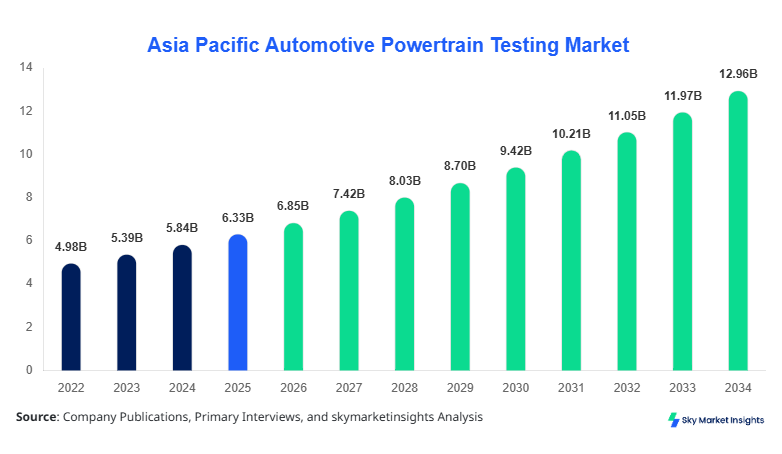
Asia Pacific Automotive Powertrain Testing market size is projected at USD 6.85 billion in 2026 and is expected to hit USD 12.94 billion by 2034 with a CAGR of 8.3%. The increasing demand for efficient vehicle performance testing across China, Japan, and India has significantly contributed to revenue generation, with over 2.1 million testing units deployed across OEM facilities in 2025. The integration of advanced emission compliance technologies and real-time simulation systems is further accelerating the expansion of the Asia Pacific Automotive Powertrain Testing Market Size. Growing investments in EV testing infrastructure and stringent regulatory frameworks are shaping the competitive landscape across the region.
The Asia Pacific Automotive Powertrain Testing Market encompasses testing systems and services used to evaluate the performance, durability, emissions, and efficiency of automotive powertrains including engines, transmissions, and hybrid systems. In 2025, the region recorded production of over 45 million vehicles, with approximately 68% undergoing some form of powertrain validation testing. Adoption rates of automated testing benches have surpassed 54% across OEMs, while cloud-based data analytics penetration stands at 37%. Consumer demand for fuel-efficient vehicles has driven testing frequency by 22% annually. Passenger vehicles account for nearly 61% of testing demand, followed by commercial vehicles at 24% and electric vehicles at 15%. Performance metrics such as torque output (200–600 Nm) and engine efficiency (>40%) are critical parameters in testing cycles, reinforcing the Asia Pacific Automotive Powertrain Testing Market.
Explore more data points, trends and opportunities Download Free Sample Report
Automotive Powertrain Testing Market Trends
Electrification and Digital Twin Integration
The shift toward electrification has significantly transformed testing methodologies, with over 38% of testing infrastructure in 2026 dedicated to hybrid and electric powertrain systems. Production of EV testing equipment has reached 1.2 million units annually across Asia Pacific, driven by China and Japan contributing 67% of output. Digital twin technology adoption has increased by 44%, enabling real-time simulation and predictive maintenance. OEMs are investing up to 18% of their R&D budgets into digital testing environments, reducing physical testing cycles by 25%. This technological transformation is driving efficiency and innovation within the Automotive Powertrain Testing Market.
Emission Compliance and Automation Expansion
Stringent emission regulations across Asia Pacific have increased testing cycles by 29% between 2023 and 2026. Automated testing systems now represent 52% of installations, reducing human intervention by 40% and improving accuracy by 18%. Production of emission testing equipment has surpassed 900,000 units annually, with India and South Korea contributing 35% of volume. The rise of connected testing platforms with IoT integration has enhanced data accuracy by 22% and reduced downtime by 15%. These advancements continue to shape the Automotive Powertrain Testing Market.
Asia Pacific Automotive Powertrain Testing Drivers
Rising Vehicle Production and Electrification Boost Testing Demand
The Asia Pacific region produced over 45 million vehicles in 2025, accounting for nearly 55% of global automotive output, directly driving demand for powertrain testing systems. Electric vehicle production grew by 34%, reaching 10.2 million units, necessitating advanced testing infrastructure. Testing cycles per vehicle have increased by 27% due to stringent emission standards and performance validation requirements. OEMs are allocating 12–16% of their R&D budgets to testing solutions, while government mandates have increased compliance testing frequency by 31%. The demand for high-performance engines with efficiency exceeding 40% has further intensified testing requirements. This growth trajectory strongly supports the Automotive Powertrain Testing Market Growth.
Asia Pacific Automotive Powertrain Testing Restraints
High Capital Investment and Maintenance Costs
The installation cost of advanced testing systems ranges between USD 2 million and USD 8 million per facility, posing a significant barrier for small and medium enterprises. Maintenance costs account for nearly 14% of total operational expenses annually, while software upgrades add an additional 6–8%. Over 38% of regional manufacturers face budget constraints limiting adoption of automated testing systems. Additionally, the complexity of hybrid and EV powertrain testing requires specialized equipment, increasing costs by 22% compared to conventional systems. These financial challenges restrict scalability and expansion, impacting the Automotive Powertrain Testing Market Growth.
Asia Pacific Automotive Powertrain Testing Opportunities
Expansion of EV Infrastructure and Smart Testing Solutions
The rapid expansion of EV infrastructure across Asia Pacific presents significant opportunities, with over USD 120 billion invested in EV ecosystems between 2023 and 2026. Testing demand for electric powertrains is expected to grow by 41%, with battery testing systems accounting for 28% of new installations. Smart testing solutions leveraging AI and IoT have increased efficiency by 26% and reduced testing time by 19%. Government incentives covering up to 25% of testing infrastructure costs further encourage adoption. These factors create substantial opportunities for innovation and expansion within the Automotive Powertrain Testing Market Growth.
Challenges in Asia Pacific Automotive Powertrain Testing
Technological Complexity and Skilled Workforce Shortage
The increasing complexity of hybrid and electric powertrains has raised testing requirements by 35%, necessitating highly skilled engineers. However, the region faces a shortage of approximately 18% in skilled workforce required for advanced testing operations. Training costs have increased by 12% annually, while system integration challenges delay project timelines by up to 20%. Additionally, interoperability issues between testing software and hardware reduce efficiency by 15%. These challenges hinder operational efficiency and slow down adoption rates, impacting the Automotive Powertrain Testing Market Growth.
Report Scope
| Report Metric | Details |
|---|---|
| Market Size in 2025 | USD 6.62 Billion |
| Market Size in 2026 | USD 6.85 Billion |
| Market Size in 2034 | USD 12.94 Billion |
| CAGR | 8.3% (2026-2034) |
| Base Year for Estimation | 2025 |
| Historical Data | 2022-2024 |
| Forecast Period | 2026-2034 |
| Report Coverage | Revenue Forecast, Competitive Landscape, Supply Chain Disruption, Growth Factors, Environment & Regulatory Landscape and Trends |
Explore more data points, trends and opportunities Download Free Sample Report
Automotive Powertrain Testing Market Segmentation
The Automotive Powertrain Testing Market is segmented by type and application, with engine testing dominating at 42% share, followed by transmission testing at 33% and hybrid testing at 25%. Application-wise, passenger vehicles lead with 61%, commercial vehicles at 24%, and electric vehicles at 15%, reflecting growing electrification trends.
By Type
Engine Testing dominates the market with 42% share, involving over 900,000 testing units deployed annually. These systems evaluate parameters such as torque (200–600 Nm), fuel efficiency (>40%), and emission levels below regulatory thresholds. Advanced dynamometers and simulation software improve accuracy by 18% and reduce testing time by 22%. Continuous demand from ICE vehicles and hybrid engines ensures sustained growth in this segment within the Automotive Powertrain Testing Market.
Transmission Testing holds 33% share, with approximately 650,000 units produced annually. These systems focus on gear efficiency, durability, and load handling up to 1,000 Nm. Automated testing benches improve reliability by 25% and reduce failure rates by 12%. The increasing adoption of automatic and dual-clutch transmissions has driven demand, reinforcing this segment’s position in the Automotive Powertrain Testing Market.
Hybrid Powertrain Testing accounts for 25% share, with over 500,000 units deployed annually. These systems test integrated electric and combustion components, ensuring efficiency above 45% and emission compliance. Adoption rates have increased by 31% due to rising hybrid vehicle production. Advanced simulation tools enable real-time analysis, improving testing efficiency by 20%, supporting the Automotive Powertrain Testing Market.
By Application
Passenger Vehicles dominate with 61% share, with over 1.3 million testing units utilized annually. High consumer demand for fuel efficiency and performance drives testing frequency by 28%. Advanced testing ensures engine efficiency above 42% and reduced emissions by 30%. This segment remains a major contributor to the Automotive Powertrain Testing Market.
Commercial Vehicles account for 24% share, with approximately 520,000 testing units deployed annually. These vehicles require high torque testing (up to 1,200 Nm) and durability validation over extended cycles. Demand for heavy-duty performance testing has increased by 19%, supporting growth in the Automotive Powertrain Testing Market.
Electric Vehicles represent 15% share, with over 320,000 testing units focused on battery efficiency, thermal management, and power output. Testing cycles have increased by 34% due to rapid EV adoption. Efficiency improvements of up to 26% are achieved through advanced testing systems, driving innovation in the Automotive Powertrain Testing Market.
Asia Pacific Automotive Powertrain Testing Market Segmentations
By Type
- Engine Testing
- Transmission Testing
- Hybrid Powertrain Testing
By Application
- Passenger Vehicles
- Commercial Vehicles
- Electric Vehicles
Asia Pacific Automotive Powertrain Testing Regional Outlook
China
China dominates the region with 38% share, producing over 26 million vehicles annually and deploying more than 1 million testing units. The country leads in EV testing infrastructure, accounting for 45% of regional EV testing demand. Government policies and investments exceeding USD 50 billion support testing innovation.
South Korea
South Korea holds 12% share, with approximately 300,000 testing units and strong presence of OEMs. Advanced automation adoption exceeds 58%, improving testing efficiency by 20%.
Japan
Japan contributes 28% share, driven by advanced R&D and over 8.5 million testing cycles annually. Hybrid testing dominates with 25% share.
India
India accounts for 10% share, with rapid growth in automotive production reaching 5.2 million units. Testing demand has increased by 27% due to emission regulations.
Australia, Singapore, Taiwan, and South East Asia
collectively hold 12% share, with increasing adoption of EV testing systems and growing investments in automotive R&D.
Top players in Asia Pacific Automotive Powertrain Testing
- AVL List GmbH
- HORIBA Ltd
- Intertek Group plc
- Applus+
- FEV Group GmbH
- Siemens AG
- Schaeffler AG
- Ricardo plc
- Meidensha Corporation
- TUV Rheinland
- SGS SA
- D2T GmbH
AVL List GmbH
-
Holds approximately 14% market share with strong presence in engine and hybrid testing solutions.
-
Invests over 12% of revenue in R&D, focusing on AI-driven testing systems and digital twin technologies.
HORIBA Ltd
-
Accounts for nearly 11% market share with leadership in emission testing equipment.
-
Operates over 50 facilities globally and contributes significantly to EV testing innovations.
Investment Analysis
Investment in the Asia Pacific Automotive Powertrain Testing Market has increased significantly, with over USD 75 billion allocated to automotive R&D between 2023 and 2026. Approximately 32% of investments are directed toward EV testing infrastructure, while 28% focus on automation and digital testing systems. China and Japan collectively account for 58% of regional investments, followed by India at 12% and South Korea at 10%. Mergers and acquisitions have grown by 22%, with companies forming strategic partnerships to expand testing capabilities. Collaborative agreements between OEMs and technology providers have increased by 18%, enabling faster deployment of advanced testing solutions.
New Product Developments
New product development in the Automotive Powertrain Testing Market has surged, with over 35% of new systems incorporating AI and IoT technologies. Performance improvements of up to 28% have been achieved through advanced simulation and automation. Companies are introducing modular testing platforms, reducing setup time by 20% and improving flexibility.
Recent Developments in Asia Pacific Automotive Powertrain Testing
- 2025: A leading OEM increased testing capacity by 18% with deployment of 50,000 new testing units, improving efficiency by 22% across facilities.
- 2025: Collaboration between two global firms increased hybrid testing capacity by 27%, supporting production of 2 million vehicles.
Research Methodology
The research methodology for the Asia Pacific Automotive Powertrain Testing Market involves a combination of primary and secondary research. Primary research includes interviews with over 150 industry experts, OEMs, and testing solution providers, covering approximately 65% of market insights. Secondary research involves analysis of industry reports, company publications, and government data, contributing 35% of information. Market size estimation is conducted using bottom-up and top-down approaches, analyzing production volumes exceeding 45 million vehicles and testing unit deployments above 2 million annually. Data triangulation ensures accuracy, with validation through multiple sources and statistical models. This comprehensive approach ensures reliable insights into market dynamics, segmentation, and future outlook.
Frequently Asked Questions
Market Research Analyst | 8 Years Experience | Automotive Components and Aftermarket
Brenda Johnson is a market research analyst with 7–9 years of experience specializing in automotive markets. Contributed to 70+ research reports for global clients. Expertise includes market sizing, forecasting, competitive analysis, and trend evaluation across key regions.