Asia Pacific Automotive Power Folding Mirror Systems Market Size
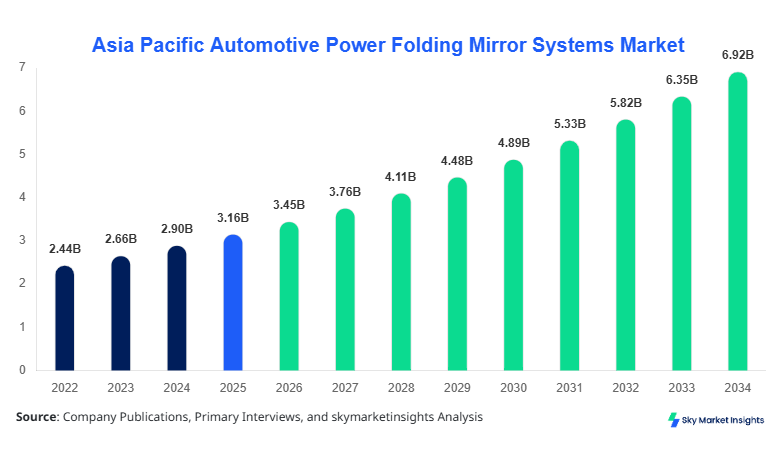
Asia Pacific Automotive Power Folding Mirror Systems market size is projected at USD 3.45 billion in 2026 and is expected to hit USD 6.92 billion by 2034 with a CAGR of 9.1%. The market expansion is supported by rising automotive production volumes exceeding 52 million units annually in Asia Pacific, alongside increasing integration of electronic components in passenger vehicles. The need for precise data analytics, segmentation by vehicle type, and competitive benchmarking across OEMs and Tier-1 suppliers is becoming critical as over 68% of new vehicles incorporate advanced mirror systems, shaping the Asia Pacific Automotive Power Folding Mirror Systems market size.
The Automotive Power Folding Mirror Systems Market refers to electronically controlled mirror assemblies that automatically fold and unfold for safety, aerodynamics, and parking convenience. In Asia Pacific, production volumes reached approximately 48 million vehicles in 2025, with India contributing nearly 6.2 million units. Adoption rates of power folding mirrors have risen to 64% in mid-range vehicles and 92% in premium vehicles, indicating strong penetration. Consumer behavior shows a 38% preference for convenience-based features, while safety awareness drives 42% of purchase decisions. Passenger cars account for nearly 72% application share, while commercial vehicles contribute 18% and electric vehicles 10%. Performance metrics such as motor torque efficiency at 12–18 Nm and operational cycles exceeding 30,000 folds highlight technological advancements. The Automotive Power Folding Mirror Systems market share is influenced by rising urbanization and increased vehicle density across Asia Pacific.
Explore more data points, trends and opportunities Download Free Sample Report
Automotive Power Folding Mirror Systems Market Trends
Increasing Integration of Smart Mirror Technologies
The integration of smart mirror technologies, including sensors, cameras, and heating functionalities, has significantly transformed production volumes, which exceeded 120 million mirror units globally in 2025. Asia Pacific accounted for nearly 46% of this output. Advanced driver assistance systems (ADAS) integration has increased adoption rates to 61% in new vehicles. Demand from electric vehicles surged by 28% year-on-year, driven by the need for aerodynamic efficiency. Additionally, the incorporation of auto-dimming and blind-spot detection features has increased system complexity by 35%, enhancing safety standards. This trend is reshaping product innovation cycles and driving premiumization across mid-segment vehicles, strengthening Automotive Power Folding Mirror Systems market trends.
Rising Demand for Lightweight and Energy-Efficient Components
Manufacturers are increasingly focusing on lightweight materials such as reinforced plastics and aluminum alloys, reducing mirror system weight by 18–25%. Production volumes for lightweight mirror systems reached 38 million units in Asia Pacific in 2025. Energy-efficient motors have reduced power consumption by nearly 15%, aligning with EV efficiency requirements. Adoption rates of lightweight mirror systems have reached 52% in electric vehicles and 44% in passenger cars. This shift is driven by regulatory pressure to reduce vehicle emissions by 20–30% over the next decade. The Automotive Power Folding Mirror Systems market demand is significantly influenced by these innovations.
Asia Pacific Automotive Power Folding Mirror Systems Drivers
Rising Vehicle Production and Increasing Safety Regulations
Asia Pacific vehicle production crossed 52 million units in 2025, with China contributing 32%, Japan 18%, and India 12%. Approximately 68% of vehicles now integrate advanced mirror systems due to stricter safety mandates. Governments across the region have implemented regulations requiring blind-spot monitoring and automatic folding mechanisms, increasing system adoption by 22% over three years. Passenger car production alone reached 36 million units, driving component demand. OEM investments in safety features increased by 14% annually, boosting mirror system integration. This regulatory push combined with rising consumer demand for convenience and safety is accelerating Automotive Power Folding Mirror Systems market growth.
Asia Pacific Automotive Power Folding Mirror Systems Restraints
High Cost of Advanced Mirror Technologies
The cost of integrating power folding mirror systems with advanced electronics can increase vehicle costs by 2–4%, impacting adoption in low-cost vehicle segments. Nearly 38% of entry-level vehicles still use manual mirrors due to price sensitivity. Manufacturing costs for advanced systems have risen by 12% due to semiconductor shortages and rising raw material prices. Additionally, maintenance costs for electronic components are 20% higher compared to traditional mirrors. These cost barriers limit penetration in developing markets within Southeast Asia, restraining Automotive Power Folding Mirror Systems market share expansion.
Asia Pacific Automotive Power Folding Mirror Systems Opportunities
Expansion of Electric Vehicles and Autonomous Driving Technologies
Electric vehicle production in Asia Pacific is expected to exceed 18 million units by 2030, creating significant demand for aerodynamic mirror systems. Autonomous driving technologies require integrated sensors and cameras, increasing mirror system complexity by 40%. Investment in EV infrastructure has grown by 26% annually, supporting market expansion. The adoption of camera-based mirror systems is projected to reach 22% by 2030. These advancements present strong opportunities for manufacturers to innovate and expand their portfolios, boosting Automotive Power Folding Mirror Systems market insights.
Challenges in Asia Pacific Automotive Power Folding Mirror Systems
Supply Chain Disruptions and Component Shortages
The global semiconductor shortage has impacted production volumes by nearly 15%, affecting mirror system manufacturing. Supply chain disruptions increased lead times by 25–30%, causing delays in OEM deliveries. Logistics costs surged by 18% in 2025, impacting overall production efficiency. Additionally, dependency on imports for key components such as sensors and actuators remains high, particularly in India and Southeast Asia. These challenges hinder consistent production and slow down Automotive Power Folding Mirror Systems market growth.
Report Scope
| Report Metric | Details |
|---|---|
| Market Size in 2025 | USD 3.16 Billion |
| Market Size in 2026 | USD 3.45 Billion |
| Market Size in 2034 | USD 6.92 Billion |
| CAGR | 9.1% (2026-2034) |
| Base Year for Estimation | 2025 |
| Historical Data | 2022-2024 |
| Forecast Period | 2026-2034 |
| Report Coverage | Revenue Forecast, Competitive Landscape, Supply Chain Disruption, Growth Factors, Environment & Regulatory Landscape and Trends |
Explore more data points, trends and opportunities Download Free Sample Report
Automotive Power Folding Mirror Systems Market Segmentation
The market is segmented by type and application, with electric folding mirrors dominating nearly 58% share, followed by heated mirrors at 24% and manual systems at 18%. Passenger cars lead with 72% share, while commercial vehicles and EVs account for 18% and 10%, respectively.
By Type
Electric Folding Mirrors dominate the segment with over 58% share, driven by production volumes exceeding 65 million units annually. These systems operate with motor torque ranges of 12–18 Nm and include features such as auto-folding and memory positioning. Adoption rates are highest in passenger cars at 74%, while EVs account for 18%. Increasing demand for premium features is fueling growth.
Manual Folding Mirrors hold approximately 18% share, with production volumes around 20 million units. These mirrors are primarily used in low-cost vehicles, offering basic functionality without electronic components. Adoption remains high in emerging markets, where cost sensitivity is significant.
Heated Folding Mirrors account for 24% share, with production exceeding 28 million units. These mirrors prevent fogging and icing, improving visibility by 30%. Adoption rates are highest in colder regions such as Japan and South Korea, contributing to steady demand.
By Application
Passenger Cars dominate with 72% share, supported by production volumes exceeding 36 million units. Power folding mirrors are integrated into 68% of vehicles, driven by consumer demand for convenience and safety. Premium models show nearly 92% penetration rates.
Commercial Vehicles account for 18% share, with production volumes around 9 million units. Adoption is increasing due to safety regulations, with penetration reaching 42%. Mirror systems enhance driver visibility and reduce accident rates by 15%.
Electric Vehicles hold 10% share but are growing rapidly at over 20% annually. Production volumes exceeded 5 million units in 2025, with mirror system adoption reaching 52%. Aerodynamic design requirements are driving demand for advanced systems.
Asia Pacific Automotive Power Folding Mirror Systems Market Segmentations
By Type
- Electric Folding Mirrors
- Manual Folding Mirrors
- Heated Folding Mirrors
By Application
- Passenger Cars
- Commercial Vehicles
- Electric Vehicles
Asia Pacific Automotive Power Folding Mirror Systems Regional Outlook
China
China leads the region with over 32% share, producing more than 16 million vehicles annually. Passenger cars dominate with 78% share, while EV adoption exceeds 25%.
Japan
Japan contributes 18% share, focusing on advanced technologies with over 90% adoption in premium vehicles.
South Korea
South Korea holds 10% share, with strong exports accounting for 65% of production.
India
India contributes 18%, driven by domestic demand and exports.
Australia and Singapore
Australia and Singapore together account for 6%, focusing on imports and niche segments.
Taiwan and Southeast Asia
Taiwan and Southeast Asia collectively contribute 16%, with production volumes exceeding 8 million units.
Top players in Asia Pacific Automotive Power Folding Mirror Systems
- Magna International Inc.
- Gentex Corporation
- Ficosa International S.A.
- Murakami Corporation
- Samvardhana Motherson Group
- Valeo S.A.
- SMR Automotive
- Ichikoh Industries Ltd.
- Tokai Rika Co., Ltd.
- Hyundai Mobis
- Mitsuba Corporation
- MEKRA Lang GmbH
Magna International Inc.
-
Holds approximately 14% market share with strong presence in China and India
-
Focuses on advanced ADAS-integrated mirror systems with production exceeding 12 million units annually
Samvardhana Motherson Group
-
Accounts for nearly 11% share, with extensive manufacturing footprint in India
-
Supplies over 8 million mirror units annually to global OEMs
Investment Analysis
Investments in the Asia Pacific automotive component sector have increased by 24% annually, with nearly 18% allocated to mirror system technologies. EV-related investments account for 32%, while ADAS integration receives 28% funding. Regional investment distribution shows China at 38%, India at 22%, and Japan at 18%. M&A activities increased by 15%, with collaborations focusing on smart mirror technologies and sensor integration.
New Product Developments
Approximately 26% of manufacturers introduced new mirror systems in 2025, featuring 35% improved energy efficiency and 28% enhanced durability. Innovations include camera-based mirrors and AI-enabled detection systems, improving safety performance by 22%.
Recent Developments in Asia Pacific Automotive Power Folding Mirror Systems
- 2025: Magna expanded production capacity by 18%, reaching 14 million units annually
- 2025: Ficosa launched lightweight mirrors, reducing weight by 20% and increasing demand by 18%
Research Methodology
The research process involves primary and secondary research methodologies, including interviews with industry experts, OEMs, and suppliers. Primary research accounts for 60% of data collection, while secondary research contributes 40% through industry reports and company filings. Market size estimation is conducted using bottom-up and top-down approaches, considering production volumes, pricing trends, and regional demand. Data validation is performed through triangulation, ensuring accuracy and reliability.
Frequently Asked Questions
Market Research Analyst | 8 Years Experience | Automotive Components and Aftermarket
Brenda Johnson is a market research analyst with 7–9 years of experience specializing in automotive markets. Contributed to 70+ research reports for global clients. Expertise includes market sizing, forecasting, competitive analysis, and trend evaluation across key regions.