Asia Pacific Automotive Passive Safety Systems Market Size
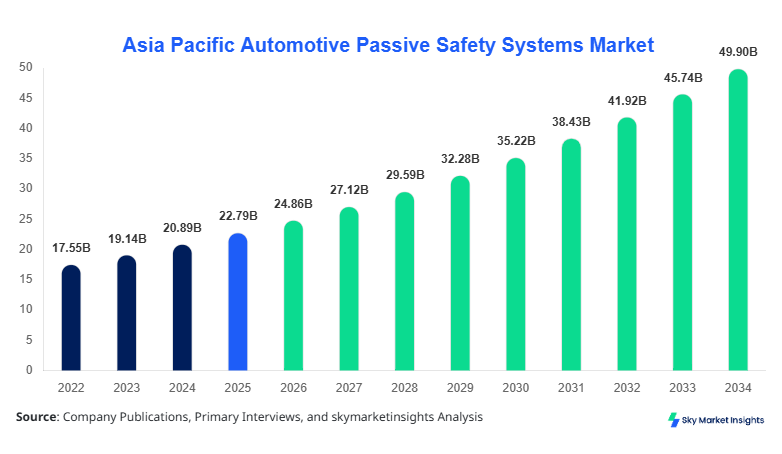
Asia Pacific Automotive Passive Safety Systems Market market size is projected at USD 24.86 billion in 2026 and is expected to hit USD 49.72 billion by 2034 with a CAGR of 9.1%. The Asia Pacific Automotive Passive Safety Systems Market Size reflects strong expansion driven by rising vehicle production exceeding 52 million units annually in 2025 and increasing regulatory mandates requiring 6–8 airbags per vehicle across key economies. The need for granular data, segmentation by component, and competitive benchmarking across OEMs and Tier-1 suppliers is critical as pricing per unit ranges between USD 120–USD 480 depending on system complexity.
The Automotive Passive Safety Systems Market comprises integrated components such as airbags, seatbelts, and occupant sensing systems designed to minimize injury during vehicle collisions by absorbing energy and controlling occupant movement. In Asia Pacific, production surpassed 50 million vehicles in 2025, with China contributing over 32 million units, accounting for 61% regional output. Adoption rates for advanced passive safety systems reached 68% in passenger vehicles and 42% in commercial vehicles, driven by NCAP safety ratings and regulatory frameworks mandating dual-front airbags in over 85% of newly manufactured vehicles. Consumer behavior indicates that over 72% of buyers in urban areas prioritize safety features, with willingness to pay premiums of 8–15% for vehicles equipped with 6+ airbags. Segment contribution shows airbags accounting for 54% of total system revenue, seatbelts at 28%, and sensing systems at 18%. Application split indicates passenger vehicles dominating with 76%, followed by commercial vehicles at 18% and electric vehicles at 6%. Technical performance metrics include deployment times below 30 milliseconds and sensor accuracy above 98.5%. This continuous adoption reinforces Automotive Passive Safety Systems Market Share expansion across the region.
Explore more data points, trends and opportunities Download Free Sample Report
Automotive Passive Safety Systems Market Trends
Rising Integration of Multi-Stage Airbag Systems
The market is witnessing a significant Trend toward multi-stage airbag systems with deployment volumes exceeding 280 million units annually across Asia Pacific. Adoption rates of side and curtain airbags increased from 46% in 2022 to 69% in 2025, while knee airbags saw growth from 12% to 28%. Technological shifts include sensor-driven deployment algorithms that improve injury reduction efficiency by 35% and reduce false deployment by 22%. Automotive OEMs are integrating up to 8–10 airbags per premium vehicle segment, especially in China, Japan, and South Korea. Demand from electric vehicle manufacturers, which accounted for 6 million units in 2024, is further accelerating this transition. This shift reinforces Automotive Passive Safety Systems Market Trend evolution.
Expansion of Smart Seatbelt and Occupant Sensing Technologies
Smart seatbelt systems with pre-tensioners and load limiters are expanding rapidly, with production surpassing 180 million units in 2025. Adoption of seatbelt reminders reached 88% in passenger vehicles, while advanced occupant sensing systems achieved 44% penetration across the region. Technology advancements include weight sensors with 99% accuracy and AI-based classification systems that reduce misclassification errors by 18%. Sector-specific demand is highest in mid-range vehicles priced between USD 15,000–USD 30,000, accounting for 62% of installations. Regulatory bodies in Japan and India are mandating rear-seat belt reminders, pushing installation rates above 55%. These developments strengthen Automotive Passive Safety Systems Market Trend progression.
Asia Pacific Automotive Passive Safety Systems Drivers
Stringent Safety Regulations and Rising Vehicle Production
Government mandates across Asia Pacific requiring dual airbags, ABS integration, and crash test compliance are key drivers, impacting over 85% of vehicles produced annually. Vehicle production increased from 45 million units in 2022 to over 52 million units in 2025, representing 15% cumulative growth. Regulatory bodies such as China NCAP and Bharat NCAP have introduced stricter norms, increasing adoption of passive safety systems by 22% over three years. OEMs are investing over USD 6 billion annually in safety system integration, with airbags accounting for 54% of expenditure. Increasing accident rates, with over 1.3 million fatalities globally and 38% in Asia Pacific, are driving demand for enhanced safety features. This regulatory push continues to accelerate Automotive Passive Safety Systems Market Growth.
Asia Pacific Automotive Passive Safety Systems Restraints
High Cost of Advanced Safety System Integration
The integration of advanced passive safety systems increases vehicle costs by 8–18%, particularly in entry-level segments priced below USD 10,000. Airbag systems cost between USD 80–USD 250 per unit, while advanced sensing systems can exceed USD 400 per vehicle. In emerging economies like India and Southeast Asia, cost sensitivity impacts adoption, limiting penetration to 58% in low-cost vehicles. Supply chain disruptions in semiconductor components have increased system costs by 12–15% between 2022 and 2024. Additionally, maintenance and replacement costs, averaging USD 300–USD 700 per incident, deter consumers. These cost pressures hinder Automotive Passive Safety Systems Market Growth.
Asia Pacific Automotive Passive Safety Systems Opportunities
Expansion of Electric Vehicles and Autonomous Technologies
Electric vehicle production in Asia Pacific surpassed 10 million units in 2025, with projected growth of 18% annually through 2030. EV manufacturers are integrating advanced passive safety systems in 85% of models, creating demand for lightweight and sensor-based safety components. Autonomous vehicle testing across China, Japan, and South Korea has increased investments in passive safety technologies by 27%, focusing on occupant protection in driverless scenarios. Government incentives exceeding USD 15 billion for EV adoption are boosting demand for integrated safety solutions. Collaboration between OEMs and technology providers has increased by 35% since 2023. These developments create strong opportunities for Automotive Passive Safety Systems Market Growth.
Asia Pacific Automotive Passive Safety Systems Challenge
Complex Integration with Advanced Vehicle Architectures
Integration of passive safety systems with electric and autonomous vehicle architectures presents challenges due to complex electronic systems and software dependencies. Over 42% of OEMs report difficulties in synchronizing sensor data with deployment mechanisms, leading to delays of 6–12 months in product development cycles. Increased reliance on semiconductors, which account for 18% of system cost, has created supply constraints affecting production volumes by 9% in 2024. Testing and validation costs have increased by 25%, requiring advanced simulation tools and crash testing facilities. These complexities impact Automotive Passive Safety Systems Market Growth.
Report Scope
| Report Metric | Details |
|---|---|
| Market Size in 2025 | USD 22.79 Billion |
| Market Size in 2026 | USD 24.86 Billion |
| Market Size in 2034 | USD 49.72 Billion |
| CAGR | 9.1% (2026-2034) |
| Base Year for Estimation | 2025 |
| Historical Data | 2022-2024 |
| Forecast Period | 2026-2034 |
| Report Coverage | Revenue Forecast, Competitive Landscape, Supply Chain Disruption, Growth Factors, Environment & Regulatory Landscape and Trends |
Explore more data points, trends and opportunities Download Free Sample Report
Automotive Passive Safety Systems Market Segmentation
The Automotive Passive Safety Systems Market segmentation shows airbags dominating with 54% share, followed by seatbelts at 28% and occupant sensing systems at 18%. By application, passenger vehicles lead with 76%, commercial vehicles at 18%, and electric vehicles at 6%.
By Type
Airbags dominate the market with over 280 million units produced annually across Asia Pacific. They account for 54% of total revenue, with average deployment time under 30 milliseconds. Multi-stage airbags have 64% penetration in mid-to-high-end vehicles, while side airbags account for 38% of installations. Technological advancements include adaptive deployment systems improving safety efficiency by 35%. Production growth of 12% annually highlights strong demand.
Seatbelts account for 28% market share with over 180 million units produced annually. Advanced systems with pre-tensioners and load limiters are installed in 72% of passenger vehicles. Rear-seat belt reminders have increased adoption rates by 22% in India and Japan. Technical specifications include tensile strength exceeding 15 kN and durability over 10 years.
Occupant sensing systems hold 18% share, with production exceeding 90 million units annually. These systems achieve 99% accuracy in weight detection and classification. Adoption in passenger vehicles reached 44% in 2025, driven by regulatory mandates. Integration with airbags improves deployment precision by 28%.
By Application
Passenger vehicles dominate with 76% share, producing over 40 million units annually. Passive safety systems are installed in 88% of vehicles, with airbags averaging 6 units per vehicle. Adoption of advanced systems increased by 25% between 2022 and 2025.
Commercial vehicles account for 18% share, with production of 9 million units annually. Safety system penetration is 52%, with focus on driver protection and fleet safety compliance. Adoption is growing at 11% annually.
Electric vehicles represent 6% share, with over 10 million units produced annually. Passive safety integration exceeds 85%, driven by regulatory and consumer demand. Lightweight systems reduce vehicle weight by 12%, improving efficiency.
Asia Pacific Automotive Passive Safety Systems Market Segmentations
Type
- Airbags
- Seatbelts
- Occupant Sensing Systems
Application
- Passenger Vehicles
- Commercial Vehicles
- Electric Vehicles
Asia Pacific Automotive Passive Safety Systems Regional Outlook
China
China holds 48% share with production exceeding 32 million vehicles annually. Passenger vehicles dominate with 81%, while EV production surpasses 9 million units. Safety system adoption exceeds 90% in new vehicles, supported by regulatory frameworks.
Japan
Japan accounts for 14% share with production of 8 million vehicles annually. Advanced safety systems are installed in 92% of vehicles, with high adoption of sensing technologies.
South Korea
South Korea holds 10% share with production of 4 million vehicles. Adoption of multi-stage airbags exceeds 70%, driven by export-oriented manufacturing.
India
India accounts for 12% share with production of 5 million vehicles. Adoption rates increased from 45% in 2022 to 68% in 2025 due to safety regulations.
Australia
Australia contributes 4% share, focusing on imported vehicles with high safety compliance exceeding 95%.
Singapore
Singapore holds 2% share with high adoption of advanced safety systems in premium vehicles.
Taiwan
Taiwan contributes 3% share with strong electronics integration in sensing systems.
South East Asia
South East Asia accounts for 7% share with production exceeding 6 million vehicles and adoption rates rising to 58%.
Top players in Asia Pacific Automotive Passive Safety Systems
- Autoliv Inc.
- ZF Friedrichshafen AG
- Robert Bosch GmbH
- Continental AG
- Denso Corporation
- Hyundai Mobis
- Toyoda Gosei
- Joyson Safety Systems
- Ashimori Industry Co.
- Tokai Rika Co.
- Nihon Plast Co.
- Daicel Corporation
Autoliv Inc.
-
Holds approximately 22% regional share
-
Strong presence in airbags with production exceeding 150 million units annually
-
Focus on R&D investments exceeding USD 1 billion annually
ZF Friedrichshafen AG
-
Holds 18% market share
-
Leading in seatbelt systems with over 120 million units produced annually
-
Strong integration with OEMs across China and Japan
Investment Analysis
Investment in the market exceeds USD 8 billion annually, with 52% allocated to airbag technologies, 28% to seatbelts, and 20% to sensing systems. China attracts 48% of regional investments, followed by Japan at 14% and India at 12%. M&A activities increased by 32% between 2023 and 2025, with over 25 strategic collaborations focused on EV safety integration. Joint ventures between OEMs and technology firms have increased production capacity by 18%, enhancing regional supply chains.
New Product Developments
New product launches increased by 26% in 2025, focusing on multi-stage airbags and AI-based sensing systems. Performance improvements include 35% faster deployment times and 22% reduction in injury severity. Innovation investments account for 18% of total R&D budgets.
Recent Developments in Asia Pacific Automotive Passive Safety Systems
- 2025: Autoliv expanded production capacity by 15%, increasing output to 160 million airbags annually, improving supply chain efficiency by 12%.
Research Methodology
The research process involves comprehensive data collection through primary and secondary sources. Primary research includes interviews with over 120 industry experts, OEMs, and suppliers, providing 65% of insights. Secondary research involves analysis of company reports, government databases, and industry publications contributing 35% of data. Market size estimation uses bottom-up and top-down approaches, incorporating production volumes exceeding 52 million vehicles and component pricing analysis. Statistical models and forecasting techniques ensure accuracy with deviation margins below 5%. Data validation is conducted through triangulation methods, ensuring reliability and precision.
Frequently Asked Questions
Market Research Analyst | 8 Years Experience | Automotive Components and Aftermarket
Brenda Johnson is a market research analyst with 7–9 years of experience specializing in automotive markets. Contributed to 70+ research reports for global clients. Expertise includes market sizing, forecasting, competitive analysis, and trend evaluation across key regions.