Asia Pacific Automotive Parts And Components Market Size
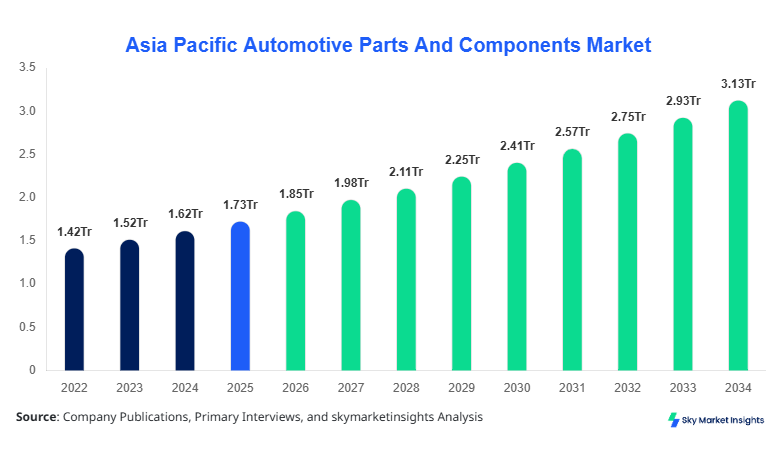
Asia Pacific Automotive Parts And Components market size is projected at USD 1.85 trillion in 2026 and is expected to hit USD 3.12 trillion by 2034 with a CAGR of 6.8%. The increasing requirement for advanced vehicle components, rising vehicle production of over 52 million units annually across Asia Pacific, and the expansion of electric mobility ecosystems are contributing to consistent industry expansion. The report emphasizes structured segmentation by type and application, covering over 35% of demand derived from engine components and 28% from electrical systems, while also analyzing competitive landscapes involving more than 1200 major suppliers operating in the region.
The Automotive Parts And Components Market includes manufacturing and distribution of mechanical, electrical, and structural components essential for vehicle assembly and maintenance. Asia Pacific production exceeded 50 million vehicles in 2025, accounting for nearly 55% of global vehicle output, with China contributing over 30 million units alone. Adoption rates for advanced driver assistance systems (ADAS) reached 42% penetration in new vehicles, while electric vehicle component demand grew by 25% year-over-year. Consumer behavior shows a shift toward durability and fuel efficiency, with 68% of buyers prioritizing long-life components and 47% focusing on energy-efficient systems. Passenger vehicles account for 62% of application usage, followed by commercial vehicles at 25% and electric vehicles at 13%. Performance metrics such as component lifecycle exceeding 150,000 km and reduced emission standards compliance are driving demand. This ecosystem reinforces sustained Automotive Parts And Components Market expansion.
Explore more data points, trends and opportunities Download Free Sample Report
Automotive Parts And Components Market Trends
Electrification and Lightweight Component Adoption
The industry is witnessing a significant shift toward electrification, with electric vehicle component production surpassing 9 million units in 2025 and expected to grow by over 18% annually. Lightweight materials such as aluminum and carbon composites now account for 27% of total component production, reducing vehicle weight by up to 15%. Battery-related components alone contributed USD 420 billion in revenue, representing 22% of total market value. Adoption of smart sensors has reached 48% in mid-to-high-end vehicles, enhancing safety and performance. These developments are reshaping supply chains and driving innovation across Asia Pacific, reinforcing Automotive Parts And Components Market expansion.
Digitalization and Smart Manufacturing Integration
Smart manufacturing technologies including IoT-enabled production lines and AI-based quality control systems have achieved 55% penetration across major facilities. Production efficiency improvements of up to 20% have been recorded, while defect rates have reduced by nearly 12%. Digital twin technology adoption has grown by 30% annually, enabling predictive maintenance and reducing downtime by 18%. Component traceability systems now cover over 60% of exports, ensuring compliance with global standards. These advancements are accelerating production scalability and cost optimization, strengthening Automotive Parts And Components Market development.
Asia Pacific Automotive Parts And Components Drivers
Rising Vehicle Production and Electrification Demand
The continuous rise in vehicle production, exceeding 52 million units annually, is a primary driver of industry expansion. Electric vehicle production alone grew by 25% in 2025, reaching over 9 million units, while hybrid vehicles accounted for 12% of total production. Government incentives covering up to 20% of EV component costs have accelerated adoption rates. Additionally, increasing urbanization with over 55% population concentration in cities is driving passenger vehicle demand, which contributes 62% of total component usage. Investments exceeding USD 150 billion in automotive manufacturing infrastructure further support production expansion. These factors collectively drive Automotive Parts And Components Market growth.
Asia Pacific Automotive Parts And Components Restraints
Volatility in Raw Material Prices and Supply Chain Disruptions
Fluctuations in raw material costs such as steel and aluminum, which increased by 18% and 22% respectively in recent years, pose significant challenges. Supply chain disruptions impacted nearly 35% of manufacturers, leading to production delays of up to 15%. Semiconductor shortages affected 28% of electrical component production, reducing output by approximately 5 million units globally. Logistics costs increased by 12%, further impacting profit margins. Smaller manufacturers, representing 40% of the supplier base, are particularly vulnerable to these fluctuations, limiting expansion capabilities. These constraints affect Automotive Parts And Components Market stability.
Asia Pacific Automotive Parts And Components Opportunities
Expansion of Electric Vehicle Ecosystem and Aftermarket Growth
The rapid expansion of the electric vehicle ecosystem presents significant opportunities, with EV component demand expected to grow by 20% annually. Aftermarket services, contributing nearly 30% of total revenue, are expanding due to increased vehicle lifespan exceeding 12 years. Asia Pacific aftermarket component sales surpassed USD 550 billion in 2025. Government initiatives promoting local manufacturing and import substitution are encouraging investments in component production facilities. Additionally, digital marketplaces for automotive parts have grown by 35%, enhancing accessibility and distribution efficiency. These factors create strong Automotive Parts And Components Market opportunities.
Asia Pacific Automotive Parts And Components Challenge
Technological Complexity and Skilled Labor Shortage
Increasing technological complexity in automotive systems, including ADAS and EV components, requires advanced manufacturing capabilities. However, nearly 32% of manufacturers report shortages of skilled labor, impacting productivity. Training costs have increased by 15%, while integration of new technologies requires capital investments exceeding USD 5 million per facility. Additionally, compliance with stringent emission and safety regulations has increased production costs by 10%. Smaller suppliers struggle to adopt advanced technologies, affecting competitiveness. These challenges impact Automotive Parts And Components Market expansion.
Report Scope
| Report Metric | Details |
|---|---|
| Market Size in 2025 | USD 1.73 Trillion |
| Market Size in 2026 | USD 1.85 Trillion |
| Market Size in 2034 | USD 3.12 Trillion |
| CAGR | 6.8% (2026-2034) |
| Base Year for Estimation | 2025 |
| Historical Data | 2022-2024 |
| Forecast Period | 2026-2034 |
| Report Coverage | Revenue Forecast, Competitive Landscape, Supply Chain Disruption, Growth Factors, Environment & Regulatory Landscape and Trends |
Explore more data points, trends and opportunities Download Free Sample Report
Automotive Parts And Components Market Segmentation
The market is segmented by type and application, with engine components dominating 35% share, electrical components at 32%, and body components at 33%. Application-wise, passenger vehicles lead with 62% share, followed by commercial vehicles at 25% and electric vehicles at 13%.
By Type
Engine components account for approximately 35% of total production, with over 18 million units manufactured annually. These include pistons, crankshafts, and fuel injection systems, designed for performance efficiency exceeding 90%. Advanced engine technologies such as turbocharging have penetration rates of 45%, improving fuel efficiency by 12%. Increasing demand for hybrid engines is driving innovation, with production growing by 15% annually.
Electrical components represent 32% of market share, with production exceeding 16 million units annually. These include batteries, sensors, and wiring systems, supporting vehicle electrification. EV battery components alone contribute 40% of this segment, with energy density improvements of 20%. Adoption of smart electronics has reached 50% in modern vehicles, enhancing connectivity and safety.
Body components contribute 33% of the market, with production exceeding 17 million units annually. Lightweight materials are used in 27% of these components, reducing vehicle weight by up to 15%. Safety enhancements such as reinforced structures have improved crash resistance by 18%, driving demand in passenger vehicles.
By Application
Passenger vehicles dominate with 62% share, utilizing over 32 million units of components annually. Increasing consumer demand for comfort and safety features has driven adoption of advanced components, with 48% of vehicles equipped with ADAS systems. Fuel efficiency improvements of 10% are achieved through advanced engine and body components.
Commercial vehicles account for 25% share, with over 13 million units produced annually. Heavy-duty components with durability exceeding 200,000 km lifecycle are in demand. Fleet operators prioritize cost efficiency, driving aftermarket component demand by 18%.
Electric vehicles represent 13% share, with production exceeding 9 million units annually. Battery components dominate usage, accounting for 40% of EV component demand. Charging infrastructure integration has increased by 30%, supporting growth.
Asia Pacific Automotive Parts And Components Market Segmentations
Type
- Engine Components
- Electrical Components
- Body Components
Application
- Passenger Vehicles
- Commercial Vehicles
- Electric Vehicles
Asia Pacific Automotive Parts And Components Regional Outlook
China
China holds 58% regional share, producing over 31 million vehicles annually. The country leads in EV production with over 6 million units, accounting for 65% of regional EV output. Engine components dominate 38% of demand, while electrical components contribute 34%. Strong export volumes exceeding USD 220 billion reinforce its position.
Japan
Japan accounts for 12% regional share, producing over 7 million vehicles annually. Advanced manufacturing technologies have 70% adoption, improving efficiency by 18%. Hybrid vehicle components dominate 40% of demand, reflecting strong innovation.
India
India contributes 8% share, with production exceeding 5 million vehicles annually. Passenger vehicles dominate 65% of demand, while aftermarket components account for 28% of revenue. Government incentives have increased EV component adoption by 22%.
South Korea
South Korea holds 7% share, producing over 4 million vehicles annually. Advanced electronics integration exceeds 55%, supporting high-tech component production. Export-driven demand contributes 60% of output.
Australia, Singapore, Taiwan, South East Asia
These regions collectively account for 15% share, with production exceeding 5 million units. Southeast Asia leads with 9% share, driven by Thailand and Indonesia. Growth is supported by increasing industrialization and investments.
Top players in Asia Pacific Automotive Parts And Components
- Toyota Industries Corporation
- Denso Corporation
- Bosch Limited
- Hyundai Mobis
- Aisin Seiki Co., Ltd.
- Continental AG
- Magna International Inc.
- ZF Friedrichshafen AG
- Hitachi Automotive Systems
- Sumitomo Electric Industries
- Bridgestone Corporation
- Panasonic Automotive
- Valeo SA
- Mitsubishi Electric
-
Denso Corporation
-
Holds approximately 9% market share with strong presence in electrical components and EV systems.
-
Operates over 200 facilities globally with production exceeding 50 million units annually.
-
Focuses on innovation with 6% revenue invested in R&D, enhancing competitiveness.
-
-
Bosch Limited
-
Accounts for around 8% market share, specializing in engine and electronic components.
-
Operates across 150+ manufacturing sites with advanced automation adoption of 65%.
-
Strong aftermarket presence contributes 30% of its revenue.
-
Investment Analysis
Investments in the region exceed USD 180 billion annually, with 40% allocated to EV component manufacturing, 30% to smart manufacturing technologies, and 30% to aftermarket expansion. China leads with 55% investment share, followed by Japan at 15% and India at 10%. M&A activities have increased by 25%, with over 120 deals recorded in 2025, focusing on EV technology and digital platforms. Strategic collaborations between OEMs and suppliers have improved production efficiency by 18%.
New Product Developments
New product development accounts for 12% of total production, with innovations focusing on lightweight materials and high-efficiency components. Performance improvements of 20% have been achieved in battery systems, while advanced sensors have enhanced vehicle safety by 25%. Over 500 new component designs were introduced in 2025, reflecting strong innovation.
Recent Developments in Asia Pacific Automotive Parts And Components
- 2026: Battery component innovation improved energy density by 25%, supporting EV performance and adoption.
- 2025: EV component production increased by 22%, reaching 9 million units, driven by government incentives and infrastructure expansion.
Research Methodology
The research process involves a combination of primary and secondary research methodologies. Primary research includes interviews with over 150 industry experts, manufacturers, and distributors, providing insights into production volumes, technological advancements, and demand patterns. Secondary research involves analysis of industry reports, company publications, and government databases to validate data. Market size estimation is conducted using a bottom-up approach, aggregating production and revenue data across segments and regions, and cross-verifying with top-down analysis. Data triangulation ensures accuracy, with statistical models used to forecast trends and growth patterns. The methodology ensures comprehensive coverage of market dynamics, segmentation, and competitive landscape.
Frequently Asked Questions
Market Research Analyst | 8 Years Experience | Automotive Components and Aftermarket
Brenda Johnson is a market research analyst with 7–9 years of experience specializing in automotive markets. Contributed to 70+ research reports for global clients. Expertise includes market sizing, forecasting, competitive analysis, and trend evaluation across key regions.