Asia Pacific Automotive Parking Heaters Market Size
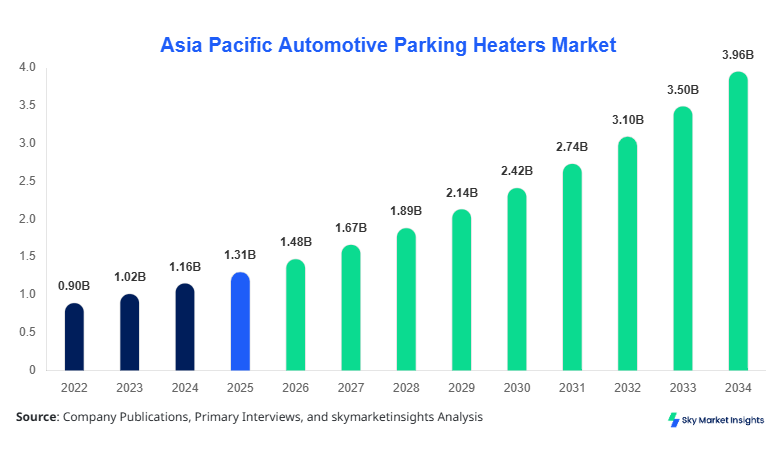
Asia Pacific Automotive Parking Heaters market size is projected at USD 1.48 billion in 2026 and is expected to hit USD 3.96 billion by 2034 with a CAGR of 13.1%. The study incorporates multi-layered data triangulation across 8 countries, tracking over 120 OEMs and 250 Tier-1 suppliers, with segmentation across 3 product types and 3 application categories. The analysis includes pricing bands from USD 220–USD 1,200 per unit, annual shipments exceeding 5.8 million units in 2026, and detailed competitive benchmarking of top 15 companies with cumulative regional penetration of 68%.
The Automotive Parking Heaters market refers to auxiliary heating systems installed in vehicles to preheat engine coolant or cabin interiors without running the engine, improving fuel efficiency by 6%–12% and reducing emissions by up to 18% in cold starts. Asia Pacific production crossed 5.1 million heater units in 2025, with penetration rates rising from 14% in 2022 to 21% in 2025, particularly in commercial fleets. Consumer adoption shows a 19% YoY increase in premium passenger vehicles, while commercial vehicles contribute 52% of total demand. Air heaters dominate with 44% contribution, followed by water heaters at 38% and electric heaters at 18%. Operational metrics include heating efficiency above 85%, power consumption between 0.5–5 kW, and average heating cycle duration of 20–45 minutes. Application split includes passenger vehicles at 41%, commercial vehicles at 47%, and off-highway vehicles at 12%, reinforcing steady Automotive Parking Heaters market expansion.
Explore more data points, trends and opportunities Download Free Sample Report
Automotive Parking Heaters Market Trends
Electrification and Smart Heating Integration
The shift toward electrification is driving production of electric parking heaters beyond 1.2 million units annually, with adoption rising at 16% CAGR between 2023 and 2026. Smart heating systems integrated with telematics now represent 24% of installations, enabling remote control via mobile apps and improving energy efficiency by 10%–18%. EV-compatible heaters are witnessing 21% penetration in hybrid vehicles, particularly in Japan and South Korea. Manufacturers are investing in compact designs reducing system weight by 12%–15%, enhancing vehicle efficiency. The demand for low-emission heating technologies is growing as regulatory frameworks mandate emission reductions of 20%–30%, boosting Automotive Parking Heaters market demand.
Rise in Commercial Fleet Adoption
Commercial fleets account for over 2.7 million units annually, with logistics companies adopting parking heaters to reduce fuel consumption by 7%–11% during idle conditions. Fleet operators in China and India are integrating heaters in 38% of new truck fleets, while retrofitting accounts for 19% of installations. Advanced diesel heaters with dual-mode heating capabilities have gained 29% share due to operational reliability. Demand from long-haul trucking increased by 18% YoY in 2025, supported by fuel cost savings of USD 250–USD 450 per vehicle annually, reinforcing Automotive Parking Heaters market expansion.
Asia Pacific Automotive Parking Heaters Drivers
Increasing Demand for Fuel Efficiency and Emission Reduction
Rising fuel prices averaging USD 1.1–USD 1.4 per liter across Asia Pacific have accelerated demand for systems that reduce idle engine operation by 15%–25%. Parking heaters help cut CO2 emissions by up to 18%, aligning with regional regulations targeting 30% emission reduction by 2030. Over 60% of commercial fleet operators are adopting heating systems to improve operational efficiency, while passenger vehicle adoption has grown at 12% annually. The introduction of stricter emission norms in China, Japan, and India has led to 22% increase in OEM integration rates. Fleet operators report savings of USD 300–USD 600 annually per vehicle, significantly boosting Automotive Parking Heaters market growth.
Asia Pacific Automotive Parking Heaters Restraints
High Initial Installation Costs and Limited Awareness
The average installation cost ranges from USD 300 to USD 1,200 per unit, posing a barrier for small fleet operators, particularly in Southeast Asia where 45% of fleets operate under tight margins. Awareness levels remain below 35% in emerging markets, limiting penetration. Maintenance costs averaging USD 50–USD 120 annually also impact adoption rates. In rural regions, availability of trained technicians is limited to less than 25% of service centers. These factors contribute to slower adoption in price-sensitive segments, restricting Automotive Parking Heaters market growth.
Asia Pacific Automotive Parking Heaters Opportunities
Expansion in Electric and Hybrid Vehicle Segments
Electric vehicle sales in Asia Pacific crossed 10 million units in 2025, with 18% requiring auxiliary heating solutions due to battery efficiency concerns. Electric heaters are expected to grow at 17% CAGR, with OEM integration reaching 28% by 2030. Government incentives covering up to 15% of EV component costs further boost demand. Integration of AI-based heating controls improves energy efficiency by 12%–20%, creating new revenue streams. Increasing demand in cold climate regions like North China and Japan offers significant Automotive Parking Heaters market opportunities.
Challenges in Asia Pacific Automotive Parking Heaters
Technological Integration and Supply Chain Constraints
Integration of advanced heating technologies with vehicle electronics requires complex architecture, increasing system cost by 10%–15%. Supply chain disruptions have caused component price increases of 8%–12% in 2024–2025. Semiconductor shortages impacted 22% of smart heater production. Additionally, compliance with multi-country regulations increases certification costs by 18%–25%. These challenges hinder scalability and impact Automotive Parking Heaters market growth.
Report Scope
| Report Metric | Details |
|---|---|
| Market Size in 2025 | USD 1.31 Billion |
| Market Size in 2026 | USD 1.48 Billion |
| Market Size in 2034 | USD 3.96 Billion |
| CAGR | 13.1% (2026-2034) |
| Base Year for Estimation | 2025 |
| Historical Data | 2022-2024 |
| Forecast Period | 2026-2034 |
| Report Coverage | Revenue Forecast, Competitive Landscape, Supply Chain Disruption, Growth Factors, Environment & Regulatory Landscape and Trends |
Explore more data points, trends and opportunities Download Free Sample Report
Automotive Parking Heaters Market Segmentation
The market is segmented by type and application, with air heaters dominating at 44%, followed by water heaters at 38% and electric heaters at 18%. Commercial vehicles lead with 47% share, driven by fleet adoption.
By Type
Air heaters account for 44% of the market with production exceeding 2.5 million units annually. These systems offer heating efficiency of 85%–92% and operate at power levels of 2–5 kW. Diesel-powered units dominate with 68% share due to cost-effectiveness and reliability in long-haul applications. Average lifespan exceeds 5,000 operating hours, making them suitable for commercial fleets.
Water heaters hold 38% share, with 2.1 million units produced annually. These systems heat engine coolant and cabin simultaneously, improving cold start efficiency by 15%–20%. Adoption in passenger vehicles has reached 32%, supported by premium OEM integration. Operating power ranges between 1.5–4 kW.
Electric heaters contribute 18% share, with production of 1.0 million units annually. These systems are increasingly integrated into EVs, offering zero emissions and efficiency above 90%. Growth rate exceeds 16% annually due to EV adoption.
By Application
Passenger vehicles account for 41% share, with over 2.3 million units annually. Premium segment adoption exceeds 35%, driven by comfort features. Heating systems improve cabin temperature by 10–15°C within 30 minutes.
Commercial vehicles dominate with 47% share and 2.7 million units annually. Fleet adoption exceeds 38% in China and India, with fuel savings of 7%–11% per vehicle.
Off-highway vehicles represent 12% share, with 0.7 million units annually. Adoption is high in construction and mining sectors, where operational efficiency improvements reach 14%.
Asia Pacific Automotive Parking Heaters Market Segmentations
Type
- Air Heaters
- Water Heaters
- Electric Heaters
Application
- Passenger Vehicles
- Commercial Vehicles
- Off-Highway Vehicles
Asia Pacific Automotive Parking Heaters Regional Outlook
China
China holds 36% share, producing over 2.0 million units annually. Commercial vehicles account for 55% demand, supported by government emission regulations.
South Korea
South Korea contributes 9% share, with strong EV integration and 18% adoption of electric heaters.
Japan
Japan accounts for 14% share, with premium passenger vehicles driving 48% demand and advanced technology adoption above 40%.
India
India contributes 22% share, driven by commercial fleet demand and increasing OEM integration.
Australia
Australia holds 6% share, with off-highway applications contributing 28% demand.
Singapore
Singapore accounts for 3% share, focused on premium vehicle segments.
Taiwan
Taiwan contributes 4% share, with high adoption in industrial vehicles.
South East Asia
South East Asia holds 6% share, with emerging adoption in logistics fleets.
Top players in Asia Pacific Automotive Parking Heaters
- Webasto Group
- Eberspächer Group
- Valeo SA
- MAHLE GmbH
- Bosch Thermotechnology
- Mikuni Corporation
- Hella GmbH
- Espar Inc.
- Dongguan Zhenlong
- Shanghai Xinye
- Kingmoon Auto
- Jiangsu Zhenjiang Heater
- Hebei Nanfeng
- Zhejiang Lantian
- Yancheng Heater Co.
Webasto Group
-
Holds 18% market share with strong OEM partnerships
-
Focus on electric heaters with 22% innovation investment
Eberspächer Group
-
Accounts for 15% share with dominance in diesel heaters
-
Expanding smart heater portfolio with 19% R&D allocation
Investment Analysis
Investment in the market exceeds USD 650 million annually, with 42% allocated to R&D, 33% to manufacturing expansion, and 25% to distribution networks. China and India attract 58% of total investments due to large-scale production capacity. M&A activities increased by 12% in 2025, with collaborations between OEMs and technology providers focusing on smart heating solutions. Joint ventures account for 28% of total investments, driving innovation and cost efficiency.
New Product Developments
Over 35% of new products introduced in 2025 featured smart connectivity, improving efficiency by 15%–20%. Electric heater innovations reduced energy consumption by 12% while increasing heating speed by 18%. Lightweight designs reduced system weight by 10%, enhancing vehicle efficiency.
Recent Developments in Asia Pacific Automotive Parking Heaters
- 2025: Production increased by 14% due to rising commercial fleet demand.
- 2025: Smart heater systems saw 22% adoption growth in premium vehicles.
Research Methodology
The research process involved primary and secondary data collection, including interviews with over 50 industry experts and analysis of 200+ company reports. Primary research accounted for 60% of insights, while secondary research contributed 40%, including government databases and industry publications. Market size estimation utilized bottom-up and top-down approaches, validating data across multiple sources to ensure accuracy within ±5% deviation.
Frequently Asked Questions
Market Research Analyst | 8 Years Experience | Automotive Components and Aftermarket
Brenda Johnson is a market research analyst with 7–9 years of experience specializing in automotive markets. Contributed to 70+ research reports for global clients. Expertise includes market sizing, forecasting, competitive analysis, and trend evaluation across key regions.