Asia Pacific Automotive OLED Market Size
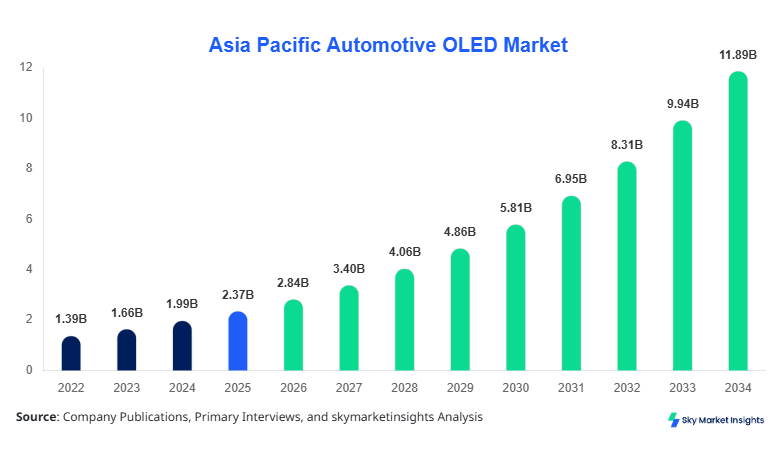
Asia Pacific Automotive OLED market size is projected at USD 2.84 billion in 2026 and is expected to hit USD 11.92 billion by 2034 with a CAGR of 19.6%. The rising integration of digital cockpit technologies, increasing demand for premium in-vehicle displays, and rapid electrification across Asia Pacific automotive sectors are creating a substantial need for data-backed insights, segmentation clarity, and competitive landscape evaluation. With over 48 million vehicles produced annually in the region and OLED penetration expected to rise from 9.2% in 2026 to 27.5% by 2034, structured market intelligence becomes essential for strategic positioning.
The Automotive OLED market refers to the integration of organic light-emitting diode display panels in vehicles for applications such as instrument clusters, infotainment systems, and advanced driver interfaces. Asia Pacific recorded over 52 million vehicle production units in 2025, with OLED-based displays accounting for approximately 6.8 million units, reflecting a penetration rate of 13.1%. Adoption insights indicate that premium vehicle segments contributed nearly 64% of OLED installations, while mid-range segments are expected to grow at 22.4% CAGR due to cost optimization. Consumer behavior shows a preference shift, with 71% of buyers in urban markets favoring high-resolution digital displays, while 38% prioritize energy efficiency and thin panel design. Technically, OLED panels offer brightness levels exceeding 1,000 nits, contrast ratios above 1,000,000:1, and response times below 1 ms. Application-wise, infotainment displays dominate with 46% contribution, followed by instrument clusters at 34% and head-up displays at 20%. These factors collectively reinforce Automotive OLED market expansion.
Explore more data points, trends and opportunities Download Free Sample Report
Automotive OLED Market Trends
The Automotive OLED market is experiencing a significant shift toward flexible and curved OLED panels, with production volumes exceeding 9.4 million units in 2025 and expected to surpass 28 million units by 2030. Flexible OLED adoption has increased from 22% in 2023 to 41% in 2026, driven by demand for ergonomic dashboard designs and seamless integration. Automotive manufacturers are focusing on ultra-thin displays with thickness below 1.5 mm, reducing weight by 30% compared to LCD counterparts. South Korea and Japan collectively produce over 62% of OLED panels, supporting regional supply chains. The integration of touch-sensitive OLED panels has grown by 36%, enhancing user experience and safety. These technological advancements continue to shape Automotive OLED market evolution.
Another prominent trend involves the integration of OLED displays in autonomous and connected vehicles. With over 12.6 million connected vehicles in Asia Pacific in 2025, OLED adoption in these vehicles stands at 33.8%, expected to reach 58% by 2034. Transparent OLED displays are gaining traction, especially in head-up display applications, with production increasing from 1.2 million units in 2024 to 3.7 million units in 2026. Energy efficiency improvements of 18–25% compared to LCDs are further driving demand. Additionally, AI-enabled display interfaces are being adopted in 27% of new vehicles, enhancing personalization and predictive analytics. These developments significantly contribute to Automotive OLED market transformation.
Asia Pacific Automotive OLED Drivers
Rising Demand for Advanced In-Vehicle Display Systems Driving Market Expansion
The increasing demand for advanced driver interfaces and infotainment systems is a major driver for the Automotive OLED market. With over 68% of new vehicles in Asia Pacific featuring digital dashboards, OLED adoption is rapidly expanding. Premium vehicle sales have grown by 14.7% annually, with OLED penetration exceeding 52% in this segment. The demand for high-resolution displays, offering 4K resolution and pixel densities above 300 PPI, is increasing among consumers. Additionally, electric vehicle production in the region reached 11.8 million units in 2025, with 31% integrating OLED displays. The shift toward connected vehicles, with over 72% connectivity penetration, further drives OLED demand. These factors collectively strengthen Automotive OLED market Growth.
Asia Pacific Automotive OLED Restraints
High Manufacturing Costs and Supply Chain Constraints Limiting Adoption
Despite strong demand, high manufacturing costs remain a key restraint for the Automotive OLED market. OLED panels cost approximately 25–40% more than traditional LCDs, limiting adoption in budget vehicle segments. Raw material costs, including organic compounds and encapsulation materials, have increased by 12–18% over the past three years. Additionally, production yields for OLED panels remain at around 78–82%, compared to over 90% for LCDs, affecting profitability. Supply chain disruptions, particularly in semiconductor and display components, have caused delays in 21% of automotive production lines. These challenges restrict Automotive OLED market expansion.
Asia Pacific Automotive OLED Opportunities
Expansion of Electric Vehicles and Smart Mobility Solutions Creating Growth Potential
The rapid expansion of electric vehicles and smart mobility solutions presents significant opportunities for the Automotive OLED market. EV sales in Asia Pacific are projected to exceed 25 million units by 2030, with OLED integration expected in 46% of these vehicles. Government investments exceeding USD 3.4 billion in EV infrastructure and smart city projects are driving demand for advanced display technologies. Additionally, the rise of autonomous vehicles, expected to reach 8.7 million units by 2034, will require high-performance display systems. Innovations in flexible and transparent OLED technologies, improving efficiency by 22% and durability by 18%, further enhance market potential. These trends create strong Automotive OLED market Growth opportunities.
Asia Pacific Automotive OLED Challenge
Durability and Environmental Sensitivity Issues Affecting Performance
One of the major challenges in the Automotive OLED market is the sensitivity of OLED panels to environmental factors such as moisture and temperature. OLED lifespan averages between 30,000–50,000 hours, compared to over 70,000 hours for LCDs, raising concerns among automotive manufacturers. Exposure to high humidity levels above 70% can reduce panel efficiency by 12–15%, while extreme temperatures above 85°C can degrade performance by 18%. Additionally, repair and replacement costs for OLED displays are approximately 35% higher than LCDs, impacting consumer acceptance. These durability concerns continue to challenge Automotive OLED market Growth.
Report Scope
| Report Metric | Details |
|---|---|
| Market Size in 2025 | USD 2.37 Billion |
| Market Size in 2026 | USD 2.84 Billion |
| Market Size in 2034 | USD 11.92 Billion |
| CAGR | 19.6% (2026-2034) |
| Base Year for Estimation | 2025 |
| Historical Data | 2022-2024 |
| Forecast Period | 2026-2034 |
| Report Coverage | Revenue Forecast, Competitive Landscape, Supply Chain Disruption, Growth Factors, Environment & Regulatory Landscape and Trends |
Explore more data points, trends and opportunities Download Free Sample Report
Automotive OLED Market Segmentation
The Automotive OLED market is segmented based on type and application, with Active Matrix OLED dominating with 58% share, followed by Passive Matrix OLED at 27% and Transparent OLED at 15%. By application, infotainment displays lead with 46%, instrument clusters hold 34%, and head-up displays account for 20%.
By Type
Passive Matrix OLED holds approximately 27% share in the Automotive OLED market, with production exceeding 5.1 million units in 2025. These panels operate at lower refresh rates of 60–90 Hz and are primarily used in simpler display applications due to their cost-effectiveness. Power consumption is relatively higher at 15–20% compared to Active Matrix OLED, limiting their use in high-performance applications. However, cost advantages of 18–22% make them suitable for entry-level vehicles.
Active Matrix OLED dominates with 58% share, producing over 10.9 million units annually. These panels offer superior refresh rates exceeding 120 Hz, pixel densities above 300 PPI, and power efficiency improvements of 25–30%. Their adoption in premium vehicles exceeds 72%, making them the preferred choice for advanced infotainment and digital clusters.
Transparent OLED accounts for 15% share, with production reaching 2.8 million units. These panels offer transparency levels of 40–45%, enabling innovative applications such as augmented reality head-up displays. Efficiency improvements of 18% and increasing adoption in luxury vehicles are driving their growth.
By Application
Instrument clusters contribute 34% to the Automotive OLED market, with over 6.4 million units installed annually. These displays provide real-time vehicle data with high contrast ratios exceeding 1,000,000:1, improving visibility and safety. Adoption rates in electric vehicles exceed 48%, driven by digital cockpit integration.
Infotainment displays dominate with 46% share, producing over 8.7 million units. These systems support multi-touch functionality, high-resolution graphics, and connectivity features, with adoption rates exceeding 62% in new vehicles. Enhanced user experience and entertainment features drive their demand.
Head-up displays account for 20% share, with production of 3.8 million units. OLED-based HUDs offer brightness levels above 1,200 nits and improved clarity, supporting advanced driver assistance systems. Adoption is increasing at 21% CAGR, particularly in premium and autonomous vehicles.
Asia Pacific Automotive OLED Market Segmentations
Type
- Passive Matrix OLED
- Active Matrix OLED
- Transparent OLED
Application
- Instrument Cluster
- Infotainment Display
- Head-Up Display
Asia Pacific Automotive OLED Regional Outlook
China
China leads the Automotive OLED market with 38% regional share, producing over 20 million vehicles annually and integrating OLED displays in 18% of them. The country hosts over 200 automotive manufacturers and dominates OLED panel production with 45% global output. EV adoption exceeding 35% further drives demand.
South Korea
South Korea holds 16% share, supported by major OLED manufacturers producing over 12 million panels annually. Japan contributes 14%, focusing on high-end automotive technologies and exporting 9.6 million vehicles annually.
India, Australia and Singapore
India accounts for 18.6% share, driven by domestic manufacturing and EV growth, while Australia and Singapore collectively contribute 6%, focusing on premium imports and technology adoption. Taiwan and Southeast Asia contribute 7.4%, with increasing production capacities and investments in automotive electronics.
Top players in Asia Pacific Automotive OLED
- LG Display Co., Ltd.
- Samsung Display Co., Ltd.
- BOE Technology Group
- Japan Display Inc.
- AU Optronics Corp.
- Visionox Technology Inc.
- Tianma Microelectronics
- EverDisplay Optronics
- Innolux Corporation
- Sharp Corporation
- Royole Corporation
- CSOT (China Star Optoelectronics Technology)
-
LG Display Co., Ltd.
-
Holds approximately 28% market share with strong dominance in flexible OLED panels, producing over 8 million automotive OLED units annually. The company focuses on high-end automotive OEM partnerships and invests over USD 900 million annually in R&D.
-
-
Samsung Display Co., Ltd.
-
Accounts for 24% share, specializing in Active Matrix OLED technology with production exceeding 7 million units. The company leads in innovation, offering panels with 120 Hz refresh rates and advanced durability features.
-
Investment Analysis
Investment in the Automotive OLED market has increased significantly, with over USD 6.2 billion allocated across Asia Pacific in 2025. Approximately 42% of investments are directed toward manufacturing facilities, 33% toward R&D, and 25% toward supply chain optimization. China and South Korea account for 58% of total investments, while India receives 14% due to government incentives. M&A activities have increased by 19%, with major collaborations between automotive OEMs and display manufacturers focusing on next-generation OLED technologies. Strategic partnerships are enhancing production capacities and reducing costs by 12–18%.
New Product Developments
New product developments in the Automotive OLED market account for 27% of total innovations, with performance improvements of 20–30% in brightness and energy efficiency. Flexible OLED panels with curvature radii below 5 mm are gaining popularity, while transparent OLEDs with 45% transparency are being introduced. Innovation in AI-integrated displays is increasing by 22%, enhancing user experience.
Recent Developments in Asia Pacific Automotive OLED
- 2025: OLED panel production increased by 18%, reaching 12 million units, driven by EV demand and premium vehicle adoption.
- 2025: R&D investments increased by 21%, focusing on durability improvements and cost reduction technologies.
Research Methodology
The research process for the Automotive OLED market involves a combination of primary and secondary research methodologies. Primary research includes interviews with over 120 industry experts, including OEMs, suppliers, and technology providers, ensuring accurate data collection. Secondary research involves analysis of industry reports, company filings, and government databases, covering over 300 data sources. Market size estimation is conducted using bottom-up and top-down approaches, considering production volumes, pricing trends, and adoption rates. Data triangulation ensures accuracy, with validation across multiple sources and statistical models. Forecasting is based on historical data from 2022–2024 and current market trends, providing reliable insights into future developments.
Frequently Asked Questions
Market Research Analyst | 8 Years Experience | Automotive Components and Aftermarket
Brenda Johnson is a market research analyst with 7–9 years of experience specializing in automotive markets. Contributed to 70+ research reports for global clients. Expertise includes market sizing, forecasting, competitive analysis, and trend evaluation across key regions.