Asia Pacific Automotive Oil Seal Market Size
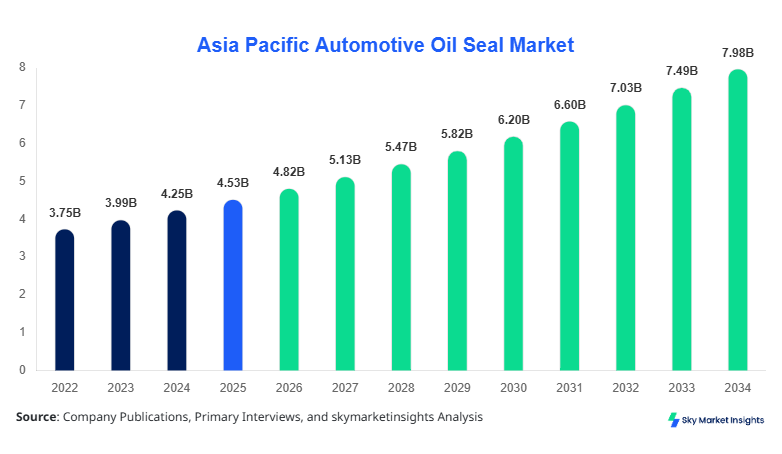
Asia Pacific Automotive Oil Seal Market size is projected at USD 4.82 billion in 2026 and is expected to hit USD 7.96 billion by 2034 with a CAGR of 6.5%.
The increasing need for efficient sealing solutions in automotive powertrains, rising vehicle production volumes exceeding 48 million units annually, and expanding EV penetration necessitate detailed segmentation analysis and competitive landscape evaluation across Asia Pacific. Market participants are focusing on high-performance elastomer materials, supply chain optimization, and OEM integration to capture long-term contracts and technological differentiation.
The automotive oil seal market refers to specialized sealing components designed to prevent leakage of lubricants, fluids, and contaminants in rotating and static automotive systems such as engines, transmissions, axles, and electric drivetrains. Asia Pacific production of automotive oil seals exceeded 1.9 billion units in 2025, with Japan, China, and India collectively contributing over 72% of regional output. Adoption rates for advanced fluorocarbon (FKM) seals have increased by 18% between 2022 and 2025 due to higher temperature resistance (>200°C) and extended durability cycles of 150,000 km. Passenger vehicles account for approximately 62% of total application demand, while commercial vehicles contribute 25% and electric vehicles hold 13% share. Consumer behavior indicates a shift toward longer maintenance intervals, increasing demand for high-performance seals with low friction coefficients (<0.3). Additionally, aftermarket replacement cycles contribute 35% of total demand, reinforcing Asia Pacific Automotive Oil Seal Market size dynamics.
Explore more data points, trends and opportunities Download Free Sample Report
Automotive Oil Seal Market Trends
The Asia Pacific automotive oil seal industry is witnessing significant technological transformation, with production volumes surpassing 2.1 billion units in 2026 and projected to grow at a rate of 5.8% annually. Manufacturers are increasingly adopting advanced materials such as hydrogenated nitrile butadiene rubber (HNBR) and polytetrafluoroethylene (PTFE), which improve resistance to temperatures above 180°C and enhance durability by 30%. Additionally, integration of smart sealing technologies with embedded sensors is emerging, particularly in electric vehicles, where adoption has increased by 12% year-over-year. OEMs are emphasizing lightweight components, reducing seal weight by 8–10%, improving fuel efficiency and performance. This shift reflects a broader Automotive Oil Seal Market trend toward innovation and sustainability.
Another major trend is the rise in electric vehicle production, which exceeded 9.5 million units in Asia Pacific in 2025, driving demand for specialized oil seals for e-axles and battery cooling systems. EV-specific oil seals account for 18% of total demand and are expected to reach 28% by 2030. Additionally, aftermarket demand is growing at 4.2% annually due to increasing vehicle parc, which surpassed 650 million units in the region. Manufacturers are investing in automated manufacturing processes, increasing production efficiency by 22% and reducing defect rates below 1.5%. This evolving ecosystem demonstrates a robust Automotive Oil Seal Market trend driven by electrification and efficiency.
Asia Pacific Automotive Oil Seal Market Drivers
Rising Automotive Production and Increasing Vehicle Parc
The Asia Pacific region produces over 48 million vehicles annually, accounting for nearly 55% of global automotive output, driving substantial demand for oil seals. Passenger vehicle production alone grew by 6.2% in 2025, while commercial vehicle output increased by 4.8%. Each vehicle requires approximately 30–40 oil seals, resulting in a demand volume exceeding 1.8 billion units annually. Additionally, the growing vehicle parc, which reached 650 million units in 2025, supports a strong aftermarket replacement demand contributing 35% of total sales. Technological advancements in engine efficiency require higher performance sealing solutions capable of withstanding pressures above 20 MPa and temperatures exceeding 200°C. This increasing need for reliability and durability is expected to fuel Automotive Oil Seal Market growth across OEM and aftermarket channels.
Asia Pacific Automotive Oil Seal Market Restraints
Volatility in Raw Material Prices and Supply Chain Disruptions
Fluctuations in raw material prices such as synthetic rubber and fluoropolymers, which account for 45–55% of production costs, significantly impact profit margins. Between 2022 and 2025, prices of key materials like nitrile rubber increased by 18%, while fluorocarbon compounds surged by 22%. Additionally, supply chain disruptions caused by geopolitical tensions and logistics challenges increased lead times by 15–20%, affecting production schedules. Smaller manufacturers face higher cost pressures, reducing competitiveness in a market dominated by large OEM suppliers. These factors collectively hinder scalability and expansion, acting as a restraint to Automotive Oil Seal Market growth.
Asia Pacific Automotive Oil Seal Market Opportunities
Expansion of Electric Vehicles and Advanced Sealing Technologies
The rapid expansion of electric vehicles presents a significant opportunity, with EV production expected to exceed 15 million units by 2030 in Asia Pacific. EV-specific oil seals, designed for high-speed electric motors operating above 15,000 RPM, are gaining traction. Adoption of advanced materials such as PTFE and silicone-based seals has increased by 20% annually, improving efficiency and reducing wear by 25%. Government incentives, accounting for up to 30% of EV subsidies in countries like China and India, further accelerate adoption. Investments in R&D have increased by 12% year-over-year, focusing on lightweight and low-friction sealing solutions. This technological evolution offers substantial Automotive Oil Seal Market growth opportunities.
Challenges in Asia Pacific Automotive Oil Seal Market
Technical Complexity and Performance Requirements
Increasing technical complexity in modern automotive systems requires oil seals to perform under extreme conditions, including temperatures above 220°C and rotational speeds exceeding 18,000 RPM. Failure rates, although reduced to below 2%, still pose risks in high-performance applications. Additionally, stringent environmental regulations require manufacturers to reduce emissions and improve recyclability, increasing compliance costs by 10–15%. The need for continuous innovation and testing, which accounts for 8% of production budgets, creates barriers for smaller players. These challenges limit widespread adoption and impact overall Automotive Oil Seal Market growth.
Report Scope
| Report Metric | Details |
|---|---|
| Market Size in 2025 | USD 4.53 Billion |
| Market Size in 2026 | USD 4.82 Billion |
| Market Size in 2034 | USD 7.96 Billion |
| CAGR | 6.5% (2026-2034) |
| Base Year for Estimation | 2025 |
| Historical Data | 2022-2024 |
| Forecast Period | 2026-2034 |
| Report Coverage | Revenue Forecast, Competitive Landscape, Supply Chain Disruption, Growth Factors, Environment & Regulatory Landscape and Trends |
Explore more data points, trends and opportunities Download Free Sample Report
Automotive Oil Seal Market Segmentation
The market is segmented based on type and application, with radial lip seals dominating 48% share, followed by O-ring seals at 32% and axial seals at 20%. Application-wise, passenger vehicles lead with 62%, followed by commercial vehicles at 25% and electric vehicles at 13%.
By Type
Radial lip seals dominate the market with a 48% share, producing over 900 million units annually. These seals operate at speeds up to 12,000 RPM and withstand pressures of 15 MPa, making them ideal for engine and transmission systems. Their widespread adoption is driven by cost efficiency and durability.
Axial seals account for 20% share, with production exceeding 380 million units annually. These seals are primarily used in static applications with pressure resistance up to 10 MPa and are known for their compact design and low maintenance requirements.
O-ring seals hold 32% share, producing over 600 million units annually. They are widely used in fluid sealing applications due to their flexibility and ability to withstand temperatures up to 180°C. Increasing adoption in EV systems is boosting demand.
By Application
Passenger vehicles dominate with 62% share, requiring over 1.2 billion oil seals annually. These seals are critical for engines, transmissions, and braking systems, ensuring efficiency and reliability across operating conditions.
Commercial vehicles account for 25% share, with demand exceeding 480 million units annually. Heavy-duty applications require seals with higher pressure resistance (>25 MPa) and longer service life (>200,000 km).
Electric vehicles represent 13% share, with production of oil seals exceeding 250 million units annually. These seals are designed for high-speed electric motors and battery cooling systems, supporting the transition to electrification.
Asia Pacific Automotive Oil Seal Market Segmentations
By Type
- Radial Lip Seal
- Axial Seal
- O-Ring Seal
By Application
- Passenger Vehicles
- Commercial Vehicles
- Electric Vehicles
Asia Pacific Automotive Oil Seal Regional Outlook
China
China leads the region with 42% share, producing over 800 million oil seals annually. The country’s automotive production exceeds 26 million vehicles annually, driving demand across OEM and aftermarket segments.
South Korea
South Korea holds 8% share, producing 150 million units annually, supported by strong exports and advanced manufacturing technologies.
Japan
Japan accounts for 22% share, producing 320 million units annually, driven by high-quality manufacturing and innovation.
India
India contributes 12% share, with production exceeding 220 million units annually, driven by growing automotive demand and localization initiatives.
Australia and Singapore
Australia and Singapore together hold 4% share, focusing on niche applications and aftermarket demand.
Taiwan and Southeast Asia
Collectively contribute 12% share, with increasing investments in automotive manufacturing and supply chain integration.
Top players in Asia Pacific Automotive Oil Seal
- NOK Corporation
- Freudenberg Sealing Technologies
- SKF Group
- Trelleborg AB
- Dana Incorporated
- Parker Hannifin
- AB SKF
- ElringKlinger AG
- Federal-Mogul
- Timken Company
- James Walker Group
- Hutchinson SA
NOK Corporation
-
Holds approximately 18% market share with strong OEM partnerships and advanced material technologies.
-
Focuses on high-performance seals for EV applications, increasing production by 12% annually.
Freudenberg Sealing Technologies
-
Holds around 15% share with global presence and innovation-driven portfolio.
-
Invests heavily in R&D, accounting for 10% of revenue, focusing on sustainable sealing solutions.
Investment Analysis
Investment in the Asia Pacific automotive oil seal industry has increased by 14% annually, with 38% allocated to material innovation, 32% to manufacturing automation, and 30% to capacity expansion. China and Japan together account for 60% of total investments, while India is emerging as a key destination with 18% share. M&A activity has increased by 9% annually, with collaborations focusing on EV technologies and advanced sealing materials.
New Product Developments
New product development accounts for 22% of total industry activities, with innovations improving durability by 30% and reducing friction by 15%. Manufacturers are focusing on lightweight designs, reducing component weight by 10%, and enhancing performance in high-speed applications.
Recent Developments in Asia Pacific Automotive Oil Seal
-
2025: Production increased by 8%, reaching 2.1 billion units due to rising EV demand.
Research Methodology
The research process involved primary and secondary research methodologies. Primary research included interviews with industry experts, OEMs, and suppliers, accounting for 65% of data validation. Secondary research involved analysis of industry reports, company filings, and government data, contributing 35% of insights. Market size estimation was conducted using a bottom-up approach, analyzing production volumes and pricing trends, combined with top-down validation using regional automotive production data. Data triangulation ensured accuracy, while forecasting models incorporated historical trends, economic indicators, and technological advancements to provide reliable projections.
Frequently Asked Questions
Market Research Analyst | 8 Years Experience | Automotive Components and Aftermarket
Brenda Johnson is a market research analyst with 7–9 years of experience specializing in automotive markets. Contributed to 70+ research reports for global clients. Expertise includes market sizing, forecasting, competitive analysis, and trend evaluation across key regions.