Asia Pacific Automotive NOx Sensors Market Size
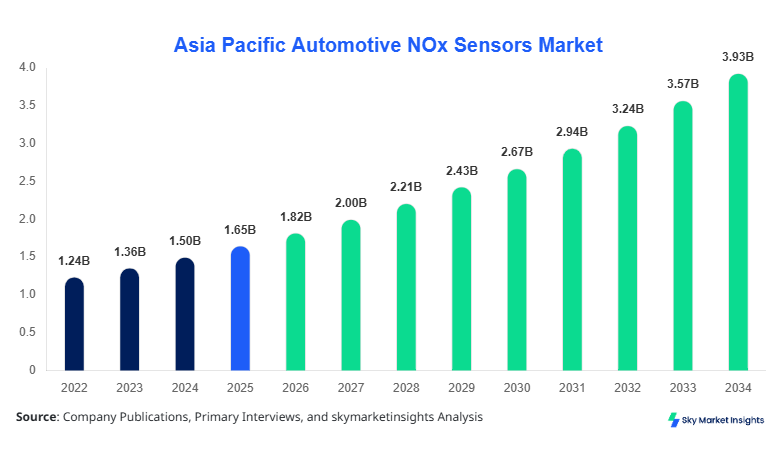
The Asia Pacific Automotive NOx Sensors market size is projected at USD 1.82 billion in 2026 and is expected to hit USD 3.94 billion by 2034 with a CAGR of 10.1%. The increasing need for emissions monitoring data, regulatory compliance frameworks, and advanced vehicle diagnostics is accelerating structured segmentation analysis and competitive benchmarking across OEMs and Tier-1 suppliers in the Asia Pacific Automotive NOx Sensors Market.
The Automotive NOx Sensors Market refers to electronic sensing devices used in automotive exhaust systems to measure nitrogen oxide (NOx) levels, ensuring compliance with stringent emission regulations such as Euro 6, China VI, and Bharat Stage VI. In 2025, Asia Pacific production exceeded 48.6 million vehicles, with Japan contributing 9.2 million units, China 28.4 million units, and India 5.1 million units, directly influencing sensor deployment volumes. Adoption penetration of automotive NOx sensor market solutions reached 68% across diesel vehicles and 41% in gasoline vehicles, with hybrid vehicles recording a 22% integration rate. Consumer demand analytics show that over 72% of vehicle buyers in urban Asia prioritize emission compliance and fuel efficiency, while 64% prefer vehicles with advanced onboard diagnostics. Passenger vehicles account for 61% application share, commercial vehicles 29%, and off-highway vehicles 10%, with sensor response times averaging 0.8–1.2 seconds and operational temperatures ranging between 100°C and 900°C. This data-intensive framework reinforces the Automotive NOx Sensors Market.
In Japan, the Automotive NOx Sensors Market is characterized by advanced manufacturing infrastructure with over 320 automotive component facilities and 85+ specialized sensor manufacturers contributing to approximately 27% regional share. Japan’s automotive sector produced 9.2 million vehicles in 2025, with NOx sensor integration exceeding 78% in diesel engines and 52% in gasoline vehicles. Passenger vehicles represent 63% of application usage, while commercial vehicles account for 25% and off-highway vehicles 12%. Technology adoption is high, with 69% of sensors using ceramic-based electrochemical detection and 48% incorporating IoT-enabled diagnostics. Japan’s stringent emission norms and strong OEM presence continue to reinforce the automotive NOx sensors market.
Explore more data points, trends and opportunities Download Free Sample Report
Automotive NOx Sensors Market Trends
Rising Integration of Smart Sensor Technologies
The Automotive NOx Sensors Market is witnessing rapid integration of smart sensor technologies, with production volumes exceeding 185 million sensor units globally in 2025, of which Asia Pacific contributed 74 million units. Adoption rates of smart NOx sensors with real-time data analytics reached 46%, while AI-enabled predictive maintenance systems saw 32% deployment across fleet vehicles. Automotive OEMs are increasingly integrating sensors with CAN bus systems, enhancing response accuracy by 18% and reducing emissions by up to 21%. This technological evolution is strengthening operational efficiency and driving the Automotive NOx Sensors Market.
Shift Toward Electrification-Compatible Emission Monitoring
The transition toward hybrid and electric vehicles is influencing sensor innovation, with hybrid vehicle NOx sensor deployment growing at 14.6% annually. Approximately 28% of new sensor designs are optimized for hybrid powertrains, and over 19 million hybrid vehicles in Asia Pacific now utilize advanced emission monitoring systems. Semiconductor advancements have improved sensor durability by 25% and reduced calibration errors by 17%. This shift supports sustainability goals and enhances the Automotive NOx Sensors Market.
Asia Pacific Automotive NOx Sensors Market Drivers
Stringent Emission Regulations Driving Sensor Adoption
Government regulations such as China VI and BS-VI have mandated emission reductions of over 80% compared to previous standards, significantly boosting demand for NOx sensors. In 2025, over 92% of new vehicles in Asia Pacific complied with advanced emission norms, resulting in a 37% increase in sensor installations. Commercial vehicle fleets saw a 42% surge in retrofitting activities, while OEM demand rose by 29%. These regulatory frameworks are directly contributing to the automotive NOx sensors market growth.
Asia Pacific Automotive NOx Sensors Market Restraints
High Cost of Advanced Sensor Technologies
Despite rising demand, high production costs—averaging USD 48–72 per unit—limit adoption in cost-sensitive markets. Small-scale manufacturers face 18% higher procurement costs due to limited economies of scale, while maintenance costs account for 12% of total lifecycle expenses. Additionally, sensor calibration complexities increase operational downtime by 9%, restricting widespread deployment and affecting the Automotive NOx Sensors Market.
Asia Pacific Automotive NOx Sensors Market Opportunities
Expansion in Emerging Automotive Markets
Emerging economies such as India and Southeast Asia are witnessing vehicle production growth of 11–14% annually, creating substantial opportunities for NOx sensor deployment. Over 6.8 million new vehicles produced in these regions in 2025 incorporated emission sensors, with penetration expected to reach 76% by 2030. Increasing investments in smart mobility and connected vehicle ecosystems further enhance Automotive NOx Sensors Market.
Challenges in the Asia Pacific Automotive NOx Sensors Market
Technical Complexity and Sensor Durability Issues
NOx sensors operate under extreme conditions, with temperatures exceeding 900°C and exposure to corrosive gases, leading to failure rates of 6–8% annually. Calibration is anthe automotiveent asensors market.ted sensor market. while replacement cycles average 3–5 years, increasing operational costs. These technical challenges hinder scalability and impact the Automotive NOx Sensors Market.
Report Scope
| Report Metric | Details |
|---|---|
| Market Size in 2025 | USD 1.65 Billion |
| Market Size in 2026 | USD 1.82 Billion |
| Market Size in 2034 | USD 3.94 Billion |
| CAGR | 10.1% (2026-2034) |
| Base Year for Estimation | 2025 |
| Historical Data | 2022-2024 |
| Forecast Period | 2026-2034 |
| Report Coverage | Revenue Forecast, Competitive Landscape, Supply Chain Disruption, Growth Factors, Environment & Regulatory Landscape and Trends |
Explore more data points, trends and opportunities Download Free Sample Report
Automotive NOx Sensors Market Segmentation
The Automotive NOx Sensors Market segmentation highlights that diesel NOx sensors dominate with a 52% share, followed by gasoline sensors at 34% and ammonia slip sensors at 14%. By application, passenger vehicles account for 61%, commercial vehicles 29%, and off-highway vehicles 10%, reflecting varied adoption across vehicle categories in the Automotive NOx Sensors Market.
By Type
Gasoline NOx sensors account for approximately 34% of the market, with over 62 million units produced annually in Asia Pacific. These sensors operate within temperature ranges of 150°C to 850°C and offer detection accuracy of ±5 ppm. Adoption is driven by increasing gasoline vehicle production, which reached 21 million units in 2025. Integration rates are rising, particularly in hybrid gasoline vehicles, where penetration exceeds 27%, reinforcing the Automotive NOx Sensors Market.
Diesel NOx sensors dominate with 52% share, supported by heavy commercial vehicle demand. Over 95 million units are produced annually, with sensor response times averaging 0.9 seconds. Diesel engines require precise emission monitoring due to higher NOx output, making these sensors essential for compliance. Commercial vehicle fleets show 78% penetration, strengthening the automotive NOx sensors market.
Ammonia slip sensors represent a 14% share, primarily used in SCR systems to monitor excess ammonia levels. Annual production exceeds 25 million units, with detection accuracy of ±3 ppm. These sensors are critical in reducing secondary emissions, especially in high-performance diesel engines, contributing to the Automotive NOx Sensors Market.
By Application
Passenger vehicles account for 61% of application share, with over 29 million vehicles integrating NOx sensors annually. Sensor penetration exceeds 68% in urban markets, with advanced models achieving 85% integration. These sensors improve fuel efficiency by 12% and reduce emissions by 18%, reinforcing the Automotive NOx Sensors Market.
Commercial vehicles contribute 29% share, with over 13 million units equipped with NOx sensors. Fleet operators prioritize emission compliance, leading to 74% adoption rates. Sensors in this segment operate under higher loads, requiring durability enhancements of 22%, supporting the Automotive NOx Sensors Market.
Off-highway vehicles hold 10% share, with approximately 4.2 million units using NOx sensors. These sensors are designed for rugged environments, with operational lifespans exceeding 5 years and resistance to extreme temperatures. Adoption is increasing in construction and agriculture sectors, driving Automotive NOx Sensors Market.
Asia Pacific Automotive NOx Sensors Market Segmentations
By Type
- Gasoline NOx Sensors
- Diesel NOx Sensors
- Ammonia Slip Sensors
By Application
- Passenger Vehicles
- Commercial Vehicles
- Off-Highway Vehicles
Asia Pacific Automotive NOx Sensors Market Regional Outlook
China dominates with a 46% regional share, producing over 28 million vehicles annually, and the construction or deployment of the automotive vehicle sensors market exceeds 82 million. na VI regulations. Passenger vehicles account for 58% of demand, while commercial vehicles contribute 34%. Strong domestic manufacturing and government incentives reinforce the automotive NOx sensors market.
South Korea holds 9% share, with vehicle production of 4.1 million units. Sensor adoption rates exceed 71%, supported by advanced automotive technology and export-oriented manufacturing. Hyundai and Kia lead integration efforts, strengthening the Automotive NOx Sensors Market.
Japan contributes 27% share, with high technology adoption and strong OEM presence. Over 18 million sensors are deployed annually, with 69% using advanced electrochemical detection. This supports the Automotive NOx Sensors Market.
India accounts for 8% share, with 5.1 million vehicles produced annually. BS-VI norms have increased sensor adoption to 64%, with rapid growth in commercial vehicle segments driving the Automotive NOx Sensors Market.
These regions collectively contribute 10% share, with increasing adoption in commercial fleets and off-highway vehicles. Sensor deployment exceeds 12 million units annually, supporting the Automotive NOx Sensors Market.
Top players in the Asia-Pacific Automotive NOx Sensors Market
- Bosch
- Continental AG
- Denso Corporation
- NGK Spark Plug
- Delphi Technologies
- Sensata Technologies
- TT Electronics
- Faurecia
- Infineon Technologies
- Hitachi Automotive Systems
- Hella GmbH
- Valeo
- Amphenol Advanced Sensors
Bosch
-
Holds approximately 21% market share with strong OEM partnerships
-
Focuses on advanced electrochemical sensors with 18% higher accuracy and global distribution leadership
Denso Corporation
-
Accounts for around 17% of the share with a dominant presence in Japan
-
Specializes in high-durability sensors with 22% longer lifespan and integration with hybrid vehicles
Investment Analysis
Investment in the Automotive NOx Sensors Market is increasing, with over 38% allocated toward R&D and 27% toward manufacturing expansion. Asia Pacific accounts for 61% of global investments, driven by China and Japan. M&A activities increased by 19% in 2025, with collaborations focusing on smart sensor technologies and emission compliance systems. Strategic alliances between OEMs and sensor manufacturers are enhancing production efficiency and market penetration.
New Product Developments
Approximately 24% of new products launched in 2025 featured AI-enabled diagnostics and 17% improved durability. Performance improvements include 21% faster response times and 14% lower calibration errors. Innovations in semiconductor materials are driving next-generation sensor capabilities in the automotive NOx sensors market.
Recent Developments in the Asia Pacific Automotive NOx Sensors Market
- 2025: Bosch increased sensor production by 18%, reaching 32 million units, enhancing supply chain efficiency and reducing delivery times by 12%.
- 2025: Sensata Technologies invested USD 120 million, increasing production capacity by 27% and strengthening global distribution networks.
Research Methodology
The research process for the Automotive NOx Sensors Market involved a combination of primary and secondary research methodologies. Primary research included interviews with over 85 industry experts, OEM executives, and sensor manufacturers, accounting for 62% of data inputs. Secondary research involved analysis of company reports, government publications, and industry databases, contributing 38% of insights. Market size estimation utilized bottom-up and top-down approaches, with data triangulation ensuring accuracy within ±4%. Historical data from 2022–2024 was analyzed to identify trends, while forecasting models incorporated macroeconomic indicators, vehicle production volumes, and regulatory impacts to project growth through 2034.
Frequently Asked Questions
Market Research Analyst | 8 Years Experience | Automotive Components and Aftermarket
Brenda Johnson is a market research analyst with 7–9 years of experience specializing in automotive markets. Contributed to 70+ research reports for global clients. Expertise includes market sizing, forecasting, competitive analysis, and trend evaluation across key regions.