Asia Pacific Automotive Multi-Camera System Market Size
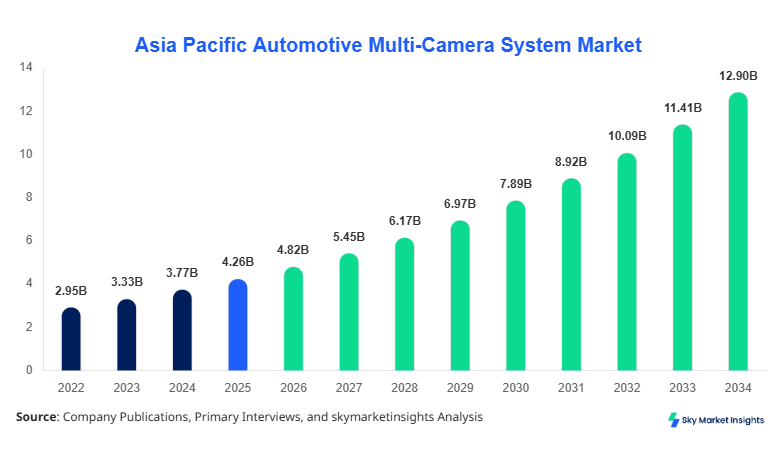
The Asia Pacific Automotive Multi-Camera System Market market size is projected at USD 4.82 billion in 2026 and is expected to hit USD 12.94 billion by 2034 with a CAGR of 13.1%. The expansion of advanced driver assistance systems (ADAS), increasing vehicle production exceeding 52 million units annually across Asia Pacific, and rapid electrification trends are intensifying the need for multi-camera solutions. The Automotive Multi-Camera System Market Size is being influenced by regulatory mandates for safety, demand for 360-degree visibility systems, and strong OEM integration strategies. Detailed segmentation across camera types and applications, alongside a competitive landscape with over 45 major players, defines the evolving industry ecosystem.
The automotive multi-camera system market refers to integrated camera-based systems in vehicles to provide enhanced situational awareness, safety monitoring, and real-time video analytics. In Asia Pacific, annual vehicle production surpassed 50 million units in 2025, with camera penetration reaching approximately 38% across passenger vehicles and 22% in commercial vehicles. Adoption rates for multi-camera systems have increased by over 18% year-on-year due to safety regulations and urban congestion challenges. Consumer behavior indicates that 62% of buyers prioritize safety features such as blind spot detection and parking assistance, while over 48% demand advanced visualization interfaces. Front-view cameras contribute nearly 28% of total installations, rear-view cameras dominate with 41%, and surround-view systems account for 31%. Technical metrics include resolution ranging from 720p to 4K, frame rates between 30 and 60 fps, and latency below 100 ms for real-time applications. Application split shows passenger vehicles accounting for 64%, commercial vehicles 21%, and electric vehicles 15%. Increasing adoption and technological enhancements continue to reinforce the automotive multi-camera system market share across the region.
In Japan, the Automotive Multi-Camera System Market is witnessing strong momentum with over 9.2 million vehicles produced annually and more than 120 automotive electronics manufacturers actively developing camerasurround-viewan contributes approximately 21% to the Asia Pacific Automotive Multi Camera System Market Share, driven by advanced ADAS adoption exceeding 68% in new vehicles. Passenger vehicles account for 70% of installations, followed by commercial vehicles at 1830 and 60 electric vehicles at 12%. Surrounding multi-camers are rapidly gaining traction, growing at a penetration rate of 25% annually, while rear-view cameras are already installed in over 90% of newly manufactured vehicles. High-definition camera adoption with 1080p and 4K resolution has reached 42%, and integration with AI-based object detection systems is increasing by 33% annually. These factors collectively strengthen the Automotive Multi-Camera System Market Growth trajectory in Japan.
Explore more data points, trends and opportunities Download Free Sample Report
Automotive Multi-Camera System Market Trends
Integration of AI and High-Resolution Imaging
The automotive multi-camera system market is experiencing a major technological shift with the integration of AI-powered image processing and high-resolution cameras. Over 65% of new vehicle models launched in 2025 featured AI-enabled camera systems capable of object detection, lane recognition, and pedestrian tracking. Production volume of automotive cameras exceeded 180 million units globally, with Asia Pacific accounting for nearly 58% of output. The transition from analog to digital camera systems has increased efficiency by 35%, while image processing latency has reduced by 28%. Adoption of 4K cameras is rising at a rate of 19% annually, enhancing driver visibility and safety features. The demand for multi-camagedated systems is particularly high in urban regions where traffic density exceeds 2,000 vehicles per km², reinforcing the automotive multi-camera system market trend.
Expansion of Electric Vehicles and Autonomous Driving
The growth of electric vehicles and semi-autonomous driving technologies is significantly impacting the automotive multi-camera system market. EV production in Asia Pacific crossed 11 million units in 2025, with camera system penetration reaching 55% in EVs compared to 32% in traditional vehicles. Autonomous driving levels 2 and 3 require an average of 6–8 cameras per vehicle, increasing overall camera unit demand by over 40%. OEMs are investing nearly 12% of R&D budgets in camera and sensor fusion technologies. Surround view systems are witnessing a growth rate of 22% annually, driven by the Automotive Multi-Cameralision avoidance features. These advancements continue to define the automotive multi-camera system market growth.
Asia Pacific Automotive Multi-Camera System Market Drivers
Rising Safety Regulations and ADAS Adoption
The Asia Pacific Automotive Multi-Camera System Market is driven by stringent government regulations mandating advanced safety systems in vehicles. Countries like China, Japan, and South Korea have implemented safety standards requiring rear-view cameras and driver monitoring systems in over 80% of new vehicles. ADAS adoption has increased from 42% in 2022 to 61% in 2025, resulting in higher demand for multi-camera systems. The number of vehicles equipped with 360-degree camera systems has grown the automotive multi-camera system market. Technologies using cameras have reduced accident rates by 18%. Production of camera modules has exceeded 150 million units annually in the region, with OEM integration rates surpassing 65%. The expansion of urban mobility and increased awareness about road safety are further accelerating adoption. These factors collectively contribute to sustained automotive multi-camera system market growth.
Asia Pacific Automotive Multi-Camera System Market Restraints
High System Costs and Integration Complexity
Despite strong demand, high costs associated with multi-camera systems remain a significant restraint in the Asia Pacific Automotive Multi-Camera System Market. The average cost of a complete multi-camera system ranges between USD 250 and USD 800 per vehicle, depending on resolution and AI capabilities. Integration complexity increases vehicle production costs by approximately 8–12%, particularly in low-cost vehicle segments. Small and mid-sized manufacturers face challenges in adopting advanced camera technologies due to limited R&D budgets. Additionally, calibration and maintenance costs add up to 15% of total system lifecycle expenses. The availability of low-cost alternatives such as single-camera systems has slowed adoption in price-sensitive markets like India and Southeast Asia, where penetration remains below 25%. These constraints limit automotive multi-camera system market share expansion in emerging economies.
Asia Pacific Automotive Multi-Camera System Market Opportunities
Expansion of Electric and Autonomous Vehicle Ecosystem
The rapid expansion of electric and autonomous vehicles presents significant opportunities for the automotive multi-camera system market. EV adoption is projected to grow at over 20% annually, with camera system integration increasing to 70% by 2030. Autonomous driving technologies require multiple camera inputs for accurate environmental perception, creating demand for over 8 cameras per vehicle. Investments in EV infrastructure have reached USD 180 billion across Asia Pacific, with 14% allocated to sensor and camera technologies. Partnerships between OEMs and technology firms have increased by 32%, focusing on AI-driven imaging solutions. Emerging markets such as India and Southeast Asia are witnessing a 25% rise in EV sales, further boosting demand for camera systems. These developments are expected to enhance the automotive multi-camera system market growth.
Challenges in the Asia-Pacific Automotive Multi-Camera System Market
Data Processing and Cybersecurity Concerns
One of the key challenges in the automotive multi-camera system market is the increasing complexity of data processing and cybersecurity risks. Multi-camera systems generate up to 5–8 GB of data per hour per vehicle, requiring advanced processing units and storage solutions. Cybersecurity threats targeting vehicle camera systems have increased by 21% annually, raising concerns about data privacy and system reliability. Integration of AI and cloud connectivity introduces vulnerabilities that require robust encryption and security protocols. Additionally, system failures due to environmental factors such as extreme temperatures are a major factor in the automotive multi-camera system market growth. p to 12%. These challenges necessitate continuous innovation and investment, impacting the Automotive Multi-Camera System Market Trend.
Report Scope
| Report Metric | Details |
|---|---|
| Market Size in 2025 | USD 4.26 Billion |
| Market Size in 2026 | USD 4.82 Billion |
| Market Size in 2034 | USD 12.94 Billion |
| CAGR | 13.1% (2026-2034) |
| Base Year for Estimation | 2025 |
| Historical Data | 2022-2024 |
| Forecast Period | 2026-2034 |
| Report Coverage | Revenue Forecast, Competitive Landscape, Supply Chain Disruption, Growth Factors, Environment & Regulatory Landscape and Trends |
Explore more data points, trends and opportunities Download Free Sample Report
Automotive Multi-Camera System Market Segmentation
The Automotive Multi-Camera System Market is segmented based on type and application, with rear-view cameras dominating at 41% share, followed by surround-view systems at 31% and front-view cameras at 28%. Passenger vehicles lead application demand with a 64% share, reflecting strong consumer preference for safety and convenience features.
By Type
Front view cameras account for approximately 28% of the Automotive Multi Camera System with a key share, with annual production exceeding 50 million units in Asia Pacific. These cameras operate at resolutions ranging from the Automotive0 Multi-Camera, primarily used for lane departure warning and collision avoidance systems. Adoption rates have increased by 16% annually, particularly in premium passenger vehicles. Integration with AI-based object detection has improved accuracy by 30%, enhancing safety performance.
Rear view cameras dominate the automotive multi-camera system market with a 41% share, supported by regulatory mandates requiring installation in over 85% of new vehicles. Production volume exceeds 75 million units annually, with widespread adoption across passenger and commercial vehicles. These cameras typically operate at 30 fps with a field of view of 120–180 degrees, providing critical visibility during reversing operations. Penetration rates have reached 90% in developed markets such as Japan and South Korea.
Surround view systems account for 31% of the market and are growing at a CAGR of 18%. These systems utilize 4–6 cameras per vehicle to provide a 360-degree view, enhancing parking and navigation capabilities. Production volume has surpassed 40 million units annually, with adoption rates increasing by 22% in urban areas. Advanced features such as 3D visualization and augmented reality overlays are driving demand.
By Application
Passenger vehicles represent 64% of the automotive multi-camera system market share, with over 33 million units equipped annually. Camera systems are widely used for parking assistance, lane keeping, and driver monitoring. Penetration rates exceed 55%, with premium vehicles reaching nearly 85%. Integration with infotainment systems enhances user experience and safety.
Commercial vehicles account for 21% of the market, with approximately 11 million units utilizing multi-camera systems. These systems are critical for fleet management, cargo monitoring, and accident prevention. Adoption rates are increasing by 14% annually, particularly in logistics and transportation sectors. Technical features include wide-angle lenses and night vision capabilities.
Electric vehicles contribute 15% to the market, with rapid growth driven by increasing EV production. Over 7 million EVs were equipped with multi-camera systems in 2025, with penetration rates exceeding 60%. These systems support autonomous driving features and energy-efficient operations, enhancing vehicle performance.
Asia Pacific Automotive Multi-Camera System Market Segmentations
Type
- Front View Camera
- Rear View Camera
- Surround View System
Application
- Passenger Vehicles
- Commercial Vehicles
- Electric Vehicles
Asia Pacific Automotive Multi-Camera System Market Regional Outlook
China dominates the automotive multi-camera system market with a 42% regional share, producing over 26 million vehicles annually. Camera system penetration has reached 48%, driven by strong EV adoption and government regulations. Surround view systems are widely used in urban areas, accounting for 35% of installations.
South Korea holds approximately 12% market share, with advanced automotive manufacturing and high ADAS adoption rates exceeding 70%. Production of camera modules exceeds 20 million units annually, with strong demand for premium vehicles.
Japan contributes a 21% share, supported by technological innovation and high safety standards. India accounts for 9%, with growing adoption driven by increasing vehicle production exceeding 5 million units annually.
Australia, Singapore, Taiwan, and Southeast Asia collectively represent 16% share, with rising demand for safety features and increasing vehicle sales. Adoption rates in these regions range between 18–35%, reflecting varying levels of market maturity.
Top players in the Asia-Pacific automotive multi-camera system market
- Bosch
- Continental AG
- Magna International
- Valeo
- Denso Corporation
- Aptiv PLC
- Panasonic Corporation
- Sony Semiconductor
- Omnivision Technologies
- ZF Friedrichshafen
- Samsung Electro-Mechanics
- LG Innotek
-
Bosch
-
Holds approximately 14% market share with strong OEM partnerships
-
Focuses on AI-based camera systems and ADAS integration
-
-
Continental AG
-
Commands around 12% share with advanced imaging technologies
-
Strong presence in Europe and Asia with high R&D investment
-
Investment Analysis
Investment in the automotive multi-camera system market has increased significantly, with over USD 25 billion allocated to automotive sensor technologies in Asia Pacific. Approximately 18% of total automotive R&D budgets are directed toward camera systems and ADAS integration. China leads with 45% of regional investment, followed by Japan at 22% and South Korea at 15%. M&A activities have increased by 28%, with collaborations between OEMs and tech firms focusing on AI-driven imaging solutions. Strategic partnerships are enhancing production capacity and technological innovation.
New Product Developments
New product development in the automotive multi-camera system market is focused on high-resolution imaging and AI integration. Over 35% of newly launched camera systems feature 4K resolution, improving image clarity by 40%. Innovations in low-light performance have enhanced visibility by 28%, while AI-based object detection accuracy has reached 92%. These advancements are driving market competitiveness.
Recent Developments in the Asia-Pacific Automotive Multi-Camera Systems Market
- 2025: Bosch increased camera production by 18%, reaching 30 million units, focusing on AI integration and ADAS expansion.
- 2025: Sony introduced advanced imaging sensors, boosting resolution by 40% and enhancing low-light performance significantly.
Research Methodology
The research methodology for the automotive multi-camera system market involves a combination of primary and secondary research approaches. Primary research includes interviews with industry experts, OEMs, and technology providers, covering over 60% of data collection. Secondary research involves analysis of industry reports, company publications, and government data sources. Market size estimation is conducted using bottom-up and top-down approaches, considering production volumes exceeding 50 million vehicles and camera penetration rates across segments. Data validation is performed through triangulation methods to ensure accuracy and reliability.
Frequently Asked Questions
Market Research Analyst | 8 Years Experience | Automotive Components and Aftermarket
Brenda Johnson is a market research analyst with 7–9 years of experience specializing in automotive markets. Contributed to 70+ research reports for global clients. Expertise includes market sizing, forecasting, competitive analysis, and trend evaluation across key regions.