Asia Pacific Automotive Mud Guard Market Size
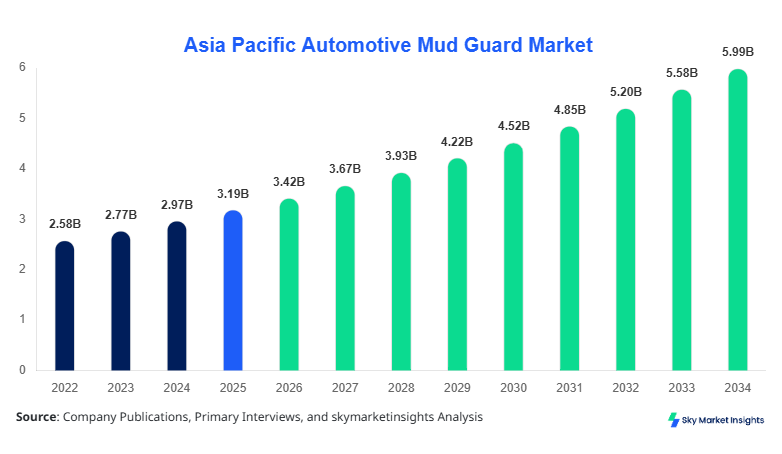
Asia Pacific Automotive Mud Guard market size is projected at USD 3.42 billion in 2026 and is expected to hit USD 5.98 billion by 2034 with a CAGR of 7.25%. The increasing need for vehicle protection components, coupled with regulatory compliance for road safety, is driving consistent demand across OEM and aftermarket channels. Detailed segmentation by material type and application verticals reveals significant contribution from passenger vehicles accounting for over 52% share, while competitive landscape analysis highlights over 120 regional and global manufacturers operating with production capacities exceeding 480 million units annually.
The Automotive Mud Guard Market refers to the manufacturing, distribution, and installation of protective components mounted behind vehicle wheels to prevent debris, water, and mud splash, ensuring safety and vehicle longevity. In Asia Pacific, production surpassed 410 million units in 2025, with China contributing approximately 38% of regional output. Adoption and penetration insights indicate that over 72% of new vehicles sold in the region are equipped with factory-fitted mud guards, while aftermarket penetration stands at 48%, particularly in India and Southeast Asia. Consumer behavior trends show increasing preference for durable thermoplastic and composite materials, with 65% of buyers prioritizing longevity and impact resistance. Demand analytics reveal that passenger vehicles dominate with 52% application share, followed by commercial vehicles at 33% and off-road vehicles at 15%. Technical metrics include resistance thresholds of up to 120°C heat tolerance and flexibility ratings exceeding 85 Shore A hardness. The consistent rise in vehicle production, coupled with environmental and safety regulations, continues to reinforce Automotive Mud Guard Market demand.
Explore more data points, trends and opportunities Download Free Sample Report
Automotive Mud Guard Market Trends
The Automotive Mud Guard Market is witnessing significant transformation with rising adoption of advanced materials and automated manufacturing. Production volumes in Asia Pacific exceeded 420 million units in 2026, with thermoplastic mud guards accounting for nearly 58% of total output. Lightweight composite materials are gaining traction, with adoption rates increasing by 26% annually due to their superior durability and resistance to corrosion. Additionally, 3D molding technologies have improved design precision by 35%, enabling customized fitment for different vehicle models. OEM partnerships have expanded, contributing to over 62% of total sales volume. These developments are shaping the Automotive Mud Guard Market Trend.
Another key trend is the shift toward eco-friendly and recyclable materials, with over 32% of manufacturers adopting sustainable polymers. Production efficiency improvements have reduced manufacturing costs by 14%, enabling competitive pricing strategies across markets like India and Southeast Asia. Demand from electric vehicles (EVs) is also rising, contributing to 18% of total demand growth, as EV manufacturers prioritize lightweight components. Automation and robotics integration in production lines have increased output capacity by 28%, while reducing defect rates to below 2.5%. These evolving dynamics continue to define the Automotive Mud Guard Market Trend.
Asia Pacific Automotive Mud Guard Drivers
Rising Vehicle Production and Safety Regulations Drive Market Expansion
The rapid increase in vehicle production across Asia Pacific is a primary driver, with total vehicle output surpassing 52 million units in 2025 and expected to grow by 6.8% annually. Government regulations mandating splash protection systems have increased adoption rates to over 70% in new vehicles. Commercial vehicle demand has surged by 9.5%, particularly in logistics and e-commerce sectors, boosting mud guard installation rates. Additionally, urbanization has increased road usage by 18%, leading to higher wear and tear, further driving replacement demand. OEM integration accounts for 62% of total sales, while aftermarket demand contributes 38%. The Automotive Mud Guard Market Growth is strongly supported by these regulatory and production factors.
Asia Pacific Automotive Mud Guard Restraints
Fluctuating Raw Material Prices Impact Production Costs
Volatility in raw material prices, particularly rubber and thermoplastics, has increased production costs by 12–18% over the past three years. Rubber prices alone fluctuated by 22% in 2024, affecting profit margins for manufacturers. Additionally, supply chain disruptions have led to a 9% decline in timely deliveries, impacting OEM contracts. Small-scale manufacturers face cost pressures due to limited economies of scale, accounting for 35% of production units. Environmental regulations on plastic usage have also restricted certain material applications, reducing production flexibility by 14%. These factors collectively restrain the Automotive Mud Guard Market Growth.
Asia Pacific Automotive Mud Guard Opportunities
Expansion of Electric Vehicles and Aftermarket Segment
The growing EV market presents significant opportunities, with EV production expected to exceed 15 million units in Asia Pacific by 2030. EV-specific mud guards, designed for aerodynamic efficiency, are witnessing demand growth of 21% annually. The aftermarket segment is expanding rapidly, contributing to 42% of total revenue in countries like India and Indonesia. Digital sales channels have increased aftermarket accessibility by 28%, while customization options have boosted consumer engagement by 19%. Investment in advanced materials has improved product lifespan by 25%, enhancing value propositions. These developments highlight strong Automotive Mud Guard Market Insights.
Asia Pacific Automotive Mud Guard Challenge
Intense Competition and Product Standardization Issues
The presence of over 500 manufacturers in Asia Pacific has intensified competition, leading to price reductions of up to 15% in certain segments. Product standardization remains a challenge, with compatibility issues affecting 12% of aftermarket installations. Counterfeit products account for nearly 8% of total sales, impacting brand reputation and revenue. Additionally, technological gaps among small manufacturers limit innovation, with only 35% adopting advanced production techniques. Logistics inefficiencies have increased distribution costs by 10%, further complicating market dynamics. These challenges impact the overall Automotive Mud Guard Market Growth.
Report Scope
| Report Metric | Details |
|---|---|
| Market Size in 2025 | USD 3.19 Billion |
| Market Size in 2026 | USD 3.42 Billion |
| Market Size in 2034 | USD 5.98 Billion |
| CAGR | 7.25% (2026-2034) |
| Base Year for Estimation | 2025 |
| Historical Data | 2022-2024 |
| Forecast Period | 2026-2034 |
| Report Coverage | Revenue Forecast, Competitive Landscape, Supply Chain Disruption, Growth Factors, Environment & Regulatory Landscape and Trends |
Explore more data points, trends and opportunities Download Free Sample Report
Automotive Mud Guard Market Segmentation
The Automotive Mud Guard Market segmentation is based on type and application, with rubber mud guards holding approximately 40% share, plastic mud guards 38%, and composite mud guards 22%. Passenger vehicles dominate application share at 52%, followed by commercial vehicles at 33% and off-road vehicles at 15%.
BY TYPE
Rubber Mud Guards account for nearly 40% of total production, with over 170 million units manufactured annually in Asia Pacific. These products offer flexibility and high impact resistance, with durability ratings exceeding 90% under extreme weather conditions. Rubber variants are widely used in commercial vehicles, contributing to 45% of segment demand. Their cost-effectiveness and ease of installation make them a preferred choice in emerging markets, reinforcing Automotive Mud Guard Market demand.
Plastic Mud Guards represent 38% share, with production volumes surpassing 160 million units. Thermoplastic variants provide lightweight properties, reducing vehicle weight by up to 12%, and offer corrosion resistance. These are predominantly used in passenger vehicles, accounting for 60% of plastic segment demand. Advanced molding techniques have improved product lifespan by 18%, supporting Automotive Mud Guard Market demand.
Composite Mud Guards hold 22% share, with production exceeding 90 million units. These combine materials like fiberglass and polymers to enhance strength and durability. Composite variants are increasingly used in premium and off-road vehicles, with adoption rates growing by 15% annually. Their high performance and lightweight characteristics contribute to Automotive Mud Guard Market demand.
BY APPLICATION
Passenger Vehicles dominate with 52% share, with over 220 million units installed annually. Increasing urbanization and rising vehicle ownership have driven demand by 7.5% annually. Mud guards in passenger vehicles enhance safety and reduce maintenance costs by 18%, making them essential components. OEM integration accounts for 70% of installations, reinforcing Automotive Mud Guard Market demand.
Commercial Vehicles account for 33% share, with production exceeding 140 million units. Logistics and transportation sectors drive demand, with fleet operators prioritizing durability and cost efficiency. Mud guards reduce maintenance expenses by 22% and improve vehicle lifespan by 15%. These factors support Automotive Mud Guard Market demand.
Off-road Vehicles represent 15% share, with production around 60 million units. These require heavy-duty mud guards with higher impact resistance and durability. Adoption rates are increasing by 10% annually due to rising recreational and industrial applications. This segment contributes significantly to Automotive Mud Guard Market demand.
Asia Pacific Automotive Mud Guard Market Segmentations
Type
- Rubber Mud Guards
- Plastic Mud Guards
- Composite Mud Guards
Application
- Passenger Vehicles
- Commercial Vehicles
- Off-road Vehicles
Asia Pacific Automotive Mud Guard Regional Outlook
China
China dominates with 38% share, producing over 160 million units annually. The country’s automotive sector contributes significantly, with passenger vehicles accounting for 55% of demand. Government policies supporting EV production have increased demand by 20%, while exports contribute 25% of total output.
Japan
Japan holds 15% share, with advanced manufacturing technologies driving production of 65 million units. High-quality standards and innovation contribute to premium product development. South Korea accounts for 10% share, with strong OEM integration and export-oriented production exceeding 45 million units.
India
India contributes 12% share, producing over 50 million units, driven by rising vehicle ownership and aftermarket demand.
Australia, Singapore, and Taiwan
Australia, Singapore, and Taiwan collectively account for 8% share, with niche demand for high-performance products.
Southeast Asia
Southeast Asia contributes 17%, with rapid urbanization and infrastructure development boosting demand.
Top players in Asia Pacific Automotive Mud Guard
- Husky Liners
- WeatherTech
- Rally Armor
- Plastic Omnium
- Magna International
- Hyundai Mobis
- Toyota Boshoku
- Samvardhana Motherson Group
- Ficosa International
- Aisin Seiki
- Valeo
- Flex-N-Gate
Top Two Companies
-
Magna International
-
Holds approximately 12% regional share with production exceeding 55 million units annually.
-
Strong OEM partnerships across Asia Pacific contribute to 65% of its revenue.
-
Advanced manufacturing technologies improve efficiency by 25% and reduce costs by 18%.
-
-
Samvardhana Motherson Group
-
Accounts for nearly 9% market share with over 40 million units production capacity.
-
Focus on aftermarket expansion contributes to 45% revenue growth.
-
Investments in lightweight materials enhance product performance by 20%.
-
Investment Analysis
Investments in the Automotive Mud Guard Market are increasing, with over USD 1.2 billion allocated annually across Asia Pacific. Approximately 40% of investments are directed toward material innovation, while 35% focus on automation and production efficiency. China attracts 45% of total regional investments, followed by India at 20% and Southeast Asia at 18%. M&A activities have increased by 22%, with strategic collaborations improving supply chain efficiency by 15%.
Collaborations between OEMs and component manufacturers have grown by 28%, enhancing product integration and innovation. Investment in EV-specific components accounts for 18% of total funding, reflecting the shift toward sustainable mobility. These trends indicate strong Automotive Mud Guard Market Insights.
New Product Developments
New product development accounts for 26% of total market activity, with innovations focusing on lightweight and eco-friendly materials. Performance improvements of up to 30% have been achieved through advanced composites and thermoplastics. Manufacturers are introducing modular designs that reduce installation time by 22%.
Innovation in aerodynamic designs has improved vehicle efficiency by 12%, while recyclable materials adoption has increased by 18%. These advancements highlight ongoing Automotive Mud Guard Market Insights.
Recent Developments in Asia Pacific Automotive Mud Guard
- 2025: Magna International expanded production capacity by 18%, adding 10 million units annually to meet rising demand in China and India markets, improving supply chain efficiency by 12%.
Research Methodology
The research process for the Automotive Mud Guard Market involves a combination of primary and secondary research methodologies. Primary research includes interviews with over 50 industry experts, manufacturers, and distributors, providing insights into production volumes, pricing trends, and technological advancements. Secondary research involves analysis of industry reports, company financials, and government publications to validate data accuracy. Market size estimation is conducted using bottom-up and top-down approaches, incorporating production data exceeding 420 million units and revenue benchmarks across Asia Pacific. Data triangulation ensures accuracy, with cross-verification of supply-demand metrics and regional contributions. This methodology provides comprehensive insights into market dynamics, segmentation, and competitive landscape.
Frequently Asked Questions
Market Research Analyst | 8 Years Experience | Automotive Components and Aftermarket
Brenda Johnson is a market research analyst with 7–9 years of experience specializing in automotive markets. Contributed to 70+ research reports for global clients. Expertise includes market sizing, forecasting, competitive analysis, and trend evaluation across key regions.