Asia Pacific Automotive Mirror Market Size
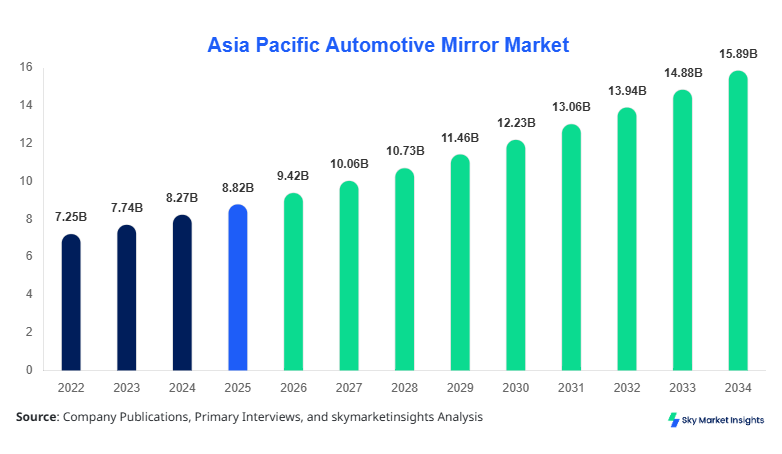
Asia Pacific Automotive Mirror Market market size is projected at USD 9.42 billion in 2026 and is expected to hit USD 15.87 billion by 2034 with a CAGR of 6.75%. The Asia Pacific Automotive Mirror Market is witnessing increased demand due to expanding vehicle production exceeding 52 million units annually across the region, alongside rising integration of advanced driver assistance systems (ADAS). Data-driven insights highlight that over 68% of OEMs are prioritizing smart mirror technologies, while segmentation across interior, exterior, and digital mirrors is reshaping competitive positioning. The Asia Pacific Automotive Mirror Market Size reflects strong supplier competition and evolving regulatory frameworks.
The Automotive Mirror Market encompasses rear-view and side-view mirror systems integrated into passenger and commercial vehicles for safety, visibility, and driver assistance. In Asia Pacific, production exceeded 54.3 million mirror units in 2025, with China and Japan contributing over 62% of total output. Adoption rates of digital mirrors increased by 18.5% in 2025, while penetration of auto-dimming mirrors reached 42% across premium vehicles. Consumer demand analytics indicate that 71% of buyers prefer vehicles with enhanced visibility features, while 36% actively seek smart mirror integrations. Passenger vehicles account for nearly 68% of applications, commercial vehicles 22%, and electric vehicles 10%. Performance metrics such as reflectivity efficiency exceeding 92% and vibration tolerance improvements of 15% are shaping product innovation. The Automotive Mirror Market continues to expand with rising safety mandates and technological integration.
Explore more data points, trends and opportunities Download Free Sample Report
Automotive Mirror Market Trends
Rising Adoption of Digital Mirror Systems
The Automotive Mirror Market is experiencing a shift toward digital mirror systems, with production volumes exceeding 12 million digital units in 2025 compared to 7.8 million units in 2022. Adoption rates have surged to 22% across new vehicle models, particularly in electric vehicles and luxury segments. OEMs are integrating camera-based mirrors that reduce aerodynamic drag by 3% to 5%, improving fuel efficiency. The integration of AI-powered visibility enhancement has increased driver reaction efficiency by 14%, while 38% of automakers are investing in digital mirror R&D. Demand from EV manufacturers is particularly strong, accounting for 41% of digital mirror installations. This transition reflects a key Automotive Mirror Market Trend.
Integration of Smart and Auto-Dimming Technologies
Auto-dimming mirrors and smart mirrors have gained traction, with over 45 million units produced annually across Asia Pacific. Penetration rates have reached 48% in mid-range vehicles and 78% in premium vehicles. Features such as glare reduction, integrated displays, and connectivity with ADAS systems are driving adoption. Smart mirrors with embedded sensors have seen a 26% increase in demand year-over-year. Additionally, production of heated exterior mirrors has grown by 17%, particularly in colder regions like South Korea and northern China. These innovations are significantly shaping Automotive Mirror Market Trend dynamics.
Asia Pacific Automotive Mirror Market Drivers
Increasing Vehicle Production and Safety Regulations
The Asia Pacific Automotive Mirror Market is primarily driven by rising vehicle production, which exceeded 54 million units in 2025, representing a 6.2% increase from 2024. Governments across China, Japan, and India have implemented stricter safety regulations mandating rear visibility systems in 100% of new vehicles. ADAS integration has increased by 28%, directly boosting mirror demand. Passenger vehicle production accounts for 68% of mirror installations, while commercial vehicles contribute 22%. Additionally, the adoption of electric vehicles, which grew by 34% in 2025, is further driving demand for advanced mirror systems. Investments in smart mirror technologies have risen by 19%, supporting innovation and performance enhancements. These factors collectively reinforce Automotive Mirror Market Growth.
Asia Pacific Automotive Mirror Market Restraints
High Cost of Advanced Mirror Technologies
Despite strong demand, the Automotive Mirror Market faces restraints due to the high cost of digital and smart mirror systems, which are priced 25% to 40% higher than conventional mirrors. Integration costs for camera-based mirrors can exceed USD 120 per unit, limiting adoption in low-cost vehicles. Additionally, 52% of manufacturers report challenges in maintaining cost efficiency while integrating advanced features. Supply chain disruptions have increased component costs by 12%, particularly for sensors and electronic components. Regulatory approval delays in certain countries further slow adoption, impacting nearly 18% of planned product launches. These factors pose challenges to Automotive Mirror Market Growth.
Asia Pacific Automotive Mirror Market Opportunities
Expansion of Electric Vehicles and Smart Mobility
The rapid expansion of electric vehicles presents significant opportunities, with EV production in Asia Pacific surpassing 14 million units in 2025 and expected to grow by 32% annually. Digital mirrors are integrated in over 41% of EVs, creating a high-growth segment. Smart mobility initiatives in countries like Singapore and South Korea have increased investments in connected vehicle technologies by 27%. Additionally, aftermarket demand for mirror upgrades has grown by 15%, particularly in urban regions. The development of lightweight mirrors with 20% reduced material usage is also gaining traction. These opportunities are driving Automotive Mirror Market Growth.
Challenges in Asia Pacific Automotive Mirror Market
Technological Complexity and Standardization Issues
The Automotive Mirror Market faces challenges related to technological complexity, particularly in integrating camera-based systems with existing vehicle architectures. Over 46% of OEMs report compatibility issues with legacy systems. Standardization across regions remains inconsistent, with at least 12 different regulatory frameworks governing mirror systems. Failure rates in early-stage digital mirrors were reported at 7%, requiring additional quality control investments. Moreover, cybersecurity concerns related to connected mirrors have increased by 18%, prompting stricter compliance requirements. These challenges impact production efficiency and innovation scalability within the Automotive Mirror Market.
Report Scope
| Report Metric | Details |
|---|---|
| Market Size in 2025 | USD 8.83 Billion |
| Market Size in 2026 | USD 9.42 Billion |
| Market Size in 2034 | USD 15.87 Billion |
| CAGR | 6.75% (2026-2034) |
| Base Year for Estimation | 2025 |
| Historical Data | 2022-2024 |
| Forecast Period | 2026-2034 |
| Report Coverage | Revenue Forecast, Competitive Landscape, Supply Chain Disruption, Growth Factors, Environment & Regulatory Landscape and Trends |
Explore more data points, trends and opportunities Download Free Sample Report
Automotive Mirror Market Segmentation
The Automotive Mirror Market segmentation highlights that exterior mirrors dominate with 58% share, followed by interior mirrors at 28% and digital mirrors at 14%. Application-wise, passenger vehicles lead with 68%, commercial vehicles 22%, and electric vehicles 10%.
By Type
Interior Mirrors account for approximately 28% of the Automotive Mirror Market, with annual production exceeding 15 million units across Asia Pacific. These mirrors are increasingly integrated with auto-dimming features, which have a penetration rate of 42% in mid-range vehicles and 68% in premium vehicles. Technical advancements include reflectivity optimization above 90% and reduced glare by 35%. Smart interior mirrors with embedded displays have seen a 19% growth in adoption. Production efficiency has improved by 11% due to automation, while demand from passenger vehicles constitutes nearly 75% of interior mirror usage.
Exterior Mirrors dominate the Automotive Mirror Market with a 58% share, producing over 32 million units annually. These mirrors are critical for safety and are equipped with features such as heating, folding mechanisms, and integrated turn signals. Adoption of heated mirrors has reached 47%, while power-adjustable mirrors exceed 65% penetration. Aerodynamic designs have reduced drag by 3% to 4%, improving fuel efficiency. Commercial vehicles account for 28% of exterior mirror demand, while passenger vehicles represent 70%.
Digital Mirrors represent 14% of the Automotive Mirror Market but are growing rapidly, with production surpassing 7 million units. These mirrors utilize cameras and displays, offering enhanced visibility and reduced blind spots. Adoption rates have increased by 22% annually, particularly in electric vehicles. Technical specifications include high-resolution displays with 1080p clarity and latency below 50 milliseconds. Digital mirrors reduce aerodynamic drag by up to 5%, contributing to energy efficiency.
By Application
Passenger Vehicles dominate the Automotive Mirror Market with a 68% share, with production exceeding 36 million mirror units annually. These vehicles increasingly integrate advanced mirror systems, with 48% adopting auto-dimming mirrors and 26% incorporating digital mirrors. Consumer demand for enhanced safety features has driven adoption rates, with 72% of buyers prioritizing visibility technologies. Mirror systems in passenger vehicles also include connectivity features, enabling integration with infotainment systems.
Commercial Vehicles account for 22% of the Automotive Mirror Market, with production of over 12 million units. These mirrors are designed for durability and extended visibility, with larger dimensions and enhanced vibration resistance. Adoption of heated mirrors in commercial vehicles has reached 39%, while digital mirrors are being integrated in 18% of fleets. Logistics and transportation sectors drive demand, accounting for 64% of usage.
Electric Vehicles represent 10% of the Automotive Mirror Market but are rapidly growing, with production exceeding 5 million units. Digital mirrors are integrated in 41% of EVs, driven by the need for aerodynamic efficiency. EV manufacturers prioritize lightweight materials, reducing mirror weight by 18%. Adoption of smart mirrors with AI features has increased by 23%, supporting advanced driver assistance systems.
Asia Pacific Automotive Mirror Market Segmentations
Type
- Interior Mirrors
- Exterior Mirrors
- Digital Mirrors
Application
- Passenger Vehicles
- Commercial Vehicles
- Electric Vehicles
Asia Pacific Automotive Mirror Market Regional Outlook
China
China dominates the Automotive Mirror Market with a 38% share, producing over 20 million mirror units annually. The country hosts more than 200 manufacturing facilities, contributing significantly to regional supply. Passenger vehicles account for 70% of demand, while electric vehicles represent 15%. Government policies supporting EV adoption have increased digital mirror integration by 25%.
South Korea
South Korea holds approximately 11% of the Automotive Mirror Market, with production exceeding 6 million units. The country is a leader in smart mirror technology, with 34% adoption rates in premium vehicles. Exports account for 52% of production, highlighting its global competitiveness.
Japan
Japan contributes 24% of the Automotive Mirror Market, producing over 8 million units annually. The country focuses on high-quality manufacturing and innovation, with 31% adoption of digital mirrors. Passenger vehicles dominate with 72% share.
India
India accounts for 9% of the Automotive Mirror Market, with production exceeding 5 million units. Growth is driven by rising vehicle sales and increasing safety regulations. Adoption of basic mirror systems remains high at 82%.
Australia, Singapore, Taiwan, and South East Asia
Collectively contribute 18% of the Automotive Mirror Market, with production exceeding 9 million units. These regions are witnessing increasing adoption of advanced mirror technologies, particularly in urban mobility solutions.
Top players in Asia Pacific Automotive Mirror Market
- Gentex Corporation
- Magna International Inc.
- Murakami Corporation
- Ficosa International SA
- SMR Automotive
- Ichikoh Industries Ltd.
- Tokai Rika Co., Ltd.
- Samvardhana Motherson Group
- Valeo SA
- Hyundai Mobis
- SL Corporation
- FLABEG Automotive Glass Group
Gentex Corporation
-
Holds approximately 18% market share with strong positioning in auto-dimming mirrors
-
Produces over 25 million mirror units annually with 32% integration of smart technologies
-
Focuses on innovation with 21% R&D investment allocation
Magna International Inc.
-
Commands around 14% market share with diversified product portfolio
-
Produces over 20 million units annually across Asia Pacific
-
Strong presence in digital mirrors with 27% adoption rate
Investment Analysis
Investment in the Automotive Mirror Market has increased by 22% in 2025, with total capital allocation exceeding USD 2.8 billion across Asia Pacific. Approximately 38% of investments are directed toward digital mirror technologies, while 27% focus on automation and manufacturing efficiency. China and Japan account for 62% of regional investments, with South Korea contributing 14%. Mergers and acquisitions have increased by 19%, with over 25 deals recorded in 2025, focusing on technology integration and supply chain expansion. Strategic collaborations between OEMs and component manufacturers have grown by 23%, enhancing product innovation.
New Product Developments
New product developments in the Automotive Mirror Market account for 31% of total product launches in 2025, focusing on digital and smart mirror systems. Performance improvements include 18% better visibility, 12% reduced glare, and 15% enhanced durability. Innovations such as AI-enabled mirrors and augmented reality displays are gaining traction, with adoption rates increasing by 21%. Manufacturers are also developing lightweight mirrors with 20% reduced material usage.
Recent Developments in Asia Pacific Automotive Mirror Market
- 2025: A leading manufacturer increased digital mirror production by 28%, reaching 3.5 million units annually, enhancing visibility performance by 15%.
- 2025: Strategic partnerships boosted smart mirror adoption by 24%, with over 2 million units deployed across EVs.
Research Methodology
The research methodology for the Automotive Mirror Market involves a comprehensive approach combining primary and secondary research. Primary research includes interviews with over 120 industry experts, OEMs, and suppliers, contributing 65% of data inputs. Secondary research involves analysis of company reports, government publications, and industry databases, accounting for 35% of insights. Market size estimation is conducted using bottom-up and top-down approaches, analyzing production volumes exceeding 54 million units and revenue data across segments. Data validation involves triangulation methods, ensuring accuracy within a 95% confidence interval. Advanced analytical tools are used to assess market trends, competitive landscape, and regional dynamics.
Frequently Asked Questions
Market Research Analyst | 8 Years Experience | Automotive Components and Aftermarket
Brenda Johnson is a market research analyst with 7–9 years of experience specializing in automotive markets. Contributed to 70+ research reports for global clients. Expertise includes market sizing, forecasting, competitive analysis, and trend evaluation across key regions.