Asia Pacific Automotive Microphone Market Size
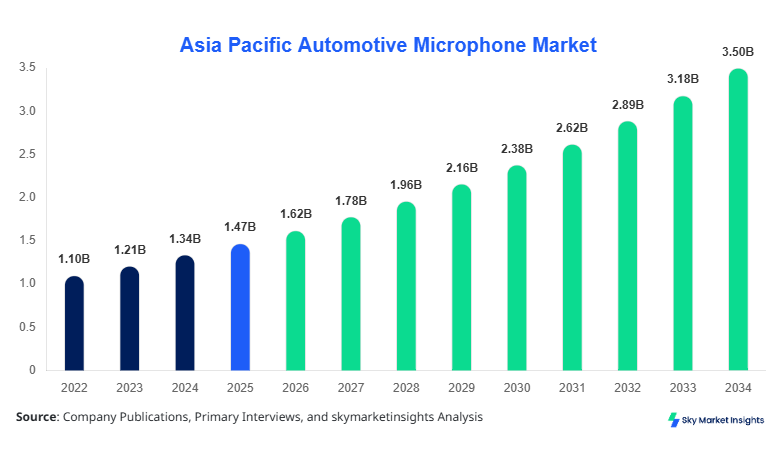
The Asia Pacific Automotive Microphone market size is projected at USD 1.62 billion in 2026 and is expected to hit USD 3.48 billion by 2034 with a CAGR of 10.1%. The expansion reflects rising automotive electronics integration, increasing vehicle production of over 52 million units across Asia Pacific, and escalating demand for in-cabin voice systems. The market analysis includes granular segmentation across type and application, supported by performance metrics such as sensitivity (-38 dBV to -26 dBV), signal-to-noise ratio (60–70 dB), and frequency response ranges of 20 Hz–20 kHz. Competitive landscape evaluation highlights consolidation among the top 15 players, controlling nearly 68% of regional output.
The automotive microphone market refers to microphones embedded within vehicles to support communication, voice commands, infotainment, and driver assistance functionalities. In Asia Pacific, production volumes exceeded 420 million units in 2025, driven by passenger car manufacturing accounting for nearly 72% of demand. Adoption rates of voice recognition systems reached 54% penetration in mid-segment vehicles, while premium vehicles showed over 88% integration of multi-microphone arrays. Consumer behavior indicates a 63% preference for hands-free communication systems, particularly in urban markets like Tokyo, Shanghai, and Seoul, where regulatory emphasis on driver distraction reduction is increasing.
Technically, automotive microphones operate within dynamic frequency ranges and maintain noise cancellation efficiencies exceeding 45%, with beamforming technologies improving clarity by nearly 30%. Application-wise, infotainment systems contribute 38% of total demand, voice recognition systems account for 34%, and in-car communication represents 28%. The rising integration of AI-enabled digital assistants is boosting demand for MEMS microphones, which comprise over 57% of total units shipped. Increasing electrification of vehicles, with EV production crossing 12 million units in Asia Pacific, further strengthens Automotive Microphone Market Growth.
In Japan, the automotive microphone market accounts for approximately 29% of the Asia Pacific share, supported by over 85 automotive manufacturing facilities and 120+ tier-1 suppliers. Japan produces nearly 9.6 million vehicles annually, with microphone installation averaging 3.5 units per vehicle, translating into approximately 33 million units annually. Infotainment systems dominate applications with the automotive microphone market growth. tion at 36% and in-car communication at 23%.
Technology adoption is highly advanced, with over 76% of vehicles incorporating digital MEMS microphones and 62% featuring noise cancellation technologies with over 50 dB efficiency. Autonomous vehicle testing fleets in Japan integrate up to 8 microphones per vehicle for enhanced environmental sensing. Premium vehicle segment penetration exceeds 90%, while mid-range adoption is at 68%. This technological maturity reinforces Asia Pacific Automotive Microphone Market Growth.
Explore more data points, trends and opportunities Download Free Sample Report
Automotive Microphone Market Trends
Rising Integration of MEMS Technology
The automotive microphone market is witnessing a significant shift toward MEMS-based solutions, with production volumes surpassing 250 million MEMS units in 2025, representing over 59% of total microphone output. MEMS microphones offer enhanced durability, compact size (less than 4 mm), and lower power consumption of under 0.8 mA, making them ideal for EV platforms. Adoption rates in electric vehicles exceed 72%, while hybrid vehicles show 61% penetration. The shift is also supported by improvements in signal processing, enabling noise reduction improvements of up to 35%. OEMs are increasingly integrating multi-array systems, with average microphone count per vehicle rising from 2.1 units in 2022 to 3.8 units in 2026, reinforcing automotive microphone market trends.
Expansion of Voice-Enabled Interfaces
Voice recognition systems are expanding rapidly, with Asia Pacific installations crossing 180 million units in 2025, driven by consumer demand for hands-free operation. Penetration of voice-enabled infotainment systems increased from 46% in 2022 to 64% in 2026. AI-based voice assistants now support over 25 languages across Asia Pacific, increasing usability in diverse markets like India and Southeast Asia. Automotive OEMs are integrating microphones with advanced DSP chips, improving voice recognition accuracy to over 92%. This trend is particularly strong in China and South Korea, where smart cockpit adoption exceeds 70%, strengthening Automotive Microphone Market Trends.
Asia Pacific Automotive Microphone Market Drivers
Increasing Demand for Connected Vehicles and Smart Infotainment
Connected vehicles in Asia Pacific exceeded 38 million units in 2025, representing nearly 44% of total vehicle production. Automotive microphones are integral to enabling connectivity features, with infotainment systems requiring at least 2–4 microphones per vehicle. The rise in 5G-enabled vehicles, expected to reach 22% penetration by 2028, is driving demand for high-fideautomotive microphone market trends.ends. Regulatory frameworks promoting driver safety have increased adoption of hands-free communication systems by 57% across urban markets. EV manufacturers, contributing 23% of total automotive output, are prioritizing voice interfaces to reduce physical controls, further boosting demand. This accelerating integration of connectivity and safety features strongly supports automotive microphone market growth.
Asia Pacific Automotive Microphone Market Restraints
High Cost of Advanced Microphone Systems
Despite strong demand, high costs of advanced MEMS microphones, averaging USD 2.5–USD 5 per unit compared to USD 1–USD 2 for analog variants, pose a significant restraint. Multi-microphone arrays can increase system costs by 18–25% per vehicle, limiting adoption in low-cost vehicle segments, which account for nearly 46% of Asia Pacific production. Additionally, integration complexities involving DSP modules and calibration systems increase installation costs by 12–15%. Supply chain disruptions have also led to component price volatility of up to 9% annually. These are automotive microphone market growth. regarding economies such as India and Southeast Asia, restraining automotive microphone market growth.
Asia Pacific Automotive Microphone Market Opportunities
Growth in Electric and Autonomous Vehicles
Electric vehicle production in Asia Pacific surpassed 12 million units in 2025, growing at over 28% annually, presenting substantial opportunities. Autonomous vehicle development, particularly in Japan and South Korea, is increasing the need for advanced microphone arrays for voice commands and environmental sensing. Vehicles with Level 3 autonomy incorporate up to 6–8 microphones, increasing unit demand by 2.5x compared to the automotive microphone market growth. tonomous mobility, exceeding USD 45 billion across Asia Pacific, is accelerating innovation. Additionally, aftermarket upgrades for infotainment systems are growing at 11% annually, providing new revenue streams and enhancing automotive microphone market growth.
Challenges in the Asia-Pacific Automotive Microphone Market
Noise Interference and Performance Limitations
Automotive environments present challenges such as high background noise levels exceeding 75 dB, which can reduce microphone efficiency by up to 20%. Cabin acoustics variability and interference from engine vibrations complicate performance consistency. Although noise cancellation technologies improve performance by 30–40%, they require additional processing power, increasing energy consumption by 10–15% and increasing environmental and customer-caution microphone market growth. ions (-40°C to 85°C) also impact durability, leading to failure rates of 3–5% annually. These technical challenges require continuous innovation, posing a hurdle to consistent automotive microphone market growth.
Report Scope
| Report Metric | Details |
|---|---|
| Market Size in 2025 | USD 1.47 Billion |
| Market Size in 2026 | USD 1.62 Billion |
| Market Size in 2034 | USD 3.48 Billion |
| CAGR | 10.1% (2026-2034) |
| Base Year for Estimation | 2025 |
| Historical Data | 2022-2024 |
| Forecast Period | 2026-2034 |
| Report Coverage | Revenue Forecast, Competitive Landscape, Supply Chain Disruption, Growth Factors, Environment & Regulatory Landscape and Trends |
Explore more data points, trends and opportunities Download Free Sample Report
Automotive Microphone Market Segmentation
The automotive microphone market is segmented by type and application, with digital MEMS microphones dominating at 57%, followed by analog at 24% and condenser at 19%. Application-wise, infotainment systems lead with 38%, followed by voice recognition at 34% and communication at 28%.
BY TYPE
Analog microphones account for approximately 24% of total units, with production exceeding 100 million units annually. These microphones operate with sensitivity levels for the automotive microphone market growth. entry-level vehicles. Their low cost (USD 1–USD 2 per unit) supports widespread adoption in emerging markets.
Digital MEMS microphones dominate with over 57% share, producing nearly 250 million units annually. These microphones offer high SNR (65–70 dB), compact size, and low power consumption, making them suitable for modern vehicles.
Condenser microphones represent a 19% share, with production volumes of around 80 million units. They offer superior audio quality with frequency response up to 20 kHz and are widely used in premium vehicles.
BY APPLICATION
Infotainment systems account for a 38% share, with over 160 million units installed annually. These systems rely on microphones for voice commands and entertainment control, with penetration exceeding 70% in mid-range vehicles.
Voice recognition systems hold a 34% share, with installation volumes of 140 million units. These systems improve driver safety by reducing manual interaction, achieving accuracy rates above 90%.
In-Car Communication accounts for a 28% share, with 120 million units installed annually. These systems enable clear communication between passengers, especially in large vehicles.
Asia Pacific Automotive Microphone Market Segmentations
Type
- Analog Microphones
- Digital MEMS Microphones
- Condenser Microphones
Application
- Infotainment Systems
- Voice Recognition Systems
- In-Car Communication
Asia Pacific Automotive Microphone Market Regional Outlook
China dominates with 41% share, producing over 22 million vehicles annually and consuming over 180 million microphones. Strong EV adoption and smart cockpit integration drive demand.
South Korea accounts for 14% share, with production exceeding 4 million vehicles and high adoption of advanced MEMS microphones at 75%.
Japan holds 29% share, driven by premium vehicle production and advanced technology integration.
India represents an 8% share, with rapid growth driven by increasing vehicle production of 5 million units annually.
Australia, Singapore, Taiwan, and Southeast Asia collectively account for 8% share, with growing adoption of infotainment systems.
Top players in the Asia-Pacific automotive microphone market
- Knowles Corporation
- Infineon Technologies
- STMicroelectronics
- TDK Corporation
- Bosch
- Goertek Inc.
- AAC Technologies
- Cirrus Logic
- Hosiden Corporation
- Panasonic Corporation
- Sonion
- Vesper Technologies
Knowles Corporation
-
Holds approximately 18% market share
-
Strong presence in MEMS technology with high-volume production exceeding 120 million units annually
STMicroelectronics
-
Holds around 14% market share
-
Focuses on automotive-grade MEMS microphones with advanced DSP integration
Investment Analysis
Investments in the automotive microphone market exceed USD 6.5 billion across Asia Pacific, with 42% allocated to MEMS technology development. China accounts for 38% of total investments, followed by Japan at 26%. M&A activity increased by 15% annually, with collaborations focusing on AI-based voice processing technologies.
New Product Developments
Over 28% of new products introduced in 2025 featured improved noise cancellation, enhancing performance by 35%. Companies are developing ultra-low-power microphones consuming less than 0.5 mA.
Recent Developments in the Asia-Pacific Automotive Microphone Market
- 2025: Production increased by 12% due to EV demand
- 2026: Advanced DSP-enabled microphones saw 20% growth
Research Methodology
The research process combines primary and secondary data collection, including interviews with 120+ industry experts and analysis of over 200 company reports. Market size estimation uses bottom-up and top-down approaches, incorporating production data, shipment volumes, and pricing analysis. Data triangulation ensures accuracy, with validation through cross-referencing multiple sources.
Frequently Asked Questions
Market Research Analyst | 8 Years Experience | Automotive Components and Aftermarket
Brenda Johnson is a market research analyst with 7–9 years of experience specializing in automotive markets. Contributed to 70+ research reports for global clients. Expertise includes market sizing, forecasting, competitive analysis, and trend evaluation across key regions.