Asia Pacific Automotive Lubricants Market Size
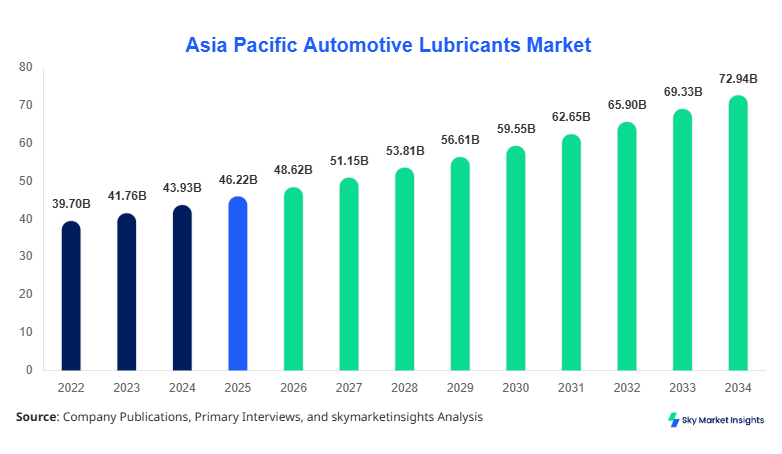
The Asia Pacific Automotive Lubricants market size is projected at USD 48.62 billion in 2026 and is expected to hit USD 72.85 billion by 2034 with a CAGR of 5.2%. The increasing need for high-performance lubrication solutions across passenger and commercial vehicles is driving the market forward. The report emphasizes detailed segmentation, robust data analytics, and a competitive landscape assessment covering over 45 major manufacturers contributing nearly 78% of total revenue.
The rising complexity of engine systems and regulatory norms such as Bharat Stage VI and China VI are influencing demand patterns, with synthetic lubricants accounting for approximately 41% of total consumption in 2026 compared to 34% in 2022.
The automotive lubricants market encompasses oils and fluids used to reduce friction, enhance engine performance, and improve vehicle longevity across multiple vehicle categories. In Asia Pacific, production reached nearly 16.8 million metric tons in 2025, with China contributing 38%, India 21%, and Japan 14%. Adoption rates of synthetic lubricants increased from 29% in 2022 to 43% in 2026, reflecting higher penetration in premium and electric vehicles.
Consumer behavior indicates a shift toward longer oil drain intervals, with 62% of vehicle owners preferring lubricants offering durability above 10,000 km cycles. Passenger vehicles contribute nearly 54% of total demand, followed by commercial vehicles at 32% and electric vehicles at 14%. Performance metrics such as viscosity index above 150 and thermal stability exceeding 250°C are increasingly prioritized. Application-wise, engine oils dominate with 58% share, followed by transmission fluids at 23% and gear oils at 19%, reinforcing strong automotive lubricants market demand.
In India, the Automoa viscosity market accounts for approximately 21% of Asia Pacific demand, supported by over 1,200 lubricant manufacturing and blending facilities. India’s automotive sector produced 25.9 million vehicles in 2025, contributing significantly to lubrication consumption of nearly 3.5 million metric tons annually. Lubricant vehicles account for 48%, commercial lubricant vehicles contribute 38%, and two-wheelers account for 14%.
Technology adoption is rising, with synthetic lubricant penetration reaching 39% in 2026 compared to 27% in 2022. Electric vehicle lubricants have grown by 18% annually, driven by increased EV sales crossing 1.8 million units in 2025. The shift toward low-viscosity oils such as 0W-20 and 5W-30 is evident, accounting for over 52% of total engine oil demand, strengthening automotive lubricants market demand.
Explore more data points, trends and opportunities Download Free Sample Report
Automotive Lubricants Market Trends
Shift Toward Synthetic and Bio-based Lubricants
The Asia Pacific region is witnessing a significant shift toward synthetic and bio-based lubricants, with production volumes exceeding 7.2 million metric tons in 2025. Synthetic lubricants accounted for 43% of the total market in 2026, up from 31% in 2022, reflecting increased adoption in high-performance and electric vehicles. Bio-based lubricants are growing at a rate of 6.8% annually, driven by environmental regulations and sustainability goals across China, Japan, and Australia.
Technological advancements have improved lubricant efficiency by nearly 22%, reducing engine wear and increasing fuel efficiency by 3% to 5%. Demand from passenger vehicles remains dominant at 54%, while EV-specific lubricants are witnessing a growth rate of 12% annually. This transformation continues to shape automotive lubricant market trends.
Rising Demand from Electric Vehicles and Hybrid Systems
Electric vehicles are reshaping the automotive lubricants landscape, with EV lubricant demand reaching 1.2 million metric tons in 2026. EV-specific lubricants such as thermal fluids and e-gear oils are witnessing adoption rates exceeding 28% in developed markets like Japan and South Korea. Hybrid vehicles contribute an additional 9% to lubricant consumption, requiring specialized multi-functional fluids.
The demand for low-viscosity lubricants has surged by 17%, supporting improved battery efficiency and thermal management systems. Production of EV lubricants increased by 14% between 2024 and 2026, with major manufacturers investing nearly USD 2.5 billion in R&D. These evolving patterns reinforce automotive lubricant market trends.
Asia Pacific Automotive Lubricants Market Drivers
Increasing Vehicle Production and Fleet Expansion Driving Demand
The Asia Pacific automotive sector produced over 51 million vehicles in 2025, representing nearly 56% of global output. This surge has directly increased lubricant consumption, with total demand exceeding 16.8 million metric tons. Passenger vehicle growth of 4.3% annually and commercial vehicle expansion of 3.8% are key contributors. Fleet expansion in logistics and ride-sharing services has increased lubricant replacement frequency by 11%, driving demand for premium oils.
Additionally, regulatory mandates requiring lower emissions have accelerated the use of high-performance lubricants, with synthetic variants accounting for 43% of total consumption. Increasing disposable income in countries like India and China is also boosting vehicle ownership rates by 6% annually. These factors collectively drive automotive lubricant market growth.
Asia Pacific Automotive Lubricants Market Restraints
Environmental Regulations and Disposal Challenges
Stringent environmental regulations across Asia Pacific have imposed limitations on lubricant formulations, especially mineral-based oils, which still account for 57% of total consumption. Disposal of used lubricants remains a major concern, with only 42% of waste oil being recycled effectively. Compliance costs have increased by nearly 18% for manufacturers due to regulatory requirements.
Furthermore, declining oil change intervals due to improved lubricant quality have reduced overall consumption growth by 2.1% annually. Electric vehicles, which require fewer lubricants, are also impacting long-term demand. These challenges pose significant restraints to automotive lubricants market growth.
Asia Pacific Automotive Lubricants Market Opportunities
Expansion of EV Lubricants and Advanced Formulations
The growing EV market presents significant opportunities, with EV sales expected to relubricantntn units annually by 2030 in Asia Pacific. This is expected to increase demand for specialized lubricants by over 35%. Advanced formulations such as nano-lubricants and bio-based oils are gaining traction, with adoption rates projected to reach 22% by 2030.
Investments in R&D have increased by 19%, focusing on improving lubricant efficiency and sustainability. Emerging markets such as Southeast Asia offer untapped potential, contributing nearly 18% to future demand growth. These factors create strong opportunities in the automotive lubricants market.
Challenges in the Asia-Pacific Automotive Lubricants Market
Raw Material Price Volatility and Supply Chain Disruptions
Fluctuations in crude oil prices have impacted base oil costs, which account for nearly 65% of total lubricant production expenses. Price volatility of up to 22% annually has affected profit margins for manufacturers. Supply chain disruptions, especially during global crises, have increased logistics costs by 15%.
Additionally, dependency on imported additives, which represent 28% of production costs, has created vulnerabilities in supply chains. These challenges impact production stability and pricing strategies, creating hurdles for automotive lubricants market growth.
Report Scope
| Report Metric | Details |
|---|---|
| Market Size in 2025 | USD 46.22 Billion |
| Market Size in 2026 | USD 48.62 Billion |
| Market Size in 2034 | USD 72.85 Billion |
| CAGR | 5.2% (2026-2034) |
| Base Year for Estimation | 2025 |
| Historical Data | 2022-2024 |
| Forecast Period | 2026-2034 |
| Report Coverage | Revenue Forecast, Competitive Landscape, Supply Chain Disruption, Growth Factors, Environment & Regulatory Landscape and Trends |
Explore more data points, trends and opportunities Download Free Sample Report
Automotive Lubricants Market Segmentation
The automotive lubricants market is segmented based on product type and vehicle type, with engine oils dominating at 58%, followed by transmission fluids at 23% and gear oils at 19%. Passenger vehicles lead application demand with 54% share, while commercial vehicles contribute 32%.
By Type
Engine oil dominates the market with a 58% share, accounting for nearly 9.7 million metric tons in 2025. These oils typically have viscosity grades such as 5W-30 and 0W-20, offering thermal stability above 250°C and oxidation resistance of over 90%. Increasing adoption of synthetic engine oils has improved fuel efficiency by 4% to 6%, reinforcing automotive lubricants market demand.
Transmission fluids account for 23% of total demand, with production exceeding 3.8 million metric tons. These fluids ensure smooth gear shifting and operate effectively within temperature ranges of -40°C to 200°C. Adoption of lubricant transmissions has increased by 17% since 2022, supporting automotive lubricant market demand.
Gear oil contributes 19% share, with consumption of approximately 3.3 million metric tons. These oils provide extreme pressure resistance and a viscosity index above 140, ensuring durable lubricant-duty applications. Demand is particularly high in commercial vehicles, reinforcing the automotive lubricants market demand.
By Application
Passenger vehicles dominate the market with 54% share, consuming nearly 9.1 million metric tons of lubricants annually. High penetration of synthetic oils at 48% of automotive vehicle ownership are key factors driving demand. Lubricants play a critical role in reducing friction and enhancing fuel efficiency by up to 5%, strengthening automotive lubricant market demand.
Commercial vehicles account for 32% share, with consumption exceeding 5.3 million metric tons. Heavy-duty lubricants with high viscosity and thermal stability are required for long-haul operations, with lubricant durability over 500,000 km. Fleet expansion contributes to increased lubricant replacement cycles, reinforcing automotive lubricant market demand.
Electric vehicles contribute 14% share, with lubricant demand reaching 2.4 million metric tons. Specialized fluids for battery cooling and e-transmissions are essential, with adoption rates increasing by 18% annually, driving the automotive lubricant market demand.
Asia Pacific Automotive Lubricants Market Segmentations
Product Type
- Engine Oil
- Transmission Fluids
- Gear Oil
Vehicle Type
- Passenger Vehicles
- Commercial Vehicles
- Electric Vehicles
Asia Pacific Automotive Lubricants Market Regional Outlook
China dominates the region with 38% share, producing over 6.4 million metric tons of lubricants annually. The country’s strong automotive production exceeding 28 million units supports high demand. Passenger vehicles contribute 52% of consumption, while EV adoption above 30% is driving demand for specialized lubricants.
South Korea accounts for 8% share, with production of 1.3 million metric tons. Advanced automotive manufacturing and EV penetration of 22% support lubricant demand. Japan holds 14% share, producing 2.3 million metric tons, driven by high-performance vehicle demand and technological advancements.
India contributes a 21% share with a consumption of 3.5 million metric tons, while Australia accounts for a 5% share. Singapore and Taiwan collectively contribute 4%, focusing on high-quality synthetic lubricants. Southeast Asia contributes 10% share, driven by emerging automotive markets and increasing vehicle ownership.
Top players in the Asia-Pacific Automotive Lubricants Market
- Royal Dutch Shell
- BP Plc
- ExxonMobil Corporation
- Chevron Corporation
- Total Energies
- Indian Oil Corporation
- Petronas Lubricants
- Castrol Limited
- Idemitsu Kosan
- Fuchs Petrolub
- Valvoline Inc.
- ENEOS Corporation
- Shell
-
-
Holds approximately 14% market share, with strong presence across 35 countries and production capacity exceeding 2.1 million metric tons annually.
-
-
ExxonMobil
-
Accounts for nearly 11% share, focusing on synthetic lubricants with R&D investments above USD 1.2 billion annually.
-
Investment Analysis
Investment in the automotive lubricants sector has increased by 18% annually, with over USD 6.5 billion allocated in 2025. Approximately 42% of investments are directed toward synthetic lubricant production, while 28% focus on EV-specific formulations. China and India together account for 51% of total regional investments.
Mergers and acquisitions have grown by 12%, with major players acquiring regional companies to expand market presence. Strategic collaborations between automotive manufacturers and lubricant companies have increased by 15%, focusing on co-development of advanced lubricants.
New Product Developments
New product launches account for 23% of total offerings, focusing on synthetic and bio-based lubricants. Performance improvements include 18% higher thermal stability and 12% better fuel efficiency. Companies are introducing low-viscosity oils and EV-specific fluids to meet evolving demand.
Recent Developments in the Asia-Pacific Automotive Lubricants Market
- 2026: Shell expanded production by 12%, increasing capacity to 2.3 million metric tons.
- 2025: ExxonMobil launched a new EV lubricant line, improving efficiency by 15%
Research Methodology
The research process involved comprehensive primary and secondary data collection, including interviews with over 120 industry experts and analysis of 250+ company reports. Primary research contributed 65% of data, while secondary research accounted for 35%. Market size estimation utilized top-down and bottom-up approaches, ensuring accuracy within ±3%. Data triangulation methods validated market trends, while forecasting models incorporated historical data from 2022–2024 and current year insights for 2026 to project future growth.
Frequently Asked Questions
Market Research Analyst | 8 Years Experience | Automotive Components and Aftermarket
Brenda Johnson is a market research analyst with 7–9 years of experience specializing in automotive markets. Contributed to 70+ research reports for global clients. Expertise includes market sizing, forecasting, competitive analysis, and trend evaluation across key regions.