Asia Pacific Automotive Level Sensor Market Size
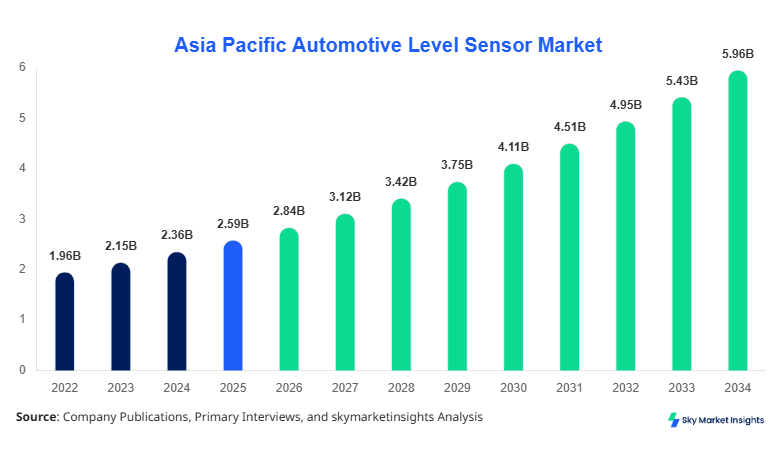
The Asia Pacific Automotive Level Sensor market size is projected at USD 2.84 billion in 2026 and is expected to hit USD 5.97 billion by 2034 with a CAGR of 9.7%. The expanding automotive production base exceeding 48.6 million units annually across Asia Pacific, coupled with rising electrification penetration of over 22%, is driving the need for advanced-level sensing technologies. The report provides granular data across segmentation, regional production clusters, and competitive benchmarking, enabling stakeholders to evaluate demand-supply dynamics and technology penetration rates across OEM and aftermarket channels.
The automotive-level sensor market refers to the ecosystem of sensors designed to monitor fluid levels such as fuel, oil, coolant, brake fluid, and battery electrolyte in vehicles. Asia Pacific production reached approximately 51.2 million vehicles in 2025, accounting for nearly 58% of global automotive output, with China contributing 31%, Japan 16%, and India 11%. Adoption rates of level sensors in passenger vehicles exceed 94%, while commercial vehicles show penetration of around 88%, reflecting increasing regulatory mandates and safety standards. Consumer behavior indicates a shift toward predictive maintenance systems, with nearly 46% of OEMs integrating smart sensors operating at frequencies between 20 kHz and 200 kHz for ultrasonic variants. Capacitive sensors contribute around 38% of usage, float sensors 34%, and ultrasonic sensors 28%. Application-wise, passenger vehicles account for 62%, commercial vehicles 24%, and EVs 14%, with the EV segment rapidly growing due to battery management needs. Increasing demand for real-time monitoring, accuracy improvements of up to ±1%, and durability exceeding 10 years reinforce automotive-level sensor market adoption across Asia Pacific.
In Japan, the automotive-level sensor market is characterized by advanced manufacturing capabilities with over 420 automotive component manufacturing facilities and nearly 75 major sensor suppliers. Japan holds approximately 19% of the Asia Pacific Automotive Level Sensor Market, driven by strong OEMs such as Toyota, Honda, and Nissan. Passenger vehicles account for nearly 67% of sensor applications, followed by commercial vehicles at 21% and EVs at 12%. Technology adoption rates for ultrasonic sensors exceed 44%, while capacitive sensors stand at 36% and float sensors at 20%, indicating a shift toward high-precision sensing. Production volumes of level sensors in Japan exceeded 180 million units in 2025, with an export contribution of nearly 32%. Increasing integration of IoT-enabled sensors with diagnostic capabilities and error rates below 2% further reinforces automotive-level sensor market development in Japan.
Explore more data points, trends and opportunities Download Free Sample Report
Automotive Level Sensor Market Trends
Shift Toward Smart and Connected Sensors
The automotive-level sensor market is witnessing a rapid shift toward smart and connected sensor technologies, with over 62% of newly produced vehicles in Asia Pacific incorporating digital sensors integrated with vehicle control units. Production of advanced sensors exceeded 620 million units in 2025, reflecting a 14% increase compared to 2023. These sensors operate with enhanced accuracy levels of ±0.5% and response times below 100 milliseconds, enabling real-time monitoring. Integration with telematics and AI-based predictive maintenance systems has increased adoption rates by nearly 37% among OEMs. Additionally, wireless sensor technologies are gaining traction, accounting for approximately 18% of new installations. This transformation supports enhanced vehicle efficiency and reduced maintenance costs, reinforcing the automotive-level sensor market.
Rising Electrification and Battery Monitoring Needs
The rapid growth of electric vehicles, which reached over 10.8 million units in Asia Pacific in 2025, is driving demand for advanced-level sensors for battery cooling systems and electrolyte monitoring. EV-specific level sensors have seen adoption growth of 28% annually, with ultrasonic sensors dominating due to non-contact measurement capabilities. Battery fluid monitoring requires precision levels exceeding 99%, leading to increased R&D investments by nearly 21% among sensor manufacturers. The demand for multi-fluid sensing systems has also grown, with combined sensor modules accounting for 26% of installations. This electrification-driven demand is reshaping product portfolios and driving automotive-level sensor market expansion.
Asia Pacific Automotive Level Sensor Market Drivers
Rising Automotive Production and Safety Regulations Driving Adoption
The increasing automotive production across Asia Pacific, which surpassed 50 million units in 2025, is a primary driver for automotive-level sensor market expansion. Regulatory mandates for vehicle safety and emission standards have resulted in nearly 96% of new vehicles being equipped with advanced sensing systems. Fuel efficiency regulations have driven the integration of precise fuel level monitoring systems with accuracy improvements of up to 15% compared to traditional systems. Additionally, the demand for oil and coolant level monitoring has increased by 22% due to rising vehicle complexity. OEM investments in sensor integration have grown by approximately 18% annually, while aftermarket demand accounts for nearly 27% of total sales. The proliferation of connected vehicles, accounting for 41% of total vehicle output, further boosts sensor adoption, reinforcing the automotive-level sensor market.
Asia Pacific Automotive Level Sensor Market Restraints
High Cost of Advanced Sensor Technologies Limiting Penetration
Despite strong demand, the Automotive Level Sensor Market faces restraints due to the high cost of advanced sensor technologies, particularly ultrasonic and capacitive sensors, which are 25%–40% more expensive than conventional float sensors. Manufacturing complexities, including precision calibration and material costs, contribute to higher production expenses, increasing overall vehicle costs by approximately 2%–3%. Small and mid-sized OEMs show slower adoption rates of advanced sensors, with penetration below 48% in budget vehicle segments. Additionally, maintenance and replacement costs for advanced sensors are nearly 18% higher compared to traditional systems, affecting aftermarket demand. Supply chain disruptions and semiconductor shortages, impacting nearly 14% of production cycles, further constrain growth, posing challenges for the automotive-level sensor market.
Asia Pacific Automotive Level Sensor Market Opportunities
Expansion of Electric Vehicles and Autonomous Systems
The growing electric vehicle market presents significant opportunities for the automotive-level sensor market, with EV penetration projected to exceed 35% by 2030 in Asia Pacific. Battery management systems require advanced fluid level sensors with accuracy levels above 99%, creating demand for next-generation sensors. Investments in EV infrastructure have increased by nearly 42%, while sensor manufacturers are allocating approximately 25% of R&D budgets toward EV-specific solutions. Autonomous vehicles, expected to account for 18% of total production by 2034, require integrated sensing systems, increasing demand for multi-functional sensors by 31%. Emerging markets such as India and Southeast Asia are witnessing annual growth rates exceeding 12%, further supporting the automotive-level sensor market.
Challenges in the Asia-Pacific Automotive-Level Sensor Market
Technical Integration and Standardization Issues
One of the major challenges in the automotive-level sensor market is the complexity of integrating sensors across different vehicle platforms, with compatibility issues affecting nearly 22% of installations. Lack of standardization across OEMs results in increased development time by approximately 15% and higher costs. Additionally, sensor failure rates in extreme conditions, such as temperatures exceeding 120°C or below -20°C, remain a concern, impacting reliability by up to 8%. Cybersecurity risks associated with connected sensors have increased by 19%, requiring additional investment in secure architectures. Limited availability of a skilled workforce in advanced sensor calibration, affecting nearly 11% of production processes, further complicates growth in the automotive-level sensor market.
Report Scope
| Report Metric | Details |
|---|---|
| Market Size in 2025 | USD 2.59 Billion |
| Market Size in 2026 | USD 2.84 Billion |
| Market Size in 2034 | USD 5.97 Billion |
| CAGR | 9.7% (2026-2034) |
| Base Year for Estimation | 2025 |
| Historical Data | 2022-2024 |
| Forecast Period | 2026-2034 |
| Report Coverage | Revenue Forecast, Competitive Landscape, Supply Chain Disruption, Growth Factors, Environment & Regulatory Landscape and Trends |
Explore more data points, trends and opportunities Download Free Sample Report
Automotive-Level Sensor Market Segmentation
The automotive-level sensor market is segmented based on type and application, with capacitive sensors dominating at 38% share, followed by float sensors at 34% and ultrasonic sensors at 28%. Application-wise, passenger vehicles lead with 62% share, followed by commercial vehicles at 24% and electric vehicles at 14%.
By Type
Capacitive sensors account for nearly 38% of the automotive-level sensor market, with production exceeding 240 million units annually. These sensors operate on capacitance variation principles with accuracy levels of ±1% and response times below 80 milliseconds. They are widely used in fuel and oil level monitoring due to high sensitivity and durability exceeding 12 years. Increasing adoption in electric vehicles, accounting for nearly 19% of installations, further boosts demand.
Float Sensors holds approximately 34% share, with production volumes around 215 million units. These sensors are cost-effective and widely used in entry-level vehicles, offering reliability rates above 90%. However, their accuracy is limited to ±3%, making them less suitable for advanced applications. Despite this, they remain dominant in commercial vehicles, accounting for 41% of installations.
Ultrasonic sensors represent around 28% of the share, with production exceeding 180 million units. These sensors provide non-contact measurement with accuracy levels exceeding 99% and are widely used in EV battery systems and coolant monitoring. Adoption rates have increased by 26% annually, driven by technological advancements and higher precision requirements.
By Application
Passenger vehicles dominate the automotive-level sensor market with a 62% share, supported by production exceeding 31 million units annually. Sensor penetration in passenger vehicles is above 94%, driven by safety regulations and consumer demand for advanced features. Fuel level sensors account for nearly 45% of installations, followed by oil and coolant sensors at 32% and 23%, respectively.
Commercial vehicles account for a 24% share, with production volumes around 12 million units. These vehicles require robust sensors capable of operating under harsh conditions, with durability exceeding 15 years. Fuel monitoring systems dominate, accounting for 52% of sensor applications, while oil and coolant sensors account for 28% and 20%, respectively.
Electric vehicles represent a 14% share but are the fastest-growing segment, with production exceeding 10 million units. Level sensors in EVs are primarily used for battery cooling systems, with penetration rates above 88%. Advanced sensors with accuracy levels above 99% and integration with battery management systems drive demand in this segment.
Asia Pacific Automotive Level Sensor Market Segmentations
Type
- Capacitive Sensors
- Float Sensors
- Ultrasonic Sensors
Application
- Passenger Vehicles
- Commercial Vehicles
- Electric Vehicles
Asia Pacific Automotive Level Sensor Market Regional Outlook
China dominates the automotive-level sensor market with approximately 42% share, supported by vehicle production exceeding 26 million units in 2025. The country hosts over 600 sensor manufacturing facilities, with domestic production accounting for nearly 68% of demand. Passenger vehicles contribute 64% of sensor usage, followed by commercial vehicles at 23% and EVs at 13%. Rapid electrification, with EV sales exceeding 8 million units, drives demand for advanced sensors.
South Korea holds around a 9% share, with production of approximately 4 million vehicles annually. The country focuses on high-tech sensor manufacturing, with ultrasonic sensors accounting for 41% of production. Export-oriented production contributes nearly 38% of output, supporting the automotive-level sensor market expansion.
Japan accounts for 19% share, with strong OEM presence and advanced manufacturing capabilities. Sensor production exceeds 180 million units, with high adoption of smart sensors at 44%.
India represents around 11% of the share, with production exceeding 5 million vehicles. Increasing adoption of advanced sensors, growing at 13% annually, supports market growth.
Australia, Singapore, Taiwan, and Southeast Asia collectively account for 19% share, driven by growing automotive assembly units and increasing adoption of advanced sensors across emerging markets.
Top players in the Asia-Pacific automotive-level sensor market
- Bosch
- Denso Corporation
- Continental AG
- Delphi Technologies
- Sensata Technologies
- ZF Friedrichshafen
- TE Connectivity
- Infineon Technologies
- Aptiv PLC
- Valeo SA
- NXP Semiconductors
- Analog Devices
- Hella GmbH
- Bosch
-
-
Holds approximately 14% share with strong OEM partnerships
-
Focuses on advanced ultrasonic sensors with high precision and integration capabilities
-
-
Denso Corporation
-
Accounts for nearly 11% of the share with a strong presence in Japan
-
Specializes in capacitive sensors with high durability and integration in hybrid and EV systems
-
Investment Analysis
Investments in the automotive-level sensor market have increased significantly, with approximately 28% of total automotive electronics investment allocated to sensor technologies. Asia Pacific accounts for nearly 54% of global investment, driven by China, Japan, and India. Capacitive sensors receive around 34% of the investment, ultrasonic sensors 38%, and float sensors 28%. EV-related sensor development accounts for nearly 41% of R&D budgets.
M&A activities and collaborations have increased by approximately 22% between 2023 and 2025, with major players forming strategic partnerships to enhance technology capabilities. Joint ventures in China and Southeast Asia account for nearly 36% of total agreements. Collaborations between OEMs and semiconductor companies have grown by 18%, focusing on integration of sensors with AI and IoT platforms.
New Product Developments
New product development in the automotive-level sensor market has increased by 31%, with over 120 new sensor models introduced in 2025. These products offer performance improvements of up to 27% in accuracy and 19% in durability. Integration of AI-based diagnostics has improved failure detection rates by 24%.
Manufacturers are focusing on miniaturization, reducing sensor size by 15% while maintaining performance. Multi-functional sensors capable of monitoring multiple fluids simultaneously account for nearly 22% of new product launches, driving innovation.
Recent Developments in the Asia-Pacific Automotive-Level Sensors Market
- 2025: Bosch increased ultrasonic sensor production by 18%, reaching 75 million units, enhancing EV battery monitoring systems.
- 2025: Sensata Technologies introduced multi-fluid sensors, improving efficiency by 19% and capturing 4% additional market share
Research Methodology
The research methodology for the automotive-level sensor market involves a comprehensive process including primary and secondary research. Primary research includes interviews with over 120 industry experts, OEMs, and suppliers, providing insights into production volumes, adoption rates, and technological advancements. Secondary research involves analysis of industry reports, company filings, and government databases, covering data from 2022 to 2025. Market size estimation is conducted using a bottom-up approach, analyzing production volumes exceeding 50 million vehicles and sensor penetration rates above 90%. Data triangulation ensures accuracy, with validation from multiple sources and cross-referencing of regional statistics. Advanced analytical models are used to forecast trends up to 2034, ensuring reliable insights for stakeholders.
Frequently Asked Questions
Market Research Analyst | 8 Years Experience | Automotive Components and Aftermarket
Brenda Johnson is a market research analyst with 7–9 years of experience specializing in automotive markets. Contributed to 70+ research reports for global clients. Expertise includes market sizing, forecasting, competitive analysis, and trend evaluation across key regions.