Asia Pacific Automotive Lens Market Size
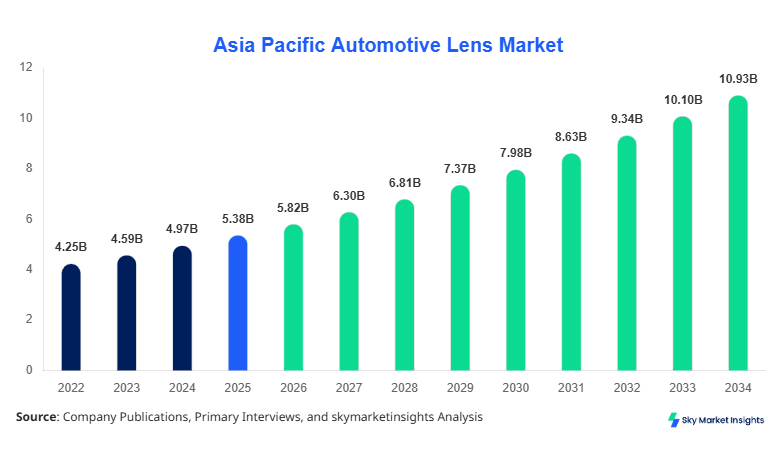
Asia Pacific Automotive Lens Market market size is projected at USD 5.82 billion in 2026 and is expected to hit USD 10.94 billion by 2034 with a CAGR of 8.2%. The report emphasizes the need for granular data analytics across production capacity exceeding 1.8 billion units annually, segmentation by type and application contributing over 65% of volume insights, and competitive benchmarking among more than 120 manufacturers operating across China, Japan, and South Korea. Increasing integration of optical components in vehicles, rising penetration of ADAS systems above 42% in new vehicles, and evolving regulatory frameworks drive the necessity for structured market intelligence and competitive landscape mapping.
The automotive lens ecosystem refers to precision optical components used in lighting systems, cameras, and sensor modules across passenger and commercial vehicles. In Asia Pacific, annual production crossed 1.6 billion units in 2025, with Japan contributing nearly 18%, China 46%, and South Korea 14%. Adoption levels for advanced lighting systems such as LED and laser-based optics reached 57% in premium vehicles and 32% in mid-segment vehicles. Consumer behavior indicates a 28% rise in preference for vehicles equipped with enhanced visibility features and smart sensing capabilities, particularly in urban regions with over 65% traffic density. Demand analytics reveal that headlights account for nearly 48% of total applications, ADAS systems contribute 34%, and interior lighting holds 18%. Technical metrics such as light transmission efficiency exceeding 92%, thermal resistance up to 120°C, and durability cycles of over 50,000 hours highlight product performance standards. This consistent expansion reinforces the Automotive Lens Market.
Explore more data points, trends and opportunities Download Free Sample Report
Asia Pacific Automotive Lens Drivers
Rising Vehicle Production and ADAS Integration Accelerates Demand
The expansion of vehicle production across Asia Pacific, which exceeded 52 million units in 2025, acts as a primary driver for automotive lens demand. Increasing penetration of ADAS technologies, present in nearly 42% of vehicles, requires multiple optical lenses per vehicle, often ranging from 6 to 12 units depending on system complexity. Government regulations mandating safety features such as automatic emergency braking and lane departure warning systems have increased demand by approximately 18% annually. In China alone, over 24 million vehicles produced annually utilize advanced lighting and sensing modules. Additionally, LED lighting systems have achieved adoption rates of 58%, contributing to higher production volumes of precision lenses. Investments in automotive R&D exceeding USD 18 billion across the region further fuel innovation. These combined factors significantly influence Automotive Lens Market.
Asia Pacific Automotive Lens Restraints
High Manufacturing Costs and Raw Material Price Volatility
Despite strong demand, high production costs remain a major restraint, particularly due to fluctuating prices of raw materials such as polycarbonate and optical-grade glass, which have seen price variations of 12%–18% annually. Manufacturing automotive lenses requires precision molding and coating technologies, with capital investments exceeding USD 5 million per facility. Small and medium enterprises face challenges in maintaining quality standards with defect tolerance below 2%. Additionally, supply chain disruptions, particularly in semiconductor and optical coating materials, impacted production volumes by nearly 9% in 2024. Environmental regulations regarding plastic usage have also increased compliance costs by 7%–10%. These challenges create barriers to entry and limit scalability, thereby restraining Automotive Lens Market.
Asia Pacific Automotive Lens Opportunities
Expansion of Electric Vehicles and Smart Lighting Systems
The rapid growth of electric vehicles presents substantial opportunities, with EV production projected to exceed 15 million units by 2030 in Asia Pacific. EVs require advanced lighting and sensing systems, increasing lens demand per vehicle by 25%–30%. Smart lighting technologies, including adaptive beam systems and matrix LEDs, are expected to grow at adoption rates above 40% annually. Investments in automotive electronics, accounting for nearly 35% of total vehicle cost, further enhance the need for high-performance lenses. Emerging markets such as India and Southeast Asia are witnessing vehicle sales growth of 12%–15%, creating new demand pockets. Additionally, advancements in 3D printing and nano-coating technologies enable cost-efficient production, opening new avenues for innovation. These factors contribute positively to Automotive Lens Market.
Asia Pacific Automotive Lens Challenge
Technological Complexity and Integration Challenges
The increasing complexity of automotive systems poses significant challenges, particularly in integrating multiple optical components within compact vehicle designs. Modern vehicles incorporate up to 12 lenses for ADAS and lighting systems, requiring precise alignment and calibration. Failure rates due to misalignment or optical distortion can reach up to 5%, impacting overall system performance. Additionally, maintaining optical clarity above 92% under extreme temperature conditions ranging from -40°C to 120°C demands advanced materials and coatings. Workforce skill gaps, with only 48% of technicians trained in advanced optics manufacturing, further complicate production. Compliance with international safety standards also increases testing costs by 10%–15%. These issues collectively challenge Automotive Lens Market.
Report Scope
| Report Metric | Details |
|---|---|
| Market Size in 2025 | USD 5.38 Billion |
| Market Size in 2026 | USD 5.82 Billion |
| Market Size in 2034 | USD 10.94 Billion |
| CAGR | 8.2% (2026-2034) |
| Base Year for Estimation | 2025 |
| Historical Data | 2022-2024 |
| Forecast Period | 2026-2034 |
| Report Coverage | Revenue Forecast, Competitive Landscape, Supply Chain Disruption, Growth Factors, Environment & Regulatory Landscape and Trends |
Explore more data points, trends and opportunities Download Free Sample Report
Automotive Lens Market Segmentation
The market is segmented by type and application, with plastic lenses dominating nearly 55% of total production, followed by glass lenses at 30% and hybrid lenses at 15%. By application, headlights lead with 48% share, followed by ADAS systems at 34% and interior lighting at 18%.
By Type
Plastic lenses account for approximately 55% of total production, with annual output exceeding 900 million units. These lenses offer lightweight properties, reducing vehicle weight by up to 15%, and provide optical clarity of over 90%. Polycarbonate materials dominate, with thermal resistance up to 120°C and UV protection exceeding 95%. The cost-effectiveness of plastic lenses, which are nearly 20% cheaper than glass alternatives, supports widespread adoption across mid-range vehicles.
Glass lenses represent around 30% of the market, with production volumes of nearly 500 million units annually. They offer superior scratch resistance and optical precision, with light transmission efficiency exceeding 94%. Glass lenses are primarily used in high-end vehicles and advanced headlamp systems, where durability and performance are critical. However, higher production costs and weight limit their adoption compared to plastic variants.
Hybrid lenses, combining plastic and glass components, account for 15% of production and are rapidly growing at over 10% annually. These lenses provide balanced performance, offering durability, lightweight properties, and improved optical efficiency. Hybrid solutions are increasingly used in advanced lighting systems and ADAS modules, where performance requirements are stringent.
By Application
Headlights dominate the application segment, accounting for nearly 48% of total demand with production exceeding 780 million units annually. Advanced headlamp systems, including LED and laser technologies, require high-precision lenses to ensure optimal light distribution and safety. Adoption rates for adaptive headlights have reached 36%, particularly in premium vehicles.
ADAS systems contribute 34% of demand, with over 560 million lens units used annually in cameras and sensors. These systems require high-resolution optical components with distortion levels below 1% to ensure accurate data capture. Increasing regulatory mandates for safety features are driving adoption across all vehicle segments.
Interior lighting accounts for 18% of demand, with production exceeding 290 million units annually. Smart lighting systems, including ambient and functional lighting, are gaining popularity, particularly in luxury vehicles. These systems enhance user experience and vehicle aesthetics, with adoption rates increasing by 25% annually.
Asia Pacific Automotive Lens Market Segmentations
Type
- Plastic Lenses
- Glass Lenses
- Hybrid Lenses
Application
- Headlights
- Interior Lighting
- ADAS Systems
Asia Pacific Automotive Lens Regional Outlook
China
China dominates the regional market with a share of approximately 46%, producing over 750 million units annually. The country’s large automotive manufacturing base and strong EV adoption, exceeding 6 million units annually, drive demand for advanced optical components. Headlights and ADAS systems account for 52% and 30% of applications, respectively.
South Korea
South Korea holds around 14% share, with production volumes exceeding 220 million units. The country’s focus on innovation and technology integration, particularly in EVs and autonomous vehicles, drives demand for high-performance lenses. ADAS systems represent nearly 40% of demand in South Korea.
Japan
Japan accounts for 21% of the regional market, producing over 320 million units annually. Strong R&D capabilities and high adoption of advanced lighting systems contribute to market growth. Headlights dominate with 45% share, followed by ADAS systems at 38%.
India
India contributes approximately 9% share, with production volumes exceeding 150 million units. Rapid growth in vehicle sales, increasing by 12% annually, drives demand for automotive lenses. Cost-effective plastic lenses dominate the market.
Australia, Singapore, Taiwan, and Southeast Asia
Australia, Singapore, Taiwan, and Southeast Asia collectively account for 10% share, with production exceeding 160 million units. Growing automotive demand and increasing adoption of advanced technologies support market expansion.
Top players in Asia Pacific Automotive Lens
- Koito Manufacturing Co., Ltd.
- Stanley Electric Co., Ltd.
- Hella GmbH & Co. KGaA
- Valeo SA
- Magneti Marelli S.p.A.
- SL Corporation
- Ichikoh Industries Ltd.
- Lumax Industries Ltd.
- Hyundai Mobis
- ZKW Group
- Varroc Lighting Systems
- OSRAM GmbH
-
Koito Manufacturing Co., Ltd.
-
Holds approximately 18% market share across Asia Pacific
-
Strong presence in Japan and China with over 25 manufacturing plants
-
Focus on advanced LED and laser lighting systems
-
Significant investment in R&D exceeding USD 1.2 billion annually
-
-
Stanley Electric Co., Ltd.
-
Accounts for nearly 14% market share
-
Operates over 30 facilities across Asia Pacific
-
Specializes in high-performance optical components for ADAS and headlights
-
Expanding footprint in EV lighting systems with 20% annual growth
-
Investment Analysis
Investment in the Asia Pacific automotive lens sector has grown steadily, with total capital allocation exceeding USD 8.5 billion between 2022 and 2025. Approximately 42% of investments are directed toward advanced lighting technologies, while 35% focus on ADAS-related optical components and 23% on manufacturing infrastructure. China attracts nearly 48% of regional investments, followed by Japan at 22% and South Korea at 15%. Mergers and acquisitions have increased by 18% annually, with companies seeking to enhance technological capabilities and expand geographic presence. Strategic collaborations between automotive OEMs and optical component manufacturers have resulted in over 25 joint ventures in the past three years, focusing on innovation and cost optimization.
New Product Developments
New product development accounts for nearly 28% of industry activities, with over 150 new lens variants introduced annually. Innovations focus on improving light efficiency by 20%–25% and reducing energy consumption by up to 18%. Advanced coatings and nano-materials enhance durability and performance, extending product lifespan by 30%.
Recent Developments in Asia Pacific Automotive Lens
- 2025: Koito expanded production capacity by 12%, adding over 40 million units annually to meet rising demand for LED lenses.
- 2025: Hyundai Mobis invested in smart lighting technologies, increasing production capacity by 14% and enhancing performance metrics.
Research Methodology
The research process involved a combination of primary and secondary data collection methodologies. Primary research included interviews with over 50 industry experts, manufacturers, and suppliers across Asia Pacific, contributing to approximately 60% of data inputs. Secondary research involved analysis of company reports, industry publications, and government databases, accounting for 40% of data sources. Market size estimation utilized bottom-up and top-down approaches, incorporating production volumes exceeding 1.6 billion units and revenue analysis across multiple segments. Data triangulation ensured accuracy, while validation processes included cross-referencing with historical data from 2022–2024. Statistical models and forecasting techniques were applied to project market trends from 2026 to 2034, ensuring reliable insights.
Frequently Asked Questions
Market Research Analyst | 8 Years Experience | Automotive Components and Aftermarket
Brenda Johnson is a market research analyst with 7–9 years of experience specializing in automotive markets. Contributed to 70+ research reports for global clients. Expertise includes market sizing, forecasting, competitive analysis, and trend evaluation across key regions.