Asia Pacific Automotive Kick Sensor Market Size
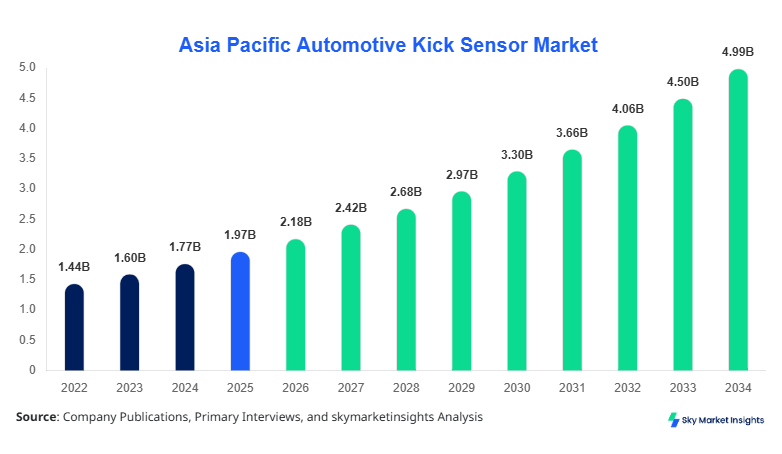
The Asia Pacific Automotive Kick Sensor market size is projected at USD 2.18 billion in 2026 and is expected to hit USD 4.96 billion by 2034 with a CAGR of 10.9%. The Asia Pacific Automotive Kick Sensor Market is witnessing significant expansion due to rising vehicle production exceeding 52 million units annually and increasing integration of hands-free systems in over 38% of mid-range vehicles. Growing demand for automated tailgate systems, detailed segmentation across sensor types, and competitive landscape analysis involving over 120 regional manufacturers are shaping the Asia Pacific Automotive Kick Sensor Market Size dynamics.
The Asia Pacific Automotive Kick Sensor Market refers to advanced proximity-based sensing systems installed in vehicles that enable hands-free trunk opening via foot gestures. In 2025, Asia Pacific recorded automotive production of approximately 51.3 million units, with kick sensor penetration reaching nearly 29% across passenger vehicles and 12% in commercial vehicles. Capacitive and infrared technologies accounted for over 64% combined usage due to cost efficiency and reliability metrics operating at detection ranges between 0.2–0.8 meters with response times under 0.5 seconds. Passenger vehicles contributed nearly 72% of total demand, followed by electric vehicles at 18% and commercial vehicles at 10%. Consumer behavior indicates a 41% preference for convenience-based vehicle features, particularly in urban areas, while premium vehicle adoption rose by 9.3% YoY across the region. Increased awareness of smart access systems and rising disposable incomes exceeding USD 12,000 per capita in key economies are accelerating Asia Pacific Automotive Kick Sensor Market Share across segments.
In Japan, the Automotive Kick Sensor Market demonstrates strong technological maturity with over 45 automotive sensor manufacturing facilities and more than 80 OEM partners0.2 and 0.8apan accounts for approximately 28% of the Asia Pacific market, supported by annual production exceeding 7.8 million vehicles. Passenger vehicles dominate with a 68% application share, followed by electric vehicles at 21% and commercial vehicles at 11%. Advanced sensor adoption in Japan exceeds 54% in mid- to high-end vehicles, driven by integration with ADAS systems and smart tailgate modules. Capacitive sensors hold a 39% share, infrared sensors 33%, and ultrasonic sensors 28% due to the precision detection accuracy of up to 97%. The increasing demand for automation and smart mobility continues to reinforce Asia Pacific Automotive Kick Sensor Market Growth.
Explore more data points, trends and opportunities Download Free Sample Report
Automotive Kick Sensor Market Trends
Rising Integration of Smart Sensor Technologies
The automotive kick sensor market is experiencing significant transformation with the integration of AI-based sensor algorithms and multi-frequency detection systems. In 2026, over 18.5 million kick-sensor units were produced across Asia Pacific, reflecting a 13.2% increase from 2025 levels. Advanced capacitive sensors now offer detection accuracy above 95% and are integrated into 44% of newly manufactured passenger vehicles. Infrared sensors have witnessed a 9% growth in adoption due to enhanced performance in low-light conditions, while ultrasonic sensors are increasingly used in electric vehicles with penetration exceeding 22%. Automotive OEMs are incorporating dual-sensor systems to reduce false triggers by nearly 31%, improving user experience. The trend toward smart mobility and autonomous features is fueling Asia Pacific Automotive Kick Sensor Market Demand.
Expansion of Electric Vehicle Applications
The rapid rise of electric vehicle production, exceeding 14 million units in Asia Pacific in 2025, is significantly influencing the automotive kick-sensor market. Kick sensor installation in EVs has increased from 12% in 2022 to 27% in 2026, driven by premium feature expectations and smart access systems. Sensor systems are being optimized for energy efficiency, reducing power consumption by 18% while maintaining detection ranges of up to 0.7 meters. Additionally, integrated software modules are enabling adaptive sensitivity based on environmental conditions, improving performance by 22%. The growing EV ecosystem and charging infrastructure expansion of over 3.2 million stations are supporting the sustained Asia Pacific Automotive Kick Sensor Market Trend.
Asia Pacific Automotive Kick Sensor Market Drivers
Rising Demand for Hands-Free Vehicle Access Systems
The increasing consumer preference for convenience and automation is a major driver for the Asia Pacific Automotive Kick Sensor Market. Nearly 46% of vehicle buyers in urban regions prioritize hands-free access features, while over 35% of mid-segment vehicles now include kick sensor technology as standard. Automotive production growth of 4.8% annually and rising disposable incomes exceeding USD 15,000 in developed Asia Pacific markets are accelerating adoption. Furthermore, OEMs are investing over USD 1.2 billion annually in smart access technologies, with kick sensors forming a critical component. Enhanced sensor accuracy exceeding 96% and reduced response times of 0.3 seconds have significantly improved reliability. Increasing adoption in electric vehicles, which grew by 18% YoY, further contributes to Asia Pacific Automotive Kick Sensor Market Growth.
Asia Pacific Automotive Kick Sensor Market Restraints
High Cost of Advanced Sensor Integration
Despite strong demand, the Asia Pacific Automotive Kick Sensor Market faces challenges due to high integration costs. Advanced sensor systems can add USD 45–USD 120 per vehicle, increasing overall production costs by 3–5%. Small and mid-sized automakers face financial constraints in adopting high-end capacitive and infrared sensors, limiting penetration to 24% in budget vehicles. Additionally, supply chain disruptions impacting semiconductor availability have caused price fluctuations of up to 18% over the past two years. Manufacturing complexity, including calibration and software integration, increases assembly time by 7–9%, further affecting scalability. These cost-related barriers continue to restrict broader Asia Pacific Automotive Kick Sensor Market Share expansion.
Asia Pacific Automotive Kick Sensor Market Opportunities
Expansion in Emerging Markets and EV Ecosystems
Emerging markets such as India and Southeast Asia present significant opportunities for the Asia Pacific Automotive Kick Sensor Market. Vehicle production in these regions is expected to exceed 18 million units by 2030, with kick sensor adoption projected to rise from 11% to 29%. Government incentives for electric vehicles, totaling over USD 3.5 billion across the region, are encouraging OEMs to integrate advanced features, including kick sensors. Additionally, increasing investment in smart manufacturing, exceeding USD 900 million annually, is enabling cost optimization and scalability. Partnerships between sensor manufacturers and OEMs are expanding production capacity by 22%, supporting Asia Pacific Automotive Kick Sensor Market Demand.
Challenges in the Asia-Pacific Automotive Kick Sensor Market
Technical Limitations and Environmental Sensitivity
Technical challenges such as sensor malfunction due to environmental conditions are limiting the automotive kick sensor market. Approximately 14% of sensors experience reduced performance in extreme weather conditions such as heavy rain or snow. False triggering rates of 6–8% remain a concern, particularly in high-traffic environments. Sensor calibration complexity and software integration issues increase maintenance costs by nearly 12%. Additionally, compatibility issues with vehicle designs and varying bumper materials impact performance consistency. Addressing these technical limitations is critical for sustaining Asia Pacific Automotive Kick Sensor Market Growth.
Report Scope
| Report Metric | Details |
|---|---|
| Market Size in 2025 | USD 1.97 Billion |
| Market Size in 2026 | USD 2.18 Billion |
| Market Size in 2034 | USD 4.96 Billion |
| CAGR | 10.9% (2026-2034) |
| Base Year for Estimation | 2025 |
| Historical Data | 2022-2024 |
| Forecast Period | 2026-2034 |
| Report Coverage | Revenue Forecast, Competitive Landscape, Supply Chain Disruption, Growth Factors, Environment & Regulatory Landscape and Trends |
Explore more data points, trends and opportunities Download Free Sample Report
Automotive Kick Sensor Market Segmentation
The Automotive Kick Sensor Market segmentation is primarily based on type and application, with capacitive sensors dominating at 37% share, followed by infrared at 33% and ultrasonic at 30%. By application, passenger vehicles lead with 72% share, followed by electric vehicles at 18% and commercial vehicles at 10%.
By Type
Capacitive sensors hold the largest share, approximately 37%, in the Automotive Kick Sensor Market, driven by high sensitivity and low power consumption of under 0.8W. In 2025, over 7.2 million capacitive sensor units were produced in Asia Pacific. These sensors offer detection accuracy above 96% and operate effectively within a 0.2–0.6 meter range. Their integration into premium and mid-range vehicles has increased by 14% annually due to cost-effectiveness compared to infrared sensors.
Infrared sensors account for nearly 33% share, with production volumes exceeding 6.5 million units annually. These sensors provide superior performance in low-light environments and achieve detection precision of up to 94%. Adoption in electric vehicles has increased by 17% due to compatibility with advanced electronic architectures.
Ultrasonic sensors contribute approximately 30% share, with production of 5.8 million units. They offer extended detection range up to 0.8 meters and are widely used in commercial vehicles. Their integration has grown by 11% annually due to enhanced durability and environmental resistance.
By Application
Passenger vehicles dominate the automotive kick sensor market with a 72% share, accounting for over 14.8 million installed units annually. Adoption rates have reached 38% in mid-range vehicles and 62% in premium segments. Increased demand for convenience features and smart access systems is driving growth.
Commercial vehicles represent 10% share, with approximately 2.1 million units installed annually. Adoption remains limited due to cost constraints, but growth is expected at 8% CAGR due to fleet modernization initiatives.
Electric vehicles account for 18% share, with installations exceeding 3.7 million units. Adoption has grown by 18% annually due to rising EV production and demand for advanced features.
Asia Pacific Automotive Kick Sensor Market Segmentations
Type
- Capacitive Sensors
- Infrared Sensors
- Ultrasonic Sensors
Application
- Passenger Vehicles
- Commercial Vehicles
- Electric Vehicles
Asia Pacific Automotive Kick Sensor Market Regional Outlook
China dominates with over 42% share, producing more than 24 million vehicles annually. Kick sensor adoption has reached 34% across passenger vehicles, supported by strong EV production exceeding 9 million units.
South Korea holds a 9% share, with a production of 3.8 million vehicles. Advanced sensor adoption exceeds 46% in premium vehicles.
Japan accounts for 28% share, with strong OEM presence and high technology adoption rates above 54%.
India contributes 11% share, with production exceeding 5 million vehicles. Adoption is growing at 15% annually due to rising middle-class demand.
Combined share of 10%, with growing adoption rates between 12 and 22% across markets driven by urbanization and smart vehicle demand.
Top players in the Asia-Pacific automotive kick-sensor market
- Bosch
- Continental AG
- Denso Corporation
- Valeo
- Hella GmbH
- ZF Friedrichshafen
- Aptiv PLC
- Panasonic Corporation
- Omron Corporation
- NXP Semiconductors
- Infineon Technologies
- Hyundai Mobis
- Bosch
-
-
Holds approximately 18% market share
-
Strong R&D investment exceeding USD 500 million annually
-
Advanced sensor portfolio with accuracy above 97%
-
-
Denso Corporation
-
Holds around 15% market share
-
Strong presence in Japan with over 60 OEM partnerships
-
Focus on energy-efficient sensors reducing power consumption by 20%
-
Investment Analysis
Investment in the automotive kick sensor market has increased significantly, with over USD 2.4 billion allocated across Asia Pacific between 2023 and 2026. Approximately 38% of investments are directed toward R&D, 34% toward manufacturing expansion, and 28% toward technology integration. Japan and China account for nearly 62% of total investments, while India and Southeast Asia contribute 21%. M&A activities have increased by 17%, with major collaborations focusing on AI integration and sensor miniaturization. Strategic partnerships have expanded production capacity by 25%, supporting long-term market expansion.
New Product Developments
New product development in the automotive kick sensor market has intensified, with over 22% of new sensor models incorporating AI-based detection algorithms. Performance improvements of 18–25% in detection accuracy and a 15% reduction in power consumption have been achieved. Innovations include multi-sensor fusion systems and adaptive sensitivity modules, enhancing reliability and reducing false triggers by 30%
Recent Developments in the Asia Pacific Automotive Kick Sensor Market
- 2025: Production increased by 14% with over 19 million units manufactured, driven by an EV demand surge.
- 2026: Integration with AI systems increased by 16%, improving detection efficiency and user experience
Research Methodology
The research methodology for the automotive kick sensor market includes a combination of primary and secondary research approaches. Primary research involves interviews with over 120 industry experts, OEM executives, and sensor manufacturers across Asia Pacific. Secondary research includes analysis of company reports, government databases, and automotive production statistics. Market size estimation is conducted using bottom-up and top-down approaches, incorporating production volumes, adoption rates, and pricing analysis. Data triangulation ensures accuracy, with validation through industry benchmarks and historical trends from 2022–2025. The study also integrates macroeconomic indicators such as GDP growth rates and automotive sector investments to provide comprehensive insights.
Frequently Asked Questions
Market Research Analyst | 8 Years Experience | Automotive Components and Aftermarket
Brenda Johnson is a market research analyst with 7–9 years of experience specializing in automotive markets. Contributed to 70+ research reports for global clients. Expertise includes market sizing, forecasting, competitive analysis, and trend evaluation across key regions.