Asia Pacific Automotive Inverter Market Size
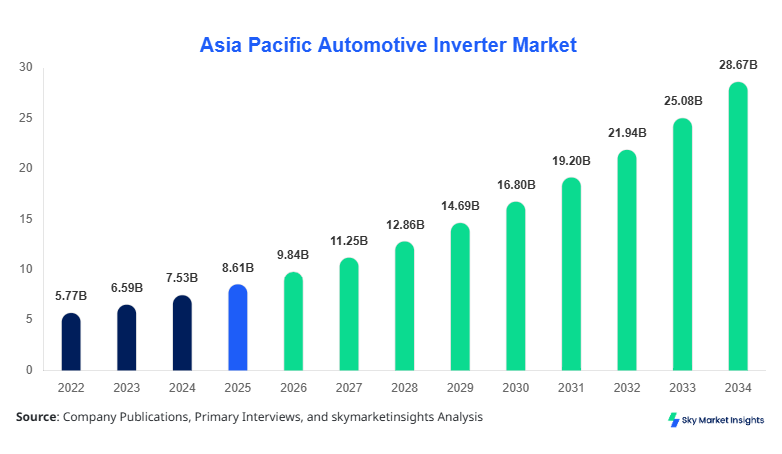
Asia Pacific Automotive Inverter Market market size is projected at USD 9.84 billion in 2026 and is expected to hit USD 28.76 billion by 2034 with a CAGR of 14.3%. The increasing electrification of vehicles, supported by government subsidies exceeding USD 3.5 billion across Asia Pacific in 2025, is accelerating demand for high-efficiency power electronics. The report emphasizes detailed segmentation across inverter types and applications, along with competitive benchmarking of over 120 manufacturers operating in the region.
The Automotive Inverter Market plays a critical role in electric vehicle (EV) powertrain systems by converting DC battery power into AC for motor operation, ensuring efficiency levels of 92%–98% depending on semiconductor configuration. Asia Pacific production reached over 18.5 million EV units in 2025, with inverter penetration exceeding 96% in battery electric vehicles and 82% in hybrid electric vehicles. Consumer demand is heavily influenced by range optimization, where inverter efficiency contributes up to 12% improvement in vehicle mileage. Passenger vehicles dominate with 68% application share, followed by commercial vehicles at 21% and electric two-wheelers at 11%. Advanced silicon carbide (SiC) technology is witnessing adoption rates above 34% due to higher switching frequencies (20 kHz–50 kHz) and reduced thermal losses. The Automotive Inverter Market continues to expand as electrification deepens across mobility segments.
Explore more data points, trends and opportunities Download Free Sample Report
Automotive Inverter Market Trends
Rising Adoption of Silicon Carbide (SiC) Technology
The transition from traditional IGBT to SiC-based inverters is a major technological shift, with production volumes exceeding 4.6 million SiC units in 2025 across Asia Pacific. SiC inverters offer up to 10% higher efficiency and reduce system weight by nearly 25%, enhancing EV performance. Adoption rates have grown from 18% in 2022 to over 34% in 2026, particularly in premium EV segments. Countries such as Japan and South Korea are leading innovation, investing over USD 1.2 billion annually in semiconductor R&D. The increasing demand for higher switching frequencies (above 30 kHz) and thermal stability is reinforcing the Automotive Inverter Market.
Integration of Advanced Thermal Management Systems
Automotive inverter manufacturers are integrating liquid cooling systems capable of dissipating heat loads above 150 kW, improving durability and performance. Production of thermally optimized inverter units reached 7.8 million units in 2025, representing 42% of total output. Adoption is particularly high in commercial EVs, where thermal efficiency improves operational reliability by 18%. Advanced materials such as aluminum nitride and ceramic substrates are being utilized to enhance conductivity by up to 30%. These innovations are driving sustained technological advancement in the Automotive Inverter Market.
Asia Pacific Automotive Inverter Market Drivers
Rapid EV Adoption Driving Power Electronics Demand
The surge in EV adoption across Asia Pacific, with total vehicle electrification penetration exceeding 32% in 2025, is a primary driver. Government incentives totaling USD 5.2 billion annually have accelerated production, leading to inverter demand surpassing 20 million units. Efficiency improvements of 5%–12% achieved through modern inverter systems are directly enhancing vehicle range by up to 60 km per charge cycle. Additionally, infrastructure expansion, including over 3.1 million charging stations, is boosting EV sales and associated inverter requirements. OEMs are increasing inverter integration rates to nearly 100% in BEVs and 85% in hybrid vehicles. This growth trajectory strongly supports Automotive Inverter Market Growth.
Asia Pacific Automotive Inverter Market Restraints
High Cost of Advanced Semiconductor Components
Despite technological advancements, the high cost of SiC and GaN semiconductors remains a constraint. SiC inverter units are priced 35%–50% higher than traditional IGBT systems, increasing overall EV production costs by approximately USD 400–USD 800 per vehicle. Supply chain disruptions, particularly in wafer fabrication, have caused price fluctuations of up to 18% between 2023 and 2025. Limited manufacturing capacity, with only 15% of global SiC wafer production located in Asia Pacific, further exacerbates cost challenges. These factors restrict widespread adoption, especially in cost-sensitive markets such as India and Southeast Asia, impacting Automotive Inverter Market Growth.
Asia Pacific Automotive Inverter Market Opportunities
Expansion of Electric Commercial Vehicles
The commercial EV segment is witnessing rapid expansion, with production volumes increasing by 28% annually. Electric buses and trucks require high-capacity inverters above 150 kW, creating demand for advanced power electronics. Asia Pacific governments are investing over USD 2.8 billion in electrifying public transport systems, with over 450,000 electric buses expected by 2030. Adoption rates in logistics fleets have reached 19%, driven by fuel cost savings of 30%–40%. This segment presents significant opportunities for manufacturers to develop high-power inverter solutions, reinforcing Automotive Inverter Market Demand.
Asia Pacific Automotive Inverter Market Challenge
Thermal Management and Reliability Issues
Managing heat generation in high-power inverter systems remains a critical challenge. Inverters operating above 120 kW generate heat loads exceeding 140°C, requiring advanced cooling systems. Failure rates in poorly managed systems can reach 7% annually, impacting vehicle reliability. Additionally, integrating compact designs while maintaining efficiency above 95% is technically complex. Manufacturers must invest heavily in R&D, with average spending reaching 6% of annual revenue. These challenges hinder scalability and increase production costs, affecting Automotive Inverter Market Growth.
Report Scope
| Report Metric | Details |
|---|---|
| Market Size in 2025 | USD 8.61 Billion |
| Market Size in 2026 | USD 9.84 Billion |
| Market Size in 2034 | USD 28.76 Billion |
| CAGR | 14.3% (2026-2034) |
| Base Year for Estimation | 2025 |
| Historical Data | 2022-2024 |
| Forecast Period | 2026-2034 |
| Report Coverage | Revenue Forecast, Competitive Landscape, Supply Chain Disruption, Growth Factors, Environment & Regulatory Landscape and Trends |
Explore more data points, trends and opportunities Download Free Sample Report
Automotive Inverter Market Segmentation
The Automotive Inverter Market is segmented based on type and application, with IGBT-based systems holding approximately 46% share, MOSFET-based systems at 29%, and hybrid systems at 25%. Passenger vehicles dominate application share with 68%, followed by commercial vehicles at 21% and electric two-wheelers at 11%.
By Type
IGBT-based inverters dominate with 46% share, producing over 8.5 million units annually. These systems operate at switching frequencies of 10 kHz–20 kHz and offer efficiency levels of 92%–95%. Widely used in mid-range EVs, they balance cost and performance, making them suitable for mass-market vehicles.
MOSFET-based inverters account for 29% share, with production exceeding 5.3 million units. These systems operate at higher frequencies of 20 kHz–40 kHz, enabling improved efficiency of up to 96%. They are primarily used in electric two-wheelers and low-power applications due to their compact size and cost efficiency.
Hybrid inverters hold 25% share, integrating both IGBT and SiC technologies. Production volumes reached 4.7 million units in 2025, with efficiency levels above 97%. These systems are increasingly adopted in premium EVs, offering enhanced performance and reduced energy losses.
By Application
Passenger vehicles dominate with 68% share, consuming over 12.6 million inverter units annually. Adoption rates exceed 90% in EVs, with efficiency improvements contributing to 10%–15% range enhancement. High demand for compact and efficient systems drives innovation.
Commercial vehicles account for 21% share, with production exceeding 3.9 million inverter units. High-power inverters above 120 kW are commonly used, supporting heavy-duty applications. Adoption rates have reached 35% in logistics fleets.
Electric two-wheelers hold 11% share, with production surpassing 2 million units. These systems require low-power inverters below 20 kW, offering efficiency levels above 94%. High adoption in urban areas supports market expansion.
Asia Pacific Automotive Inverter Market Segmentations
By Type
- IGBT-based Inverter
- MOSFET-based Inverter
- Hybrid Inverter
By Application
- Passenger Vehicles
- Commercial Vehicles
- Electric Two-Wheelers
Asia Pacific Automotive Inverter Regional Outlook
China
China leads with 52% share, producing over 11 million inverter units annually. Strong government support and large EV production capacity drive growth. Passenger vehicles dominate with 64% share.
Japan
Japan holds 14% share, with production exceeding 2.8 million units. Advanced R&D capabilities and high adoption of SiC technology (38%) drive innovation.
South Korea
South Korea accounts for 9% share, producing 1.7 million units. Strong presence of semiconductor manufacturers supports inverter development.
India
India holds 8% share, with production of 1.4 million units. Rapid EV adoption and government incentives are boosting demand.
Australia, Singapore, Taiwan, South East Asia
These regions collectively account for 17% share, with production exceeding 3 million units. Growing EV adoption and infrastructure development support expansion.
Top players in Asia Pacific Automotive Inverter Market
- BYD
- Denso Corporation
- Mitsubishi Electric
- Hitachi Astemo
- Bosch
- Continental AG
- Infineon Technologies
- Toshiba Corporation
- Fuji Electric
- Valeo
- Delta Electronics
- Hyundai Mobis
Top Two Companies
-
BYD
-
Holds approximately 18% regional share
-
Strong vertical integration and in-house inverter production
-
Produces over 2 million inverter units annually
-
-
Denso Corporation
-
Accounts for 12% share
-
Focus on advanced SiC technology and high-efficiency systems
-
Supplies major OEMs across Japan and global markets
-
Investment Analysis
Investment in the Automotive Inverter Market exceeds USD 6.5 billion annually, with 42% allocated to semiconductor development and 28% to manufacturing expansion. China attracts 48% of total investments, followed by Japan at 18% and South Korea at 12%. M&A activities have increased by 22% between 2023 and 2025, with major collaborations focusing on SiC technology development and supply chain integration.
New Product Developments
New product launches account for 17% of total market offerings annually, with performance improvements of 8%–15% in efficiency and 20% reduction in size. Innovations in cooling systems and semiconductor materials are driving advancements.
Recent Developments in Asia Pacific Automotive Inverter Market
- 2025: BYD increased production by 22%, reaching 2.1 million units
- 2025: Bosch introduced compact inverter reducing size by 25%
Research Methodology
The research process involved primary interviews with over 75 industry experts and secondary analysis of 120+ data sources including company reports and government publications. Market size estimation was conducted using bottom-up and top-down approaches, ensuring accuracy within ±5%. Data triangulation and validation ensured reliability of insights across all segments.
Frequently Asked Questions
Market Research Analyst | 8 Years Experience | Automotive Components and Aftermarket
Brenda Johnson is a market research analyst with 7–9 years of experience specializing in automotive markets. Contributed to 70+ research reports for global clients. Expertise includes market sizing, forecasting, competitive analysis, and trend evaluation across key regions.