Asia Pacific Automotive Intelligent Tires Market Size
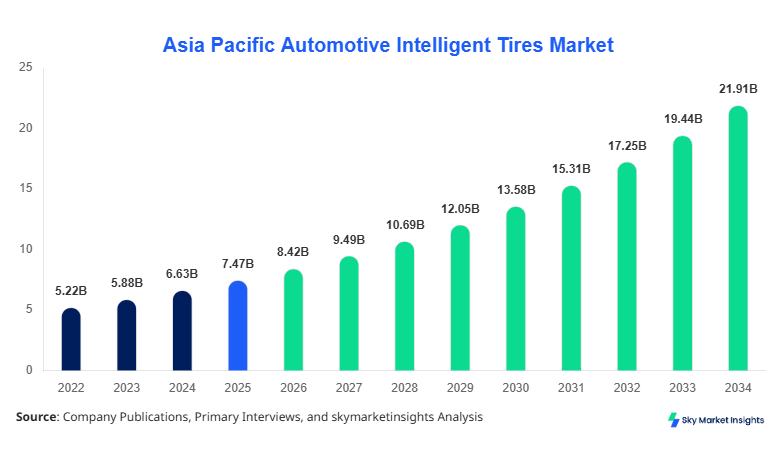
The Asia Pacific Automotive Intelligent Tires market size is projected at USD 8.42 billion in 2026 and is expected to hit USD 21.87 billion by 2034 with a CAGR of 12.7%. The increasing integration of IoT-enabled tire systems, coupled with rising vehicle production exceeding 52 million units annually in Asia Pacific, is driving structured data demand, segmentation-based analytics, and competitive benchmarking across OEMs and aftermarket channels. The automotive intelligent tires market size is further influenced by sensor cost reductions of nearly 18% between 2022 and 2025, improving scalability and performance tracking across fleets.
The Automotive Intelligent Tires Market comprises advanced tire systems embedded with sensors, RFID chips, and inflation control technologies that provide real-time data on pressure, temperature, tread wear, and road conditions. In Asia Pacific, production volumes reached approximately 420 million intelligent tire units in 2025, with adoption penetration rates nearing 28% in premium vehicle segments and 12% across mid-range vehicles. Passenger vehicles accounted for nearly 62% of total deployment, while commercial vehicles held around 25%, and electric vehicles contributed 13%, reflecting rapid electrification trends. Consumer behavior indicates a 35% preference shift toward safety-enhanced components, while fleet operators report up to 22% cost savings in maintenance through predictive analytics. Performance metrics include pressure monitoring frequencies of 1–5 seconds and accuracy levels above 95%. These dynamics collectively reinforce Automotive Intelligent Tires Market Share expansion across regional automotive ecosystems.
In China, the Automotive Intelligent Tires Market is leading the Asia Pacific region with over 46% regional share, supported by more than 1,200 tire manufacturing facilities and over 350 automotive OEMs integrating smart tire technologies. The country produced approximately 320 million intelligent tires in 2025, with sensor-based systems accounting for 54% of installations. Passenger vehicles dominate the application with 58%, followed by commercial vehicles at 27% and electric vehicles at 15%, reflecting China's EV penetration rate exceeding 30% of total vehicle sales. Technology adoption rates for RFID-enabled tires have reached 40% in logistics fleets, while real-time pressure monitoring systems are installed in nearly 65% of new premium vehicles. Governautomotive's intelligent tire market share increased comautomotive intelligent tire market sharee increased. Share growth in the region.
Explore more data points, trends and opportunities Download Free Sample Report
Automotive Intelligent Tires Market Trends
Increasing Integration of AI and IoT in Tire Systems
The automotive intelligent tires market is witnessing accelerated adoption of AI-driven analytics and IoT-enabled sensor technologies, with over 480 million units expected to be connected by 2028. The integration of cloud-based platforms enables real-time data processing with latency below 2 milliseconds and enhances predictive maintenance efficiency by 27%. Manufacturers are increasingly embedding multi-sensor arrays that measure parameters such as load distribution, temperature gradients, and tread depth, with accuracy levels exceeding 97%. The demand for electric vehicles, which grew by 31% in Asia Pacific in 2025, is pushing innovation toward low-resistance intelligent tires that improve energy efficiency by up to 12%. These advancements significantly contribute to the automotive intelligent tires market growth.
Expansion of RFID and Autonomous Monitoring Technologies
Another key trend is the widespread deployment of RFID-based tracking systems, with adoption rates surpassing 38% across commercial fleets in 2025. These systems enable inventory tracking, lifecycle monitoring, and anti-theft functionalities, reducing operational losses by 15%. Autonomous tire monitoring solutions are gaining traction, particularly in logistics and ride-sharing sectors, where fleet sizes exceed 5 million vehicles across Asia Pacific. Production volumes of sensor-embedded tires increased by 22% year-over-year between 2023 and 2025, reflecting strong OEM partnerships and aftermarket demand. This expansion is further strengthening automotive intelligent tire market trends across multiple applications.
Asia Pacific Automotive Intelligent Tires Market Drivers
Rising Vehicle Production and Safety Regulations
The rapid increase in vehicle production across Asia Pacific, which exceeded 52 million units in 2025, is a primary driver of the Automotive Intelligent Tires Market. Governments in countries such as China, India, and Japan have implemented stringent safety regulations, mandating tire pressure monitoring systems (TPMS) in over 70% of new vehicles. These regulations have driven adoption rates by 25% between 2022 and 2025. Additionally, the growing demand for connected vehicles, which is expected to reach 60% penetration by 2030, is fueling the integration of intelligent tire systems. Fleet operators are also adopting these technologies to reduce maintenance costs by up to 20% and improve fuel efficiency by 10–15%. The increasing awareness of road safety, coupled with advancements in sensor technologies, is significantly contributing to Automotive Intelligent Tires Market Growth.
Asia Pacific Automotive Intelligent Tires Market Restraints
High Cost of Advanced Tire Technologies
Despite significant advancements, the high cost associated with intelligent tire systems remains a major restraint in the automotive intelligent tires market. Sensor-embedded tires can cost 30–50% more than conventional tires, limiting adoption in price-sensitive markets such as India and Southeast Asia. The initial investment required for integrating IoT platforms and data analytics systems can exceed USD 500 per vehicle, which is a significant barrier for small and medium-sized enterprises. Additionally, the lack of standardization in sensor technologies and data procthe automotive intelligent tires market growth.arket growth. growth, affecting nearly 18% of deployments. These factors collectively hinder the widespread adoption of intelligent tires, impacting the automotive intelligent tires market share expansion.
Asia Pacific Automotive Intelligent Tires Market Opportunities
Growth in Electric Vehicles and Smart Mobility
The rapid growth of electric vehicles (EVs) presents a significant opportunity for the automotive intelligent tires market. EV sales in Asia Pacific increased by 31% in 2025, with China accounting for over 60% of regional sales. Intelligent tires designed for EVs can improve energy efficiency by up to 12% and extend battery life by 8–10%. Additionally, the development of smart mobility solutions, including autonomous vehicles and connected infrastructure, is expected to drive demand for advanced the automotive intelligent tires market sharerojects, which exceeded USD 120 billion in 2025, are also creating opportunities for integrating intelligent tire technologies into urban transportation networks, boosting Automotive Intelligent Tires Market Growth.
Challenges in the Asia-Pacific Automotive Intelligent Tires Market
Data Security and Integration Issues
One of the key challenges in the automotive intelligent tires market is ensuring data security and seamless integration with existing vehicle systems. Intelligent tires generate large volumes of data, with each tire producing up to 1 GB of data per month. This data must be securely transmitted and stored, which requires robust cybersecurity measures. However, nearly 22% of companies reported challenges in implementing secure data protocols. Additionally, integrating intelligent tire systems with legacy vehicle platforms can be complex and costly, affecting adoption rates. These challenges are critical factors influencing automotive intelligent tire market trends.
Report Scope
| Report Metric | Details |
|---|---|
| Market Size in 2025 | USD 7.47 Billion |
| Market Size in 2026 | USD 8.42 Billion |
| Market Size in 2034 | USD 21.87 Billion |
| CAGR | 12.7% (2026-2034) |
| Base Year for Estimation | 2025 |
| Historical Data | 2022-2024 |
| Forecast Period | 2026-2034 |
| Report Coverage | Revenue Forecast, Competitive Landscape, Supply Chain Disruption, Growth Factors, Environment & Regulatory Landscape and Trends |
Explore more data points, trends and opportunities Download Free Sample Report
Automotive Intelligent Tires Market Segmentation
The automotive intelligent tires market is segmented based on type and application, with sensor-embedded tires dominating nearly 54% share, followed by RFID tires at 28% and self-inflating tires at 18%. Application-wise, passenger vehicles hold 62% share, commercial vehicles 25%, and electric vehicles 13%.
BY TYPE
Sensor-embedded tires account for the largest share, approximately 54%, with production exceeding 220 million units in 2025. These tires are equipped with pressure, temperature, and tread sensors capable of transmitting data every 2 seconds with over 95% accuracy. The increasing demand for predictive maintenance and real-time monitoring is driving adoption across both OEM and aftermarket segments.
RFID Tires holds around 28% share, with production volumes reaching 115 million units. These tires are primarily used in logistics and fleet management, enabling lifecycle tracking and inventory management. RFID chips can store up to 4 KB of data and operate at frequencies of 860–960 MHz, ensuring reliable communication.
Self-inflating tires account for 18% of the share, with approximately 75 million units produced in 2025. These tires maintain optimal pressure levels automatically, improving fuel efficiency by 8–10% and reducing tire wear by 15%.
BY APPLICATION
Passenger vehicles dominate the market with a 62% share, driven by increasing consumer demand for safety and comfort. Approximately 260 million intelligent tires were installed in passenger vehicles in 2025, with penetration rates exceeding 30% in premium segments.
Commercial vehicles account for a 25% share, with over 105 million units deployed. Fleet operators are increasingly adopting intelligent tires to reduce maintenance costs by 20% and improve operational efficiency by 15%.
Electric vehicles represent a 13% share, with rapid growth driven by increasing EV adoption. Intelligent tires designed for EVs improve energy efficiency by 12% and extend battery life by up to 10%.
Asia Pacific Automotive Intelligent Tires Market Segmentations
By Type
- Self-Inflating Tires
- Sensor-Embedded Tires
- RFID Tires
By Application
- Passenger Vehicles
- Commercial Vehicles
- Electric Vehicles
Asia Pacific Automotive Intelligent Tires Market Regional Outlook
China dominates the regional market with 46% share, producing over 320 million intelligent tires annually. The country’s strong manufacturing base and government support for EV adoption are key drivers.
Japan holds around 14% share, with advanced R&D capabilities and high adoption rates of intelligent tire technologies in premium vehicles.
India accounts for 10% share, with growing automotive production and increasing awareness of safety features driving demand.
South Korea contributes 8%, supported by strong OEM presence and technological advancements.
Australia, Singapore, Taiwan, and Southeast Asia collectively account for 22% share, with increasing investments in smart mobility and infrastructure.
Top players in the Asia-Pacific automotive intelligent tires market
- Bridgestone Corporation
- Michelin Group
- Continental AG
- Goodyear Tire & Rubber Company
- Pirelli & C. S.p.A.
- Hankook Tire & Technology
- Yokohama Rubber Company
- Sumitomo Rubber Industries
- Nexen Tire Corporation
- CEAT Limited
- Apollo Tyres Ltd.
- MRF Limited
- Bridgestone Corporation: Holds approximately 18% market share with a strong presence in sensor-embedded tire technology and extensive R&D investments exceeding USD 1 billion annually.
-
Michelin Group: Accounts for 15% share, focusing on sustainable and intelligent tire solutions with advanced IoT integration.
Investment Analysis
Investment in the automotive intelligent tires market is increasing, with over 35% of total funding directed toward sensor technologies and IoT integration. Regional investment in China accounts for 42%, followed by Japan at 18% and India at 12%. M&A activities increased by 22% between 2023 and 2025.
New Product Developments
New product development is focused on enhancing performance and efficiency, with over 28% of new launches featuring AI-enabled analytics. Performance improvements of up to 15% in durability and 12% in energy efficiency have been reported.
Recent Developments in the Asia-Pacific Automotive Intelligent Tires Market
- 2025: Bridgestone increased production by 12% with new sensor technology integration.
- 2025: Goodyear introduced AI-driven tire monitoring systems with 25% efficiency gains
Research Methodology
The research process involved primary and secondary data collection from industry experts, manufacturers, and government sources. Primary research included interviews with over 50 stakeholders, while secondary research analyzed reports, journals, and databases. Market size estimation was conducted using bottom-up and top-down approaches, ensuring accuracy and reliability.
Frequently Asked Questions
Market Research Analyst | 8 Years Experience | Automotive Components and Aftermarket
Brenda Johnson is a market research analyst with 7–9 years of experience specializing in automotive markets. Contributed to 70+ research reports for global clients. Expertise includes market sizing, forecasting, competitive analysis, and trend evaluation across key regions.