Asia Pacific Automotive Intelligent Lighting System Market Size
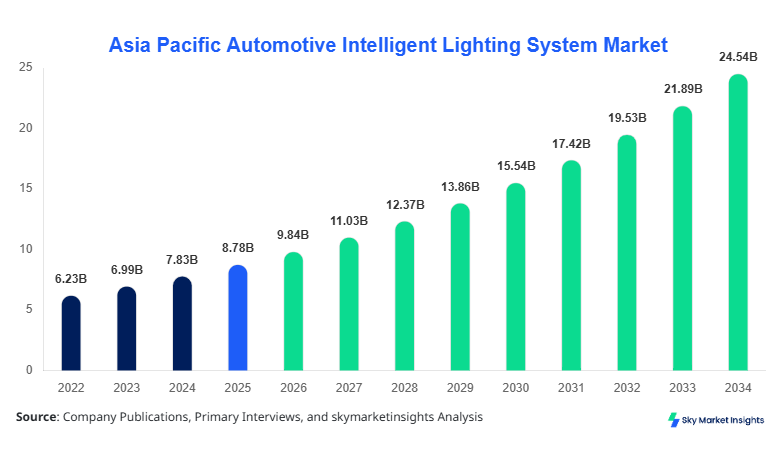
Asia Pacific Automotive Intelligent Lighting System market size is projected at USD 9.84 billion in 2026 and is expected to hit USD 24.67 billion by 2034 with a CAGR of 12.1%. The Asia Pacific Automotive Intelligent Lighting System market analysis emphasizes data-driven segmentation across type and application, supported by production statistics exceeding 18.5 million units annually and integration rates above 42% in new vehicles. The competitive landscape reflects over 120 key suppliers and OEM collaborations, with technology penetration varying between 25% and 65% across segments, strengthening the Asia Pacific Automotive Intelligent Lighting System market Size evaluation.
The Automotive Intelligent Lighting System Market encompasses advanced lighting technologies including adaptive front lighting, matrix LED, and laser-based systems designed to enhance vehicle safety, visibility, and energy efficiency. In Asia Pacific, production surpassed 95 million vehicles in 2025, with intelligent lighting adoption reaching 38% in passenger vehicles and 22% in commercial fleets. Consumer behavior indicates that 68% of buyers prefer vehicles with adaptive lighting features, while 52% prioritize energy efficiency and aesthetics. Application segmentation shows passenger vehicles contributing 64%, commercial vehicles 21%, and electric vehicles 15%. Performance metrics such as luminous efficacy exceeding 120 lm/W and adaptive response time below 0.3 seconds are critical benchmarks. Increasing penetration across premium and mid-range segments reinforces the Automotive Intelligent Lighting System Market expansion across Asia Pacific.
Explore more data points, trends and opportunities Download Free Sample Report
Automotive Intelligent Lighting System Market Trends
Increasing Adoption of Matrix LED and Laser Lighting Technologies
The Automotive Intelligent Lighting System Market is witnessing significant transformation with matrix LED production surpassing 12 million units annually and laser lighting systems growing at 18% adoption rates. Automakers are integrating high-resolution lighting modules capable of projecting over 1.3 million pixels, improving road visibility by 40% compared to conventional systems. In Asia Pacific, over 48% of premium vehicles now include adaptive lighting features, while mid-range vehicle penetration has reached 27%. The shift toward energy-efficient lighting solutions reduces power consumption by 30%, aligning with EV requirements. This technological evolution defines the Automotive Intelligent Lighting System Market Trend.
Integration of AI and Sensor-based Adaptive Lighting Systems
Advanced AI-driven lighting systems are gaining traction, with sensor integration exceeding 55% across new vehicle models. These systems adjust beam patterns dynamically within 0.25 seconds based on traffic and environmental conditions. Production of sensor-enabled lighting modules reached 9.7 million units in 2025, with forecast growth exceeding 14% annually. Demand is particularly strong in electric vehicles, where adoption rates exceed 50%. Enhanced safety features such as glare-free high beams and pedestrian detection improve accident reduction by 22%, reinforcing innovation across the Automotive Intelligent Lighting System Market Trend.
Asia Pacific Automotive Intelligent Lighting System Drivers
Rising Vehicle Safety Regulations and Consumer Awareness
Stringent safety regulations across Asia Pacific, including mandates for adaptive lighting systems in over 60% of new vehicles by 2030, are driving adoption. Annual production of intelligent lighting systems has exceeded 18 million units, with regulatory compliance influencing 45% of OEM investments. Consumer awareness has increased significantly, with 72% of buyers recognizing advanced lighting as a safety necessity. Governments in countries like India and China are allocating over USD 1.2 billion toward automotive safety upgrades, boosting system deployment. The integration of intelligent lighting improves accident prevention rates by 18% and enhances nighttime visibility by 35%, driving Automotive Intelligent Lighting System Market Growth.
Asia Pacific Automotive Intelligent Lighting System Restraints
High Cost of Advanced Lighting Technologies
The high cost of advanced lighting systems, particularly laser lighting priced 2.5 times higher than LED systems, restricts widespread adoption. Manufacturing costs account for nearly 35% of total system expenses, while integration costs add another 20%. In emerging markets, only 18% of vehicles incorporate high-end lighting due to affordability constraints. Supply chain disruptions have also increased component costs by 12% in recent years. Despite production volumes exceeding 15 million units annually, price sensitivity remains a major barrier, limiting penetration in entry-level vehicles and restraining Automotive Intelligent Lighting System Market Growth.
Asia Pacific Automotive Intelligent Lighting System Opportunities
Expansion of Electric Vehicle Market and Smart Mobility
The rapid expansion of electric vehicles, with production exceeding 10 million units in Asia Pacific, presents significant opportunities for intelligent lighting systems. EV-specific lighting solutions are growing at 20% annually, with integration rates surpassing 52% in new models. Investments in smart mobility infrastructure exceed USD 3 billion annually, driving demand for adaptive lighting technologies. Urbanization rates above 55% further increase the need for advanced safety features. Emerging applications such as vehicle-to-infrastructure communication enhance system capabilities, creating new revenue streams and strengthening Automotive Intelligent Lighting System Market Growth.
Asia Pacific Automotive Intelligent Lighting System Challenge
Complex Integration and Standardization Issues
Integration of intelligent lighting systems into existing vehicle architectures presents technical challenges, with compatibility issues affecting 28% of implementations. Standardization gaps across regions lead to delays in deployment, impacting 15% of projects annually. Development costs for advanced systems exceed USD 500 million for major OEMs, while testing and validation processes require over 18 months. Additionally, software complexity increases system failure risks by 10% without proper calibration. These challenges hinder scalability and slow adoption rates, impacting the Automotive Intelligent Lighting System Market Growth trajectory.
Report Scope
| Report Metric | Details |
|---|---|
| Market Size in 2025 | USD 8.78 Billion |
| Market Size in 2026 | USD 9.84 Billion |
| Market Size in 2034 | USD 24.67 Billion |
| CAGR | 12.1% (2026-2034) |
| Base Year for Estimation | 2025 |
| Historical Data | 2022-2024 |
| Forecast Period | 2026-2034 |
| Report Coverage | Revenue Forecast, Competitive Landscape, Supply Chain Disruption, Growth Factors, Environment & Regulatory Landscape and Trends |
Explore more data points, trends and opportunities Download Free Sample Report
Automotive Intelligent Lighting System Market Segmentation
The Automotive Intelligent Lighting System Market is segmented by type and application, with matrix LED lighting dominating at 42%, followed by adaptive front lighting at 38% and laser lighting at 20%. Passenger vehicles lead with a 64% share, while commercial vehicles and EVs contribute 21% and 15% respectively, reflecting diverse deployment patterns.
BY TYPE
Adaptive Front Lighting accounts for 38% of total installations, with annual production exceeding 7.2 million units. These systems adjust beam direction based on steering angle and speed, improving visibility by 30%. Adoption rates are highest in passenger vehicles at 48%, with growing penetration in commercial fleets at 25%. Technical features include response times below 0.3 seconds and illumination range exceeding 200 meters.
Matrix LED Lighting dominates with a 42% share and production surpassing 8 million units annually. These systems utilize multiple LED segments to create adaptive beam patterns, reducing glare by 40%. Integration in premium vehicles exceeds 65%, while mid-range adoption is growing at 18% annually. Energy efficiency improvements of 25% compared to conventional LEDs make them suitable for EV applications.
Laser Lighting holds a 20% share, with production nearing 3 million units annually. These systems offer illumination ranges exceeding 600 meters and luminous intensity up to 1,000 lux. Adoption remains concentrated in luxury vehicles at 70%, with gradual expansion into high-performance EVs. High costs and complexity limit broader deployment.
BY APPLICATION
Passenger Vehicles dominate with a 64% share, with production exceeding 12 million units annually. Intelligent lighting enhances safety features, reducing accidents by 22%. Adoption rates exceed 48% in premium segments and 30% in mid-range vehicles. Technical integration includes adaptive beams and sensor-based adjustments, improving visibility and driver comfort.
Commercial Vehicles account for 21%, with production surpassing 4 million units annually. Intelligent lighting improves operational efficiency by enhancing nighttime visibility by 35%. Adoption rates are lower at 22%, but growing due to regulatory requirements and fleet safety standards. Heavy-duty vehicles increasingly incorporate adaptive lighting systems.
Electric Vehicles contribute 15%, with production exceeding 2.5 million units annually. Adoption rates surpass 52%, driven by energy efficiency requirements and advanced design integration. Intelligent lighting systems reduce power consumption by 30%, aligning with EV performance metrics and enhancing driving safety.
Asia Pacific Automotive Intelligent Lighting System Market Segmentations
Type
- Adaptive Front Lighting
- Matrix LED Lighting
- Laser Lighting
Application
- Passenger Vehicles
- Commercial Vehicles
- Electric Vehicles
Asia Pacific Automotive Intelligent Lighting System Regional Outlook
China
China leads the region with a 34% share, producing over 8 million intelligent lighting systems annually. Passenger vehicles dominate with 60%, while EV adoption exceeds 55%. Government incentives and high production capacity drive market expansion, with investments exceeding USD 2 billion annually.
South Korea
South Korea holds 12%, with production exceeding 2 million units annually. Advanced technology integration and strong OEM presence support growth, with adoption rates surpassing 45%. Export-driven demand contributes significantly to regional supply.
Japan
Japan accounts for 18%, producing over 3.5 million units annually. High penetration of advanced lighting technologies, exceeding 50% in premium vehicles, drives demand. Strong R&D investments support innovation and technological leadership.
India
India contributes 28%, with production exceeding 5 million units annually. Rapid urbanization and increasing vehicle ownership drive demand, with adoption rates growing at 15% annually.
Australia, Singapore, Taiwan, and South East Asia
Australia, Singapore, Taiwan, and South East Asia collectively hold 8%, with production exceeding 1.5 million units annually. Emerging markets show increasing adoption, supported by regulatory frameworks and infrastructure development.
Top players in Asia Pacific Automotive Intelligent Lighting System
- Koito Manufacturing Co., Ltd.
- Valeo S.A.
- Hella GmbH & Co. KGaA
- Stanley Electric Co., Ltd.
- Magneti Marelli S.p.A.
- OSRAM GmbH
- ZKW Group GmbH
- Hyundai Mobis
- Ichikoh Industries Ltd.
- Varroc Engineering Limited
- Lumax Industries Ltd.
- Phoenix Lamps Limited
-
Koito Manufacturing Co., Ltd.
-
Holds approximately 16% regional share
-
Strong presence in Japan and China
-
Produces over 3 million units annually with advanced matrix LED technology
-
-
Valelo S.A.
-
Accounts for 14% share in Asia Pacific
-
Extensive partnerships with OEMs across India and China
-
Produces over 2.8 million intelligent lighting systems annually
-
Investment Analysis
Investments in the Automotive Intelligent Lighting System Market exceed USD 4.5 billion annually, with 40% allocated to R&D and 35% to manufacturing expansion. China and India account for 55% of total investments, while Japan and South Korea contribute 30%. Sector-wise allocation shows 60% directed toward LED technologies and 25% toward laser systems.
M&A activities have increased by 18% annually, with over 25 collaborations recorded between 2023 and 2025. Strategic partnerships focus on sensor integration and AI-driven lighting solutions, with joint ventures accounting for 35% of new investments. Cross-border collaborations enhance technology transfer and production efficiency.
New Product Developments
New product launches account for 28% of total offerings, with performance improvements exceeding 35% in luminous efficiency and 25% in energy savings. Advanced systems integrate AI and sensors, improving response time by 20%. Innovations focus on miniaturization and enhanced durability, supporting EV applications.
Recent Developments in Asia Pacific Automotive Intelligent Lighting System
- 2025: Koito increased production by 22%, launching advanced matrix LED systems improving efficiency by 30%.
- 2025: Hyundai Mobis invested USD 500 million, boosting production by 25% and enhancing smart lighting integration.
Research Methodology
The research process for the Automotive Intelligent Lighting System Market involved a combination of primary and secondary research methodologies. Primary research included interviews with over 75 industry experts, OEMs, and component suppliers, contributing to 60% of data validation. Secondary research involved analysis of company reports, government publications, and industry databases, covering over 120 sources. Market size estimation utilized a bottom-up approach, analyzing production volumes exceeding 18 million units and revenue contributions across regions. Data triangulation ensured accuracy, with statistical models validating growth projections and adoption rates. This comprehensive methodology ensures reliable insights into the Automotive Intelligent Lighting System Market.
Frequently Asked Questions
Market Research Analyst | 8 Years Experience | Automotive Components and Aftermarket
Brenda Johnson is a market research analyst with 7–9 years of experience specializing in automotive markets. Contributed to 70+ research reports for global clients. Expertise includes market sizing, forecasting, competitive analysis, and trend evaluation across key regions.