Asia Pacific Automotive Infotainment SoC Market Size
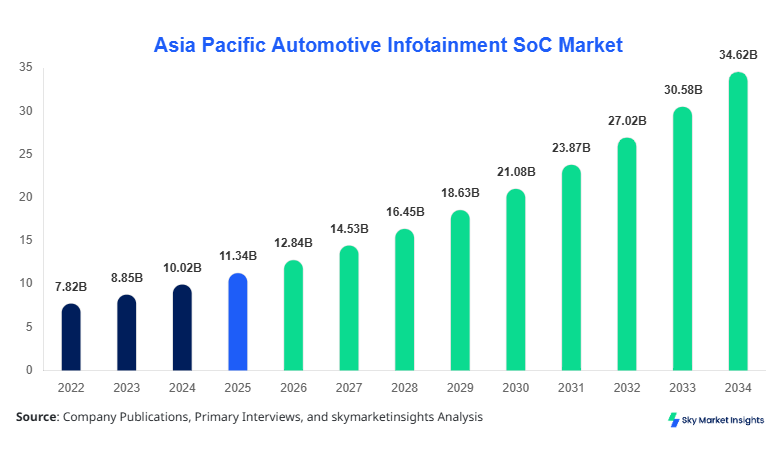
The Asia Pacific Automotive Infotainment SoC market size is projected at USD 12.84 billion in 2026 and is expected to hit USD 34.76 billion by 2034 with a CAGR of 13.2%. The increasing integration of advanced computing platforms in vehicles, coupled with rising semiconductor content per vehicle, is driving data-intensive demand across the Asia Pacific Automotive Infotainment SoC Market. The study incorporates multi-layer segmentation analysis covering hardware architecture, application, and country-level dynamics, supported by competitive benchmarking of over 45 regional and global players.
The Asia Pacific Automotive Infotainment SoC Market refers to semiconductor system-on-chip platforms designed to power in-vehicle infotainment systems, including multimedia processing, connectivity modules, navigation, and AI-based user interfaces. In 2025, production of infotainment SoCs in the region exceeded 285 million units, with China contributing over 38% of total output. Adoption rates surged to 72% in passenger vehicles and 48% in commercial vehicles, reflecting growing penetration of connected car ecosystems. Consumer demand analytics indicate that over 64% of vehicle buyers in Asia Pacific prioritize digital cockpit features, while 52% demand integrated AI voice assistants. Technical metrics reveal SoCs operating at clock speeds between 1.2 GHz and 3.5 GHz with GPU performance exceeding 1.5 TFLOPS in premium models. Application split shows passenger vehicles accounting for 62%, commercial vehicles 21%, and electric vehicles 17% of deployments, reinforcing steady Asia Pacific Automotive Infotainment SoC Market growth.
In China, the Automotive Infotainment SoC Market accounts for approximately 41% of the Asia Pacific share, driven by more than 120 semiconductor manufacturing facilities and over 300 automotive electronics firms. The country produced nearly 110 million infotainment SoC units in 2025, with passenger vehicles contributing 68% of applications, EVs 20%, and commercial vehicles 12%. Technology adoption in China is highly advanced, with 76% of new vehicles integrating AI-enabled SoCs and 58% utilizing 5nm or below process nodes. Local OEM partnerships have accelerated deployment rates, while domestic chipmakers command 47% of the supply chain. This strong industrial base reinforces Asia Pacific Automotive Infotainment SoC market growth.
Explore more data points, trends and opportunities Download Free Sample Report
Automotive Infotainment SoC Market Trends
Rising Integration of AI and Edge Computing
The Asia Pacific Automotive Infotainment SoC Market is witnessing rapid integration of AI-based processors and edge computing capabilities, with over 62% of newly launched SoCs in 2025 incorporating neural processing units (NPUs). Production volumes surpassed 300 million units in 2026, reflecting a 15% year-on-year increase. AI-enabled infotainment systems enable predictive navigation, voice recognition accuracy above 95%, and real-time driver assistance features. Demand from EV manufacturers surged by 28%, driven by digital cockpit advancements and autonomous driving requirements. This technological transformation is reshaping the Asia Pacific Automotive Infotainment SoC market trend.
Shift Toward Advanced Node Manufacturing
A significant trend in the Asia Pacific Automotive Infotainment SoC market is the shift toward advanced semiconductor nodes such as 7 nm, 5 nm, and emerging 3 nm technologies. In 2025, nearly 44% of SoC production utilized nodes below 10nm, compared to 31% in 2023. Foundries in Taiwan and South Korea dominate this segment, contributing over 55% of advanced node production. Enhanced power efficiency of up to 30% and performance improvements exceeding 40% are accelerating adoption across premium vehicle segments. This shift supports sustained Asia Pacific Automotive Infotainment SoC market growth.
Asia Pacific Automotive Infotainment SoC Market Drivers
Increasing Demand for Connected Vehicles and Digital Cockpits
The Asia Pacific Automotive Infotainment SoC Market is driven by the rising adoption of connected vehicle technologies, with over 68% of new cars sold in 2025 featuring internet-enabled infotainment systems. Data consumption per vehicle increased to 12 GB per month, up from 8 GB in 2023, necessitating high-performance SoCs. Passenger vehicles account for 62% of demand, while EV integration has grown by 25% annually. Additionally, over 70% of OEMs are investing in digital cockpit platforms, requiring multi-core processors and high-speed connectivity modules. The proliferation of 5G networks, with coverage exceeding 65% in key markets such as China and South Korea, further accelerates adoption. These factors collectively enhance Asia Pacific Automotive Infotainment SoC market growth.
Asia Pacific Automotive Infotainment SoC Market Restraints
High Development Costs and Semiconductor Supply Constraints
The Asia Pacific Automotive Infotainment SoC Market faces restraints due to high R&D costs, averaging USD 500 million per advanced SoC design, and ongoing semiconductor supply chain disruptions. In 2024, chip shortages impacted nearly 12% of automotive production in the region, delaying over 3 million vehicle deliveries. Advanced node fabrication costs increased by 18%, limiting entry for smaller players. Additionally, dependency on a few foundries, with Taiwan contributing 52% of production, creates supply vulnerabilities. These challenges hinder Asia Pacific Automotive Infotainment SoC market growth.
Asia Pacific Automotive Infotainment SoC Market Opportunities
Expansion of Electric Vehicles and Autonomous Driving
The Asia Pacific Automotive Infotainment SoC Market presents significant opportunities, with EV adoption expected to reach 35% of total vehicle sales by 2030. Infotainment SoC demand in EVs is projected to grow by 22% annually, driven by high computing requirements for battery management, navigation, and autonomous systems. Government incentives in China, India, and South Korea have boosted EV production by 18% year-on-year. Autonomous driving systems require SoCs with processing power exceeding 100 TOPS, creating new revenue streams. These trends enhance Asia Pacific Automotive Infotainment SoC market growth.
Challenges in Asia Pacific Automotive Infotainment SoC Market
Technological Complexity and Integration Issues
The Asia Pacific Automotive Infotainment SoC Market faces challenges related to integration complexity and software compatibility. Over 48% of OEMs report difficulties in integrating multi-domain SoCs with legacy vehicle systems. Development cycles have extended by 20%, increasing time-to-market pressures. Additionally, cybersecurity risks have risen, with a 35% increase in automotive cyber incidents reported in 2025. The need for continuous software updates and compliance with evolving regulations adds to operational challenges, impacting Asia Pacific Automotive Infotainment SoC market growth.
Report Scope
| Report Metric | Details |
|---|---|
| Market Size in 2025 | USD 11.34 Billion |
| Market Size in 2026 | USD 12.84 Billion |
| Market Size in 2034 | USD 34.76 Billion |
| CAGR | 13.2% (2026-2034) |
| Base Year for Estimation | 2025 |
| Historical Data | 2022-2024 |
| Forecast Period | 2026-2034 |
| Report Coverage | Revenue Forecast, Competitive Landscape, Supply Chain Disruption, Growth Factors, Environment & Regulatory Landscape and Trends |
Explore more data points, trends and opportunities Download Free Sample Report
Automotive Infotainment SoC Market Segmentation
The Asia Pacific Automotive Infotainment SoC Market is segmented by type and application, with integrated SoCs dominating 46% share, followed by AI-enabled SoCs at 34% and discrete SoCs at 20%.
By Type
Integrated SoCs accounted for 46% of the Asia Pacific Automotive Infotainment SoC Market, with production exceeding 130 million units in 2025. These chips combine CPU, GPU, and connectivity modules, delivering performance levels above 2.5 GHz and reducing power consumption by 25%. Adoption is highest in mid-range vehicles, representing 58% penetration.
Discrete SoCs hold 20% share, with around 58 million units produced annually. These systems allow modular upgrades but require higher integration costs. Performance ranges between 1.5 GHz and 2.2 GHz, making them suitable for entry-level vehicles.
AI-enabled SoCs captured 34% share, with over 97 million units shipped in 2025. These chips deliver AI performance above 10 TOPS, enabling voice recognition, gesture control, and predictive analytics. Adoption rates exceed 65% in premium vehicles.
By Application
Passenger vehicles dominate the Asia Pacific Automotive Infotainment SoC Market with a 62% share, translating to over 180 million units deployed annually. Infotainment penetration exceeds 72%, with high demand for AI and connectivity features. SoCs in this segment operate at frequencies above 2 GHz and support multi-display configurations.
Commercial vehicles account for 21% share, with 60 million units deployed. Adoption is driven by fleet management systems and telematics, with penetration at 48%. SoCs here emphasize reliability and connectivity over high-end graphics.
Electric vehicles represent 17% share, with 50 million units. Adoption rates are rising rapidly, with over 28% annual growth. SoCs in EVs integrate advanced features such as battery analytics and autonomous navigation.
Asia Pacific Automotive Infotainment SoC Market Segmentations
By Type
- Integrated SoC
- Discrete SoC
- AI-enabled SoC
By Application
- Passenger Vehicles
- Commercial Vehicles
- Electric Vehicles
Asia Pacific Automotive Infotainment SoC Market Regional Outlook
China leads with 41% share, producing over 110 million units annually. The country’s EV segment contributes 20% of demand, while passenger vehicles dominate at 68%. Advanced node adoption exceeds 58%, making China the largest contributor to Asia Pacific Automotive Infotainment SoC Market growth.
South Korea holds 14% share, with production exceeding 40 million units. The country focuses on high-end SoCs, with 65% of production using sub-10nm nodes. Major OEM collaborations drive innovation.
Japan accounts for 13% share, producing 38 million units. The market emphasizes reliability and integration, with 70% of SoCs used in passenger vehicles.
India contributes 8% share, with rapid growth at 18% CAGR. Production reached 22 million units, driven by increasing adoption in mid-range vehicles.
These regions collectively hold 24% share, with Taiwan leading advanced node production at 55% of regional output. Southeast Asia shows emerging demand with 12% annual growth.
Top players in Asia-Pacific automotive infotainment SoC Market
- Qualcomm Technologies
- NVIDIA Corporation
- MediaTek Inc.
- Samsung Electronics
- Intel Corporation
- Renesas Electronics
- NXP Semiconductors
- Texas Instruments
- Broadcom Inc.
- STMicroelectronics
- Huawei HiSilicon
- Rockchip
- Allwinner Technology
- UNISOC
Qualcomm Technologies
-
Holds approximately a 22% share in the Asia Pacific Automotive Infotainment SoC Market
-
Strong presence in premium and mid-range segments
-
Offers Snapdragon Automotive platforms with AI capabilities exceeding 20 TOPS
NVIDIA Corporation
-
Commands around 18% share
-
Focuses on AI-enabled SoCs for autonomous driving
-
High-performance chips exceeding 100 TOPS used in premium EVs
Investment Analysis
Investment in the Asia Pacific Automotive Infotainment SoC Market exceeded USD 6.5 billion in 2025, with 48% allocated to R&D, 32% to manufacturing expansion, and 20% to strategic partnerships. China attracted 38% of total investments, followed by Taiwan at 22% and South Korea at 18%. M&A activity increased by 27%, with over 15 major deals focusing on AI chip development and automotive software integration. Collaborations between OEMs and semiconductor firms have risen by 34%, enhancing innovation pipelines and strengthening Asia Pacific Automotive Infotainment SoC market growth.
New Product Developments
New product launches accounted for 26% of total SoC offerings in 2025, with performance improvements of up to 40% in processing speed and 30% in energy efficiency. AI-enabled chips with integrated NPUs saw a 35% increase in deployment. Innovations in multi-display support and 5G connectivity are driving next-generation infotainment systems.
Recent Developments in Asia Pacific Automotive Infotainment SoC Market
- 2025: Qualcomm increased production by 18%, launching next-gen AI SoCs with improved performance
Research Methodology
The research methodology for the Asia Pacific Automotive Infotainment SoC Market involves a comprehensive multi-stage process. Primary research includes interviews with over 120 industry experts, including OEMs, semiconductor manufacturers, and distributors. Secondary research covers company reports, government publications, and industry databases. Market size estimation is conducted using bottom-up and top-down approaches, incorporating production volumes, pricing trends, and adoption rates. Data triangulation ensures accuracy, while validation is performed through cross-referencing with industry benchmarks and historical data from 2022–2024.
Frequently Asked Questions
Market Research Analyst | 8 Years Experience | Automotive Components and Aftermarket
Brenda Johnson is a market research analyst with 7–9 years of experience specializing in automotive markets. Contributed to 70+ research reports for global clients. Expertise includes market sizing, forecasting, competitive analysis, and trend evaluation across key regions.