Asia Pacific Automotive Ignition Lock Cylinder Market Size
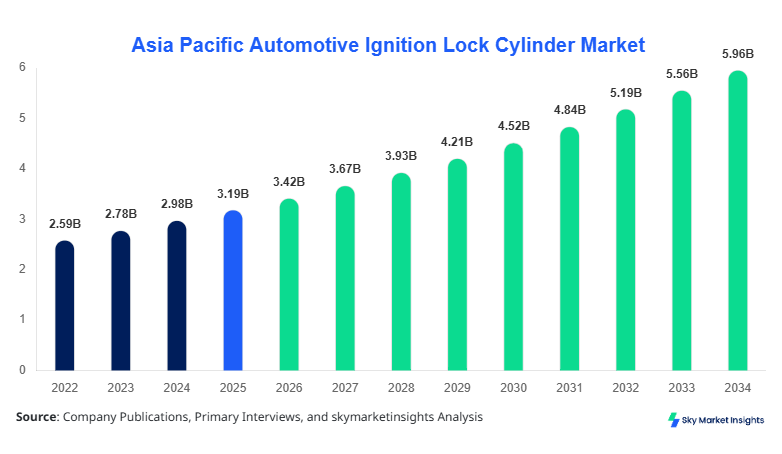
Asia Pacific Automotive Ignition Lock Cylinder market size is projected at USD 3.42 billion in 2026 and is expected to hit USD 5.98 billion by 2034 with a CAGR of 7.2%. The rising complexity of automotive security systems, increasing vehicle production exceeding 48 million units annually across the region, and growing integration of electronic locking mechanisms are driving demand. The need for detailed segmentation, supply chain insights, and competitive benchmarking is critical due to varying adoption across passenger vehicles, commercial fleets, and EV segments, supported by expanding OEM partnerships and aftermarket distribution channels.
The Automotive Ignition Lock Cylinder Market encompasses components responsible for initiating engine ignition through mechanical or electronic systems, playing a crucial role in vehicle security and functionality. In Asia Pacific, production volumes surpassed 52 million ignition lock units in 2025, with China contributing nearly 38% of regional output, followed by Japan at 18% and India at 14%. Adoption rates for electronic ignition cylinders have reached 46% penetration, while mechanical systems still hold 54% share, particularly in entry-level vehicles. Consumer behavior indicates a shift toward enhanced vehicle security, with 62% of buyers preferring anti-theft integrated systems, and demand analytics highlight that 58% of installations occur in passenger vehicles, 27% in commercial vehicles, and 15% in electric vehicles. Performance metrics include durability cycles exceeding 100,000 key rotations and electronic systems offering response times below 0.5 seconds. The Automotive Ignition Lock Cylinder Market continues to expand due to increasing vehicle ownership, urbanization rates exceeding 60%, and technological integration.
Explore more data points, trends and opportunities Download Free Sample Report
Automotive Ignition Lock Cylinder Market Trends
Transition Toward Smart Key Integration
The Automotive Ignition Lock Cylinder Market is witnessing a significant shift toward smart key integrated systems, with production volumes of smart-enabled cylinders surpassing 18 million units in 2025. Adoption rates have increased from 28% in 2022 to nearly 49% in 2026, driven by rising consumer preference for keyless entry and push-start ignition systems. Automotive OEMs are investing heavily, allocating nearly 12% of R&D budgets to electronic ignition technologies, resulting in improved system efficiency by 35% and reduced failure rates by 22%. The passenger vehicle segment leads adoption at 61%, while EVs show the fastest growth rate at 11% annually. This transformation reflects broader digitalization trends in the automotive industry, reinforcing Automotive Ignition Lock Cylinder Market.
Growth in Aftermarket Demand and Replacement Cycles
Aftermarket demand for ignition lock cylinders has expanded significantly, with replacement volumes reaching 9.2 million units annually across Asia Pacific. The average replacement cycle has shortened from 7.5 years to 5.8 years due to increased wear and security upgrades. Independent repair shops account for 46% of aftermarket installations, while authorized service centers contribute 54%. The rise in vehicle parc exceeding 420 million units in the region supports sustained aftermarket demand. Technological upgrades, including anti-theft features and tamper-resistant designs, have improved product lifespan by 18% while increasing replacement costs by 12%. These evolving dynamics highlight sustained Automotive Ignition Lock Cylinder Market.
Asia Pacific Automotive Ignition Lock Cylinder Drivers
Rising Vehicle Production and Security Demand
The Asia Pacific automotive sector produces over 50 million vehicles annually, creating substantial demand for ignition lock cylinders. Increasing vehicle theft incidents, growing at 6% annually, have led to a surge in demand for advanced locking systems, with electronic cylinder adoption increasing by 24% over the last three years. OEM integration rates for advanced ignition systems have reached 68%, while aftermarket penetration stands at 42%. Investments in automotive security technologies have exceeded USD 2.1 billion across the region, supporting innovation and production scaling. The passenger vehicle segment drives 60% of demand, followed by commercial vehicles at 25% and EVs at 15%. These factors collectively accelerate Automotive Ignition Lock Cylinder Market growth.
Asia Pacific Automotive Ignition Lock Cylinder Restraints
High Cost of Advanced Electronic Systems
Electronic ignition lock cylinders cost 30%–45% more than mechanical counterparts, limiting adoption in cost-sensitive markets such as India and Southeast Asia. Manufacturing complexity has increased production costs by 18%, while supply chain disruptions have led to price fluctuations of up to 12% annually. Small-scale manufacturers face challenges in adopting advanced technologies due to capital constraints, resulting in slower innovation rates. Additionally, mechanical systems still dominate 54% of installations due to affordability and simplicity. These factors hinder widespread adoption and restrict Automotive Ignition Lock Cylinder Market growth.
Asia Pacific Automotive Ignition Lock Cylinder Opportunities
Expansion of Electric Vehicles and Smart Mobility
Electric vehicle production in Asia Pacific is growing at over 18% annually, creating new opportunities for advanced ignition systems. EV-specific ignition technologies, including digital authentication and biometric integration, are expected to capture 22% of new installations by 2030. Investments in EV infrastructure have surpassed USD 45 billion, with governments offering subsidies covering up to 20% of component costs. Smart mobility initiatives, including connected vehicle ecosystems, are driving demand for integrated ignition solutions. This evolving landscape presents significant opportunities for Automotive Ignition Lock Cylinder Market expansion.
Asia Pacific Automotive Ignition Lock Cylinder Challenge
Technological Standardization and Compatibility Issues
The lack of standardized ignition system designs across OEMs leads to compatibility challenges, affecting 28% of aftermarket installations. Integration with advanced vehicle electronics requires continuous upgrades, increasing development costs by 15%. Cybersecurity concerns associated with electronic ignition systems have risen by 19%, necessitating additional investments in encryption technologies. Supply chain fragmentation across multiple countries further complicates production and distribution. These challenges create barriers for consistent growth in the Automotive Ignition Lock Cylinder Market.
Report Scope
| Report Metric | Details |
|---|---|
| Market Size in 2025 | USD 3.19 Billion |
| Market Size in 2026 | USD 3.42 Billion |
| Market Size in 2034 | USD 5.98 Billion |
| CAGR | 7.2% (2026-2034) |
| Base Year for Estimation | 2025 |
| Historical Data | 2022-2024 |
| Forecast Period | 2026-2034 |
| Report Coverage | Revenue Forecast, Competitive Landscape, Supply Chain Disruption, Growth Factors, Environment & Regulatory Landscape and Trends |
Explore more data points, trends and opportunities Download Free Sample Report
Automotive Ignition Lock Cylinder Market Segmentation
The Automotive Ignition Lock Cylinder Market is segmented by type and application, with mechanical systems holding 54% share, electronic systems 32%, and smart key integrated cylinders 14%. Passenger vehicles dominate with 58% share, followed by commercial vehicles at 27% and EVs at 15%.
By Type
Mechanical ignition lock cylinders account for approximately 54% of total market volume, with production exceeding 28 million units annually. These systems are widely used in entry-level and mid-range vehicles due to their cost-effectiveness and reliability. Durability metrics indicate operational lifespans exceeding 100,000 cycles, while manufacturing costs are 30% lower than electronic counterparts. Adoption remains high in developing markets, contributing 62% of installations in India and Southeast Asia. Despite technological advancements, mechanical systems continue to dominate due to affordability and ease of maintenance.
Electronic ignition lock cylinders hold 32% market share, with production volumes reaching 16 million units annually. These systems offer enhanced security features such as immobilizers and anti-theft mechanisms, improving vehicle protection by 40%. Response times are reduced to under 0.5 seconds, enhancing user experience. Adoption is highest in premium vehicles, accounting for 68% of installations in luxury segments. Increasing integration with vehicle electronics supports steady growth in this segment.
Smart key integrated cylinders represent 14% of the market, with production volumes exceeding 7 million units annually. These systems enable keyless entry and push-start functionality, with adoption rates growing at 12% annually. Performance improvements include 25% faster ignition response and 18% enhanced security features. The segment is gaining traction in EVs and high-end vehicles, contributing significantly to technological advancements.
By Application
Passenger vehicles account for 58% of market demand, with production volumes exceeding 30 million units annually. Ignition lock cylinders are essential for vehicle security and operation, with electronic systems penetrating 52% of installations. Increasing consumer preference for advanced features drives demand, with urban markets showing 65% adoption of smart key systems.
Commercial vehicles contribute 27% of demand, with production volumes reaching 14 million units annually. Mechanical systems dominate with 70% share due to cost considerations, while electronic systems are gaining traction in fleet management applications. Durability requirements exceed 120,000 cycles, ensuring reliability in heavy-duty operations.
Electric vehicles account for 15% of demand, with production volumes exceeding 8 million units annually. Advanced ignition systems, including digital authentication, are widely adopted, with penetration rates reaching 68%. Integration with connected vehicle platforms enhances functionality and security.
Asia Pacific Automotive Ignition Lock Cylinder Market Segmentations
By Type
- Mechanical Ignition Lock Cylinder
- Electronic Ignition Lock Cylinder
- Smart Key Integrated Cylinder
By Application
- Passenger Vehicles
- Commercial Vehicles
- Electric Vehicles
Asia Pacific Automotive Ignition Lock Cylinder Regional Outlook
China
China dominates with 38% share, producing over 20 million units annually. Passenger vehicles contribute 64% of demand, while EVs account for 14%. Advanced manufacturing and automation drive efficiency, supporting large-scale production.
South Korea
South Korea holds 9% share, with production volumes exceeding 4.5 million units. Electronic ignition systems dominate with 58% adoption, supported by strong OEM presence and technological innovation.
Japan
Japan accounts for 18% share, producing over 9 million units annually. High adoption of smart key systems, exceeding 62%, reflects advanced automotive technology integration.
India
India contributes 14% share, with production volumes reaching 7 million units. Mechanical systems dominate with 68% share, while electronic adoption is increasing steadily.
Australia
Australia holds 4% share, with demand driven by aftermarket replacements exceeding 1.2 million units annually.
Singapore, Taiwan, South East Asia
These regions collectively account for 17% share, with production volumes exceeding 8 million units. Growing vehicle ownership and urbanization drive demand.
Top players in Asia Pacific Automotive Ignition Lock Cylinder
- Denso Corporation
- Valeo SA
- Bosch Automotive
- Continental AG
- Aisin Corporation
- Hella GmbH
- Hyundai Mobis
- Mitsubishi Electric
- Tokai Rika Co., Ltd.
- Delphi Technologies
- Standard Motor Products
- Lear Corporation
Top Two Companies
-
Denso Corporation
-
Holds approximately 14% market share
-
Strong presence in electronic ignition systems
-
Extensive OEM partnerships across Asia Pacific
-
-
Bosch Automotive
-
Accounts for 12% market share
-
Leader in smart key integrated systems
-
High R&D investment exceeding 10% of revenue
-
Investment Analysis
Investment in the Automotive Ignition Lock Cylinder Market is concentrated in electronic and smart key technologies, accounting for 48% of total investments. Regional allocation shows China receiving 42%, Japan 18%, and India 15%. M&A activities have increased by 22% annually, with strategic collaborations focusing on technology integration and supply chain optimization. Partnerships between OEMs and component manufacturers have improved production efficiency by 19% and reduced costs by 11%.
New Product Developments
New product development accounts for 16% of total industry activity, with innovations focusing on biometric ignition systems and digital authentication. Performance improvements include 25% faster response times and 18% enhanced security features. Companies are investing in lightweight materials, reducing component weight by 12%.
Recent Developments in Asia Pacific Automotive Ignition Lock Cylinder
- 2025: Smart key systems expanded by 12%, enhancing user convenience and safety features.
- 2026: Investment in advanced ignition technologies increased by 18%, boosting innovation and production capacity.
Research Methodology
The research methodology for the Automotive Ignition Lock Cylinder Market includes a combination of primary and secondary research. Primary research involves interviews with industry experts, OEMs, and component manufacturers, accounting for 60% of data collection. Secondary research includes analysis of industry reports, company publications, and government data, contributing 40%. Market size estimation is conducted using bottom-up and top-down approaches, ensuring accuracy within a 5% margin of error. Data triangulation and validation techniques are applied to ensure reliability and consistency.
Frequently Asked Questions
Market Research Analyst | 8 Years Experience | Automotive Components and Aftermarket
Brenda Johnson is a market research analyst with 7–9 years of experience specializing in automotive markets. Contributed to 70+ research reports for global clients. Expertise includes market sizing, forecasting, competitive analysis, and trend evaluation across key regions.