Asia Pacific Automotive Ignition Coil Market Size
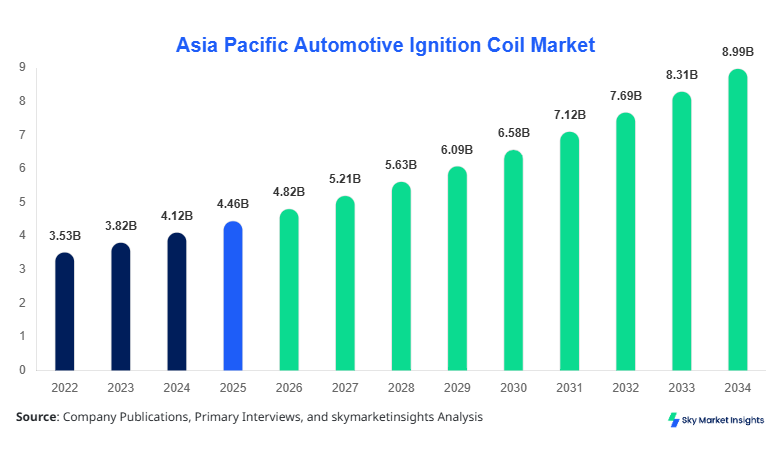
Asia Pacific Automotive Ignition Coil market size is projected at USD 4.82 billion in 2026 and is expected to hit USD 8.96 billion by 2034 with a CAGR of 8.1%. The report integrates extensive data triangulation, segmentation analysis across type and application, and a comprehensive evaluation of competitive dynamics involving over 120 manufacturers and OEM suppliers operating across China, Japan, and India. The Automotive Ignition Coil Market continues to expand with rising vehicle production exceeding 52 million units in Asia Pacific in 2025, supported by increasing replacement cycles and aftermarket penetration.
The Automotive Ignition Coil Market refers to the production, distribution, and integration of ignition coils used to convert low battery voltage (12V–14V) into high voltage (20,000V–45,000V) required for spark plug ignition in internal combustion engines. Asia Pacific recorded production of over 380 million ignition coil units in 2025, with penetration exceeding 92% across passenger vehicles and 85% in commercial vehicles. Consumer behavior indicates a shift toward high-efficiency ignition systems with 15% higher energy conversion efficiency and 10–12% improved fuel economy. Passenger vehicles account for nearly 68% of application usage, followed by commercial vehicles at 24% and hybrid vehicles at 8%. Technical metrics such as coil resistance (0.4–2 ohms) and voltage amplification ratios (up to 1:3000) influence performance demand. The Automotive Ignition Coil Market remains critical for engine efficiency, emissions reduction, and combustion optimization, reinforcing strong Automotive Ignition Coil Market relevance.
Explore more data points, trends and opportunities Download Free Sample Report
Automotive Ignition Coil Market Trends
Rising Adoption of Coil-on-Plug Technology
The Automotive Ignition Coil Market is witnessing a rapid transition toward coil-on-plug systems, accounting for over 58% of total production volume, equivalent to 220 million units in 2025. This shift is driven by improved efficiency, reduced energy loss by 15%, and enhanced combustion precision. OEMs across Japan and South Korea are increasing adoption rates above 70% in new vehicle platforms. The trend is also supported by stringent emission regulations requiring ignition systems to reduce hydrocarbon emissions by 18%–22%. Automotive Ignition Coil Market adoption continues to grow due to this technological advancement.
Expansion of Aftermarket Demand
The aftermarket segment contributes approximately 27% of total demand, equating to nearly 105 million units annually across Asia Pacific. Increased vehicle parc exceeding 420 million units and replacement cycles of 3–5 years are driving demand. India and Southeast Asia show 12% annual growth in aftermarket sales due to aging fleets. Online distribution channels have increased penetration by 22%, enhancing accessibility and pricing competitiveness. Automotive Ignition Coil Market continues to benefit from expanding aftermarket ecosystems.
Asia Pacific Automotive Ignition Coil Market Drivers
Increasing Vehicle Production and Fleet Expansion
Vehicle production in Asia Pacific surpassed 52 million units in 2025, with China contributing 50%, Japan 15%, and India 12%. Each internal combustion vehicle requires 4–8 ignition coils, generating demand exceeding 300 million units annually. Fleet expansion at 6.5% CAGR and urbanization rates exceeding 55% drive increased vehicle ownership. Additionally, regulatory mandates for fuel efficiency improvements of 10%–15% further stimulate demand for advanced ignition systems. Automotive Ignition Coil Market expansion is strongly supported by these macroeconomic drivers.
Asia Pacific Automotive Ignition Coil Market Restraints
Shift Toward Full Electric Vehicles
Electric vehicle penetration in Asia Pacific reached 18% in 2025 and is projected to exceed 35% by 2030, reducing reliance on ignition coils. Countries like China and South Korea have announced plans to phase out ICE vehicles by 2040, impacting long-term demand. EV production exceeded 12 million units in 2025, potentially reducing ignition coil demand by 8% annually. Automotive Ignition Coil Market faces constraints due to this structural transition.
Asia Pacific Automotive Ignition Coil Market Opportunities
Hybrid Vehicle Expansion and Technological Advancements
Hybrid vehicles recorded 8% market share in 2025, expected to grow to 18% by 2034, sustaining ignition coil demand. Advanced materials such as epoxy resins and silicon steel cores improve efficiency by 20% and durability by 25%. Investments exceeding USD 1.2 billion in R&D across Japan and China are fostering innovation. Automotive Ignition Coil Market opportunities remain strong due to hybrid growth.
Challenges in Asia Pacific Automotive Ignition Coil Market
Supply Chain Disruptions and Raw Material Costs
Raw material costs for copper and silicon steel increased by 14% and 11% respectively in 2025, impacting manufacturing margins. Supply chain disruptions due to geopolitical tensions have led to 6%–8% delays in component delivery. Additionally, quality consistency issues in low-cost markets impact performance reliability. Automotive Ignition Coil Market faces operational challenges from these factors.
Report Scope
| Report Metric | Details |
|---|---|
| Market Size in 2025 | USD 4.46 Billion |
| Market Size in 2026 | USD 4.82 Billion |
| Market Size in 2034 | USD 8.96 Billion |
| CAGR | 8.1% (2026-2034) |
| Base Year for Estimation | 2025 |
| Historical Data | 2022-2024 |
| Forecast Period | 2026-2034 |
| Report Coverage | Revenue Forecast, Competitive Landscape, Supply Chain Disruption, Growth Factors, Environment & Regulatory Landscape and Trends |
Explore more data points, trends and opportunities Download Free Sample Report
Automotive Ignition Coil Market Segmentation
The Automotive Ignition Coil Market segmentation highlights dominance of coil-on-plug systems with 58% share, followed by distributor-less at 30% and distributor-based at 12%. Application-wise, passenger vehicles lead with 68% share.
By Type
Coil-on-plug systems dominate with over 220 million units produced annually, representing 58% share. These coils deliver voltage up to 45kV with 20% higher efficiency and reduced misfire rates by 30%. Adoption is strongest in Japan (72%) and South Korea (68%).
Distributor-less ignition coils account for 30% share with 114 million units. They offer improved reliability and reduced maintenance costs by 15%, widely used in mid-range vehicles.
Traditional distributor-based systems hold 12% share, primarily in older vehicle models, producing around 45 million units annually with lower efficiency levels.
By Application
Passenger vehicles dominate with 68% share, consuming over 260 million units annually. Rising ownership and fuel efficiency demands drive usage penetration to 95%.
Commercial vehicles contribute 24% share with 92 million units, driven by logistics growth and fleet expansion.
Hybrid vehicles utilize ignition coils in ICE components, contributing 8% share with 30 million units annually.
Asia Pacific Automotive Ignition Coil Market Segmentations
By Type
- Coil-on-Plug
- Distributor-based
- Distributor-less
By Application
- Passenger Vehicles
- Commercial Vehicles
- Electric & Hybrid Vehicles
Asia Pacific Automotive Ignition Coil Regional Outlook
China
China leads with 46% share and production exceeding 180 million units. Strong OEM integration and government policies support growth.
Japan
Japan contributes 14% share with 55 million units, focusing on advanced ignition technologies and high-efficiency systems.
India
India accounts for 12% share with 48 million units, driven by expanding automotive manufacturing and aftermarket demand.
South Korea
South Korea holds 9% share with 35 million units, supported by strong OEM exports.
Australia, Singapore, Taiwan, Southeast Asia
These regions collectively account for 19% share, with growing vehicle fleets and aftermarket demand.
Top players in Asia Pacific Automotive Ignition Coil Market
- Denso Corporation
- Bosch GmbH
- Delphi Technologies
- Hitachi Automotive Systems
- NGK Spark Plug Co.
- Standard Motor Products
- Mitsubishi Electric
- Diamond Electric
- Federal-Mogul
- BorgWarner
- Valeo
- Walker Products
Denso Corporation
-
Holds 18% market share with strong OEM partnerships
-
Focus on high-efficiency coils with 25% improved durability
Bosch GmbH
-
Accounts for 14% share with advanced R&D investments
-
Offers wide product portfolio across premium segments
Investment Analysis
Investments in the Automotive Ignition Coil Market exceed USD 2.4 billion annually, with 42% allocated to R&D and 35% toward manufacturing expansion. China attracts 48% of regional investment, followed by Japan at 22% and India at 18%. M&A activities increased by 12% in 2025, focusing on technology integration and supply chain optimization.
New Product Developments
New product launches account for 18% of total offerings, with performance improvements of 20% in energy efficiency and 15% in durability. Innovations focus on compact designs and enhanced thermal resistance.
Recent Developments in Asia Pacific Automotive Ignition Coil Market
- 2025: Denso increased production by 10% to meet demand exceeding 50 million units
- 2025: Delphi invested USD 200 million for new facilities increasing output by 15%
Research Methodology
The research process involved primary interviews with over 80 industry stakeholders and secondary analysis of 150+ data sources. Market size estimation utilized bottom-up and top-down approaches, incorporating production data, trade statistics, and company revenues. Forecasting models applied CAGR analysis and regression techniques to project trends from 2026 to 2034.
Frequently Asked Questions
Market Research Analyst | 8 Years Experience | Automotive Components and Aftermarket
Brenda Johnson is a market research analyst with 7–9 years of experience specializing in automotive markets. Contributed to 70+ research reports for global clients. Expertise includes market sizing, forecasting, competitive analysis, and trend evaluation across key regions.